

You watched a video of a Japanese flat with bare counters and a closet that actually closes, spent a weekend emptying every shelf you own, and by the third week the counters were full again and the plan had quietly gone. The method did not fail you; one technique was being asked to do the job of seven. The Japanese home organization techniques people copy most (KonMari, Danshari, Mottainai, One In One Out, 5S, Ma and Oosouji) each keep their original words, from dan, sha, ri to seiri through shitsuke to a year-end clean that must finish by 28 December, and each answers a different question. Below is what each one changes, how to pick the one that matches your mess, and what it takes to make it hold in a rental, a big house or a busy one.
Quick Answer
Seven Japanese techniques answer seven separate questions, so pick the one that matches your mess and add a second only after a few weeks.
- KonMari: what to keep, tidied by category in a fixed order
- Danshari: what is allowed to come in
- Mottainai: whether to buy it at all
- One In One Out: how the count stays level
- 5S: where each thing lives and how that stays true
- Ma: how much empty space to leave on purpose
- Oosouji: the yearly reset with a fixed end date
Japanese Home Organization Techniques Answer Different Questions
The core idea: small daily habits, not a weekend overhaul
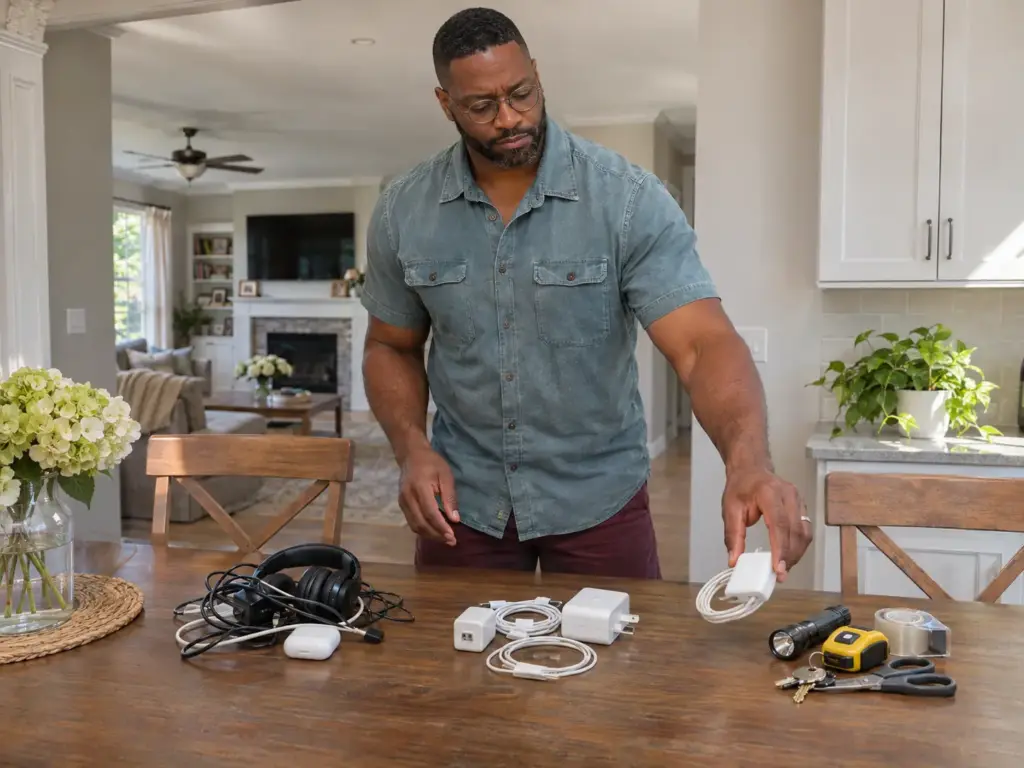
Underneath the seven techniques sits one idea that is smaller than any of them: an orderly home comes from many small daily habits, not from one dramatic purge. Put the thing back at once, fix a small mess while it is still small, and keep like things grouped by what they do. The bare counters in those videos are what the habits leave behind, and the look side of the same style (pale wood, quiet palettes) arrives afterward as a result, never as the cause.
Most of it costs nothing. Ma, One In One Out, putting things back at once, the five-minute reset and the year-end date need no purchase. The few products further down are optional, they only close gaps the free versions cannot reach, and each one comes with a no-buy alternative.
Why trying all seven at once fails
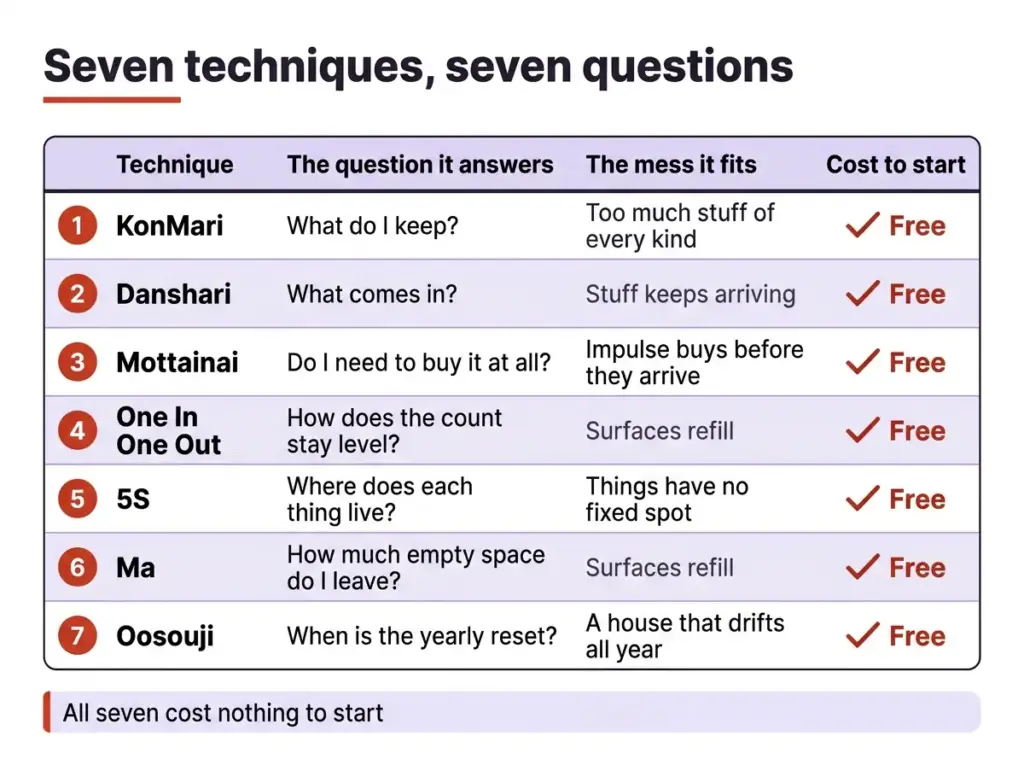
Lined up, the seven split the work cleanly. KonMari decides what to keep. Danshari decides what is allowed in.
Mottainai is the what-a-waste question asked before a purchase, and One In One Out keeps the count level once the shelves are cleared. The 5S method decides where each thing lives and how that stays true, Ma decides how much empty space is left on purpose, and Oosouji is the yearly reset with a fixed end date.
Stack them in one weekend and they contradict each other. A purge method and a daily-habit method are being asked to run in the same two days, and the one that needs weeks loses. It is the same arc as a thirty-day challenge that starts strong and stalls by day fifteen: the effort is front-loaded and nothing is left for upkeep.
Start whole-house KonMari on a Saturday with two young children around and the second pile is where it stalls. The method answered what to keep, and the weekend was asking it how to keep it up.
And the promise that a home will never rebound does not survive kids, a move or a busy year. After a move, containers sized for the old shelves turn into clutter of their own. What outlasts the purge is the maintenance habit, so the second half of this guide is about upkeep.
Which technique fits which mess
Name the mess first, then pick the technique. Too much stuff of every kind, in every room, points to KonMari’s category order. If things keep arriving faster than they leave, the answer is Danshari and Mottainai, since both work on the inflow.
Things with no fixed spot (the keys, the umbrella, the charger) belong to the 5S method. Surfaces that refill by midweek need Ma and One In One Out working together, and a house that drifts all year needs Oosouji plus the daily reset.
Pick one, run it for a few weeks, and add a second only when the first has become something you no longer think about. Two techniques that answer different questions will cooperate; seven started together will not.
What to Keep and What to Refuse: KonMari, Danshari and the Buying Filter

KonMari: tidy by category, in a fixed order
Tidy one shelf at a time and you never see the real volume. Each shelf looks nearly fine, and the pile that would have shocked you stays scattered across five rooms. Marie Kondo’s answer is to tidy by category, not by location, and to keep what sparks joy. Every shirt you own goes into one pile, then every book, so the quantity shows up once and the decisions are made against it.
The order is fixed: clothes, then books, then papers, then komono (miscellaneous items), and sentimental things last. It runs from easy to hard on purpose, so the keepsake decisions arrive after you have had practice deciding.
The honest limit is time. The whole sequence in one push is a lot for a household with young children, and the version that survives is one category per stretch of weeks, finished before the next one begins. For the sorting and folding in order, see the six steps of the KonMari method and how to actually finish them.
Danshari: dan, sha, ri, and why it starts with the inflow
Danshari comes from Hideko Yamashita, and its three syllables are a sequence. Dan means refuse what is coming into the house, sha means dispose of what you are not using, and ri means separate yourself from the attachment that made you hold on. Notice the order. The first step is about inflow, which makes Danshari a buying technique before it is a storage technique, and a purge that skips the first syllable only clears the shelves for the next delivery.
KonMari gets named first in most conversations, and it deserves that place for a home with one big mess. For a household with small children and no free weekend, though, begin with dan instead. Refusing the free tote bag, the party favors and the just-in-case duplicate takes no time at all, and it shrinks the pile that KonMari would later have to sort.
Give every non-essential item a seven-day wait in the online cart or on a note on the fridge. Whatever is still wanted when the week ends is a purchase; whatever is not was an impulse, and the wait cost nothing.
Mottainai and One In One Out: the filter before the shopping cart
Mottainai translates roughly as what a waste, and in this set it is the question asked before the purchase, not after the regret. Japan’s Ministry of Foreign Affairs traces the word’s reach outside Japan to Wangari Maathai, who took it up after a 2005 visit and framed it as reduce, reuse, recycle plus respect. At home it comes down to mindful shopping: a pause at the cart.
One In One Out is the household rule that holds the count level afterward: when something comes in, something of the same kind leaves. It is a common home rule, not a KonMari one, since Kondo sets her method apart from the get-rid-of-something-old-for-every-new-thing approach. Pair it with a short wait before any non-essential buy and you close the gap where clutter sneaks up on you, which sits between the purge and the next shopping trip. All of this is free; the cost is the pause. For the rule in detail, see one-in-one-out and the other limits that keep the count down.
Ma, Vertical Folding and Hidden Storage: Using Space You Already Have

Ma: empty space as a choice, not a leftover
The counter is clear on Sunday and refilled by Wednesday, and nobody remembers putting anything there. Ma (間) is the Japanese word for the space between things, and in this tradition that space counts as a positive element: an empty counter is not wasted counter, because the gap is what lets the few objects around it read as calm. The practical rule is small. Choose one surface per room that stays empty by design, and let the rest absorb daily life.
The failure is just as practical. An empty surface is an agreement, not a decoration, and in a busy house the empty spot nobody owns is the first one the household fills. Name who owns the clear counter: one person whose job is to clear it, and a rule about where its contents go (in a house of four, whoever cooks last is a fair choice).
Do not pick the surface that already collects mail and keys as your empty one; it will lose that fight. Choose a surface nothing needs to be set on, such as the end of a dresser or the top of a bookshelf, and give the landing spot at the door its own tray.
Vertical folding: why it saves a drawer
The drawer where the bottom shirt has not been seen in a year is a stacking problem. In a pile, everything below the top two items is invisible, so it goes unused.
Vertical folding, also called file folding, turns each garment into a small rectangle that stands on its edge. Every item shows from above, and any one can be pulled without toppling the rest. It needs no container, no purchase and no drawer dividers.
Of everything in this guide, the fold is the habit most likely to survive a move or a busy year, because it needs no upkeep beyond returning the shirt to its slot. The folding guide with real drawer measurements covers the steps, and other folds that save a drawer cover garments that will not stand.
Hidden and multi-use storage
A Japanese apartment often comes with no built-ins, so storage has to hide inside other things: a suitcase that holds off-season bedding, a drawer under the bed, a bench that opens, multi-use furniture such as a table that does two jobs. In compact living, floor clutter reads as mess, so the working answer is tall closed shelving plus deliberately empty tabletops and shelves.
In a house with deep shelves the same idea turns into a labelled home, in storage bins, for the seasonal things, kept out of daily reach. The shelf you open daily then stays for daily things, and the winter coats and holiday boxes stop competing with them.
5S and the Genkan: Give Every Item a Place, Starting at the Door
The five words as a loop, not a list
According to the EPA, “5S is a system to reduce waste and optimize productivity through maintaining an orderly workplace and using visual cues to achieve more consistent operational results.” The five words are Japanese: seiri (sort), seiton (set in order), seiso (shine), seiketsu (standardize) and shitsuke (sustain). The system grew out of the Toyota Production System, and its working idea is a marked place for everything.
Sorting and placing are the easy half. The last two words, the standard and the habit, decide whether the order lasts, and that is why 5S is a loop and not a list. Everything has a place is only true until the first week of rush, and shitsuke is the word for the week after.
Setting the entry in order: umbrella, keys, one wall
The genkan is the small, stepped-down entry of a Japanese home where shoes come off and outdoor things stay. What carries over is the landing zone, not the architecture.
Good entryway storage starts with arrivals. Whether your home has a hall, a foyer or only a door, everything that arrives with a person needs a place: keys, umbrella, bag, gloves. A key bowl that holds keys, mail, coupons and a dead battery is a pile with a rim, so give each kind of thing its own spot. For the layout of the whole entry, see an entryway layout that stays neat.
Start with the version that costs nothing: one hook per item, a tray for keys, a basket for gloves, and one rule that the bag goes here and not on the sofa. If that holds for a couple of weeks, you may not need anything else.
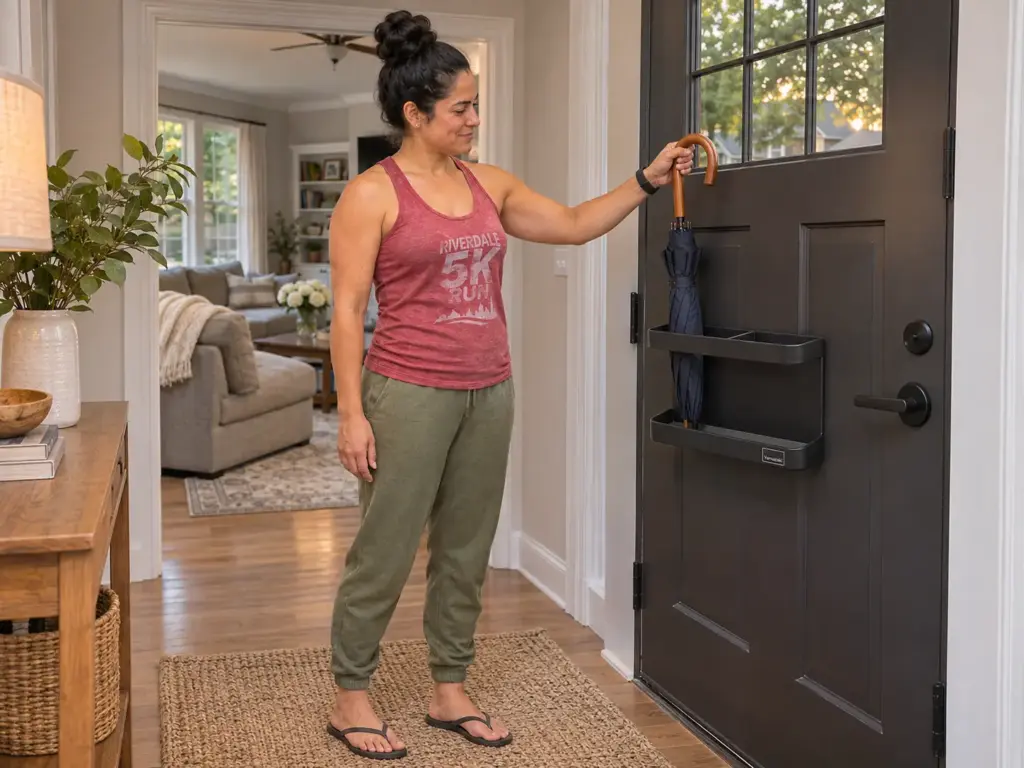
If the umbrella is what ends up on the floor behind the door, the Yamazaki 7642 Magnetic Umbrella Stand uses the door instead. It holds four umbrellas, about 4.4 lb in total, in a footprint of roughly 6 by 2 by 2 inches. It is the obvious pick for the problem and the right pick only behind a steel or iron door, because the magnets grip nothing else and it is useless on wood or aluminum. A magnetic hook rated for the same load is the budget path on a steel door, and on any other door a plain hook on the wall beside it does the job.
For keys, gloves and the small things that follow you in, the YAMAZAKI Home Tower Magnetic 2-Tier Entryway Organizer (model 1971-P) is a magnetic storage unit with four hooks and a small shelf, about 5 by 10 by 8 inches. The footprint is its limit: four hooks and a shelf for keys and gloves, with no room for a bag. A no-drill adhesive key rail covers the same job for less when the door is not steel.
When the entry has a wall but no shelf, the YAMAZAKI Home Tower Magnetic Wall Panel (model 5530-P) stands in for one. It is about 28 inches wide and 6 inches tall, and it holds only about 4.4 lb in total, so it is for keys, notes and light utensils, not tools. It mounts with pins or screws, both included, so a renter can use the pins; the same panel works on a kitchen wall for light utensils. For more ways to set up the key drop without holes, see no-drill key and mail ideas for renters.
A zone for every room, in a bigger house
Bigger houses fail the other way: space with no owner. The 5S step of setting in order has to name a zone per room, and each zone needs an owner. Without that, the living room absorbs everything, because it is where people sit, and the spare room stays empty and unused. In practice, the living room owns the remote, the throw and the current book; the child’s toys go to the child’s zone, and the mail goes to the entry.
A room set aside just for clutter is the workaround that only moves the problem down the hall. What holds is a labelled home per zone, because everything has a place only when the place is named and someone is responsible for it.
Tight Spots: The Kitchen Station, Under the Sink and the Closet Gap
The Japanese kitchen and closet use vertical storage and narrow gaps, not floor area. In a bigger house the same idea answers a different problem: a deep cabinet where the back row disappears behind the front one. If that is your kitchen, the math of how far you can really reach into a deep cabinet shows why a pull-forward tray beats a deeper shelf. In each of the three spots below, the free version comes first and the product only fills what it cannot.
The spice and oil station by the stove
The cabinet where the things you use daily sit behind the things you use twice a year is solved by moving, not buying. A non-skid turntable brings the back row forward, and the storage bin that held the daily items can move to the one spot that gets the daily reach.
For a counter station, the hook-on spice racks that get named most only work if the range hood has a lip about 10 inches wide (25.5 cm), and a slim hood leaves nothing to grab. The YAMAZAKI Home Spice Rack, 2-Tiers with Sliding Drawer (model 4334-P) stands on the counter instead, so it needs no hood. It is roughly 20 inches wide, 5 inches deep and 21 inches tall, and the sliding drawer takes the oil bottles and the small jars. The flaw is the price tier: it is a premium piece, and the turntable does the same job for much less.
Under the sink: a telescoping rack and the height it needs
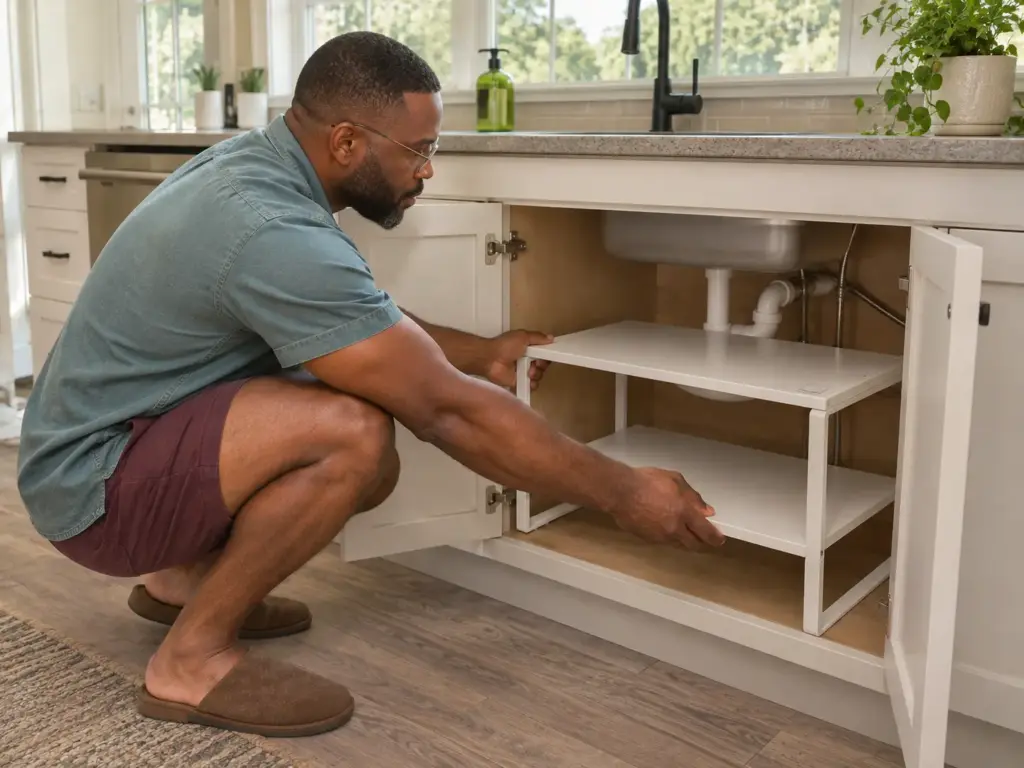
Measure the pipe gap first. A telescoping rack is only as good as the space around the drain: it needs flat, parallel cabinet sides, and 7 inches of height clears a trap but not a garbage disposal. If a disposal sits in the cabinet, a basic bin beside the pipes does the job, and no rack that tall will fit above it.
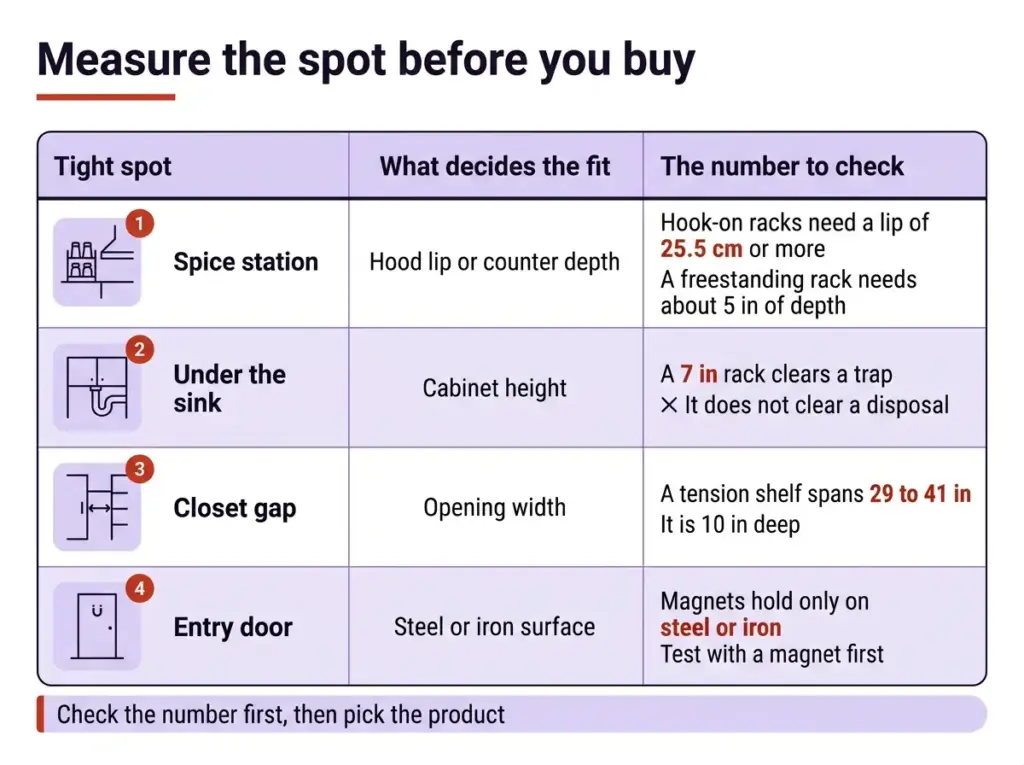
If the cabinet is clear, the Yamazaki Industries 2-Shelf Minimalist Under-Sink Organizer (model 3829) telescopes from about 14 to 24 inches wide and measures about 9 inches deep and 7 inches tall. It stands on its own without screws, so a renter has nothing to patch. Its limits are the two above: the sides must be flat and parallel, and the height clears a trap and nothing more. A basic expandable two-tier rack is the budget path.
Measure from the cabinet floor to the lowest pipe, and from side wall to side wall at the narrowest point, with the door shut. Write both numbers in your phone before you open any product page; they decide the purchase.
The closet gap: a no-drill shelf where a rod won’t fit
The narrow gap between the closet wall and the shelf, the 12 inches nothing fits into, is dead space, and it is where Japanese flats put a slim rack. The free version is a board cut to the gap and set on two supports, though a board on two brackets needs a drill, and that is the part a renter cannot do.
The Home in Bold Tension Rod Shelving is the no-drill answer. It spans about 29 to 41 inches, is about 10 inches deep and holds 20 to 25 lb when installed correctly, with no screws, so it suits a rental.
The install is the flaw: the rods have to be stretched slightly past the opening and pressed down level, or the shelf slides, so follow the maker’s instructions for the installation. The depth is 10 inches and no more, which makes it a shelf for folded things and shoe boxes, not for heavy boxes. For more ideas in the same family, see more tension-rod shelving ideas that hold real weight.
Keeping It Going: Oosouji, the Daily Reset and What Fails by Month Three

Oosouji: a deadline, not a mood
Oosouji means big cleaning, and it is the year-end clean, traditionally finished by 28 December. Kokugakuin University explains that the 29th to the 31st are avoided, which gives the deep clean a fixed end date. Penn’s Japanese-studies scholars on what oosouji is for describe the purpose as clearing away what daily life leaves behind, both in the house and in the person, not only physically.
Even in Japan the ritual is fading. A Duskin survey reported by Nippon.com found that only 51.8% of households still did it at the end of 2022, and the job people put off most was the kitchen hood and extractor fan, the same job postponed here.
The advice most people hear is to schedule one big clean; the part that works is the date, not the single day. If a free weekend does not exist, set the end date for each room in advance and spread the rooms across the weeks before it. A clean with an end date happens.
The five-minute reset and seasonal rotation
The daily habits are three: put it back at once, fix a small mess early, group by function. They hold when they are attached to a fixed moment (after dinner, before the lights go off), a fixed spot (the counter, the entry) and a rule about who does it, usually whoever is last in the room. Five-minute cleaning at that point does more than an afternoon twice a year.
Seasonal rotation keeps daily rooms calm. The off-season things go out of the daily rooms into the hidden storage from earlier, and the next season comes down. Two moves a year, each with a labelled home.
How each technique fails, and the version for your home
Each technique fails when asked to do another one’s job. KonMari at once, for a family with young kids, stalls by the second category.
Danshari without a house rule leaves the stuff arriving faster than it leaves.
One In One Out turns into a pile of one in, one soon to go, which is the same pile with a waiting room.
5S without its last two words reverts, because sorting and placing were never the hard part.
Ma without an owner is refilled by midweek.
Oosouji without a date never happens. For the same arc in minimalist systems generally, see why minimalist systems fail in the first months.
The version for your home depends on what you can do to the walls. The renter keeps tension, magnetic, freestanding and pin-mounted pieces: every product in this guide is renter-friendly and mounts without drilling, and how far this logic goes in a small apartment shows the limit, with closet systems that leave no holes for the rest.
The owner can mount a rail or a shelf, so the system can be fixed to the wall; lean on the manufacturer’s instructions for the weight and the fasteners. The big home needs zones with an owner each, a front-row rule for deep shelves, and a close look at the walk-in closet that slowly became storage.
The five techniques that cost nothing carry the result. The products are for the gaps the free versions cannot reach.
Match the Technique to the Mess, Then Leave One Surface Empty
Pick the technique that matches your mess and run it alone first. The free ones (Ma, One In One Out, putting things back at once, the five-minute reset and the Oosouji date) do most of the work, and the products only close the gaps they leave. A purge makes the shelves look right; a habit keeps them that way.
At the next year-end clean, or after the first month of a daily reset, look at two places: whether the surface you left empty is still empty, and whether each item at the door still has its hook.
Today, choose one surface that stays empty, or put one hook where the thing that lands on the floor at the door can live. At the end of the week, notice whether it held.
Frequently Asked Questions
01How do Japanese people keep their houses so clean?
Japanese households keep homes orderly mostly through small daily habits: putting things back at once, fixing small messes early, and giving every item a fixed place. Many also finish one scheduled year-end clean by a set deadline, though only about half of households still keep that tradition.
02What should I remove first when decluttering the Japanese way?
Remove clothes first, because those are the easiest decisions; KonMari then moves through books, papers, miscellaneous items and, last of all, sentimental things. Danshari adds that the true first step is refusing what has not yet come into the house.
03What are the rules of Japanese minimalism, and do I need all of them?
No, you do not need all of them, because the seven techniques answer seven different questions and running them together makes them contradict each other. Pick the one that matches your mess and add a second after a few weeks. The section on which technique fits which mess shows how to choose.
04What is the best way to organize my room to keep it clean?
Give every item a fixed home, keep one surface empty on purpose, and finish with a five-minute reset at a set point in the day. Renters can use tension, magnetic and freestanding pieces, owners can fix a rail to the wall, and a large room needs a named zone with an owner.
05Do these techniques work in a big house or a rental?
Yes, with a translation: renters keep the no-drill half of the idea, and a big house adds a named zone and an owner for each room. The methods themselves cost nothing in either. Where gear helps, tension shelves, magnetic panels and freestanding racks solve the narrow spots.
Disclaimer: ClutterlessNest is a participant in the Amazon Services LLC Associates Program. As an Amazon Associate we earn from qualifying purchases. This article may contain affiliate links — if you buy through them, we may earn a small commission at no extra cost to you. We only recommend products we have tested or genuinely believe in.