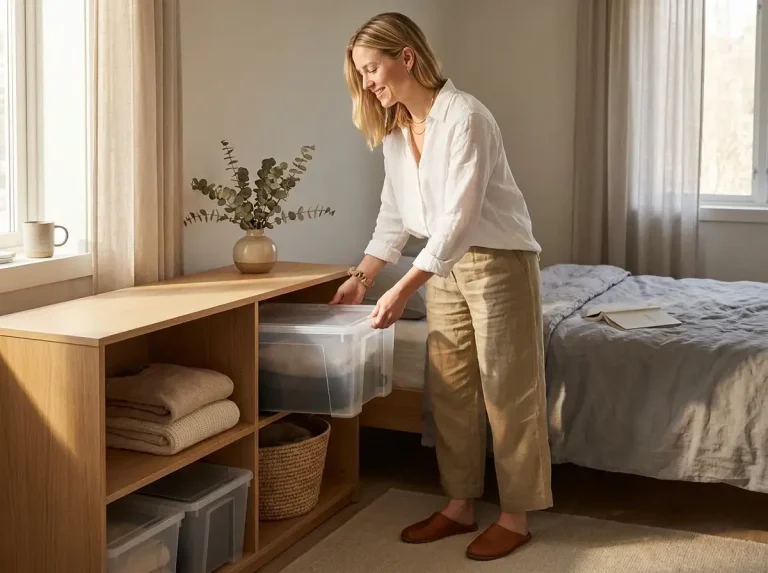

A week after the matching set goes up, the shelf still looks calm. Then you need the spare charger, and six identical oat-colored bins stare back at you with no clue which one holds it. Neutral and modern organization is a look made of three repeated decisions, a palette, a container shape and a label style, and only one of those three costs money. This guide covers what the look is, how to build it from what is already in your house, which materials hold their color, and what keeps it working after the novelty fades.
Quick Answer
Neutral and modern organization is one repeated palette (two or three base tones plus one accent), straight-sided containers sized to the shelf they sit on, one labeling style, and a rule for how full each bin gets. It lasts because of the measuring and the material choice, not because the set matches.
What Neutral and Modern Organization Actually Means
Save a dozen calm pantry and closet photos in one folder and ask what they share, and “pale” is about as far as most people get. The common part of neutral home organization is shorter and more useful than that. It is a list of decisions, and none of them is a purchase.
The Look in One Sentence: A Palette, a Shape and a Label
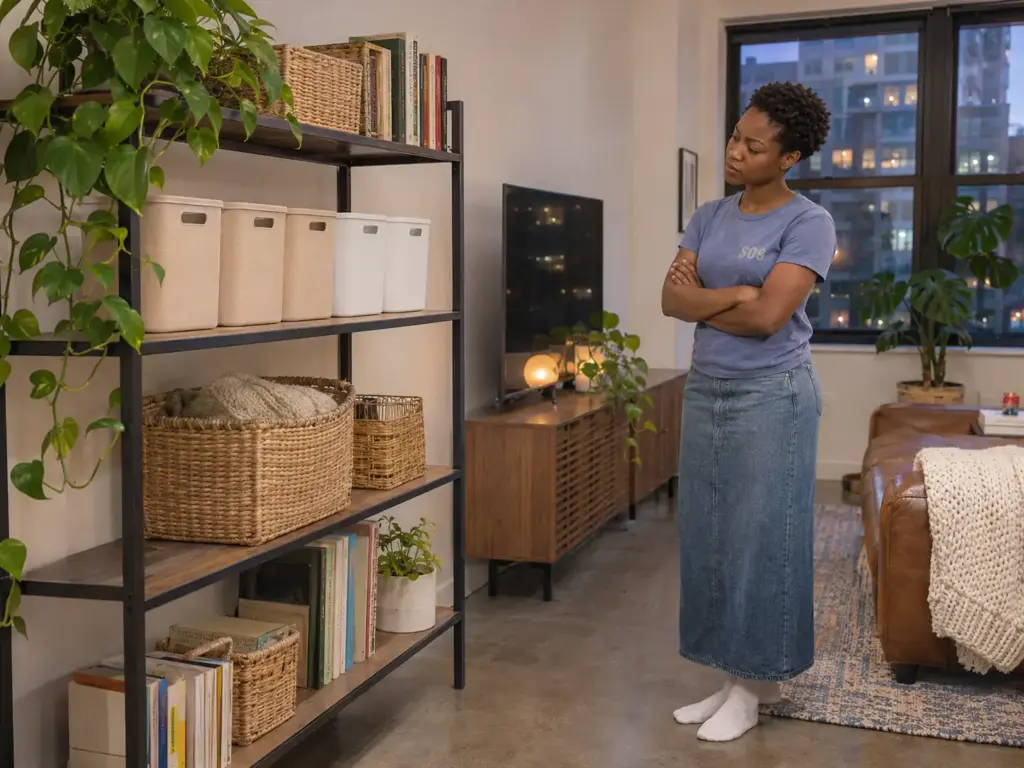
The palette is a neutral color palette: white, off-white, cream, oat, beige, greige, grey and warm wood, with a single black, charcoal or brass accent. The shape is a container with straight sides, square or rectangular, repeated in a few sizes. The label is one lettering style used everywhere. Repeat those three and a shelf of mismatched brands reads as a set, which is matching container organization without a full restock.
“Modern” and “neutral” do different jobs. Neutral is the palette. Modern is the materials and lines: matte surfaces, clear acrylic and glass, matte black hardware or brass, warm oak, nothing ornate.
Modern storage solutions follow that list: straight lines, no pattern, and hidden storage behind a door wherever it can go, so the room gets storage that blends in instead of storage that performs. Neither word says a thing about how much you own, which is where the confusion with other styles starts.
How It Differs From Minimalist, Aesthetic and Japandi Organization
Minimalism is a rule about quantity, and the case for owning less in the first place has its own guide. This look has no quarrel with a full shelf, as long as the full shelf repeats itself. Aesthetic organization is about the photographed look and why it falls apart, the version built for a camera on day one. And the earthier, wood-led cousin sticks to one wood tone and one weave.
What is left for this guide is narrower and more practical: repeating a palette and a shape so that things you already have, and things you will add one at a time, belong together.
Why the Photo Version and the Lived-In Version Part Ways
The failure state of this look is easy to picture: a home full of beautifully matched, well-organized empty containers. The second failure is quieter. Matching opaque bins hide what is inside, so everything is tidy and you still dig through it all to find one item. Both are the reason the sections below exist, and both come from copying the surface of the photo instead of the decisions underneath it.
Edit First, Buy Second
Plenty of people buy organizers to organize the organizers, then find the floor visible again and half the bins dumped out on it to locate one thing. The order was reversed. The calm in this look comes from what is left out, and the cheapest version of it costs nothing.

The Edit That Comes Before Any Container
Sort by what gets used and what is loved, and size the container to what survived, never the other way round. A common rule of thumb is to leave negative space, about a fifth of each shelf or drawer empty on purpose. It is a rule of thumb, not a standard, but it explains why a calm shelf has gaps in it.
A “maybe” box with a date written on it, set at roughly sixty days, keeps the edit from turning into a family argument. Whatever nobody opened by then goes. If you want the full argument for cutting before containing, reduce before you contain is the place for it.
The Free Tier: What You Already Own
Shop your house before any store: lidless shoeboxes on a closet shelf do the job of a bought basket. They do not snag knitwear, they wipe clean, and nobody gets precious about them. A handful of small plastic baskets from a discount store, all in one color, pass the same test. Jars already in the kitchen cabinet can hold dry goods the day you decide they will.
This is the anti-sell in plain view: the most budget-friendly version of this look sometimes costs nothing. If the free tier works for a shelf, stop there.
When a Professional Organizer Is Worth It
A whole-house edit, or a household that cannot agree on what stays, is where help pays. According to the National Association of Productivity and Organizing Professionals, “Organizing and Productivity Professionals can help you achieve your goals.” Their guidance on hiring one is the place to start if that is where you are.
Pick One Palette and Repeat It
Five shades of “white” that look yellow beside each other, and a brown basket that fights the cabinet behind it: that is a palette problem, and it is fixed by choosing fewer tones once.
What Counts as Neutral, and How Many Base Tones to Use
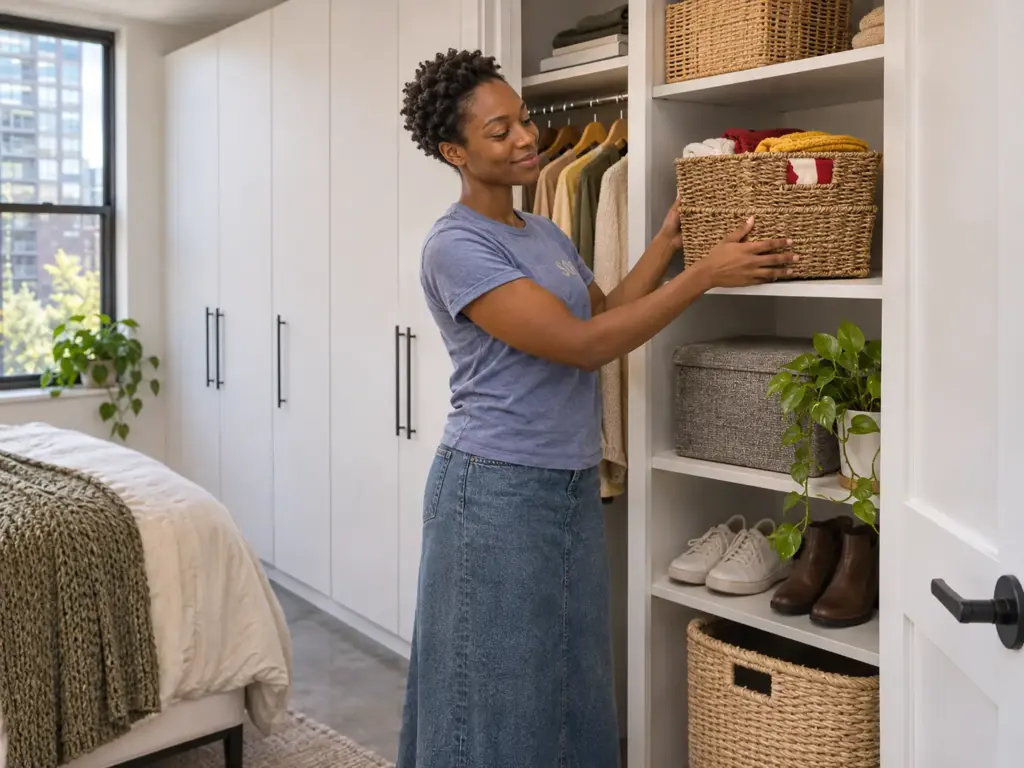
Two or three base tones plus one accent is the working rule. Pick from white, cream, oat, beige, greige, grey and warm wood, and settle which side you are on. Cream, oat, beige and wood run warm; bright white and grey run cool. Mixing the sides is what reads as mismatched, even when every single piece is “neutral”.
One Accent, Three or Four Finishes at Most
The accent is black or brass, one or the other, showing up in hardware, a label frame or a single tray. Finishes are the materials: matte plastic, clear acrylic or glass, woven fiber and wood. Three or four is the ceiling, because every extra finish is one more thing that has to look right beside the rest. For a restrained take that holds even tighter, the single-wood, single-weave version of this palette shows how far you can narrow it.
Texture: The Woven Half of the Palette
A woven basket (seagrass, wicker or water hyacinth) or a wood lid warms a pale shelf that would otherwise read like a hospital supply closet. Texture is what keeps a one-color home from looking flat. The cost is that natural fiber belongs in dry rooms only (the damp-room rules are further down), so a woven basket is a decision about the room before it is a decision about style.
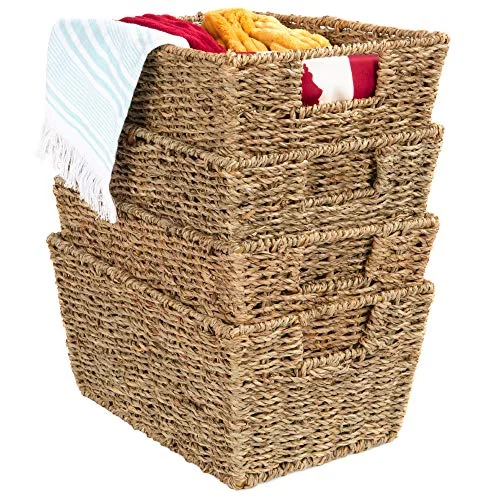
For the warm side of the palette in a repeatable family, the Best Choice Products Rustic Set of 4 Multipurpose Stackable Seagrass Storage Basket is a wire basket frame wrapped in seagrass that holds its shape and stacks. Each basket is 12.2 by 8.7 by 6.3 inches and takes up to 26 pounds, so it sits on a 12-inch shelf without overhang.
Some sets arrive smaller than the photo suggests, so measure the shelf first. It is a pack of four, which suits one shelf or one closet rather than a whole house. And if you are still choosing between baskets in general, which decorative baskets are worth the shelf space covers the field.
On open shelving where the shapes fight each other, the answer is fewer, larger, matching containers rather than more small ones.
Make Mismatched Brands Read as One Family
A pantry with seven brands of container and a closet with three kinds of hanger makes people assume the look needs a full restock. It needs a decision about which two or three things get matched first.

Decant Into One Jar Family
Match what the eye lands on first: the front row of the pantry, the hangers on the closet rail, the bins on the visible shelf. Everything behind a door can stay mixed. That is the cheapest way into the look, and for most kitchens it means decanting only the two or three things you open every day.
When you do decant, square glass jars line up with no gaps. The ComSaf Glass Pantry Storage Containers come as a set of six in three sizes (0.7, 1.2 and 1.6 quarts, two of each), and every jar has the same 3.9 by 3.9 inch footprint, so one brand runs across the shelves. The bamboo lid presses on with a silicone gasket, which seals dry goods but not liquids, so oils and sauces stay in their own bottles. For which food goes in which jar, the pantry guide sorts it by what each container suits.
One Container Family Across Pantry, Linen and Bath
The same logic works across rooms. One repeated clear bin, used in the pantry, the linen closet and the under-sink cabinet, makes three separate storage problems look like one decision.
The family extends to a laundry room shelf and to under-bed storage, where a lid keeps the dust out. The Vtopmart 6 Pack Clear Stackable Storage Bins with Lids and Handles (11 by 7.5 by 6 inches each) is built for that: six of the same container in the same size. Its lids do not snap on firmly and tend to fall off, which is a quiet argument for leaving the lid off a bin that gets opened daily.
Be careful with the pantry shelf, though. Matching glass jars on a shallow shelf can hide a second row behind the first, and glass jars on a shallow shelf and what hides behind them walks through that back-row trap.
Hangers, and the Things People Forget to Match
Uniform hangers are the cheapest single change in a closet and the one that makes the whole rail read as one set. No product needed, just the same hanger, all the way along. Hangers are the one match worth doing everywhere, because a closet rail is on view every time the door is open.
Hung light to dark within each type, a color-coded closet reads as a palette with no containers at all. Drawers are the other forgotten match: drawer dividers in one finish keep a bathroom or desk drawer reading as part of the set.
The shared-home angle starts here too. A system has to survive someone who will never decant. Decide who gets which jar (the one person who cooks gets the pantry jars, not “the family”), and let everyone else keep using the box it came in.
Match the front row, not the whole cabinet. A shelf looks like a set when the first thing your eye reaches is uniform; the back of a shelf and the inside of a closed door can stay as mixed as they like.
Measure the Shelf Before You Buy the Bin
Every measurement printed on a bin listing is a bin measurement. None is a shelf measurement. That is how people end up with a cube that hangs over the front edge, or a bin that wedges tight and stops being pulled out after a week. Here are the numbers that decide whether a bin fits.

Shelf Depth First: Why a Reach-In Closet Almost Always Means 12 Inches
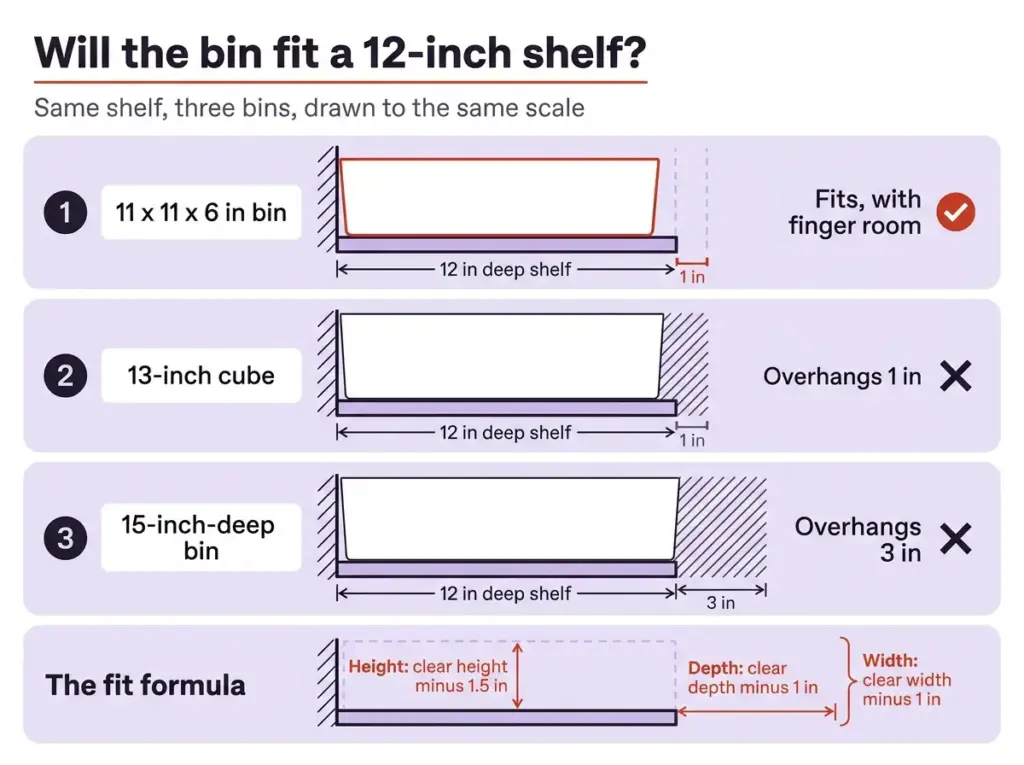
Wire closet shelving is made in 6, 9, 10, 12, 16 and 20 inch depths, and a reach-in closet almost always has the 12-inch one. Anything 15 inches deep hangs over the edge. Measure before you buy: front to back first, then the rest. For what a shelf that depth actually holds, what a 12-inch closet shelf actually holds goes through it.
The Fit Formula
Organizers use a simple margin. The bin’s width is the clear width minus 1 inch, its depth is the clear depth minus 1 inch, and its height is the clear height minus 1.5 inches. Below that margin the bin wedges, and you stop reaching for it.
A 13-inch cube, the one everybody buys because it was built for cube shelving, leaves about 1 inch hanging over a 12-inch shelf. A 15-inch-deep bin leaves 3. That overhang dents your sightline and drops the front edge of everything behind it. If you buy one size blind, an 11 by 11 by 6 inch bin is the sensible bin footprint for folded clothes on a 12-inch shelf: finger room all around, one-hand pull.
Width Arithmetic, Straight Sides and How Full a Bin Should Be
Plan the row on paper before spending a cent. One 13-inch cube fits a 24-inch shelf, two fit a 36-inch shelf, three fit a 48-inch shelf and five fit a 72-inch shelf. Straight-sided bins use the full shelf; tapered ones waste depth on the shelf and volume inside the bin, which looks softer and stores less. When the budget allows only some baskets to be right, storage sized to real shelf depths shows the baskets that fit the numbers above.
Fullness is the last number. Bins look intentional at roughly two-thirds to 75 percent full and read as clutter when brim-full, a common rule of thumb that works for bins and shelves both.
A lid adds a step, and that step is where the pile forms: things get set on top “for later”. Reserve lids for seasonal and dust-prone things. In a large home the same arithmetic applies to a deep pantry, where the problem is the back row, not overhang. A tiered shelf lifts the rows behind so the labels show, and the pantry guides cover the rest.
Lay painter’s tape on the shelf in the footprint of the bin you are considering, then pull a few things out of the closet and set them inside the tape. If the tape rectangle already feels tight, the bin will feel tighter.
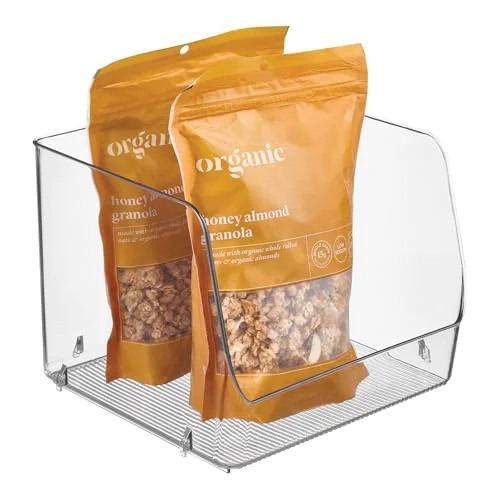
One bin satisfies the formula and shows its label at a glance: the iDesign Stackable Clear Open Front Storage Bin (model 65370) measures 8.5 by 8.5 by 7.25 inches, with straight sides, clear walls and an open front, so your hand goes in without lifting a lid. It sits well inside the 12-inch limit. How sturdy it feels depends on the unit you get, and it is the pricier way to buy a single bin, so the Vtopmart six-pack above covers much of the same job for less. It can also be hard to find in stock.
For rented shelves where the numbers are tight, clear bins that suit a rented shelf lists more options.
Label Everything in One Voice
Containers that all match, each with a different handwriting on the front: that shelf still reads as mismatched. Labels are the first thing the eye reads, and they are what makes a mixed set look chosen.
One Type, One Position, One Color
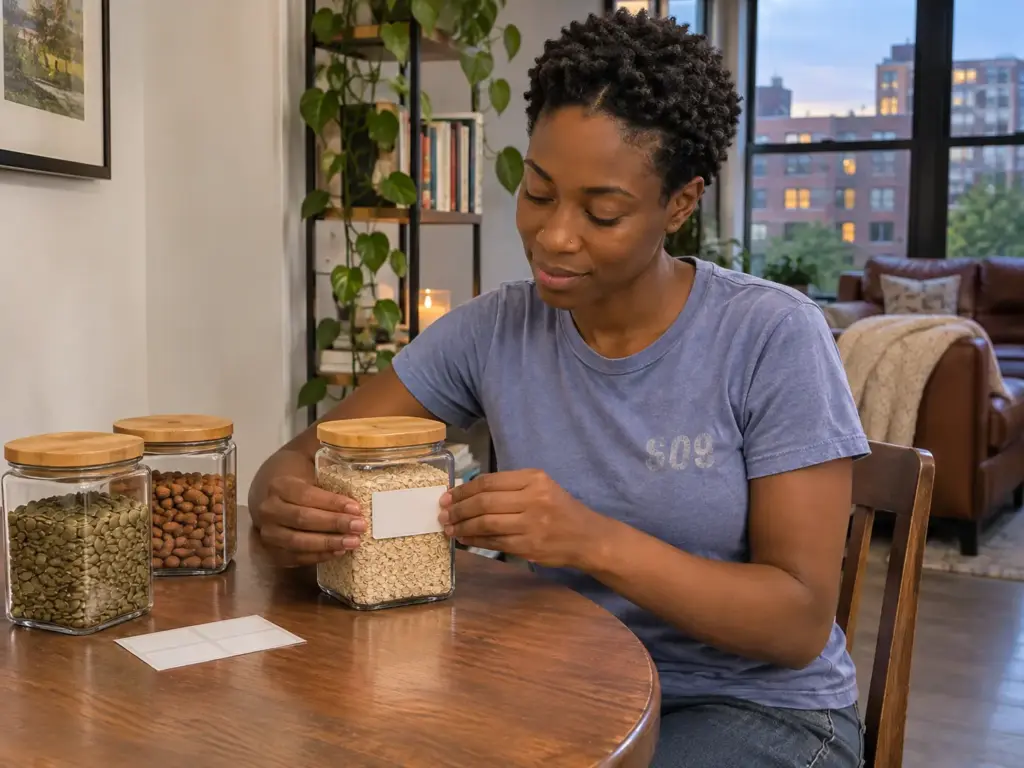
A single typeface in a single color on every label does more for the “set” effect than matching jars. The labels are the real bottleneck of the look. Category labels do the sorting for you: one word per zone, such as baking, snacks or breakfast, and a shelf becomes a small zone organization system instead of a row of containers. Put them in the same spot on every container, on the side that faces out, because a label on a lid is invisible the moment that lid gets stacked under another.
The CZZGSM 6 Pack Square Glass Kitchen Storage Jars (35 ounces each) arrive with 132 matte white labels in the box, which is the whole job for a set of pantry canisters in one purchase. Durability and the airtight seal are mixed: some jars break easily and do not close completely tight. So treat them as dry-goods jars for the front row and keep anything that needs a true seal elsewhere.
Labels That Survive a Wet Cloth and a Month
For containers you already own, the Talented Kitchen Pantry Labels for Food Containers are a 157-piece sheet of black script vinyl (8.5 by 11 inches), and it is the cheapest step in the whole look. They are water-resistant, not waterproof, and vinyl is single-use, so it lifts on a jar that gets wiped with oil or steam. A label that lifts after a month is nearly always a wet or oily surface, not a bad label, and why pantry labels peel off and what to stick them on deals with the surface side of it.
Vinyl labels are the low-cost start. A label maker is the permanent version, and it earns its place on plastic bins that will never change contents. Chalk labels suit a pantry whose contents change month to month, since they wipe off and rewrite.
Labeling for People Who Will Not Relabel
A labeled bin only works if the person who puts things back reads the label. Use the word the household actually says, not the tidy word. If the family calls it “the chargers box”, the label says chargers.
Opaque matching bins need extra care here. An index card taped inside the lid of each bin, or a written list of which box holds what, is the fix people land on after the hidden-but-still-digging disaster. Better still is a clear front, so the label and the contents both show.
Open Shelves, Closed Doors and the Styled Row
Open storage is a promise to put things back. The reader who admires an open shelf in a photo may own a wall they cannot drill and a household that sets everything on the nearest surface. Which things go on view, and which go behind a door, comes down to how the space is used.

What Goes on View and What Goes Behind a Door
Open shelves work for the things you want to look at and use daily, in one repeated container with space between them. Closed storage takes everything else. A common rule of thumb leaves a third or more of an open shelf empty, and the empty part is what makes the full part look intentional.
The Owner’s Version and the Renter’s Version
If you own the home, built-ins painted to match the wall make the storage disappear, and sliding doors do the same for the awkward stuff. A short ledge fixed to the wall will carry a styled row without a full shelving unit. The IEEK 6 PCS White Acrylic Floating Shelves (15 by 4.33 by 3 inches each) hold a row of jars or a small basket, but they need a drilled hole for an anchor before they go up, so they are not for renters.
Renters have a different set of tools. Removable hooks and adhesive options hold light things, never the heavy jar row, and that limit is worth stating plainly rather than testing on a good wall. Removable wall hooks and organizers sorted by what you hang breaks it down by item. Free versions work too: a freestanding shelf unit that leans, or a rail on a tension rod.
Small Home or Large Home: Where the Look Fails
In a small home the 12-inch arithmetic from the measuring section and one repeated container family do the work. In a large home a deep shelf swallows things, so the answer is fewer, larger containers at the front and a clear label, not more storage.
The shared-home failure is the catch-all basket by the door. It fills with whatever the house hands it and nobody empties it, so it is a failure mode rather than a fix. One basket, one named owner and one purpose is the version that survives.
Which Neutrals Age Badly
The white bin row was white when it went up and is cream a year later, and the seagrass basket in a steamy bathroom is growing something inside the weave where nobody can look. The look was fine. The room was wrong for the material.
White and Clear Plastic: How It Yellows, and Why It Cannot Be Undone
An all-white organization aesthetic shows age fastest, because there is no pattern to hide a color shift.
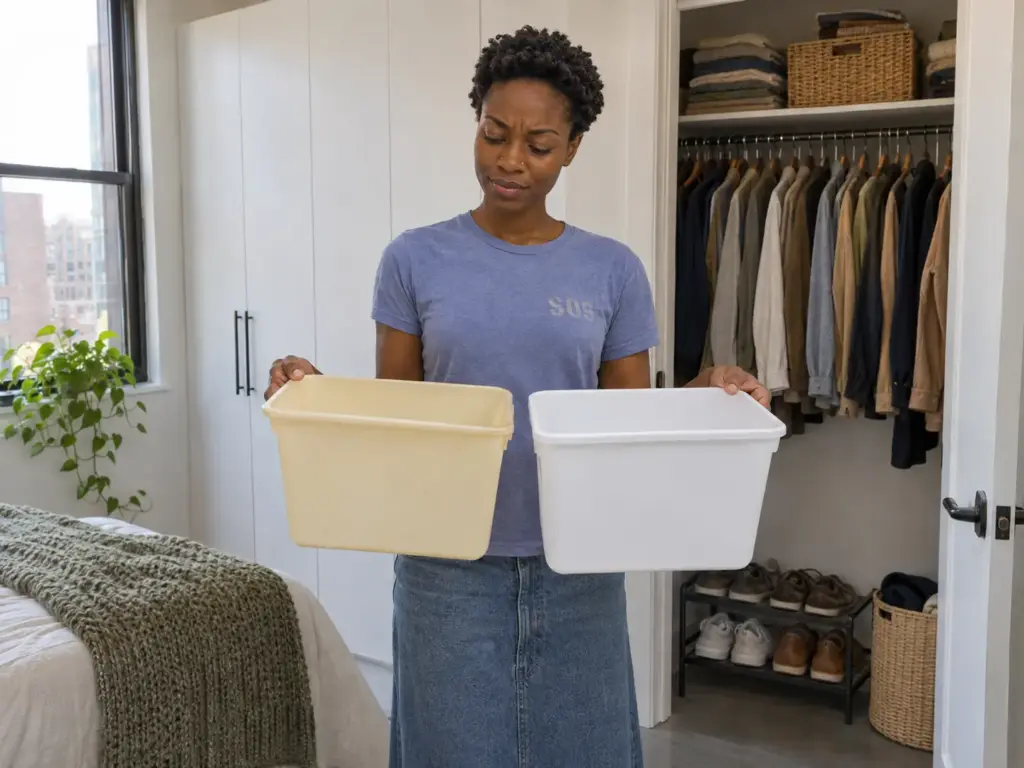
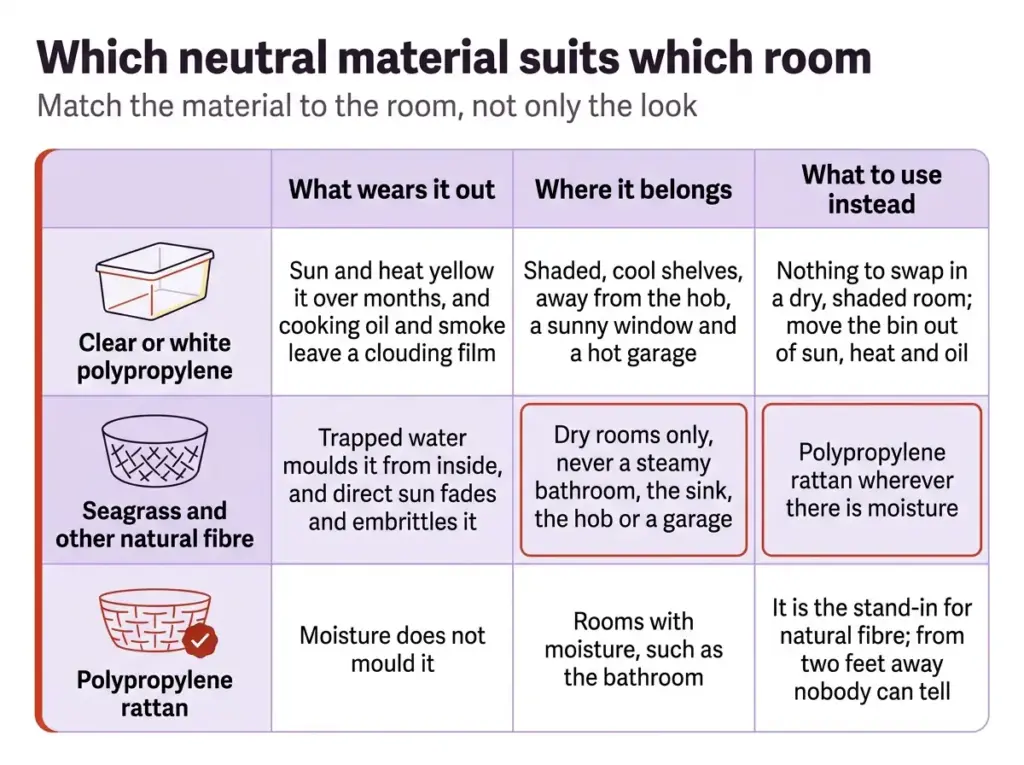
Clear and white polypropylene yellows under UV light and heat over months to years, and deep yellowing cannot be fully reversed. Harsh chemical sprays, smoke and cooking oil leave a film that darkens and clouds it. The shelf above the stove and a garage in summer are the worst places in the house for a white plastic bin, with a sunny window next. Fabric has its own weak points, and how fabric and plastic bins each fail compares them.
Plastic also does not breathe. A slightly damp towel or gym kit sealed in a clear lidded bin turns musty, because the moisture has nowhere to go. A lidded clear bin is for dry things only.
Natural Fiber: Dry Rooms Only
Seagrass has to stay dry. Water trapped in the twist cannot dry, and the basket molds from the inside; direct sun fades and embrittles it. Natural fiber belongs in dry rooms only: never a steamy bathroom, never beside the sink or the stove, never a garage.
Where moisture is a fact of the room, a polypropylene “rattan” gives the same look, and from two feet away nobody can tell. For the damp-room exception in detail, what survives a steamy bathroom is the one to read.
The Environmental Protection Agency frames the whole thing in one line: “The key to mold control is moisture control.” Its own guidance says water-damaged items should be dried within 24 to 48 hours, and the EPA’s mold and moisture guidance is short enough to read in one sitting. So anything in a damp room (baskets, paperboard, canvas) is a moisture decision first and a style decision second.
Natural-fiber baskets also have habits that have nothing to do with water: they collect dust in the grooves, snag knitwear and cannot be washed, and a dyed felt hamper can bleed onto a damp shirt. Those habits are a big part of the anti-basket backlash, and they are real.
Soft materials fail differently. A canvas bin sags at the corners when it is overfilled, a felt bin holds lint and can bleed dye, and a paperboard box softens in a damp room.
Rotate a white bin row a quarter turn at each season change. One side always takes the window light, and swapping which side faces out spreads the yellowing instead of leaving one stripe.
Lids, Opaque Bins and the Cost of Hiding Everything
Opaque matching bins remove the cue that made the system work: the sight of what is inside. Everything is hidden, and you still dig through it. The answer is a clear front, a label or a written list, not another bin. Where the clear look is the goal, when the clear look is worth it and when it scratches weighs acrylic against the rest, and choosing storage bins that last is the wider guide to materials.
The Same Look at Three Budgets
Pricing a full matching set from a boutique brand makes the look seem reserved for people with a storage budget. It is not. The look is a palette and a label, and both are cheap.

The Nothing-to-Buy Version
Regroup what the house already holds by palette. Lidless shoeboxes, one repeated color of existing baskets, jars from the cabinet. The look often needs nothing bought, and it is worth trying that first for every room before touching a cart.
The Budget Version
Big-box and discount-store plastic bins in one repeated color, one pack of the same container across rooms (the six-pack idea from earlier), and a sheet of labels. That is the same look for far less than the boutique version, and the first shelf can be done in an afternoon. The trap is stopping there: budget closet makeovers revert when the budget covers containers and skips the edit and the label, and why budget closet makeovers revert explains the mechanism.
The Boutique Version and When It Is Worth It
Splurge vs save comes down to sightlines: spend on what is on view and save on everything behind a door. Designer sets from design-led brands earn their keep in a few places where the object is always on view and used daily: the pantry front row, the entryway tray. They do not earn it on every shelf. The difference is mostly finish and consistency, not function.
Buying nothing new is the right call in three situations: a room that has not been edited, a shelf that has not been measured, and a household that will not label. The purchase solves none of those. And the constraints shift the answer: renters stick to adhesive, freestanding and no-drill options, owners can add built-ins or a fixed ledge, small apartments live by the 12-inch arithmetic, and large homes use fewer, larger containers at the front of a deep shelf.
Keeping It Neutral After the Novelty Wears Off
Six weeks in, the bins still match and the contents are quietly drifting: receipts in the pantry basket, a “temporary” bin by the door. The look survives. The system does not, unless somebody has a job.

The Weekly Reset, the Monthly Edit and the Quarterly Refresh
The rhythm works as a rule of thumb: a short weekly reset, a monthly edit of anything that no longer earns its place, and a quarterly refresh to check which bins have stopped fitting. None of the three takes long, and they work because each has a different scale.
Weekly is putting things back. Monthly is deciding. Quarterly is measuring.
One In, One Out, and the Basket That Fills Up
One-in-one-out keeps the empty space the look depends on. A bin at about two-thirds full has room for a new thing without needing a second bin.
The catch-all basket does the opposite: it multiplies instead of solving, and a giant entry basket can collect a year of outgrown shoes. Cap it, name one owner and empty it on a fixed day. When a photographed shelf turns messy within weeks is the same failure in a different room.
Shared Homes: Who Re-Labels
The system has to survive the person who will not re-label. Choose the container and the label that cost them nothing to follow, and name one person for the monthly edit. And check the contents before buying anything, because the cost of drift is the same as any other failure: the next purchase is another bin.
Palette First, Then the Tape Measure
The look is a palette and a label with a container between them. Pick the tones before the containers, measure the shelf before the bin, choose each material for the room it will live in, and give the routine to a named person. Everything else on a calm shelf follows from those.
Check back at the next season change. White plastic and seagrass show their age over months to a year, so that is the moment to look for yellowing, a bin that has started to wedge or a basket that smells of the room. If something has failed, it failed in a way the sections above predict, which makes it a quick swap.
Today, pick one shelf or one drawer and regroup it into your palette using containers you already have. Put one label style on it. After a few days, notice whether you reach for things without looking, and whether anything has quietly drifted back in.
Frequently Asked Questions
01What does neutral and modern organization mean?
It is one repeated palette, one container shape and one label style used across a home. It is about repetition, not owning less: a full shelf still reads calm when everything on it belongs to the same family.
02Do all my storage bins need to match?
No. Match what the eye lands on first and keep the labels uniform, then leave the rest mixed. Fewer, larger matching containers also beat many small mismatched ones on open shelving.
03What colors count as neutral for organizing?
White, cream, oat, beige, greige, grey and warm wood, with one black or brass accent. Choose a warm or a cool side and keep to it, because mixing the two is what looks mismatched.
04How do I keep white storage bins from turning yellow?
You cannot fully reverse deep yellowing, so prevention is the only fix. UV light, heat, smoke and cooking oil cause it. Keep white plastic away from sunny windows, the stove and a hot garage, or choose clear glass or a colored neutral in those spots.
05Can I do neutral and modern organization in a rental?
Yes, because the palette, the containers and the labels need no drilling. Only fixed ledges and built-ins do, and removable hooks cover light items.
Disclaimer: ClutterlessNest is a participant in the Amazon Services LLC Associates Program. As an Amazon Associate we earn from qualifying purchases. This article may contain affiliate links — if you buy through them, we may earn a small commission at no extra cost to you. We only recommend products we have tested or genuinely believe in.