

You are standing in the aisle with a 13-inch white bin in one hand, certain it will fit the white frame at home, and the frame’s cubes measure 1.2 inches less. That gap is how an all-white organization aesthetic goes wrong: not on the shelf it was photographed on, but on a shelf beside the stove, a sunny sill, or a row whose lid stopped being made. White is the one palette that shows every mistake, so three measurements carry this whole article: 13-inch bins, 11.8-inch cube openings and a 12-inch shelf depth. Below are the five mistakes that make the look read dirty, and the fix for each.
Quick Answer
An all-white organization aesthetic is one family of white repeated across a zone, with closed storage hiding anything loud. It holds when the white is chosen before anything is bought, each bin is sized to its frame, the label and the bulb suit white, grease and damp stay away, and each finish is cleaned as its material allows.
What an All-White Organization Aesthetic Actually Takes

One white family, low contrast and closed storage doing the hiding
Strip away the photos and the look is three decisions. One white family repeated across a zone. Low contrast, so nothing on the shelf is darker or louder than its neighbor. And closed storage, so whatever is loud (printed packaging, cords, paper) sits behind a front or inside an opaque box while two or three chosen objects stay in view.
It is stricter than it sounds. The palette and container rules that tie a neutral home together leave room for beige, wood and grey, and white leaves almost none.
Why white bins make leftover clutter louder, not quieter
A row of matching white bins draws an outline around everything in it. Fill that outline with mixed cereal boxes, charging cables and unopened mail, and the clutter reads louder than it did loose, because the clean frame leaves the mess as the only thing to look at. Clear bins have a version of the same problem: they show every printed label, and a clear row of busy packaging looks busy no matter how neatly it stacks. Opaque bins or a closed front are the calmer choice for anything printed, and hidden clutter stays hidden.
Declutter first, then decide what gets shown and what gets hidden
The cut comes before the color, in every all white organization plan and every list of white organization ideas. A bin bought around volume you did not reduce locks that volume in place, and the amount you keep decides how many bins the shelf needs at all, which is usually fewer than the cart in your head.
The cheapest first step costs nothing: move everything that is not white out of sight for a week (a laundry basket makes a fine holding pen) and see how much of the shelf is calm already. Buying the look is not the look. This article goes deeper on the white itself, while styling a whole room so it still holds real things covers the rest of the room.
Why Two Whites Make Each Other Look Dirty

Warm white, cool white, pure white and cream are four different families
White is not one color. Warm white leans toward cream, cool white toward blue-grey, pure white sits between with no lean, and cream white is the family that admits it is yellow. Put two of them on one shelf and each makes the other look dirty.
The easiest place to watch it happen is in the listings themselves: a white cube frame, a 13-inch cloth cube that resolves to beige and an ivory canvas bin look like one set in a thumbnail. Beside a window they are three families. A beige cube inside a white frame reads as a stain even though nothing in the room is dirty.
How a set drifts: yellowing plastic and the lid that was discontinued
A set is uniform only while every part stays in production and ages at the same rate. Cheap white plastic drifts toward yellow near a window, while painted board stays exactly as it was, so a shelf that mixes the two parts company within a season or two. Matte and gloss white from the same maker can also differ, since gloss throws light back and reads cooler.
Then there is the lid. When a white lid is discontinued, the replacement is a slightly different white, and one bin in the row starts to look off while the rest still match. The sets that last are bought in one go, with a spare lid or bin bought alongside when the set is going to grow.
How to test two whites before they share a shelf
Hold the two white storage bins (or any two pieces) together against a window, then again under the lamp they will sit beneath. A pair that agrees only at noon is a pair that disagrees at night, and the lamp is where the shelf is looked at longest.
If the pair fails, do not hunt for a third white to bridge them. Pick one family for the zone and return the piece that does not belong. For a set already in the house and losing the argument, what to do when a neutral set is already in the house and not holding up walks through the repair.
Carry the pieces you already like to the shop, not a photo of them. Two whites that look identical on a phone screen split apart under store lighting, and the beige cube is the one most often mistaken for white online.
The beige cube is not a flaw to hide, by the way. It is the warm-cream option: right beside a warm white, wrong beside a cool-white frame.
Build the White Set Once, After Measuring the Frame
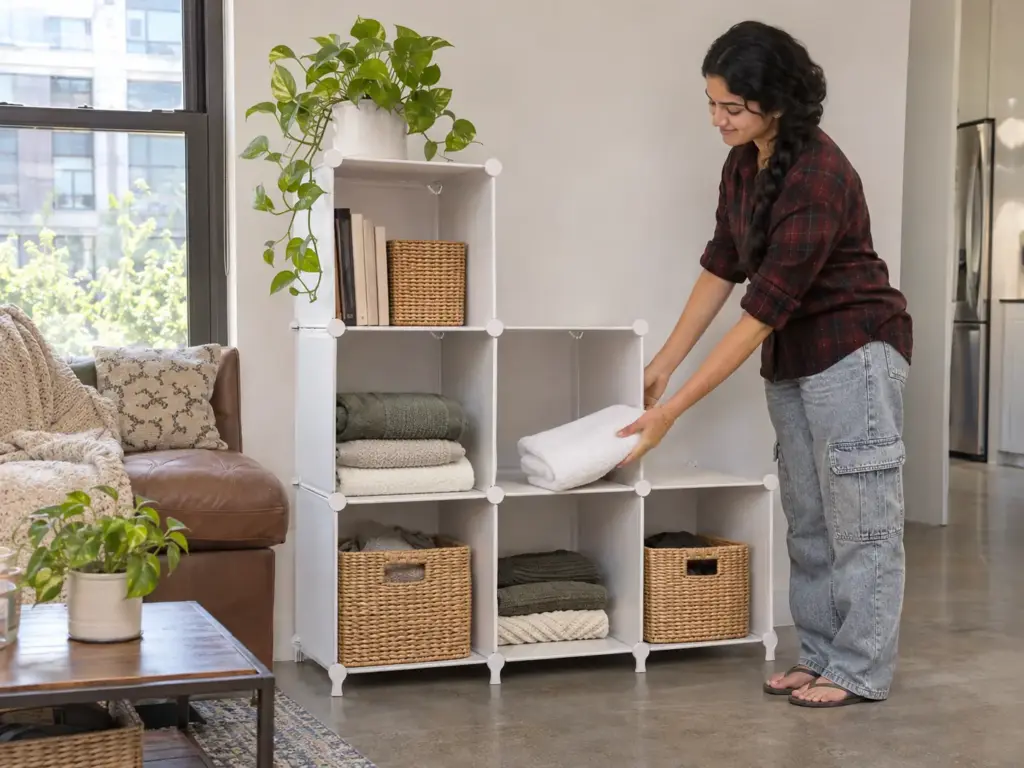
Measure the opening before the colour (13-inch bins, 11.8-inch frames)
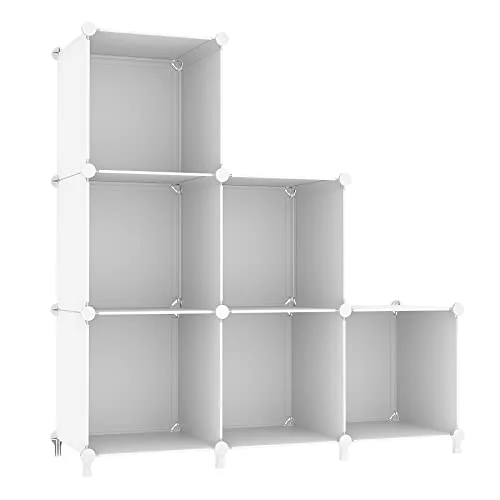
Bins sold as 13 inch cube bins are built for frames with 13-inch openings. The cheap six-cube frame is 35.5 inches wide, 11.8 deep and 37.5 high, so each cube opening is 11.8 inches, and the bin either bulges or you settle for a smaller one and the gap shows on a white shelf like a missing tooth. Nothing standardizes either number. The listing says what a bin fits, and the opening is what you measure, which is the same habit as how to measure an opening before a pale piece is ordered.
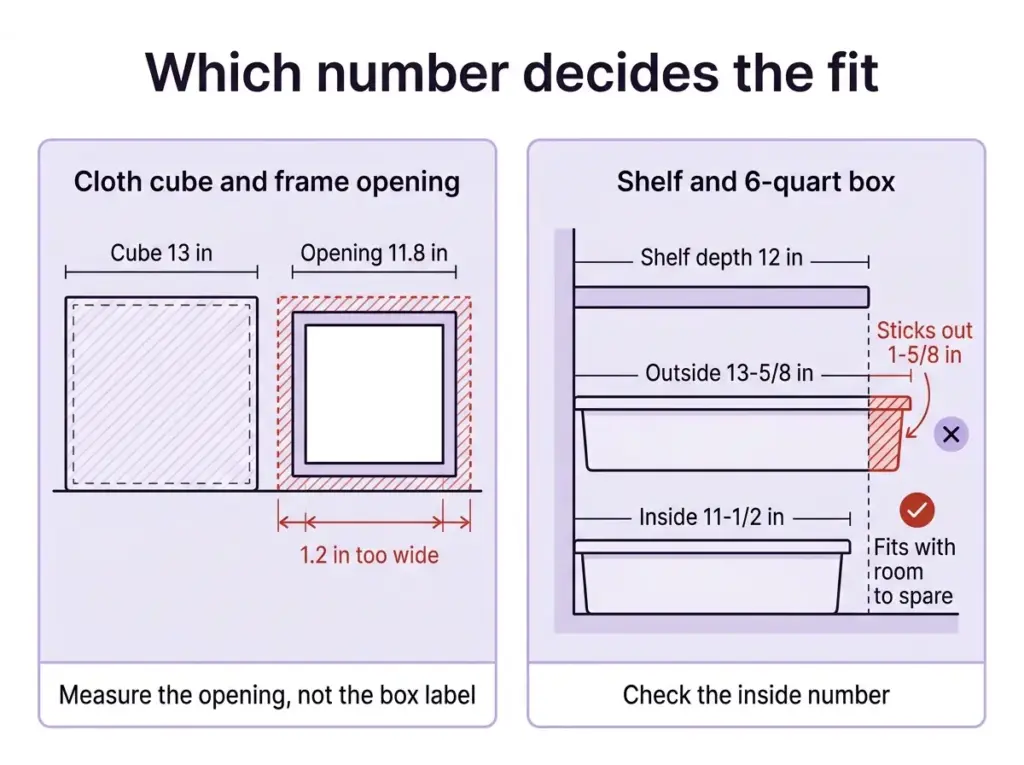
The 13-inch figure sounds like a rule, and it is not one: it is the size a family of cloth cubes was cut to. If your frame opens at 11.8 inches, the better call is a bin cut for that opening, or a different frame built for the bins you already like.
Choose the frame and the bin as a pair, and write the frame’s inside measurement in your phone before the cart. Free first, too: hold the boxes you have against a 12-inch and a 13-inch mark. One of them may already be the right bin.
The cube frame and the cloth cubes that close it
A white cube organizer is the budget way into a closed white wall, and what to look for is short: closed white sides for a clean outline, a build that stacks, a footprint that fits the wall, and a weight rating you read before anything heavy goes in.
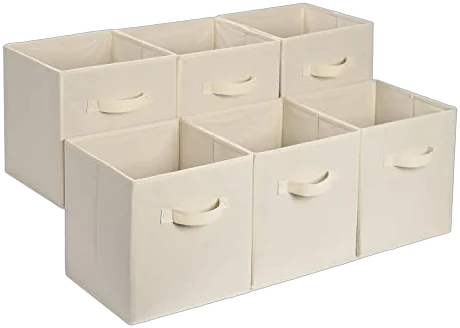
An open frame still shows its contents, so the cloth cubes are what turn it into a closed face. The one in the card below is beige, not white, and it reads as warm cream beside a white frame, so it belongs with warm whites. It is also built for 13-inch openings, which means it will not sit flush in the 11.8-inch frame above.
White furniture hides its own weight, and a tall frame is the kind that tips. According to the CPSC’s Anchor It! campaign, “Anchoring all furniture with drawers, doors, and shelves to the wall prevents tip-over injuries and deaths.” Fix the frame to the wall with the maker’s kit before it is loaded, not after.
Clear boundaries that keep stacks from sliding without adding a colour
On an open shelf, folded linens and stacked boxes slide toward the edge, and the usual answer is a divider in a color that breaks the white. The free version comes first: a standing book or a flat box makes a bookend that costs nothing and stops a stack from creeping. When the shelf needs a real boundary, SPACEKEEPER adjustable shelf dividers are clear acrylic, two sets spanning 26.2 inches overall, so the stacks stay put and no new color appears. Pick a height that clears the lip of the shelf above, or the divider will not slide into place.
Open or closed: which face goes on which shelf
Closed for anything printed, open for the few things meant to be seen. Cloth cubes make the frame a closed face, so leave one cube open at eye level, put two objects in it, and close the rest. A shelf that is open all the way down is the hardest place for this look, and a cabinet front already does most of the job before you add a single bin.
The Label, the Light and the One Warm Accent

Why black label tape breaks an all-white shelf
A strip of black label tape is the first thing the eye lands on, and on a white shelf it is the only thing. The labels that disappear are a metal slot, an embossed mark, white on white, or a small brass tag in a brass label holder. A label maker is fine if the tape is white label tape and the print stays small, and a chalkboard label reads black on a white shelf, so skip it. Invisible means low contrast, not tiny, because the label still has to be readable at standing height.
The Bigso Karin collapsible box in white solves it with a metal label window: it is a rigid fiberboard box with a paper wrap, 12.4 by 8.9 by 5.4 inches, and the label slides into a slot instead of onto the shelf. Assembly splits opinion (the holes do not always line up cleanly) and so does the value, so treat it as a good label solution in a middling box. For jars and containers, labels that stay on a pantry jar for years cover the craft.
What a warm bulb and a cool bulb do to white
A warm bulb pulls white toward cream. A cool bulb pulls it toward grey. Neither is wrong, but the choice is made once for the room and has to match the whites picked earlier: a cool-white set under a warm bulb looks yellowed, and a warm-white set under a cool bulb looks flat and clinical. The shelf that looks right at noon and like a hospital corridor under the evening bulb is almost always a bulb problem, not a bin problem.
Test the bulb before you replace a single bin. Swap one lamp in the zone, look at the shelf that evening, and keep whichever bulb makes your existing whites agree.
One wood or woven piece and one plant, and where they go
The look turns sterile when nothing in it is warm. One wood accent (or one woven white basket) and one green plant, set in the zone the eye lands on first, is enough; add more and it becomes a different look. How one wood tone and a woven basket warm a calm shelf shows how little it takes.
Texture has places too: woven where hands reach, matte where fingers touch, a seagrass basket where something needs hiding, and gloss only where dust is wiped often. And if the full version is out of reach, settling a little short of the photo still beats clear bins that show every label.
Where All-White Fails Room by Room
The pantry shelf next to the stove, and the 12-inch shelf that fits nothing
A white shelf above the range picks up a yellow film of grease within weeks, and no bin color hides it.
Check shelf height and door clearance too, since a bin that clears the shelf above can still catch the cabinet door. Upper cabinets run about 12 inches deep and lower ones about 24, so a 13-inch cube bin will not go front to back in an upper cabinet, while a Sterilite 6-quart box, at 13-5/8 by 8 by 4-5/8 inches outside, turns sideways and fits with room to spare. The white lid carries the color and the clear base shows what is inside, and the pack of twelve covers a whole shelf in one purchase. Some lids do not seat fully, so it suits dry goods and not liquids.
For the pantry version of this look built on real shelves, pair it with airtight canisters that actually seal, which is what lets bags disappear.
Decanting dry goods is what lets the color-coded packaging disappear: decant dry goods into uniform containers, glass jars with white lids included, and the red cereal box stops competing with the shelf. Split the shelf into pantry zones, a breakfast zone and a snack zone, so each row gets one white and one label height. A small pantry needs only one of those zones to start.
A walk-in pantry has the opposite problem: deep shelves swallow what is white at the back, and the answer is pull-outs and a rule that the front row is the only row.
The counter: a bread box instead of a bag, and grease on white
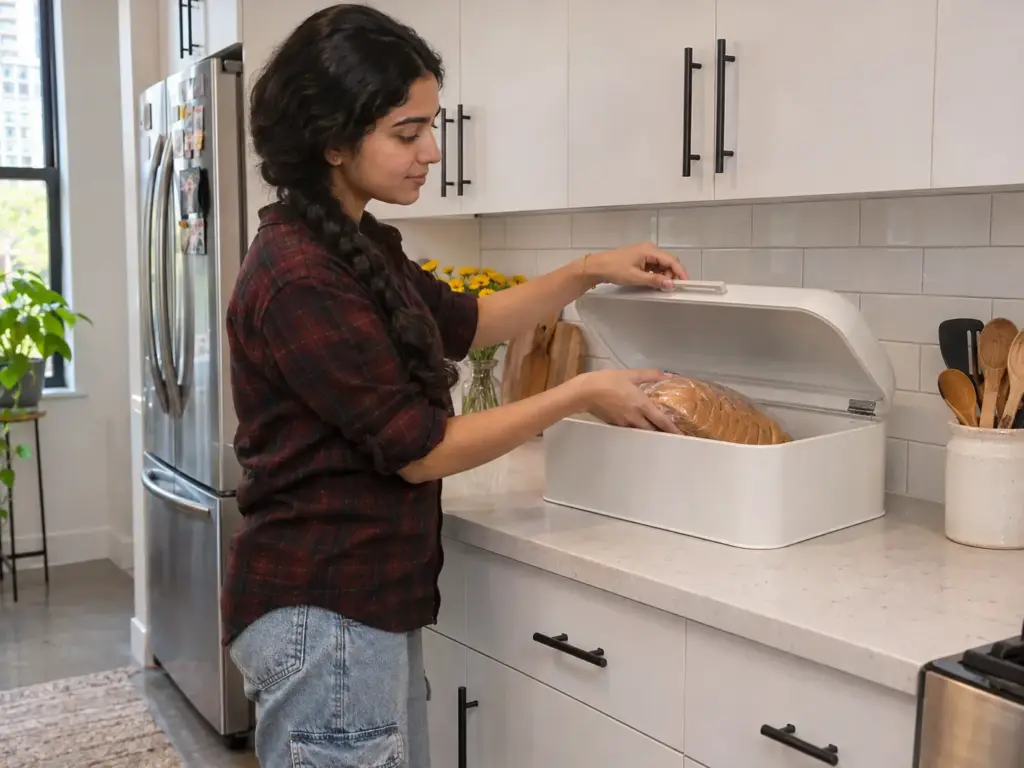
A bread bag and its twist tie are exactly what breaks an all-white counter. A lidded basket you already have does the job for free, and it hides the bag as well as anything. If the counter needs something that wipes clean, the Culinary Couture extra large white bread box is powder-coated steel, 16.5 by 8.9 by 6.5 inches, and a damp cloth takes grease off it. It does take real counter depth, so measure the spot before you carry it home.
Under the sink and in the laundry closet: pull-out drawers and the humidity limit
In an under sink cabinet, the obvious pick for the back is a bigger bin, and a bigger bin is worse: it goes in once and never comes out. In a 12-inch cabinet, the Vtopmart stackable drawers reach the back, measure 12 by 7.5 by 7 inches (11 by 5.8 by 6.5 inside), and the clear finish keeps the white unbroken. They are rated for 15 pounds when stacked, which is the ceiling. Where a pipe cuts the cabinet in two, an under-sink setup built around the pipes comes first.
The laundry closet fails differently. A linen closet shares its humidity limit. Lint settles on white, and damp turns the joints of white finishes grey-black with speckle. According to the EPA’s mold and moisture guide, “The key to mold control is moisture control.”
Keep indoor humidity below 60 percent, ideally between 30 and 50 percent, and dry anything wet within 24 to 48 hours. Laundry storage for a closet this narrow shows what fits when the closet cannot take pull-outs.
Kids’ zones: where white is the wrong colour
In a kids playroom, crayon and sticky hands mark white in a day, and a kids’ cubby is where a white bin loses fastest. Go dark or woven at child height, where marks do not read, and keep the white up high where small hands do not reach. The look can still run through the room, and the zone that takes the abuse does not have to join it.
How to Get the Look on Shelves That Aren’t White

Cover the shelf, do not replace it
A brown melamine shelf and a lease that forbids drilling look like the end of this look, but they are not.
Removable contact paper or peel-and-stick wallpaper in white, on the face and top of the shelf, brings the white without a replacement shelf.
It is the no-drill, rental friendly route, and nothing here mounts or drills. A plain box wrapped in the white you want does the same job for a bin. When the old shelf is sound, covering it costs a fraction of replacing it, and at conversational distance the room does not notice the difference. The budget version of the bins follows the same logic: dollar store bins work if they test as one family under your lamp, and fail if they do not.
Press the paper onto a back corner of the shelf and leave it a full week before covering the face. A week shows whether the edge lifts or the white drifts toward yellow under your bulb, and you find out on one square instead of the whole shelf.
Small apartment, closet or walk-in: what changes
On a dresser top or an entryway bench the one-family rule applies at a smaller scale. In a small apartment, the answer is stacking the cube frame up the wall and closing it with cloth, since floor space is the constraint. In a walk-in, the same frame is the wrong tool: the depth swallows what is white at the back, so pull-outs and a front-row rule do the work. A closet sits between them, where the open wire rack, or a cloth-lined wire basket, is the place the look needs the most help and the cloth cubes do it.
Open shelving or closed storage
Open shelving is for the few things meant to be seen, and closed storage is for everything printed. For styling open shelves that have to stay open, open-shelf styling that holds up through a normal week shows how to keep it to two or three chosen objects per shelf instead of a full wall.
What White Shows, What It Hides and How to Clean It

The grey dust line, the grease film and the fingerprint
Each failure has its own look. Dust reads as a grey line at the join where a white bin meets a white shelf. Grease reads as a film on the shelf above the stove. Fingers leave grey smudges on matte white.
None of these is a stain in the usual sense, which is why scrubbing them is the mistake: the right removal differs by material, and the wrong one leaves a mark that stays.
Matte against gloss: where each belongs
Matte white plastic has no glare, so a grease film and light scuffs do not catch the lamp, and it belongs where hands and grease land. But it takes fingerprints as grey smudges, and it cannot be scrubbed: matte plus an abrasive leaves a permanent matte shine patch, a single square that reads shinier than the rest for good. Gloss white acrylic does the opposite, showing every fingertip but wiping clean in one pass, which suits the places where dust settles and the shelf is wiped often.
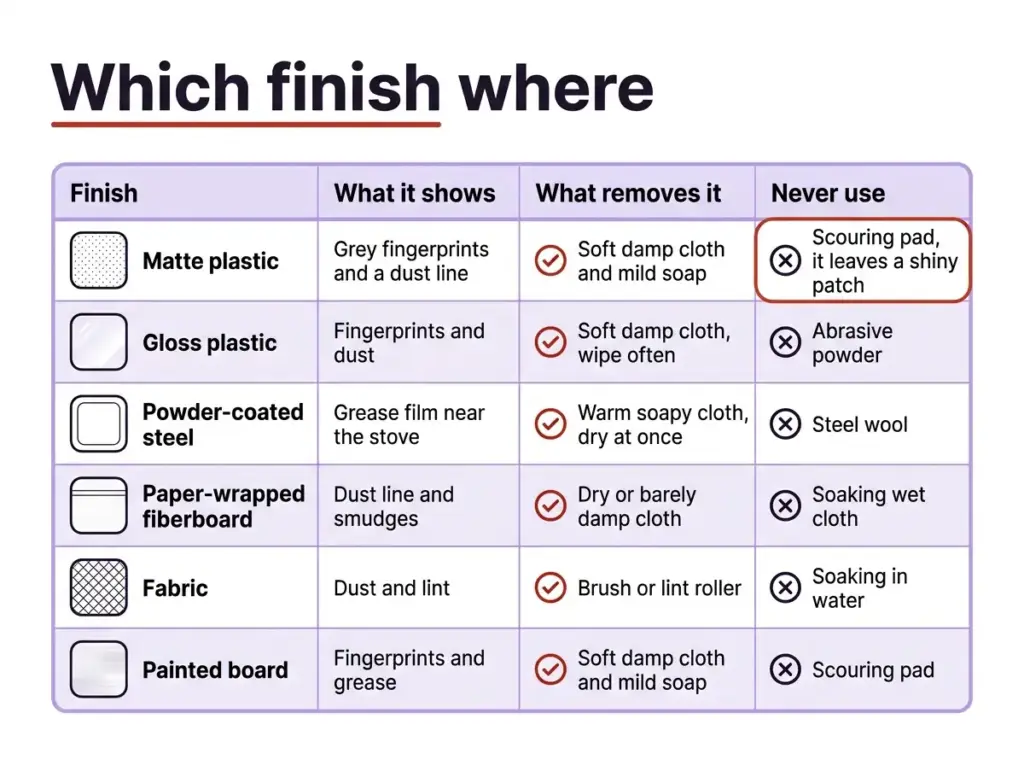
The materials in this article clean differently. Powder-coated steel (the bread box) and polypropylene (the 6-quart boxes) wipe with a damp cloth. PET (the clear drawers) takes the same. The paper wrap of a fiberboard box wants a barely damp cloth, never a soak.
Cleaning that keeps the finish
A soft damp cloth and mild soap handles all of it. Never a scouring pad. Fabric cubes get brushed or run over with a lint roller, not soaked. Painted board, painted MDF included, takes the damp cloth too, and dries before anything goes back on it.
A short weekly reset (a wipe of the touch points: the handles, the front edge of the shelf, the lid of the box you open daily) is the cadence that holds, plus a look at the whites under the lamp once a month to catch any that have drifted a shade.
Stand Your Whites Together Under the Lamp This Week
The look comes down to a few decisions made before anything is bought: one white family for the zone, bins sized to the frame and not to a photo, a label and a bulb that suit white, grease and damp kept away from it, and each finish cleaned the way its material allows. The shelf that fails is almost never short on products, only on one of those decisions.
After the first greasy week of cooking and one evening under the lamp, look at three spots: the shelf above the stove for a film, the joint where bin meets shelf for a grey line, and the row of bins for any piece that has drifted a shade. Today, carry the whites already in the house to a window, then under the lamp, and see which ones do not belong. Set those aside and notice how much calmer the rest already looks.
Frequently Asked Questions About the All-White Organization Aesthetic
01What makes an all-white organization aesthetic work?
One white family repeated across a zone, with closed storage hiding anything loud. Keep contrast low, show only a few chosen objects on one styled open shelf, and let closed fronts handle everything printed. The five mistakes above are what break it.
02Do all the whites in an all-white organization aesthetic have to match?
They have to agree in family (warm, cool, pure or cream), not in every detail. A beige cube beside a cool-white frame reads dirty. Hold any two pieces together under the room’s own light before they share a shelf.
03How do you keep an all-white organization aesthetic from looking sterile?
Add one wood or woven piece and one small plant, and use a warm bulb. Texture does more than color here, and keeping the label low contrast stops a strip of black tape from becoming the only thing the eye lands on.
04Should I use open shelving or closed storage for an all-white organization aesthetic?
Closed for anything printed, open only for the few things meant to be seen. A closed cabinet front already does most of the work, and an open rack needs cloth cubes to close it into one calm face.
05What should I remove first before buying white bins?
Everything printed in color or loud, plus anything you would not miss. Sort and cut before any container is bought, because a bin built around volume you did not reduce makes that volume louder.
Disclaimer: ClutterlessNest is a participant in the Amazon Services LLC Associates Program. As an Amazon Associate we earn from qualifying purchases. This article may contain affiliate links — if you buy through them, we may earn a small commission at no extra cost to you. We only recommend products we have tested or genuinely believe in.