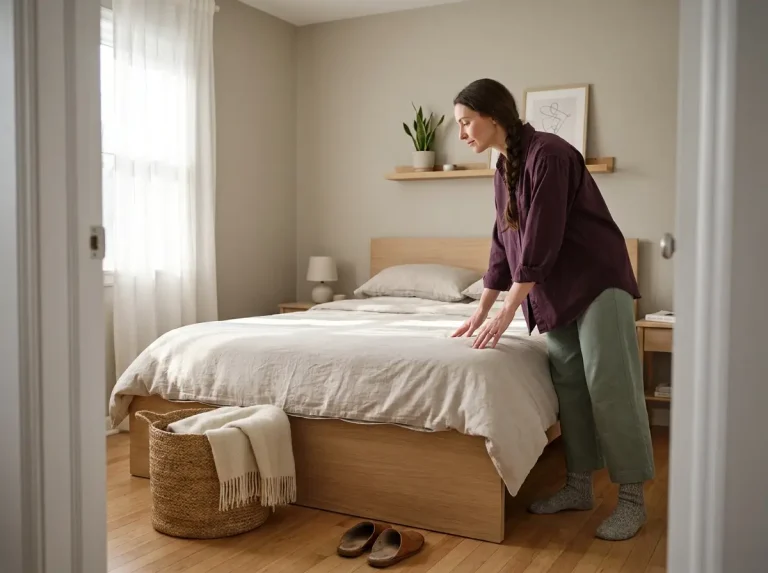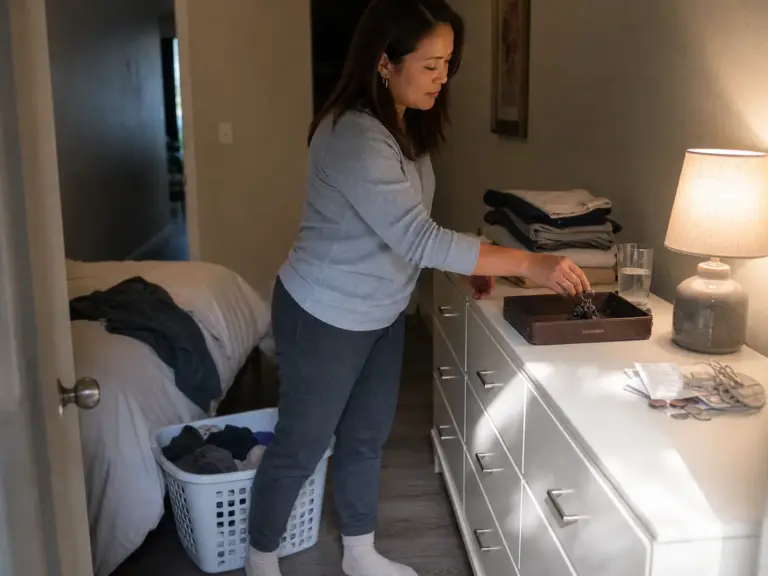

The photos you saved of calm, nearly empty bedrooms look nothing like your room by Wednesday: a chair holding five days of clothes, a hair dryer with no home, a bag slumped on the floor. Those rooms are mostly closed storage, and that is the part aesthetic room organization ideas rarely admit: what a styled room hides matters as much as what it shows.
The professional organizers’ association caps a styled surface at two or three pieces, and every product below comes with the measurement that decides whether it fits. The order is what stays visible, one repeated material, the closet, the gap under the bed, the rod, storage that reads as furniture and a reset that survives a shared room. The long game, the one-container-family rule that keeps a styled room from reverting, has a dedicated page, so this guide stays on the room itself.
Quick Answer
Decide what the room is allowed to show, then fix each space with one measured move.
- Surfaces: give every visible surface one job and move the busy things behind a door, a lid or a drawer.
- Palette: repeat one basket material, one metal and one wood tone instead of adding colors.
- Closet: swap to one family of slim hangers before buying any storage.
- Under the bed and on the rod: lift the bed for a bin that slides out, and hang the shoes off the rod.
- Furniture that stores: put a lidded basket or a stool where a bin would show.
Start Aesthetic Room Organization by Deciding What Stays Visible
Picture the end of a long cleaning session: the floor is clear, the laundry is folded, and the room still looks the way it did an hour ago. Nothing is out of place and nothing looks calm. That gap between tidy and calm is where most aesthetic rooms are won or lost, and no amount of new storage closes it until you settle what the room is allowed to show. An aesthetic bedroom is a tidy one with less visual clutter, and that comes from deciding, not from storage.
Why a Clean Room Can Still Feel Cluttered
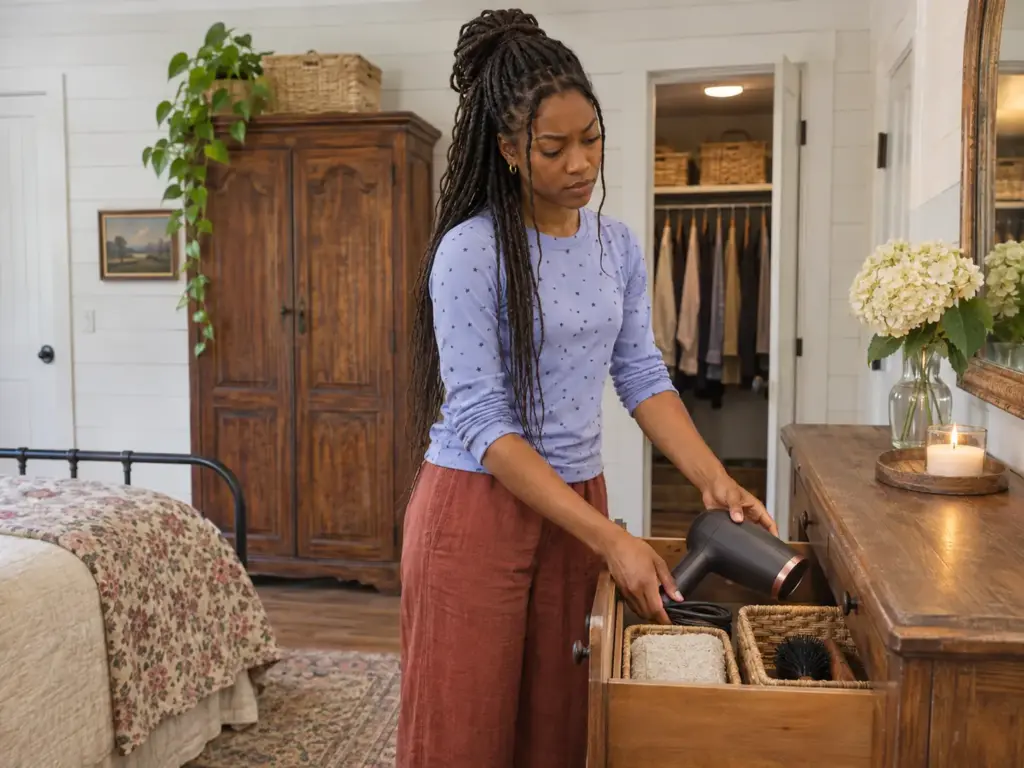
A room can feel cluttered even when it is clean because the eye counts shapes, not objects. A shelf holding the things you use every day is a shelf of mismatched shapes (a charger, a mug, a half-open box of tissues), and it reads as busy no matter how neatly each one is lined up. Clean and calm are two different states, and the second one depends on how many separate shapes your eye has to process from the doorway. Shape count is visual noise, and a clutter-free room is simply one where that count stays low.
The reverse also holds. A room with a lot of belongings reads calm when most of them sit behind doors and lids, which is exactly how the rooms in your saved photos work. If you want to see the same surface creep in a bedroom that has already been cleared once, a bedroom that stays cluttered after it is cleared follows it step by step.
One Job for Every Visible Surface
Give each visible surface exactly one job: dresser top, nightstand, open shelf, desk, windowsill. The job is either display or the two or three things you touch daily, never both and never a pile. The count is not a decorator’s whim. According to the National Association of Productivity and Organizing Professionals, “Limit décor to 2-3 pieces per surface for a cleaner, calmer look.” Everything that looks busy goes behind a door, a lid or a drawer.
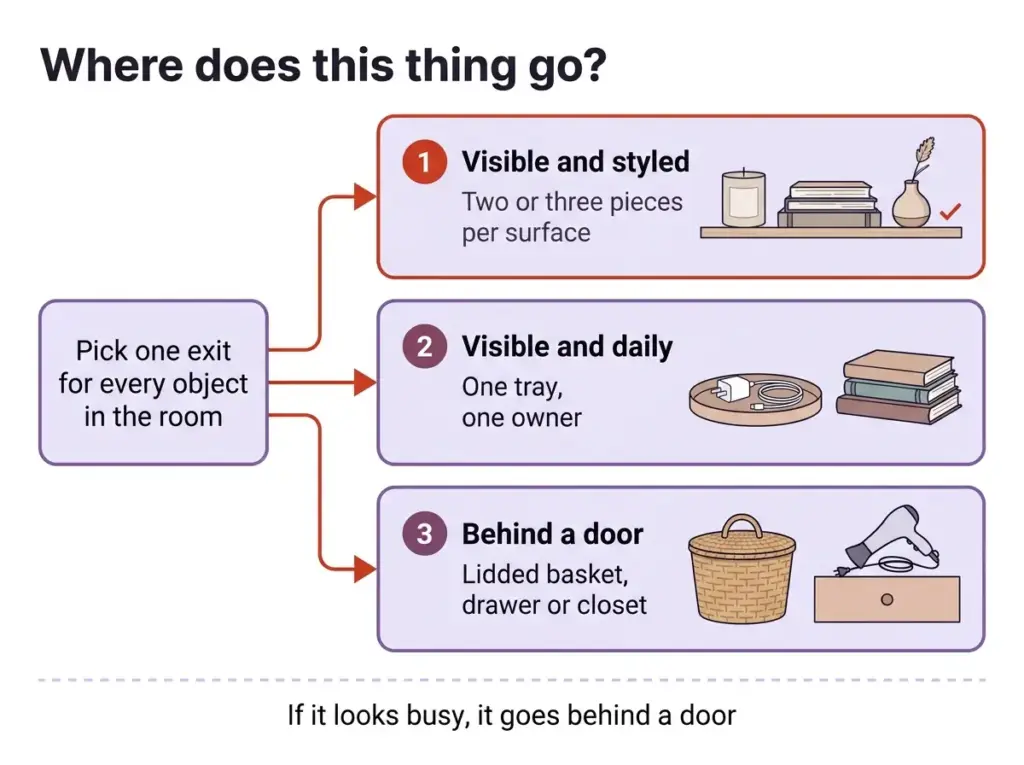
The dresser top is the biggest flat surface in most bedrooms, so it breaks the rule first, and what a dresser top can hold before it reads as clutter comes down to the same count with a tray as the boundary. The desk is a separate case: the desk gets its own item cap and its own cable rules, so it stays out of this guide.
The Styled Shelf Is Not the Storage Shelf
An open shelf is a display surface, and it has a limited capacity. Leave negative space on it: an empty third of the shelf is part of the look. Put the hair dryer, the charger and the daily bag on it and the aesthetic room turns back into a messy one by midweek. Most readers expect more shelves to solve a cluttered room, and the opposite is true: every added open shelf is another surface that will collect the daily things unless they have somewhere else to go.
So the shelf you style and the shelf you store on have to be different pieces. Give the daily things a closed home within arm’s reach, such as a lidded basket by the bed or a top drawer, with a catch-all tray by the door as the drop zone for the daily bag, and the display shelf stops being the landing strip. Styling a visible shelf without it turning into storage is the same line drawn on a bookcase.
There is also the black hole to deal with: the drawer or corner where objects go in and never come out. It feeds every surface in the room, because whatever has no true home ends up on the nearest flat spot. Empty that one first.
Subtract Before You Buy a Single Container
Subtraction is the free half of the system. Declutter in small daily pulls: five items a day out of the room before any container enters it, and give the item you are keeping “for one day” a hard test: if it has not been worn or used in a year, it goes. A designated place for everything only works after the subtraction, because a place has to be smaller than the pile that is looking for it. Treat the size of each closed home as a capacity rule and run one-in-one-out on it: when the basket is full, something leaves before anything arrives.
Finish one surface before you start the next. Organizing in small pieces and stopping when you are tired is the common way a half-sorted pile becomes the new mess, and a room with three half-finished surfaces looks worse than one with a single finished one.
Use an open paper bag by the door for the five-a-day pass. A bag has no lid, so nothing can hide in it, and by the end of the week you will see exactly what the room kept no use for.
Make the Palette a Count of Repeats, Not a Color Scheme
Many people buy one item in every color of the saved photo and end up with a room that looks like a sampler. The problem is not the colors you chose. It is the number of different materials in sight, because a room reads styled when a few materials repeat many times, and that repetition is what an organized aesthetic is made of.
Fewer Materials, Repeated More Often
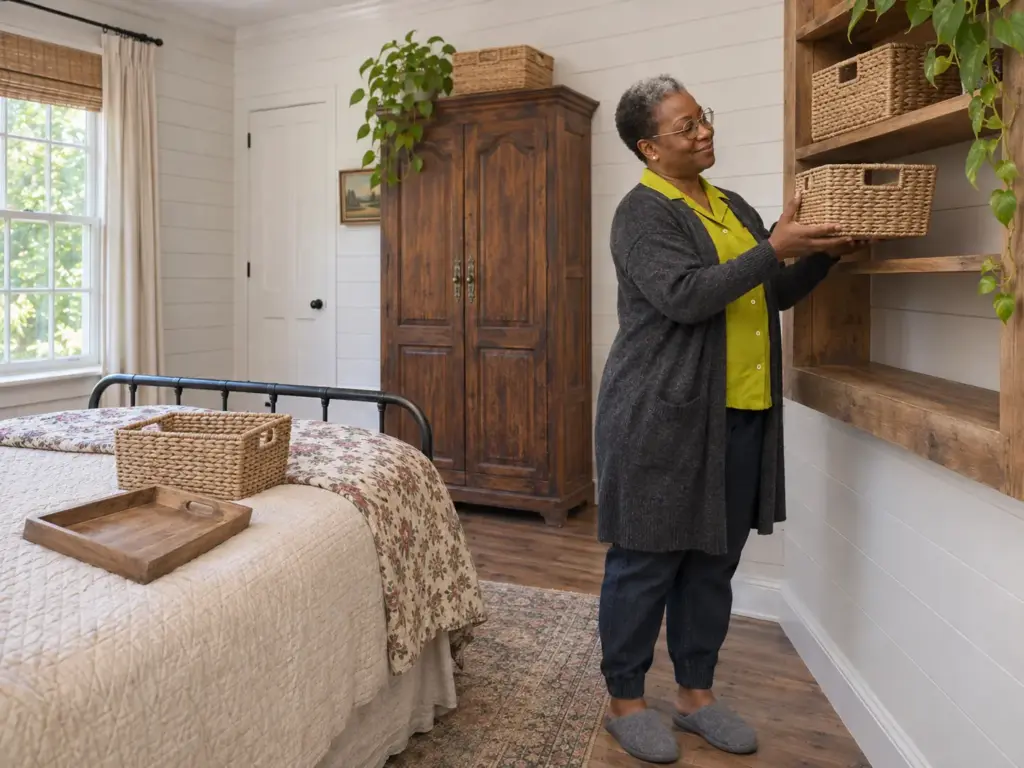
Pick one material family, down to one texture where you can: one basket material, one metal tone and one wood tone.
Carry each across the baskets, the hangers or hooks, the shelf brackets and the tray. This is design judgment, not a law, but it works for a plain reason: the eye keeps meeting the same thing, so it has less to sort. A color palette follows from that, and a neutral palette is the easiest to hold because it adds nothing new. The look you saved (neutral, boho, minimal, Y2K) is a decision made once, and it is easier to make from the materials that already dominate the room than from the photo.
The One-Photo Test
Take one photograph of the room as it is today. Look at the photo, not the room, and count which material repeats most. That is the one already working, so build the rest of the room around it and return or relocate the item that matches nothing.
A photo flattens the room into the shapes the eye counts, which makes the mismatch obvious in a way standing in the doorway never does. For the other half of restraint, why a stripped-back room drifts back to its old state covers what happens when a bare look has no system behind it.
Where Repeats Come From: Baskets, Hangers, Brackets, Trays
Most repeats arrive through products you need anyway. One hanger family makes the closet read as a line. One woven material, in a lidded basket, answers the shelves and the nightstand.
One steel tone shows up in the frame of a hanging shoe organizer. One bin family bought as a single pack looks calmer than three sets bought on three impulses. Choose opaque bins for the open shelf, because a clear bin shows every shape inside and brings the visual noise back.
The matching container set is where this idea goes wrong, and the cause is the order of operations. The set gets bought for the photo before the shelf is measured, so a shelf 11.5 inches deep meets a basket 12 inches across, and the set is returned or ends up under the bed. Measure before buying, and decide the palette after the tape measure, not before it.
Slim Down the Closet Line Before You Buy Any Storage
If the rod is full and the clothes sit in a sawtooth of mismatched hangers, the closet reads as clutter before anyone opens a drawer. The swap is one afternoon, needs no drill, and works the same for a renter and an owner.
One Hanger Family, One Line
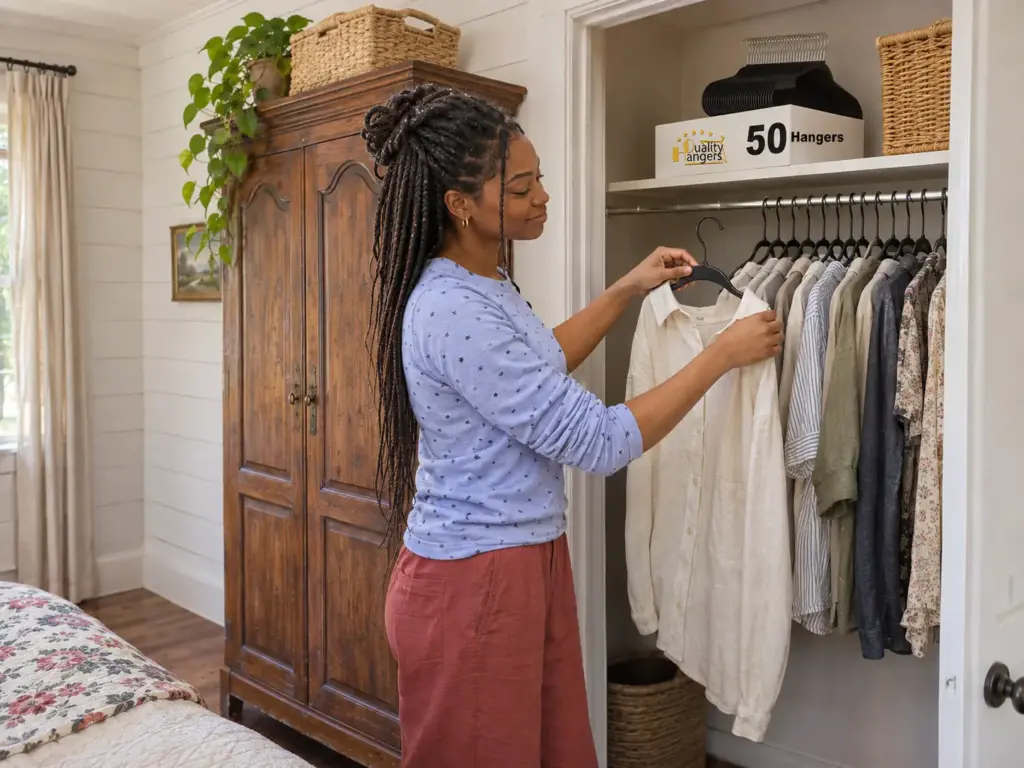
Everything on one family of slim hangers hangs at the same level, and the professional organizers’ association makes the same point: the eye then reads a line instead of a sawtooth. The Quality Hangers 50 Pack Plastic Hangers are slim, non-velvet and 17.5 inches wide, which clears a standard 24-inch-deep closet rod, and the maker states they are the same thickness as flocked hangers. That last detail corrects a common assumption: velvet hangers get the credit for saving space, but thickness is the only thing that frees the rod, so a smooth plastic hanger matches the velvet one inch for inch.
Any slim 50-pack you already have in the house does the same job, so treat the brand as optional and the swap as the point.
What the Swap Buys and What It Does Not
In a side-by-side measurement of five slim hangers on one rod, the swap freed 11 inches of rod. That is roughly one extra armful of clothes per rod, from the cheapest real gain in the whole room.
What it does not buy is vertical space. Thickness does not change rod height, and extra height comes from a second rod, not a thinner hanger. Say that plainly to yourself before you count on it.
Rotate Out-of-Season Clothes With Vacuum Bags
A closet that was streamlined and went back to full within a month usually has one thing in common: the out-of-season pile never left the rod. Seasonal rotation is what keeps the swap in place, and vacuum bags are the quickest way to move a winter pile out of the way. The Cozy Essential Vacuum Storage Bags with Hand Pump come as a 20-bag combo in five sizes, from a jumbo at 39.35 × 27.5 inches to a small at 23.5 × 15.7 inches, plus travel roll-ups, and the maker claims an 80 percent volume reduction.
Treat the claim as the maker’s, because this style of bag has a known weakness: seals that do not hold, thin plastic that tears easily and air that creeps back in over time. That limits them to what you open twice a year or less, like the winter coats and the guest bedding. Anything you open more often belongs in a flat rigid bin. And before you compress anything delicate, what compressed bags do to the clothes inside and where they stop being worth it covers the part the packaging leaves out.
Use the Gap Under the Bed Before You Add Furniture
Everyone has the moment of carrying a flat bin to a platform bed and watching it stop an inch short of the frame. The bin was not the failure. The gap was, and it is a number you can measure in ten seconds.
Measure the Clearance First
Under bed storage starts with one number, the under-bed clearance.
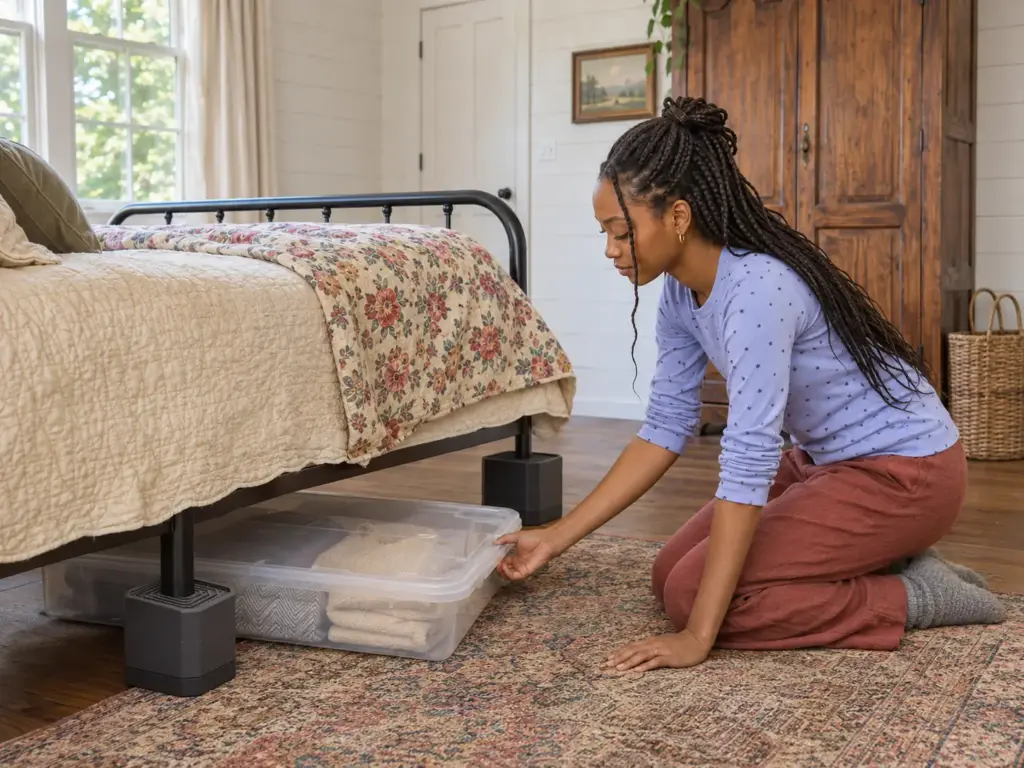
A platform bed often leaves about 4 to 7 inches under it, and a metal frame about 7 to 9. Those are typical figures, so measure your own from the floor to the lowest rail. A bin needs its own height plus roughly an inch to slide out with one hand, and if it needs a second hand or a knee on the mattress, it will stay put for good. Bins that actually clear a low frame lists the heights worth shopping for.
The Riser Decides, Not the Bin
Raising the bed is usually cheaper than finding a shorter bin. A 3-inch riser takes a 4-to-7-inch platform to about 7 to 10 inches, which is the difference between a 4.5-inch flat box and a real 6-inch bin you can slide out cleanly. The bin you wanted in the first place suddenly fits.
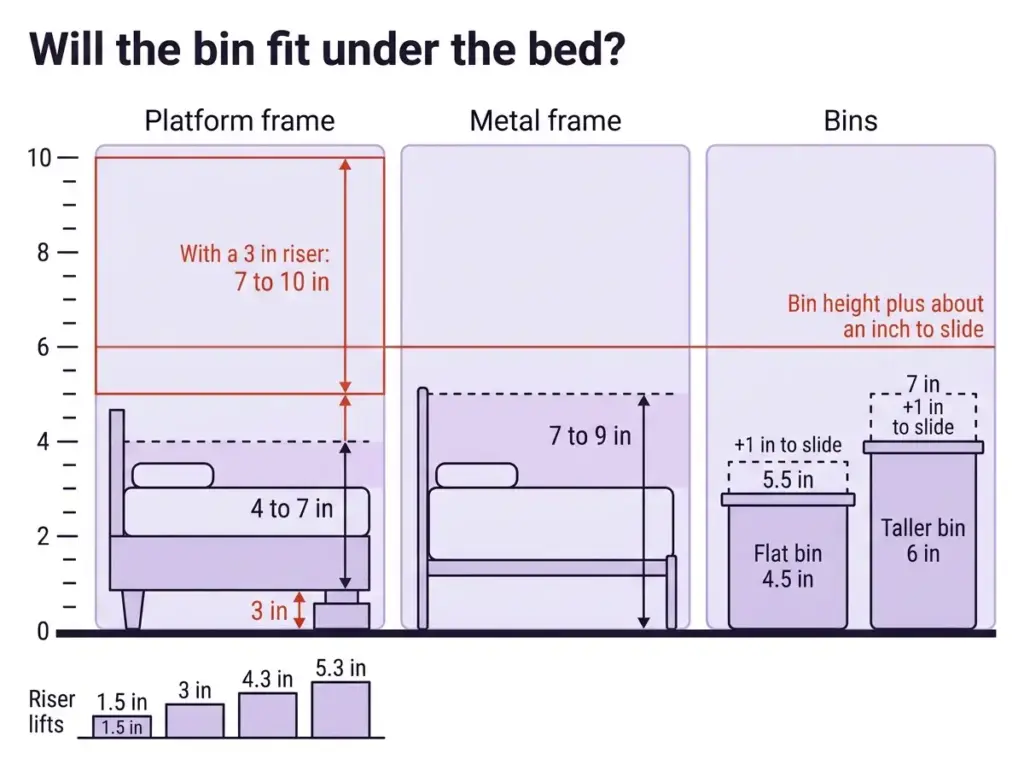
The EclatBain Adjustable Bed Risers come as a set of four with lifts of 1.5, 3, 4.3 and 5.3 inches, and the maker rates the set at 4,000 pounds total, or 1,000 pounds per riser. A queen with two sleepers, a frame and a mattress sits well inside that rating, so weight is not the limit.
The stacking rule is. The single-layer unit has no intermediate section and cannot be stacked, while the two- and three-layer ones can, and the 1.5-inch lift buys almost nothing. Never stack the single-layer unit, however stable it looks.
So the honest claim is inches, not acres: about 3 inches, and only on the models built to stack. (Risers that promise an “expansive” new storage zone are rounding up.) Renters get one more reason to like them, since risers need no hole and no permission.
A stack of old books under each leg costs nothing and holds less, and it is fine for a trial week to see whether the extra inches change how you use the space. After that, read more ways to use the floor space under a small bedroom’s bed for the layouts that justify buying the risers.
Why Bed Legs Walk Off Risers
The one real complaint with risers is not the weight rating. It is that bed legs shift and fall off, and the failure happens at the moment you put the bed down, not months later. Seat each leg fully in its cup before you let the weight settle, and check all four after the first few nights.
Push the bed gently from each corner after the first night. A leg that sits crooked in its cup will walk off within a week, and reseating it takes ten seconds with the bed empty.
Hang Shoes and Folded Stacks Off the Rod Instead of Adding a Dresser
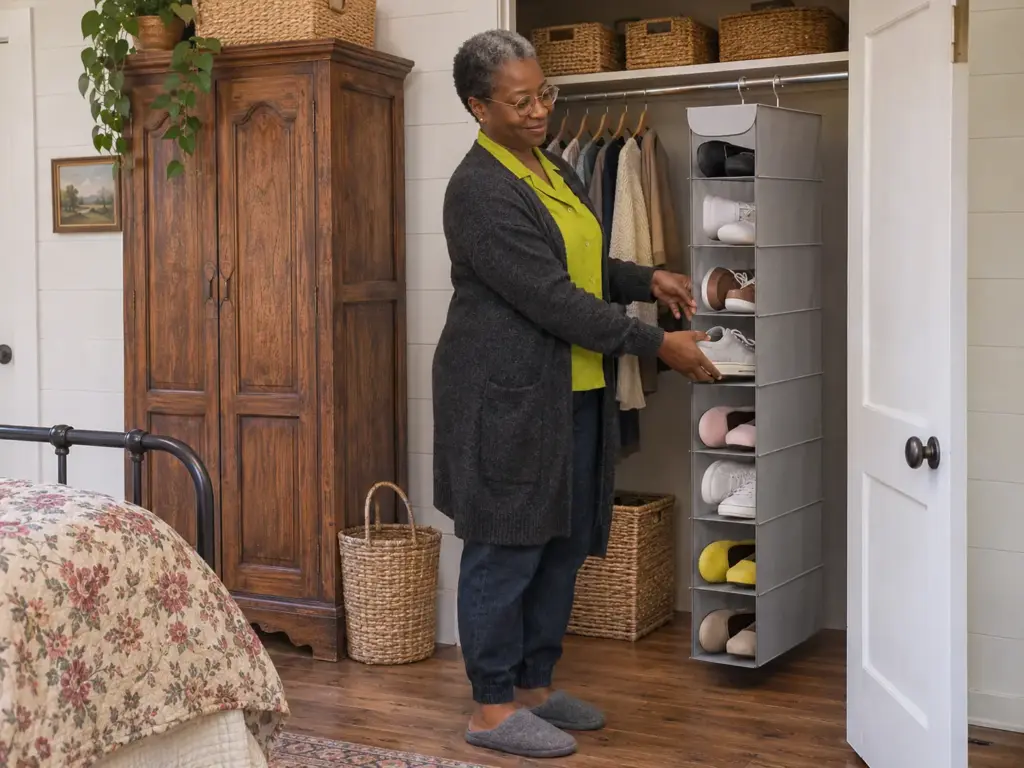
In a closet with one rod and a floor covered in shoes, the temptation is a dresser the room cannot fit. The rod already has the depth for storage if the organizer is sized to it, and the closet already counts as furniture.
The 11.5-Inch Depth Decides It
The Whitmor Hanging Shoe Organizer has eight shelves and measures about 11.5 inches deep, 5.5 inches wide and 41 inches high, and it hangs from the rod on a steel frame with hooks, no tools and no holes. The depth is the number that decides it. On a standard 24-inch-deep closet it eats about 11.5 inches of floor space, so it belongs on the side the door does not swing into, and the door width tells you how far the swing reaches.
An organizer hung where the door sweeps it will catch the edge every time the door opens. Arranging a small bedroom so the closet door can still swing helps you work out which side that is.
It holds one shoe per compartment in larger sizes, and the fabric tears if you load it with boots, so use it for flats, sneakers and sandals. A second rod and the shelf the closet already has can do the same job for free, if your closet has them.
Open the closet door all the way and put a strip of tape on the rod where the door’s edge sweeps. Hang the organizer on the far side of the tape and it will never be in the door’s path.
What a Renter Does When the Closet Has One Rod
A rented closet rarely has a second rod, and a landlord rarely lets you add one. The same logic carries over to folded stacks: a hanging closet organizer with shelves takes sweaters off the shelf above the rod and onto the rod itself. In a small room with one rod, the rod is the storage, and the dresser that cannot fit stays in the store. For the full set of options, closet organizers that need no drill for a rented closet sorts them by what hangs and what bolts.
Choose Storage That Reads as Furniture
The basket in your saved photos is doing two jobs: it is decoration, and it is where the throw blanket, the spare pillows and the clutter went. The lid is what turns a basket into storage you can leave in the open. Decorative storage only earns the name when it closes, so storage that doubles as decor has to hide what it holds.

A Lidded Basket That Clears the Bed Frame
The HONCESTA Large Storage Basket with Lid is a woven basket in cotton rope, 18 × 18 × 14 inches and 4.4 pounds. Fourteen inches of height clears the side of a bed frame and sits fine on a dresser top, and the neutral brown and white feeds the repeat count from the palette section. The basket needs ironing into shape and is not as firm as it looks, and the lid has a mixed record, so do not stack anything on it and treat the lid as a cover, not a shelf.
Measure the shelf depth and the shelf gap against the basket rim before you order, and expect a 12-inch basket to need more than 11.5 inches of depth. If the spot is next to the bed instead of on a shelf, how to size a basket to a surface you have measured carries the same math. A bedside gap is its own zone, and a bedside surface sized to the gap beside the bed is worth a look before you commit.
The Free Version Already in the House
A lidded stool or a storage ottoman does the same job with no purchase, and for a small apartment the furniture that doubles as storage is a whole branch, covered in furniture that stores things while it is also a seat or a table. The boutique version, a designed bench with storage inside, has a better build than the basket. The lidded basket gets most of the same job done for much less, and it is the safer first buy if you are still deciding on a look.
The Wall Is a Display Shelf, Not Storage
The wall shelf is the most-drilled item in the room and the one a renter cannot have, so it is the one idea in this list that splits by who you are. An owner can drill a shelf into a stud and it holds what its rating says. A renter’s no-drill version holds a small fraction of that, only the weight written on the packaging, so read the maker’s weight limit and never assume. Which floating shelves hold weight and which only look like they do sorts them by mount.
The physical rule is editorial: a shelf run shorter than the furniture under it reads as an accident rather than a line. Treat the wall as a display surface, with the same two-or-three-piece cap as any other, not as a place to keep things.
Anything taller than it is wide, a dresser or an armoire, is an anchoring job, not a styling job. The CPSC’s Anchor It! campaign is blunt about it: “Anchoring all furniture with drawers, doors, and shelves to the wall prevents tip-over injuries and deaths.” Do that before you style the top.
Keep the Room Calm With a Reset That Works in a Shared Space
A room styled on Saturday and tangled with chargers and a bag on the floor by Wednesday never had a reset. It only had a styling day. A tidy room rarely stays tidy past a few days, and a reset built for the real week is what changes that.
Hide the Cords and Tech Before Anything Else
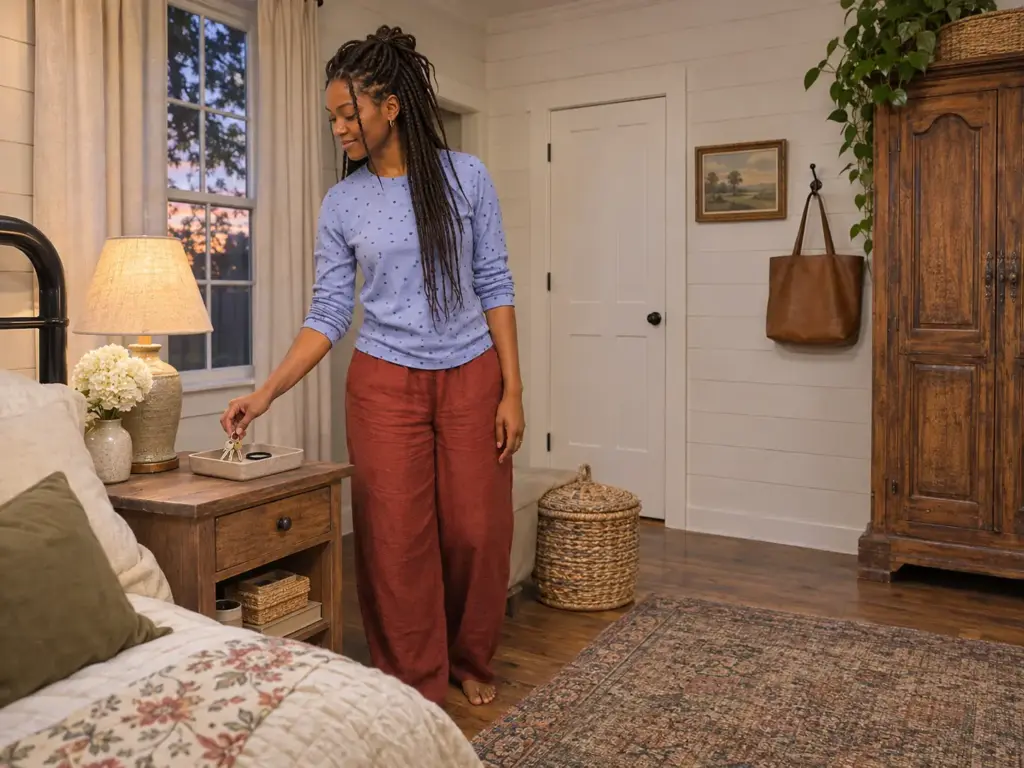
A charger on the nightstand is the most visible object in a bedroom that is trying to look calm. One cable sleeve or a cord organizer clip that keeps the cable behind the furniture, plus a single charging station such as a lidded tray or a drawer, beats a visible power strip. Hide cords first: it is a small change, and it removes the one thing that makes a styled room look lived-in the wrong way.
Choose one charging spot per person and let the phone sleep there. A second charger on the other side of the bed is where the cord tangle starts.
One Owner for Every Surface
In a shared room, give each surface one owner: this tray is mine, that shelf is yours. The reset then does not depend on a conversation, because everyone knows whose things land where. Each person’s closed home, a basket or a drawer, is also what stops their things from landing on the other person’s display.
The Five-Minute Reset and What Breaks First
The reset takes five minutes a day, with a longer weekly reset on the weekend for the closed homes, and returns each visible surface to its one job: the daily items go back to their closed home, the display stays at two or three pieces and the floor is clear. What breaks first is the chair that holds clothes and the daily bag, so give each one a home inside arm’s reach, such as an adhesive hook on the closet door (check its weight limit first) or a lidded basket, or they will keep winning. If you want the mechanism behind it, why a cleared surface refills within days and what stops it explains what is going on.
Take One Photo Today and Check Your Surfaces Next Weekend
An aesthetic room that holds real stuff comes down to a short list of decisions. Decide what stays visible first, then repeat one material instead of adding colors. Swap the hangers before you buy any storage, measure the gap under the bed against riser plus bin, and hang shoes off the rod on the side the door does not sweep. Choose the lidded piece that reads as furniture, and keep a reset the whole room can run in five minutes.
Next weekend, open the photo from today and count which surface has crept past its two or three pieces. That surface is where the next reset starts.
Today, take one photograph of the room and count which material repeats most, then return or move the one piece that matches nothing. Notice how much of the room was already calm before you bought a thing.
Frequently Asked Questions
01How do you make your room more aesthetic?
Give every visible surface one job, with two or three pieces at most, and put the busy things behind a lid or a door. Then repeat one material across the baskets, hangers and brackets so the eye has less to sort.
02What is the best way to organize a room?
Subtract first, then give each thing a closed home within arm’s reach. After that, use the space the room already has, under the bed, on the rod and behind the door, before adding any furniture.
03What are some good room organizing items?
Slim hangers in one family, bed risers with a stated stacking rule, a hanging shoe organizer, a lidded basket and vacuum bags for seasonal clothes. Each one should be sized to a measurement the room gives you.
04How do you keep an aesthetic room from going back to a mess?
Run a five-minute reset that returns each surface to its one job, and in a room two people share, give each surface its own owner. The daily items need a closed home within arm’s reach, or they will land on the display.
05What aesthetic room organization ideas work when you rent and can’t drill?
The hanger swap, bed risers, a hanging shoe organizer and a lidded basket all need no hole. The wall shelf is the one that does, so read the maker’s weight rating on a no-drill version before relying on it.
Disclaimer: ClutterlessNest is a participant in the Amazon Services LLC Associates Program. As an Amazon Associate we earn from qualifying purchases. This article may contain affiliate links — if you buy through them, we may earn a small commission at no extra cost to you. We only recommend products we have tested or genuinely believe in.