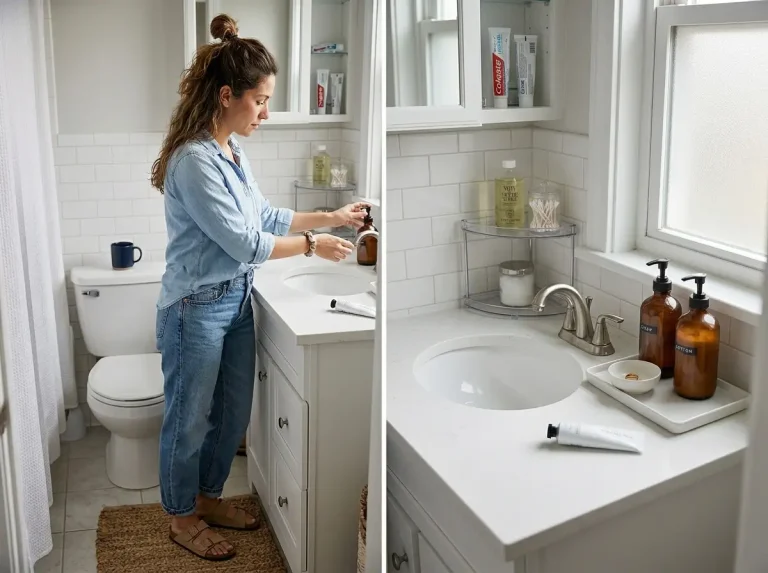

By Friday, the tray you set up on Sunday holds a razor, a half-used lotion and two hair ties, the bamboo lid has gone dark at the rim, and the guest towel is the only styled thing left in the room. The organizers were fine. Aesthetic bathroom organization breaks down because this is the one room where every surface gets wet and shared, and a Sunday reset plans for neither. The EPA wants indoor humidity kept below 60 percent and wet areas dried within 48 hours, and a common single vanity runs only about 19 inches deep, so the room’s own numbers decide what survives.
These bathroom organization ideas go in the order people see the room: what the counter keeps and what goes behind a door, the measurements to take first, the drawer and the cabinet under the sink, the shower, the gap by the toilet, and the weekly reset that keeps all of it standing.
Quick Answer
An aesthetic bathroom is one material family the room can survive plus a hard line between what stays out (used daily, wet) and what goes behind a door (used weekly, refill stock). Glass, resin, clear plastic and aluminum hold up in the steam; bamboo needs lifting and drying.
Aesthetic Bathroom Organization Starts on the Counter, With One Material Family
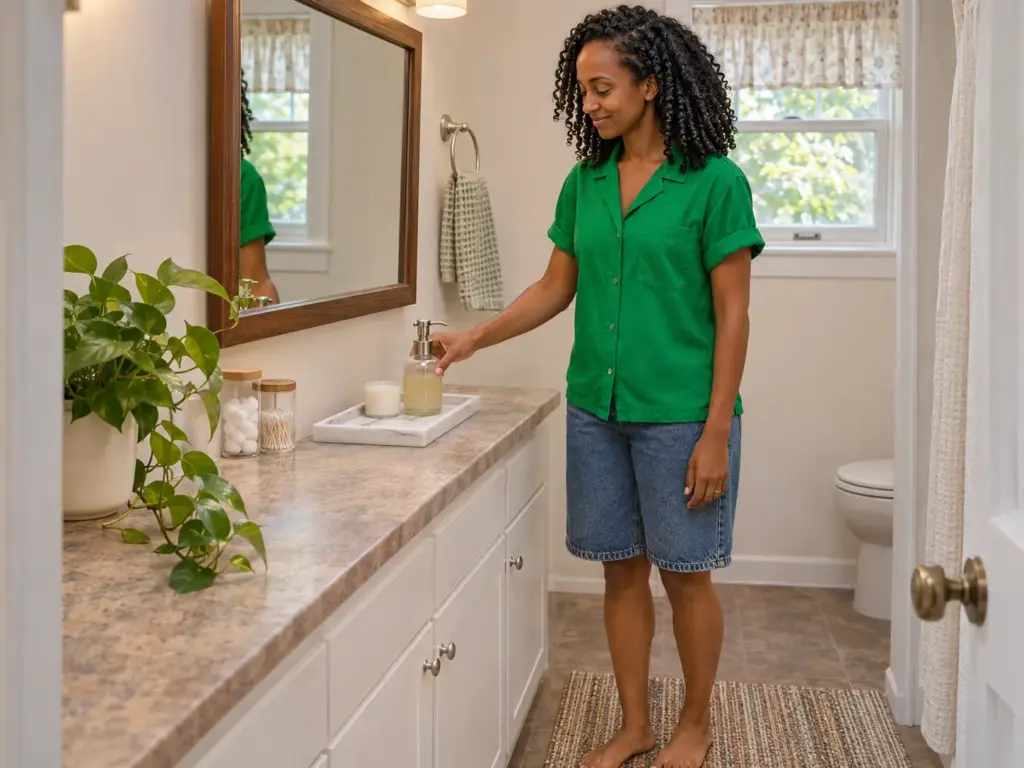
Stand at a 24-inch vanity with wet hands and the saved photos of calm, spa-like counters stop helping, because none of them shows anyone actually using the sink. The counter is the smallest display surface in the house and the only one that gets used while soaking. It gets settled first, and the rest of the room borrows its rules.
What Makes a Bathroom Read as Styled, in Two Rules
A bathroom aesthetic reads as styled when two things agree: one material family, and one hard line between what stays out and what goes behind a door. A cohesive palette, the towels and the candle only decorate those two decisions. The same pairing sits at the center of how an aesthetic system stays together past the first week, and the bathroom is where it gets tested hardest.
The line is drawn with two questions: is it used daily, and does it get wet? Soap, toothbrushes and the hand towel pass both and stay out. The razor stock, the second lotion and the cotton pads are weekly things, so they live in a drawer. Refill stock goes up and back.
The rule works because the counter is smaller than the list of things that want to live on it, and which things earn a visible spot in a whole room is the same split drawn at room scale.
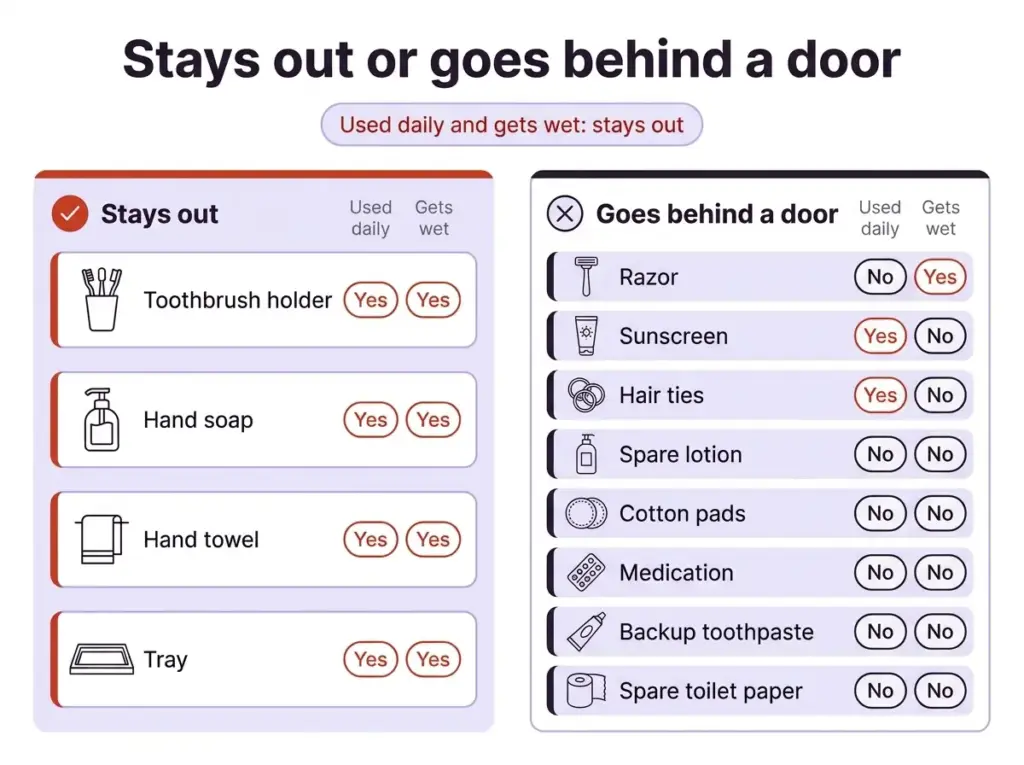
The version that holds is the one that survives a bad day, not the one in the after photo. So the rule has to be simple enough to follow with one hand still on the tap. On a double vanity it runs per sink, with a tray for each person.
One Material Family the Room Can Survive
Pick one family, or two that agree: clear acrylic with chrome, bamboo with matte black, glass with white resin. A bathroom differs from a shelf in the living room because every surface here gets wet, so a family is judged by what water does to it, not by how it photographs.
The EPA’s guidance on moisture and mold keeps indoor humidity below 60 percent, the ceiling that bathroom humidity has to stay under after a shower, and notes that mold grows on organic materials such as wood. Bamboo and a woven basket are organic too, so a bamboo lid or shelf is the piece that needs lifting and drying. Glass, resin and clear plastic are not organic, so they ask for a wipe instead of a drying routine. None of them is a promise that nothing will ever grow.
Bamboo with matte black gets named as the default pairing, and in a bathroom with no window or a fan that barely moves air it is the weakest one on the list, because steam means warping and dark rims. I’d go glass and white resin there, and keep bamboo to a single piece that is easy to lift, like a lid. In a bathroom with a window that opens, a bamboo shelf slatted enough to drain is a reasonable second material.
The Tray, the Daily Holder and the Glass Canister
The tray draws a border around the few things allowed to stay, and that border is what makes a counter look intentional. Use one tray, not three. A flat tray adds order, not height, and height is the thing a small counter cannot spare.
That is why the two-tier vanity organizer, the classic bathroom countertop organizer, deserves a hard look before it goes on the counter. It adds height, not floor, and a 9 by 9 inch rotating tower on a counter about 19 inches deep leaves roughly 10 inches for everything else. At a 30 to 32 inch top it also sits in your eye line. Leave the reach under a wall-mounted mirror or light bar free, and measure that gap before choosing anything taller than a bottle.
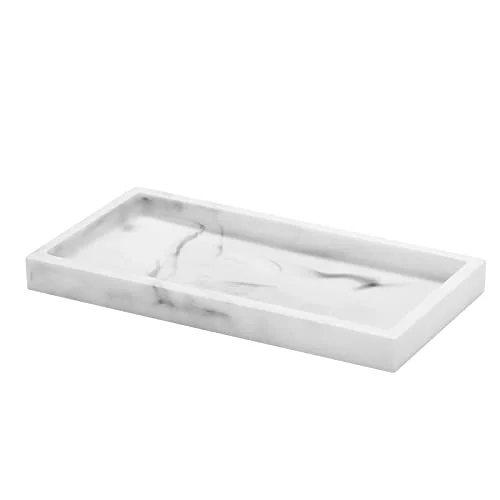
The Luxspire resin vanity tray is a white marble tray in look and resin in fact. It covers the order part with a footprint of 7.9 by 3.9 by 0.7 inches, which on a counter about 19 inches deep leaves most of the surface free for hands. Marble resin made to look like stone weighs well under a pound.
Luxspire lists a care range of 0 to 104 degrees F, so hot tap water straight onto it is outside what the maker supports; a damp cloth or mild soap and water is the care it calls for. The material divides opinion, with some seeing stone and others seeing plastic, so if the counter already has a ceramic dish that holds soap and one candle, the dish is the free tray. The one-tray rule for a small counter explains how far a single tray can stretch before it becomes a parking lot.
For the daily holder, the GFWARE 5-slot toothbrush holder takes five brushes plus a tube, at 6.88 by 3.3 by 3.93 inches. Its removable inner tray drains and lifts out to rinse, and that is the feature that lets a holder survive a wet counter. A plain cup does the same job for nothing, which makes the cup the honest answer if one already matches the tray.
Pads and swabs want a lidded glass canister, the bathroom’s version of an apothecary jar. Glass reads clean, it is not organic, and the lid is the only weak point. The real test is whether it opens with one wet hand.
Decanting Is Worth It for Some Bottles, Not All
Uniform containers, down to a decant soap dispenser, remove the branded noise that makes a counter look busy, and that effect is real. The downside is that an opaque bottle hides how much is left, and the back of the original bottle carries the directions and the ingredient list you may need later. Decant the hand soap and the hand lotion. Keep sunscreen and anything medicated in its own bottle.
The canister for pads and swabs is where the lid test matters. The INIUNIK glass q-tip holder with a bamboo lid is 3 inches across and 3.6 inches tall, with a glass jar and a lid that lifts off one-handed. The lid is bamboo, which makes it the part to lift and dry under the EPA’s rule.
The lid fit is not snug on every unit and the canister runs smaller than the photo suggests, so check that 3-inch diameter against the tray before ordering. A clean jam jar with its own lid is the free version.
Nothing in this section needs a hole in the wall. Every piece stands on the counter, and the free version of each is a dish, a cup and a jar that are already in the house.
Measure the Vanity, the Gap and the Tank Before You Buy a Single Organizer
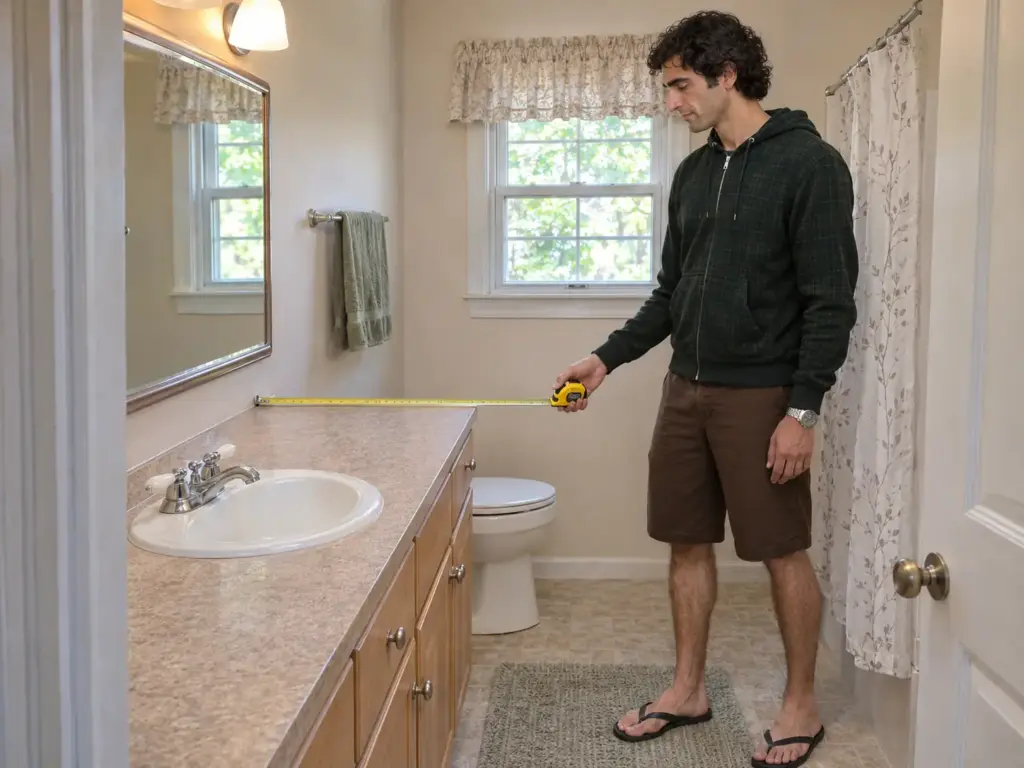
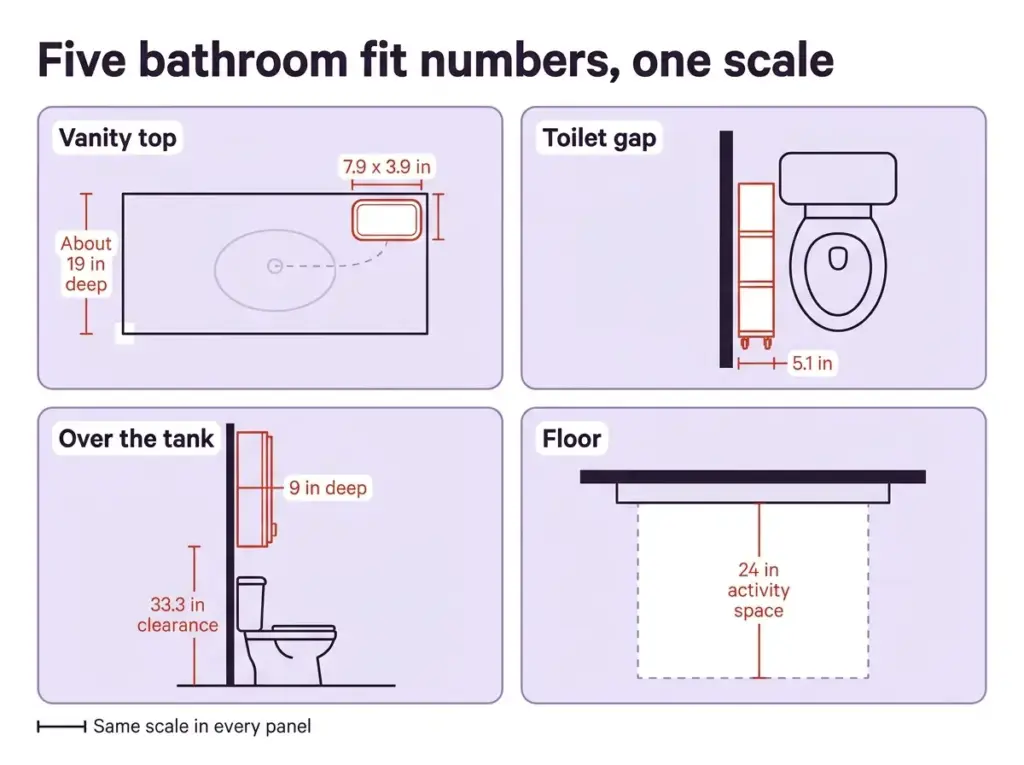
Measure before buying, because a “fits perfectly” on a product page is a claim about the maker’s counter, not yours. Small bathroom organization comes down to five numbers, and the toolkit is a tape measure and a sheet of paper. This is the section to do with the doors and drawers open, because that is how the room is actually used.
The Vanity Is About 19 Inches Deep, Not 22
A common single vanity between 24 and 31.5 inches wide is about 18.9 inches deep, with an install height of 32 to 37 inches, per Dimensions.com. The standard vanity height and depth puts the usual top at 30 to 32 inches, with comfort-height tops at 36. So the vanity depth in front of you is about 19 inches front to back, not the 21 or 22 that most people assume, and at a 30 to 32 inch top you look down onto it. Anything tall sitting on a riser lands in your face.
The cabinet underneath follows the same math, only deeper. The last 6 to 8 inches of depth sits behind the P-trap, and nothing you can reach goes there. That number is the one the under-sink section builds on.
The Gap Beside the Toilet and the Tank Clearance
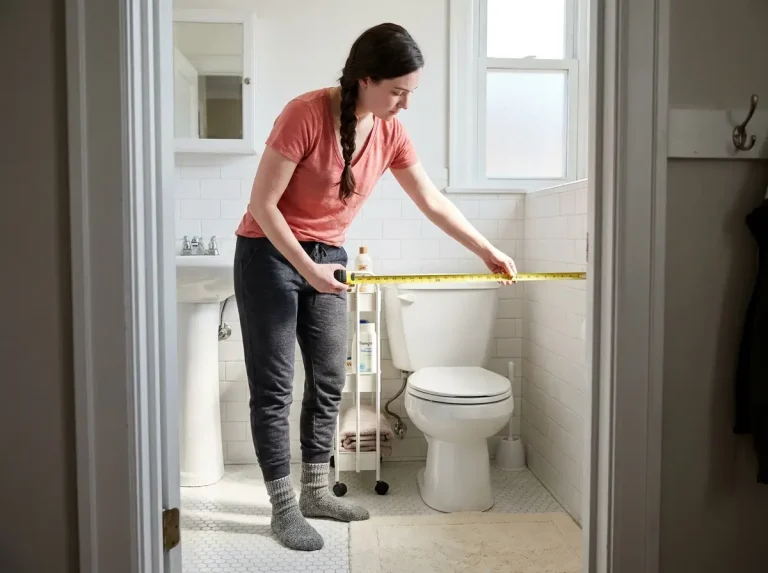
The number that decides whether a slim cart is an option is the narrowest point of the gap, and the narrowest point includes the baseboard and the door swing. Measure it, then subtract a little so the cart can slide in and out. A slim storage cart in the 5-inch class exists for exactly this gap, and the 2 to 6 inch range is a rule of thumb to measure against, not a published standard. The seven zones of a small bathroom show where this gap sits among the others.
Photograph the gap beside the toilet with the tape measure in frame, held at the narrowest point where the baseboard meets the door swing. The number you remember in the store is usually the wide one, and the photo is the one you can check against a product page.
The tank gives the second number. An over-toilet cabinet needs 33.3 inches from the floor to the top of the tank, and 9 inches of depth over the bowl; Spirich prints both for its model. At 66 inches tall it is a tip-over without its anti-tip fitting, which is covered in the over-toilet section below, so measure first and read that section before ordering.
The Floor in Front Is Not Storage
Dimensions.com gives 24 inches of activity space around a fixture, 30 inches of circulation and a 60 inch turning circle. Those are the numbers a cart or a cabinet must not eat. The floor in front of the vanity is where you stand, and a piece of storage that takes it makes the room worse, however neat the shelves look.
The free version of all this is a cardboard template. Cut one to the tray’s footprint, set it on the counter for a day, and see whether hands still fit around it. Do the same for a cart: cut a 5-inch strip of cardboard and walk past it.
Renter and homeowner measure the same things; what changes is what can be fixed to the wall afterward. A double vanity gets a tray per person, and a walk-in shower takes the caddy covered in the shower section. When the numbers are in hand, a wider sort of bathroom organizers by what each one fits is the next place to look.
The Hidden Half of an Aesthetic Bathroom Is the Drawer and the Cabinet Under the Sink
The styled counter is the easy part. The drawer that is one pile and the cabinet that is a cave decide whether the counter stays styled, because that is where the weekly things go when the counter stops accepting them.
Drawer Bins Sized to the Drawer, Not to the Photo
Sort by category, not by bin size. The daily things sit in front, and in a shared vanity one bin per person (the razor, the backup toothbrush, the skin products) is the cheapest way to settle whose is whose. Keep drawer organizer bins to one level, with lids optional, so the back of the drawer is never a mystery.
The Vtopmart 7-piece clear drawer organizer set comes in four footprints, the largest 9 by 6 by 2 inches, which fill a 24 inch drawer without dead gaps. Two inches of height clears a shallow vanity drawer. Seven pieces is more than a small drawer needs, so lay them out on the counter first and keep only the ones that fill the drawer. Cut-down delivery boxes are the free version.
Under the Sink Starts at the Trap
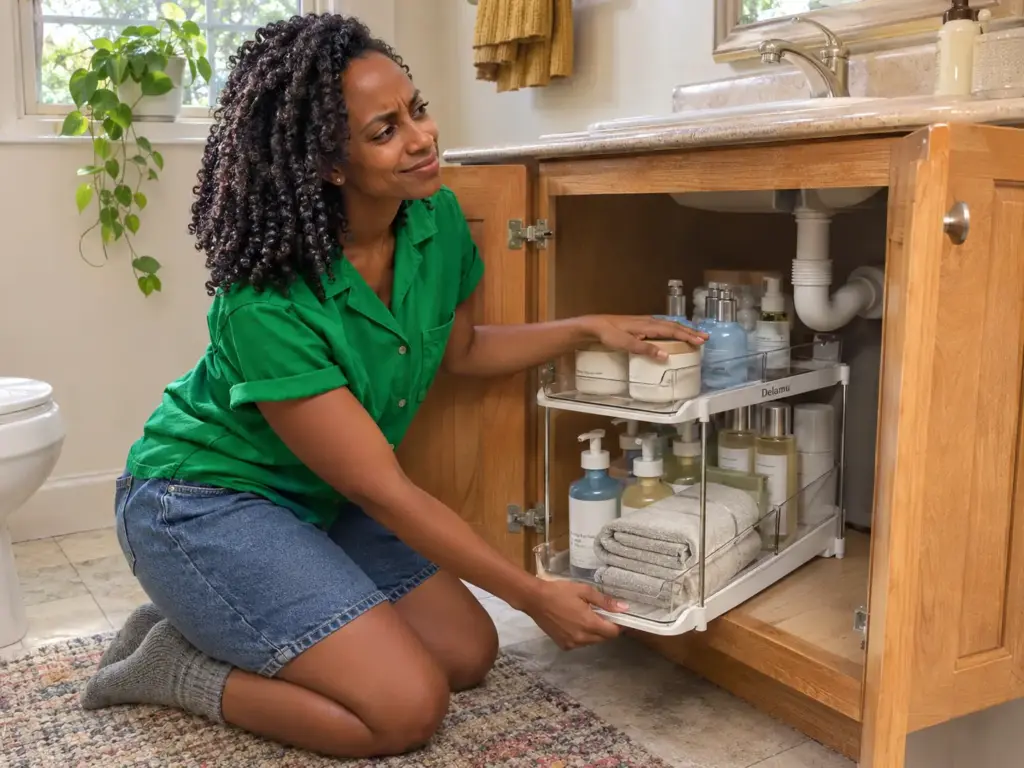
Deep cabinets lose their back row to the under sink pipes. The P-trap is the obstacle, and an under sink organizer with movable dividers is the answer because the dividers move to the pipe instead of the pipe moving. How the pipes shape the whole cabinet is worth reading before choosing anything, since the same cabinet can hold very different layouts depending on where the drain falls.
The Delamu 2-tier pull-out under sink organizer is 13.19 inches wide and 8.27 inches deep, with tiers about 9 and 10.6 inches tall and eight movable dividers. In a 24 inch cabinet that leaves roughly 10 inches on the trap side. The plastic is mixed: sturdy to some, flimsy to others, and it runs smaller than the photo suggests, so measure the door opening and the trap before choosing. A plastic storage tub cut to clear the trap is the free version, and pull-out units compared against a steamy cabinet shows how the plastic holds up in the room.
Set the unit in the empty cabinet and close the door before you load a single bottle. If the door will not shut or a divider touches the trap, send it back that day.
What goes in the cabinet is refill stock and weekly things; the daily things live up top. The walls and the inside of the cabinet door are the two surfaces that take the overflow when the shelf runs out, and a light hook on the door covers a lot. The order to empty, sort and put the cabinet back keeps the job from turning into a weekend. Check the supply lines once a month, because a drip in the cabinet is the first thing a pull-out unit hides, and water damage starts there.
Nothing here fixes to anything. Every piece stands in the drawer or on the cabinet floor, and a homeowner with a deep cabinet and a large vanity can double the tiers.
Why a Sealed Acrylic Stack Clouds and Grows Damp Behind
Clear acrylic storage drawers are a popular look, and in a steamy room a sealed stack holds damp and fogs. Leave one box open or dry the inside after a shower, and keep the sealed, stackable storage drawers for the linen closet. The EPA’s rule is that wet areas get dried within 48 hours, and an acrylic box with a lid on is a small closed room that never dries unless someone opens it. Why clear acrylic fogs in a wet room covers the clouding in more detail.
That is editorial judgment, not a maker claim, and it changes the shopping list: open-top bins in the drawer, a lid only where the contents are dry.
Shower and Wall Storage That Does Not Need a Niche
A cut shower niche or a mounted floating wall shelf is a renovation, and a lease can say no. This section is about the substitute for each, and which substitutes a deposit can survive.
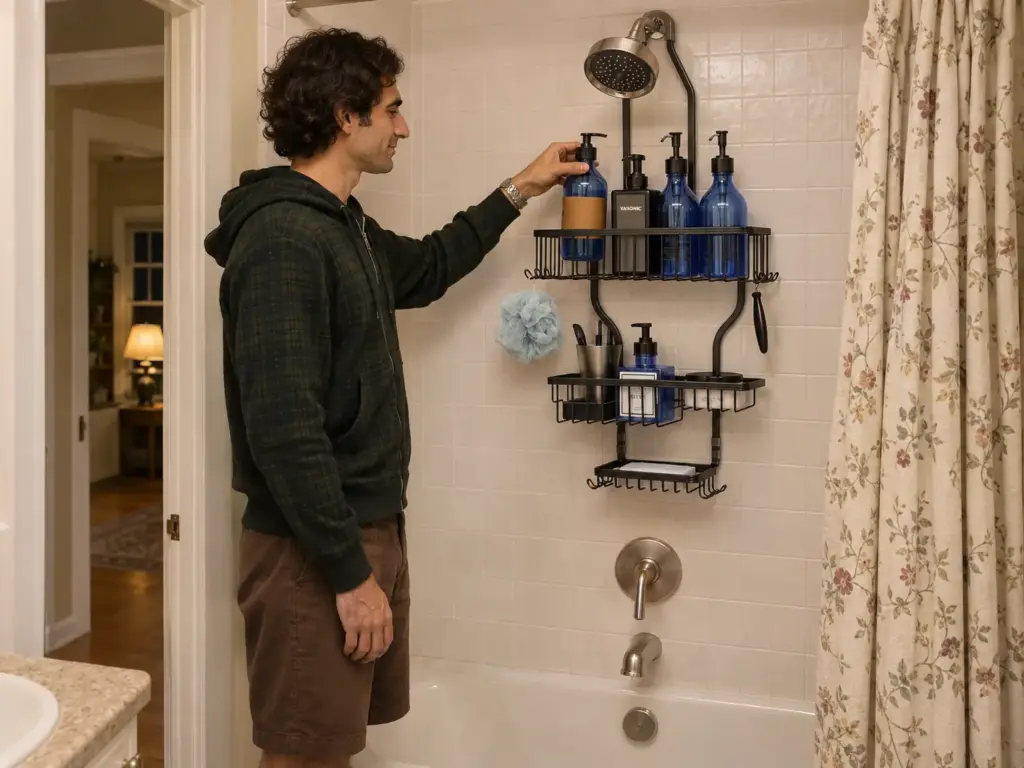
A Caddy That Hangs, So the Load Is Not on the Wall
A hanging shower caddy puts its weight on the arm, not the wall. The YASONIC 3-tier hanging shower caddy is 14.8 inches wide and 5.12 inches deep, with three baskets and ten hooks, and the maker states an aluminum alloy frame. That makes the frame rust-resistant next to steel, which is a material fact and not a lifetime promise.
Stability is the complaint: it can swing or slide on a wide arm, so test it with the bottles you own and keep the heavy bottle on the bottom. A wire basket on a tension rod needs no hole and is the free version.
Hang the caddy empty and give it one firm tug, then add bottles one at a time, heaviest in the bottom basket. If it swings when you tug it empty, it will swing with a wet hand on it.
Which mount suits which shower sorts the mount types by what the arm can carry. In a shared shower, two adults’ products in one caddy fail by the third week. One basket per person, labelled by position, and the one bottle that is both people’s on the third hook, works better; who gets which basket when two people share one shower goes through the zoning.
A shower caddy full of hotel bottles is the failure. Keep the basket to the bottles in use and the rest in the cabinet below the sink.
What an Adhesive Strip Is and Is Not For
Adhesive strips are a light-item tool. Read the rating printed on the strip’s own pack for glazed tile and grout, and treat it as a limit, not a target. That number varies by product, and a wet shower wall is the hardest surface the pack was written for. An adhesive shelf of acrylic held up by strips is not the easy answer it looks like.
The sound way to use them is for one-off light items: a razor hook, a washcloth, nothing that holds liquid. Anything heavier belongs on the arm, on the floor or in a cabinet.
The Free Versions of the Renovation Ideas
The cut niche becomes the caddy on the arm. The built-in medicine cabinet becomes the tray of the first section and the drawer of the third. Accent furniture becomes the over-toilet piece in the next section, or a lidded basket if the lease forbids anchoring.
What a deposit can survive is everything that stands or hangs. Anything that needs a screw does not survive it. The no-hole ladder for a rented bathroom lays out the removable version of each in order.
A homeowner can do more. A floating wall shelf gives towel storage and a place for the candle that styling wants, and fixing it to a stud gives it real capacity; what a floating shelf holds before it needs a stud gives the limits. The renter’s version is a leaning shelf on the floor, which holds the same things and asks nothing of the wall. In a large bathroom the shower answer is a second caddy on a second arm, not a bigger first one.
Hiding the Backstock Without Eating the Floor
What a guest sees when the door opens mid-week is the pile of toilet paper next to the toilet, not the styled counter. The backstock needs a home that does not take the floor, and the answer depends on the width of the gap and the wall above the tank.
The Narrow Gap Beside the Toilet
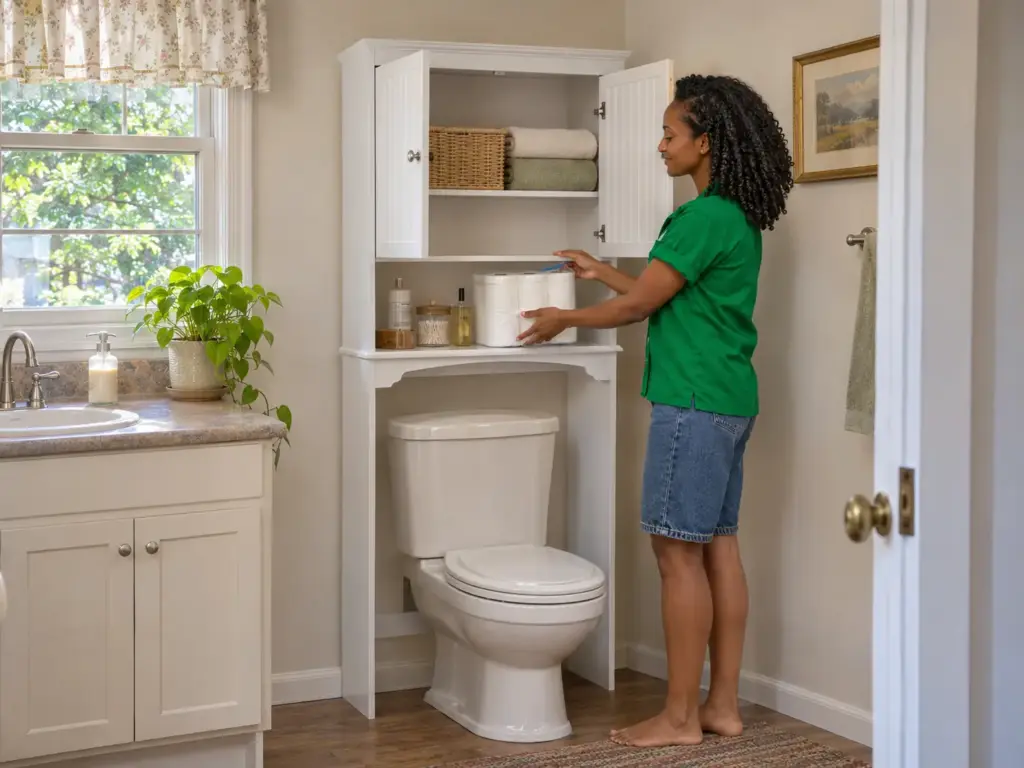
Measure the gap at its narrowest point, with the baseboard and the door swing, then choose. The SPACELEAD slim 3-tier cart is 5.1 inches wide with a mesh base that drains, which is the width that fits the gap most people never measure.
The build is light, so it can feel unstable loaded with heavy bottles. Keep the paper on the top and the heavy bottles at the bottom or in the cabinet. A lidded bin on the floor or a tension-rod shelf is the free version. More places a small bathroom can keep things covers the rest of the room.
A second cart beside a double vanity runs on the same logic, as the budget piece of the three in this section.
The Cabinet Over the Toilet, and the Strap It Needs
The over-toilet cabinet is the one piece that hides the backstock behind doors and still reads as furniture. The cost no product page shows is the strap. The cabinet is 66 inches tall, and without its anti-tip fitting fixed to the wall it is a tip-over.
According to the CPSC’s Anchor It! campaign, “Anchoring all furniture with drawers, doors, and shelves to the wall prevents tip-over injuries and deaths.”
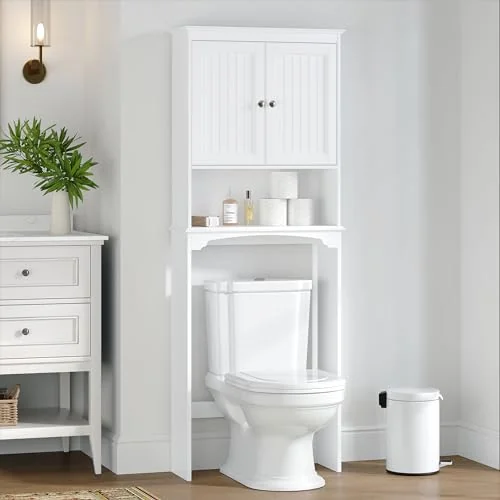
The cabinet is the right answer where there is a blank wall over the toilet and a stud to take the strap, and a large bathroom with that wall can use it fully. Keep it to dry paper goods and sealed bottles, and never tuck anything electrical or any cord behind it.
The No-Hole Version for a Rental
A cabinet that must be fixed to a wall is not the renter’s piece, and that is simply how it is. The no-hole version is a lidded basket on the tank for the spare paper, with the slim cart in the gap. In a small apartment bathroom nothing is lost except the look of furniture.
Toilet paper and cleaning supplies split cleanly. Toilet paper storage goes up, in the cabinet or a basket on the tank. The cleaning supplies go low and behind a door, in the cabinet below the sink, with nothing left on the floor inside the 24 inches of activity space.
The other steam-proof zone, the medicine cabinet follows the same weekly-things split. For a shared bathroom or a guest bathroom, hiding the floor and the toilet gap is most of the work. After that, the guest towel and one tray are enough to read as styled.
Why the Look Collapses by Week Three, and the Reset That Holds
The Sunday reset undoes itself by Friday, and it does it in the same way every time: the two-tier organizer becomes a shelf for everything, the tray becomes a parking lot, the caddy fills with hotel bottles, and the lid goes dark. What fails first is predictable enough to design around.

The Four Things That Fail First
The tray becomes a parking lot, and the limit is the tray’s own footprint: once the third item crowds in, nothing has a spot. The bamboo goes dark at the rim because it was left wet. The caddy fills with trial sizes, which nobody uses and nobody throws away. The drawer bins lose their category the day a second person starts using the drawer.
None of these is a character flaw. They are what a room does when every surface is shared, wet and small, and a system built for the photo has no slack for any of it. The same material rule on the smallest surface in the house fails in the same predictable order, only slower.
In a shared bathroom, two adults in one 24 inch vanity need one tray position each and one drawer bin each. The partner who leaves the counter wet is a design input, not a flaw: the tray that drains and the lid that lifts with one hand are made for exactly that person.
The Ten-Minute Weekly Reset
The reset routine is a short list, done once a week. Lift and dry the bamboo lids and wipe the tray. Return the tray to its three things.
Empty the caddy of anything not in use. Reset the one drawer bin that drifted. Check under the sink for a drip.
The EPA’s drying rule is why the first item comes first. In its words, “In general, all wet areas should be completely dried within 48 hours to prevent mold from growing.” The EPA’s rule for drying a wet room is the clock a weekly lift of the lid keeps. A system that needs more than ten minutes will not run on a bad week, and why a system that looks right on day one fails by month three makes the same point for the whole house.
Which Zone to Fix First, and Where Spending Pays
Fix the counter first, since it is the one surface a guest reads and so has the highest visual return. Then the drawer, then under the sink, then the shower, then the toilet gap.
Do not fix every zone in one weekend. Fix the counter, live with it for a week, then do the next. How one container family per shelf works in a kitchen uses the same one-zone-at-a-time order.
A cheap version handles more than the boutique version admits. A tray, a cup and a jar do the whole counter. The drawer is cardboard, and the cabinet is a tub.
Where the better version actually differs is narrower: the removable tray inside the holder, the dividers that move around the trap, and glass that does not fog. Spend there, and nowhere else. That is a recommendation, and it holds only as long as the zones stay small.
The version that still works after weeks of ordinary use is the one with fewer pieces than the photo. If a zone fails twice, take a piece away instead of adding one. The renter and the homeowner follow the same order, and the homeowner’s extra step is the wall piece and the cabinet, fixed once and left alone.
Fix the Counter First, and Take a Piece Away When a Zone Slips
The room that stays styled has one material family it can survive, a counter limited to what is used daily and wet, a drawer and a cabinet sorted around the trap, a shower that hangs instead of mounts, and a backstock that does not take the floor. Measure the vanity, the gap and the tank before ordering anything, and dry the bamboo before it goes dark.
After two weeks of ordinary mornings, look at the tray and the lids and see which pieces are still doing their job. The one that has become a parking lot is where the next change belongs.
Tonight, clear the counter and put back only the soap, the toothbrushes and the hand towel. Notice how much of the look came from the space and how little from anything new.
Frequently Asked Questions
01What makes a bathroom look aesthetic?
A bathroom looks aesthetic when one material family and one hard line between what stays out and what goes behind a door agree with each other. Keep out only what is used daily and gets wet, such as soap, toothbrushes and a hand towel. Weekly things go in a drawer.
02What goes on the bathroom counter?
The few things used every day and wet belong on the counter: soap, toothbrushes and a hand towel, gathered on one tray. A flat tray adds order, while a two-tier bathroom countertop organizer adds height, so the footprint against a counter about 19 inches deep decides which one fits.
03Are bamboo organizers a bad idea in a humid bathroom?
Bamboo is not a bad idea, but it is the material that needs lifting and drying, because mold grows on organic material when it stays wet. The EPA says wet areas should be dried within 48 hours, so lift the lid and wipe the tray once a week.
04Where do toilet paper and cleaning supplies go when the vanity is tiny?
Up and back: paper goes in a cabinet or a lidded basket over the tank, cleaning supplies sit low behind a door, and nothing stays on the floor. A cart 5.1 inches wide fits a narrow gap, and an over-toilet cabinet needs 33.3 inches of clearance to the tank.
05Should you decant everyday products into matching dispensers?
Decant soap and lotion, but keep sunscreen and anything with directions or an ingredient list in its own bottle. The trade-off is that an opaque dispenser hides how much is left, so pick one with a clear window if you want to see the level.
Disclaimer: ClutterlessNest is a participant in the Amazon Services LLC Associates Program. As an Amazon Associate we earn from qualifying purchases. This article may contain affiliate links — if you buy through them, we may earn a small commission at no extra cost to you. We only recommend products we have tested or genuinely believe in.