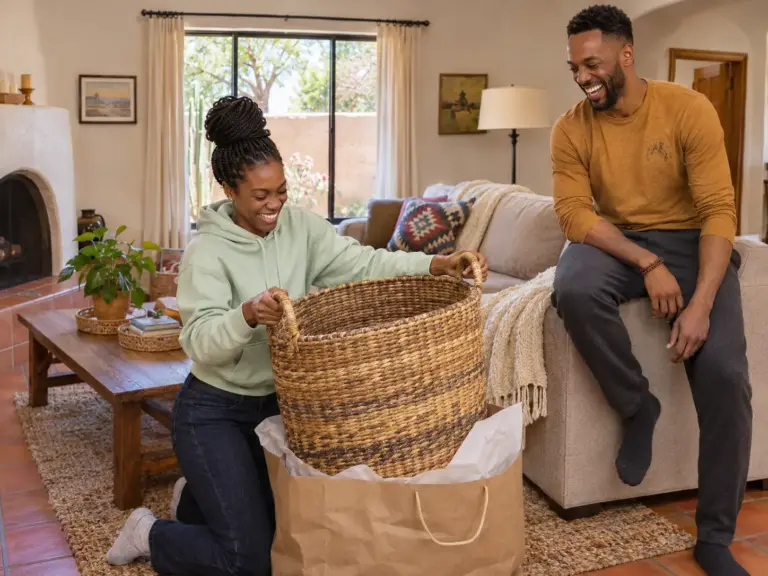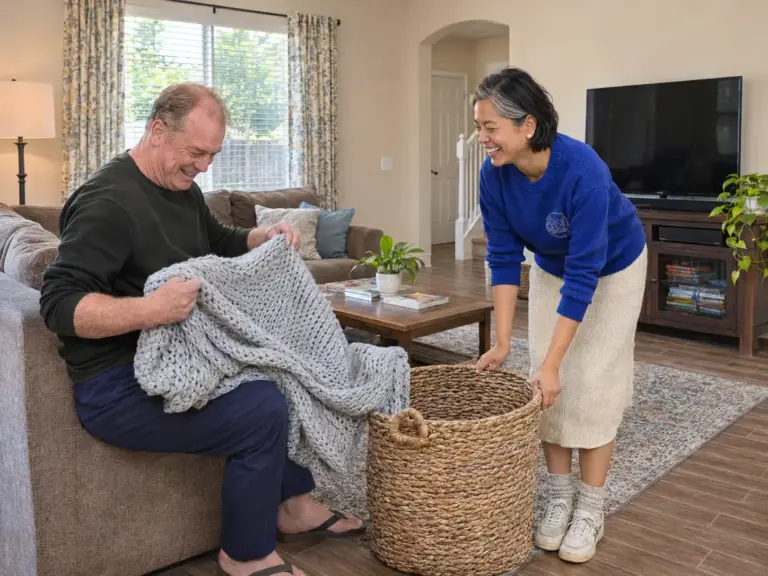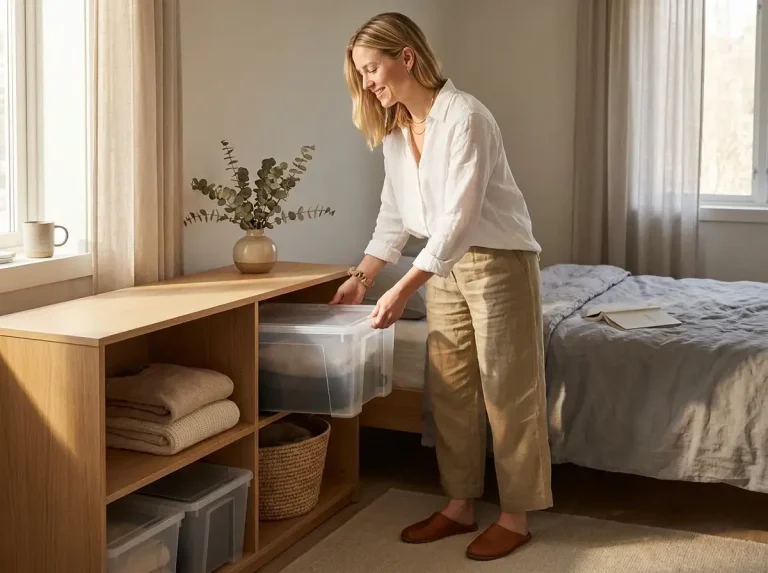
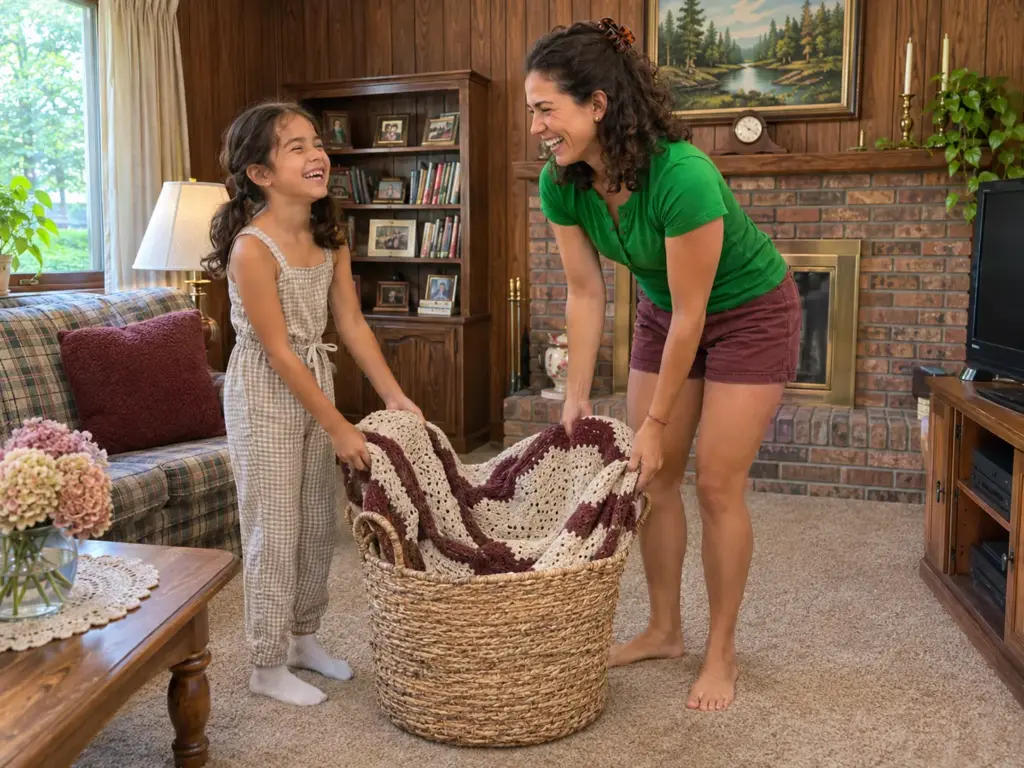
You bought the right woven baskets, and the room still feels empty and chaotic at the same time. Or it reads like a hotel lobby, because everything arrived new, matching and machine-made. Boho organization style (bohemian organization, if you search it that way) is storage that reads as decor, and it holds up only when the materials, the grouping and the density are chosen on purpose, with the shelf’s measurements and the room’s moisture checked first. The rest of this guide covers what separates boho from a pile, which woven materials last, and how to keep every basket findable.
Quick Answer
Boho organization style is storage that reads as decor: woven natural materials, objects grouped on purpose, and a split between what you show and what you hide. Give each open shelf one closed piece and each surface one cluster, and match every basket to the room’s moisture and the shelf’s measurements.
What Makes Boho Organization Style Boho and Not Just Messy
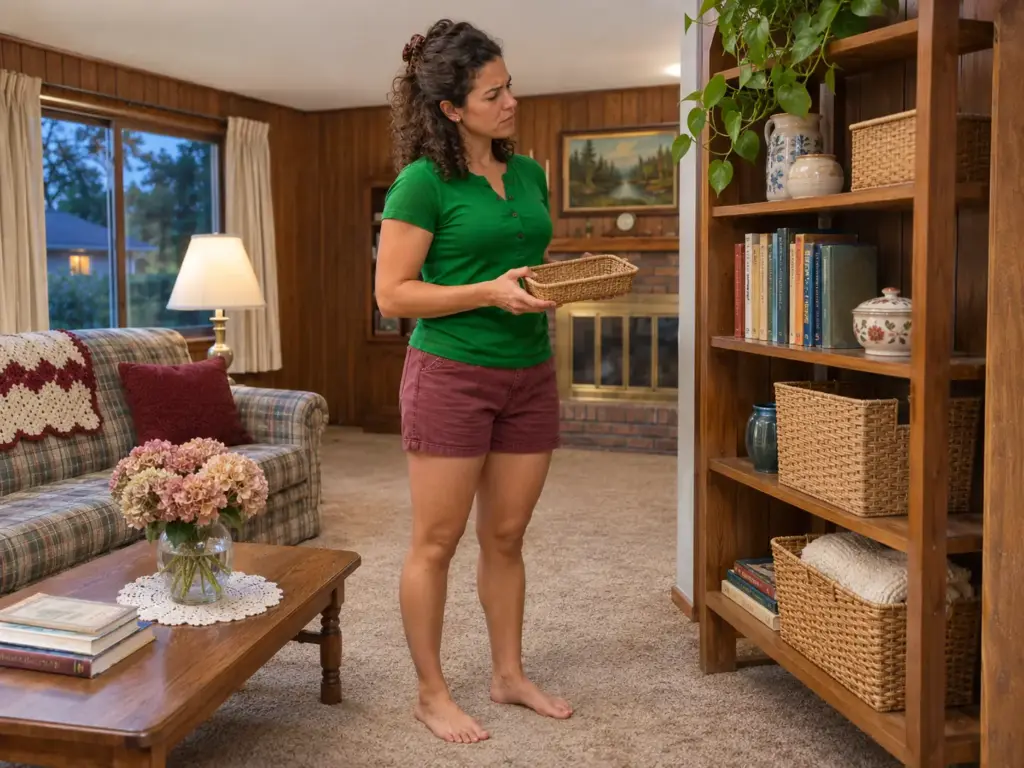
Storage that reads as decor
Boho goes wrong in two opposite directions, and one room can manage both at once. The first is too much order: every basket new, every texture machine-made, everything at the same height in the same row. That is corporate boho, and it photographs well and feels like a showroom. The second is too many layers added in a single weekend, until the shelf feels small and chaotic and nobody can say which object to remove.
What makes storage boho in practice is a short list: natural woven materials, warm earth tones and finishes, objects grouped instead of scattered, and a deliberate split between what is displayed and what is hidden. That list is editorial judgment, not a standard, so use it as a checklist rather than a definition. The boho aesthetic leans on layered textures, and woven storage baskets are where most of them come from. A seagrass basket holding the remote controls is decor and storage in one object; a plastic bin in the same spot is only storage.
It also means boho cannot lean on the cut-everything-first approach that minimalist rooms run on. Cutting still helps, but it is half the job here. Once the surplus is gone, you still have to decide what is allowed to stay in view.
Why a room of brand-new baskets still looks like a hotel
Newness is the tell. Baskets bought new in one weave, one color and one size carry the symmetry of a catalogue, and a catalogue has no history in it. Hotel vibes, lobby vibes, a room that is tidy and strangely anonymous: they all come down to nothing in the room being handmade, inherited or found.
One vintage or thrifted piece does more for the room than ten more baskets. The budget route is the thrift store or the pay-by-weight outlet, where a handmade basket with a worn handle costs less than a new one and does a job no new one can: it looks like it belongs to somebody.
Two plain questions test any shelf. Can you find the thing in under a minute? Does the shelf still look deliberate afterward? A room that passes the first and fails the second is a storage room, and the reverse is a set.
The rule underneath: show some, hide the rest
Everything in boho storage rests on one split. Plants, books, ceramics and a few good baskets carry the style, so they stay in view. Cables, chargers, paper, toys and the daily overflow go behind a lid or a door.
The closed-door calm of Japandi homes hides nearly everything and lets the room breathe through bare surfaces. Boho bends that rule on purpose: more stays open, and the discipline moves from “hide it all” to “hide the ugly parts and arrange the rest”. The shelf that results looks lived-in, because the visible objects are chosen, and it works, because the unchosen ones are shut away.
Seagrass, Water Hyacinth and Cotton Rope: What Each Material Does in a Real Room
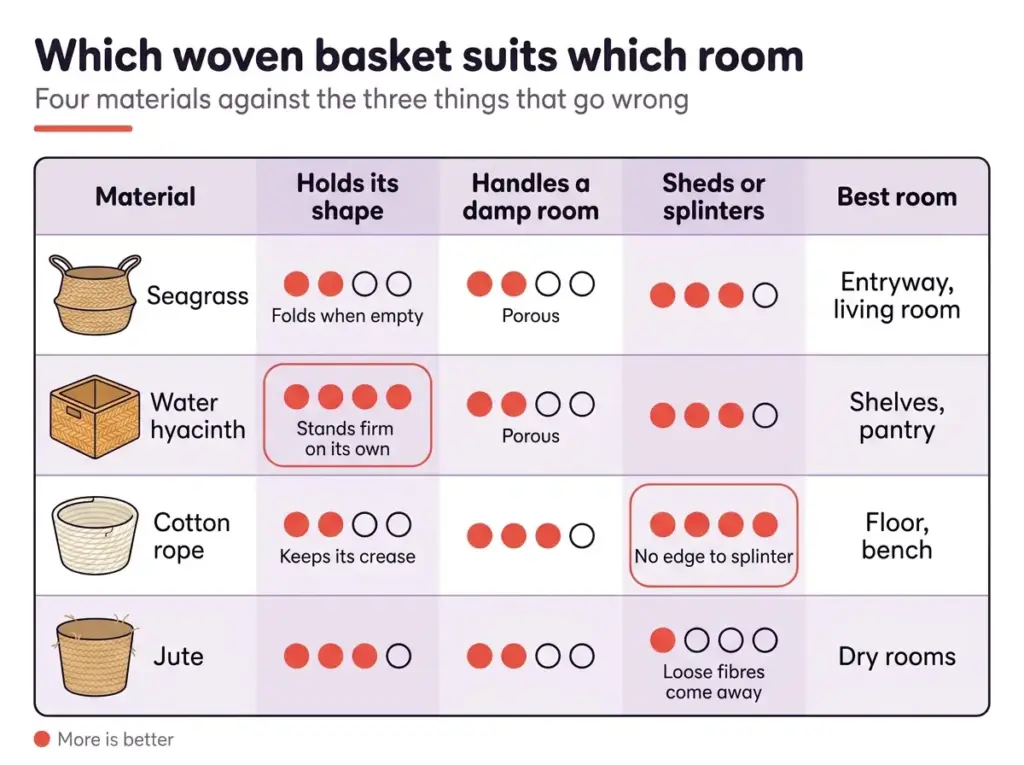
Picture the basket that folded flat in the box and never recovered, or the cotton rope one still wearing its shipping crease a month later. Woven storage gets bought by look and judged by behavior, and the behavior differs a lot between fibres.
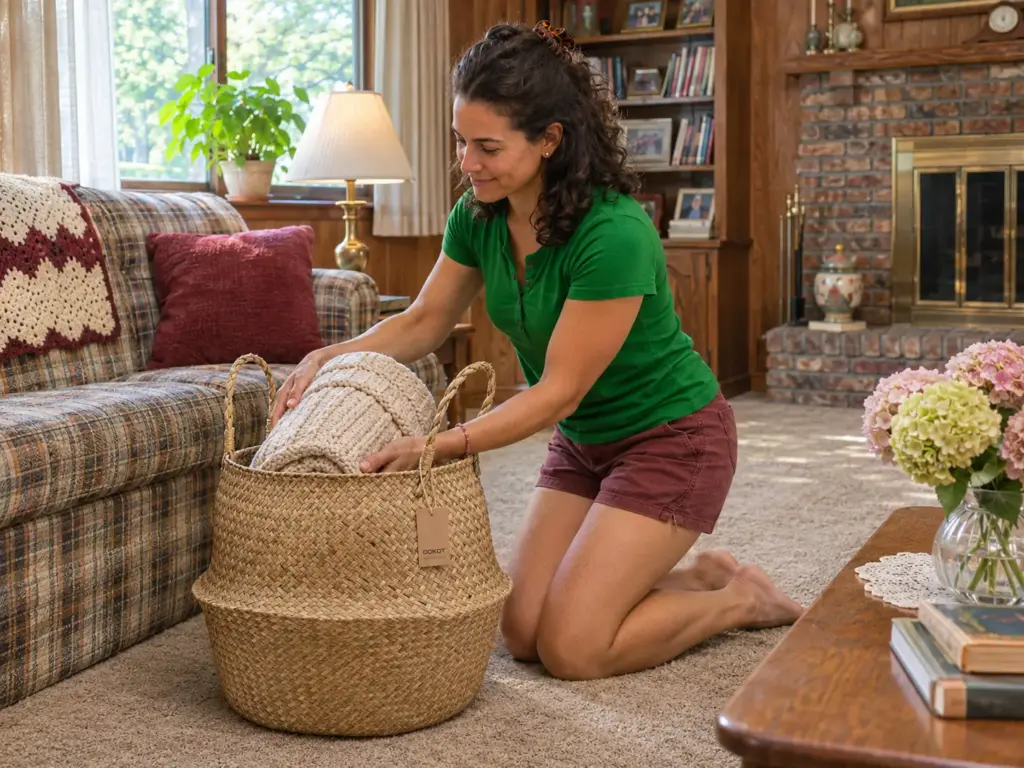
Seagrass: the tall, loose-shaped basket
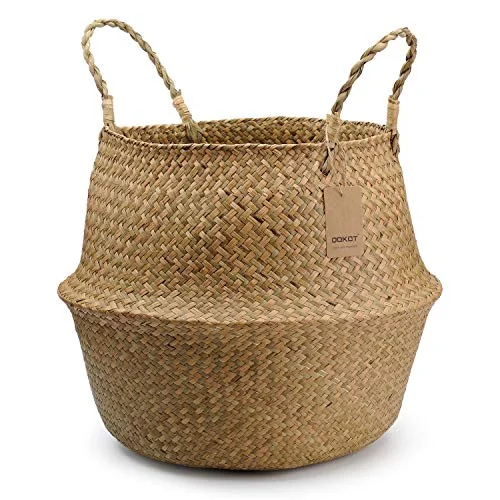
Seagrass, rattan and wicker are all woven baskets, but the wicker basket or rattan basket is firmer and shapes a shelf better, while seagrass makes the tall, loose, slightly slouchy basket that sits in the corner of most boho rooms. The fibre is soft enough to fold and loose enough to lose its shape when empty, so it behaves more like a soft bag than a bin. It also runs smaller than the photographs suggest.
The sweetgrass basket and the seagrass basket are close cousins, and the one everyone names first is the belly basket, and for a plant, a throw or a pile of produce it is a good call. For a shelf it is the wrong pick. Its job is vertical: it needs tall clearance, not shelf depth. When the job is a run of shelves, the firmer water hyacinth basket set in the next subsection is the one that holds a line.
Water hyacinth: the firm one for shelves and pantry
Water hyacinth is the firmer cousin: a tighter weave, more structure, and sizes that nest. That structure makes it the better material for shelf and pantry duty, where a basket has to keep a straight edge between the jars and the wall.
The Honey-Can-Do woven water hyacinth nesting set comes as three graduated sizes starting around 9 × 9 × 6 inches, which suits a run of shelves and not a single one, because the three only look right when they sit at different heights together. Some sets arrive smelling strongly of natural fibre. Air them for a few days before they go near food or linens.
Pantry baskets face the same fibre-versus-moisture decision in a kitchen, and the breakdown of aesthetic pantry organization covers what survives there.
Cotton rope and jute: soft, with no edge to splinter
Cotton rope is the soft one. It has no hard edge to splinter, which makes it the sensible material for blankets and a child’s soft toys. It also ships folded, so it arrives creased and keeps the crease until steamed back, and a pass with a garment steamer is part of owning one. The large blanket versions, around 22 × 17 inches in the 72-liter size, are floor or bench baskets. They will not sit on a shelf at all.
Jute is rougher and stiffer than cotton rope, with a coarse look that suits rugs and big floor baskets; a jute basket is the choice for a hallway floor, not a bookshelf. The cheap versions shed loose fibre at the rim, which is exactly what the buying test below catches.
Put the four materials against each other and the pattern is simple. Seagrass is tall and loose, hyacinth is firm, cotton rope is gentle on whatever it holds, and jute is coarse and sturdy. All four are porous, which matters in a damp room, and the cheap set does the entryway job the boutique set does. What the higher price buys is shape retention and less shedding.
How to tell a basket that will last before you buy it
Pick the basket up if you can, or study the weave in the listing photos.
The weave should be tight, the rim finished and wrapped, and the seams sewn rather than glued. Run a hand across the surface: if loose fibres come away on your palm, skip it, because they will end up on whatever the basket holds. And stand it up empty. A basket that will not stay upright empty will not keep its shape once it is full of throws.
A basket liner matters more than the weave for anything small or made of paper, since it keeps fibres off the contents altogether. Match the material to the room with which baskets suit which humidity, and weigh the thrifted option first: a flea market or estate sale basket often beats a new one for character, costs less, and has already shown how its fibre ages.
Keep the box or bag a basket arrived in for the first week. One that sheds, smells or folds flat in its first days is easiest to send back while the weave is still clean.
Why Boho Storage Fails: Dust, Damp, Sag and Shed
Picture a faint smell in the bathroom basket, or grey dust sitting in the valleys of a weave that looked clean last month. Those are the two ways woven storage announces that it has stopped working, and neither one is the basket’s fault alone.
Open weave collects dust where you cannot see it
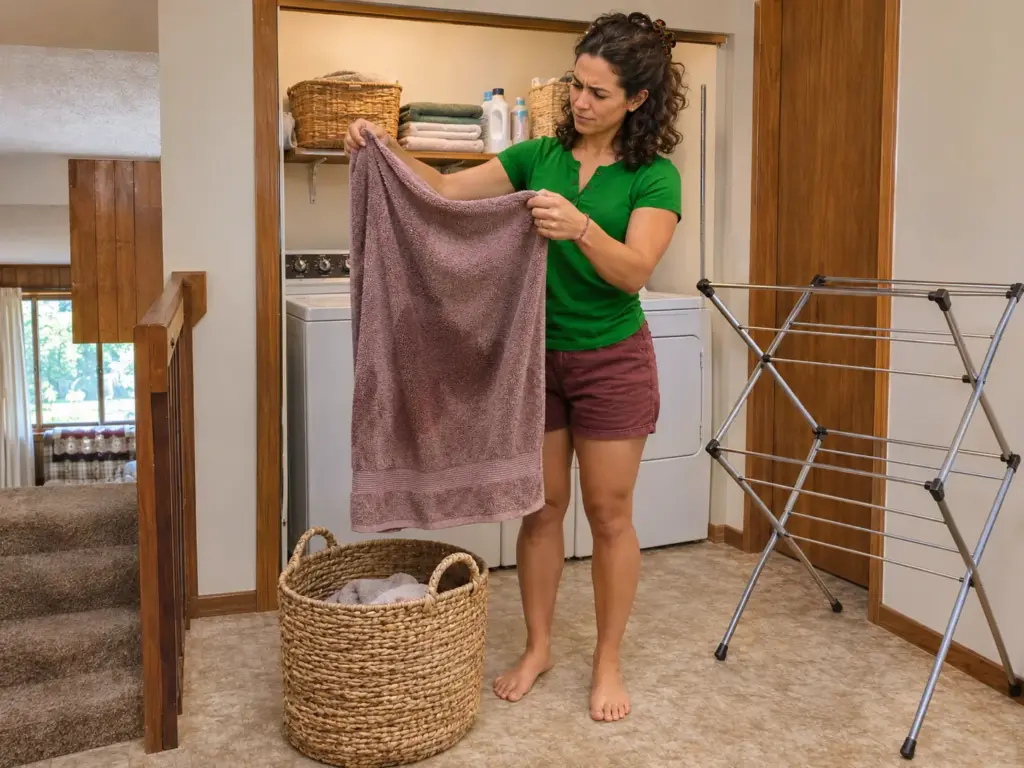
An open weave is a surface made of valleys, and every valley holds dust. It does not show from standing height. It shows when light hits the basket from the side, or when you lift it and a grey outline stays behind on the shelf. Dried grasses and pampas are the worst of it, because they are all fibre and no wipeable surface, and dust collecting on dried stems is the first reason to pull them from a bedroom shelf.
The mechanism is simple: dust settles, the weave holds it, and wiping pushes it deeper. A soft brush, or a vacuum with a brush attachment, worked along the direction of the weave lifts it out. Weekly, it takes a minute per basket. Left for a season, it becomes a job.
A steamy room and a damp towel do the damage, not the basket
Mold needs moisture, and woven baskets are porous. According to the EPA’s guide to mold, moisture and your home, “If possible, keep indoor humidity below 60 percent (ideally between 30 and 50 percent) relative humidity.” A closed bathroom after a hot shower is where that line gets crossed.
The same guide explains that absorbent and porous materials may have to be thrown away once they turn moldy, because mold fills the crevices, and that wet or damp materials dried within 24 to 48 hours usually will not grow mold. Read together, those two lines point at the real cause: a damp towel left in the basket overnight. A moldy weave is a write-off, not something you wipe down.
So run the fan until the mirror clears, and give the towel a hook of its own instead of the basket. What holds up in a steamy bathroom goes through the rest of the wet-room decision. In a damp room, a ventilated, lidded basket plus a running fan is the workable compromise, and that is our judgment, not a standard.
Soft baskets sag and cheap ones shed
Cotton rope sags. Load a soft basket and stack something on top of it, and it slowly settles into an oval that no longer fits the shelf it was bought for. Once a sagging basket has gone oval, it stays oval.
Cheap baskets have the opposite problem: the weave is stiff enough to splinter, and the splinters shed fibre onto whatever is inside, whether that is a sweater, a stack of paper or a phone charger. A liner is the cheap fix for shedding, and turning a soft basket a quarter turn each week, instead of stacking on it, slows the sag.
A five-minute upkeep that keeps woven storage working
The upkeep that lets you maintain woven storage is short enough to fit inside the weekly reset:
- Run a soft brush or a vacuum brush attachment along the weave of every open basket.
- Line any basket that holds paper or small things, so fibres never touch them.
- Turn soft baskets instead of stacking on them.
- In a damp room, run the fan until the mirror clears and keep the damp towel out of the basket.
- Sniff the bathroom basket. A musty smell is the cue to empty it and check how long things have been sitting damp.
Grouping Mixed Objects So the Mix Looks Deliberate
Picture a tabletop of nine unrelated objects, each one loved, and the whole reading as a pile. The objects are not the problem. The missing structure around them is.
Odd numbers, one tray, one shared thread
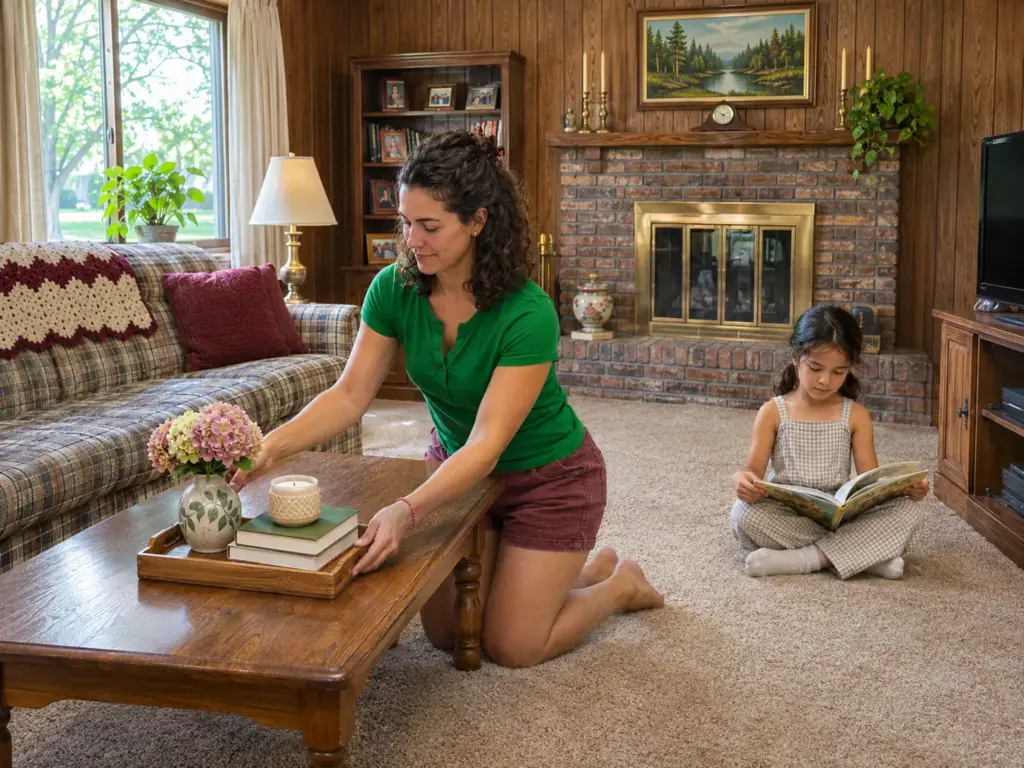
The odd-number rule of thumb says to group in threes, fives or sevens. It is a decorating habit, not a standard, and it works because an odd count looks arranged where a pair looks matched. A group needs two other things to read as chosen: a border and a thread.
This grouping of mixed objects needs a border, and the border can be a tray, a shelf section or the edge of a rug, anything that tells the eye where the cluster stops. The thread is one thing the objects share, such as a color, a material or a theme. Three objects in a tray with a shared warmth look like a decision. Nine on a bare surface look like an inventory.
A neutral base with one patterned accent
Build the color story from a neutral base of warm neutrals, warm woods and naturals, then add one patterned or colored accent per cluster. The neutral base a colour story sits on is the same idea in a calmer room, and boho borrows it before adding pattern. Wood tones agree when they share warmth, not shade, so a honey oak and a walnut get along while a honey oak and a gray-washed pine do not.
If you wonder whether every container has to match, the matching container organization ideas show the opposite end of the spectrum, and the answer for boho is no: shared warmth is enough.
Negative space is part of the style, and it is the visual breathing room that keeps chosen clutter from turning into plain clutter. The empty third of a shelf is what makes the full two-thirds read as chosen.
Keep the piece with a history, drop the rest
The handmade piece with a story, from a thrift store or a pay-by-weight outlet, does work that a matching set from a store cannot. When a cluster feels crowded, remove the newest, most generic object first and keep the one that looks like it has been somewhere. That is usually a faster edit than deciding what you like least.
The Clutter Line: One Closed Piece for Every Open Shelf
Picture the shelf where every object is nice and the whole reads as a pile, and you cannot say which one to take away. That is the clutter line, and it is easy to cross because every object on a boho shelf is a little bit decor.
How much can stay in view
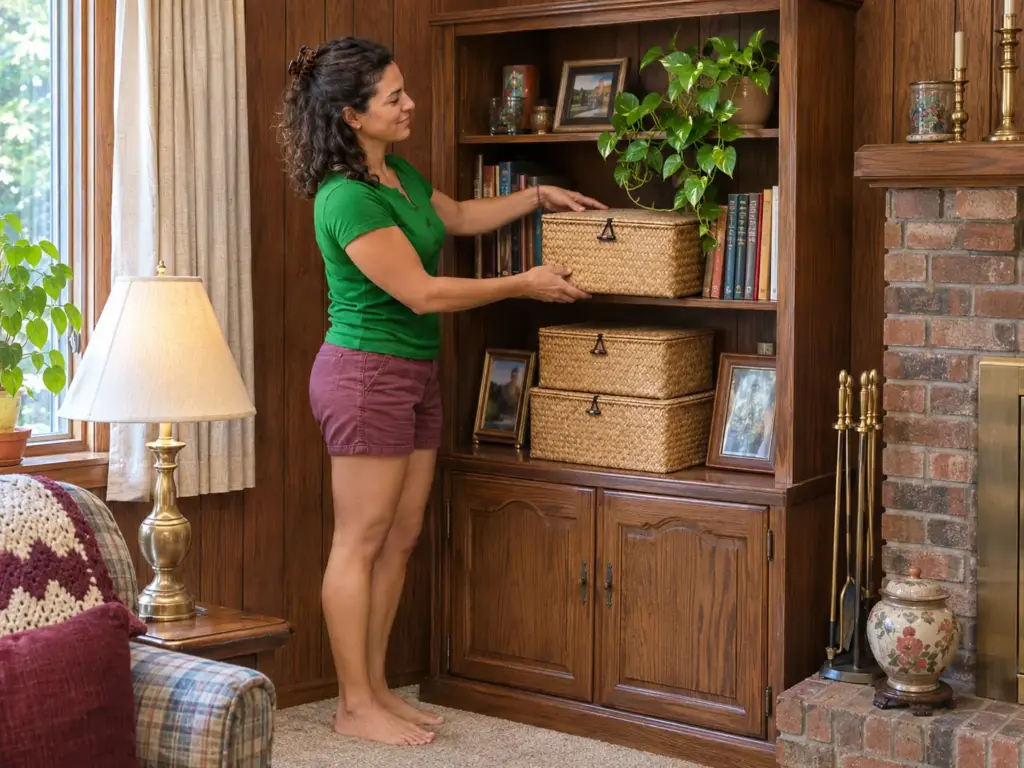
Here is the density rule we use: one closed piece per open shelf, one cluster per surface, and the rest empty, which works out to about a third of each shelf. This is our editorial rule, not a standard. It exists because boho tips into clutter faster than any other style, since the storage itself is decor and nothing looks out of place until everything does.
The closed piece is what makes the open part possible. Once the cables, mail and loose odds and ends have one lidded home, the shelf can hold three ceramics, a plant and a stack of books without any of them carrying a job they were not made for.
What goes behind a lid and what gets displayed
Hide the everyday mess in closed storage behind lids: cables, chargers, paper and toys. Display what carries the style on open shelving: the plants, the books and the ceramics, with keys and loose change in one catch-all tray. The sorting question for each object is whether you would be pleased to see it from the sofa.
The easy rule is to put everything behind a lid, and that fails on anything you reach for daily. The lid becomes one more step, and a basket you have to open every morning ends up with the things you need piled on top of it. Keep daily items in an open basket at hand height, and give the lids to the overflow you touch weekly or less. Before buying a lidded set, check whether a drawer or a lift-top bench in the room can be the closed piece.
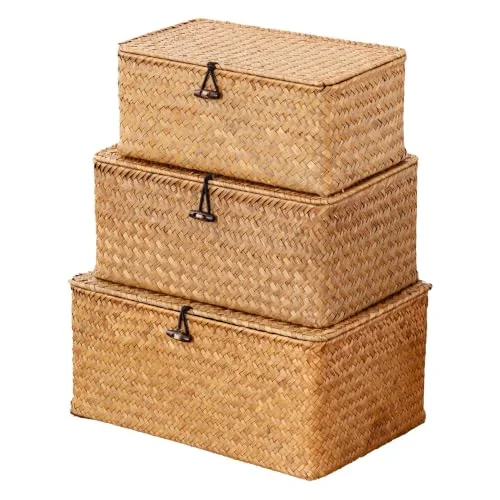
If the seams are the worry, the budget answer is a flat, fabric-lined lid on a basket you already have, or a thrifted lidded basket whose weave has already proved it holds.
A shelf that fails the test, and the fix
Take a three-foot shelf with eight objects on it, two plants, a stack of books, a ceramic bowl, three framed pieces, and a tangle of chargers wound around the base of the lamp. Nothing is wrong with any single item, and the shelf still reads as a pile. The cure is subtraction and one lid: the chargers and anything else with a cable go into a closed basket, the frames drop to one, and the bowl takes the empty third. When a photographed shelf stops working in daily life is the same failure in a room built for photos, and the fix runs the same way.
When a shelf feels crowded and you cannot choose what to remove, take everything off and put back only the objects you would miss. What is left on the table is the overflow, and it is usually what the closed basket was missing.
Measure the Shelf First: Depth, Height, Lid and Opening
Picture the basket that looked right online and sits an inch proud of the shelf edge, or the tall one that will not slide under the shelf above. Baskets get picked by vibe, and shelves are indifferent to vibe.
Shelf depth: what a basket has to clear
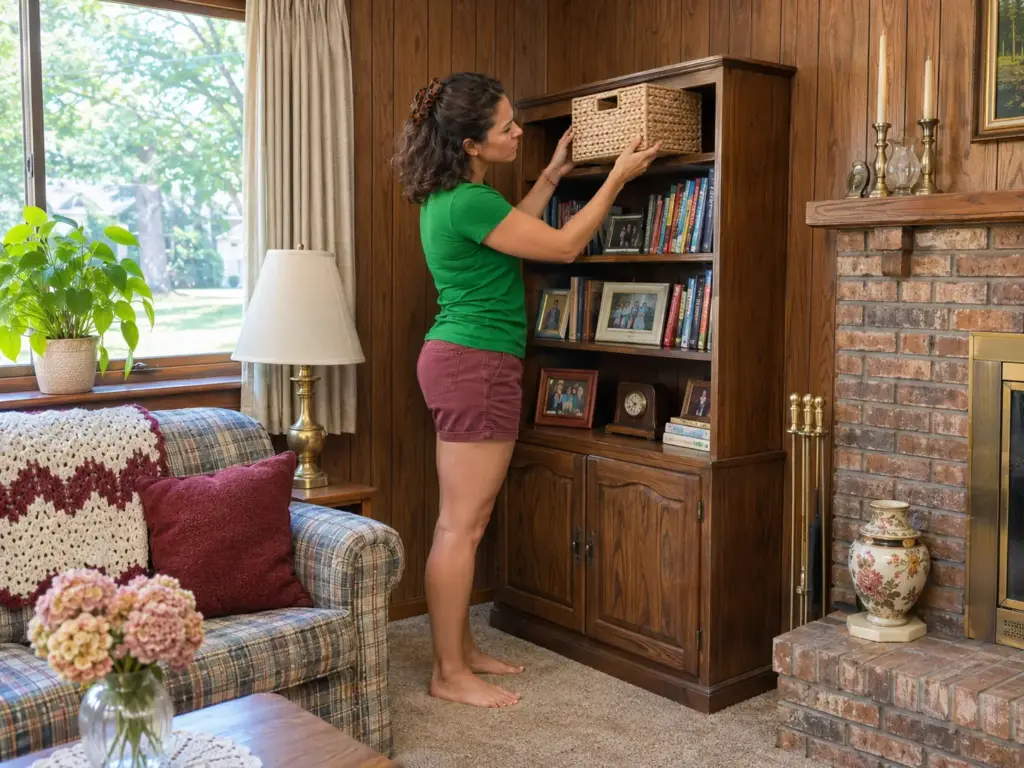
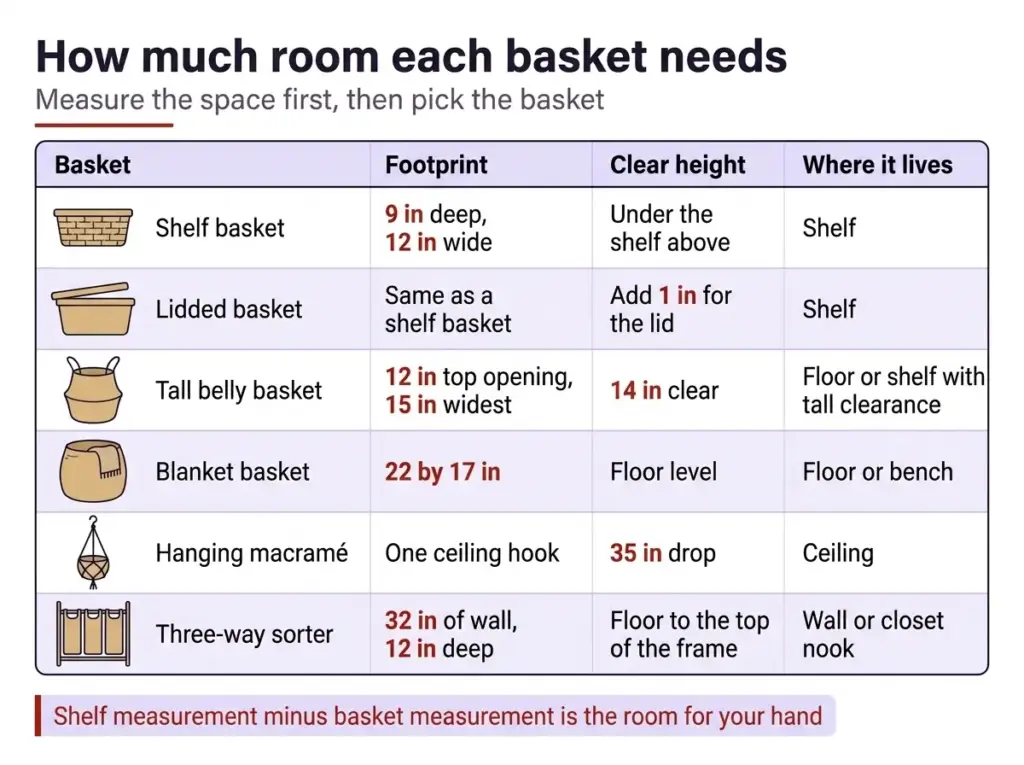
A 12-inch shelf takes a basket about 9 inches deep with room to get a hand behind it, and a shelf basket usually runs around 12 inches wide. Take the shelf depth, subtract the basket depth, and what remains is the room you have to reach in. If there is no room to reach in, there is no habit of using it. The measurements to take before ordering a piece lays out the rest of that checklist, and baskets against Scandinavian shelf depths runs the same arithmetic on a different style of shelving.
Cut a piece of cardboard to the basket’s footprint and slide it onto the shelf before ordering. If you cannot get your hand behind it, the basket is a floor piece, not a shelf piece.
Height and lid: the clearance you forget
A lid adds about an inch to every height, so measure the gap with the lid lifted, not just the basket. A tall belly basket needs about 14 inches of vertical clearance, and the number that decides is height, not depth. A blanket basket around 22 by 17 inches will not sit on a shelf at all. It is a floor or bench basket.
Floor baskets, hangers and sorters: the numbers that do not involve a shelf
A hanging macramé piece drops about 35 inches from the hook, so the number you measure is floor to ceiling, not shelf width. A three-way sorter wants about 32 inches of wall and 12 inches of depth, so measure the closet nook or the corner before it comes home. Neither one asks for a shelf, and both fail the same way a shelf basket does: the measuring got skipped.
Boho Storage Room by Room
Walk through your own home and one basket probably does the wrong job in the wrong place. The fix is placement, and each room has a piece that suits it.
Entryway: a drop zone with a basket on the bench
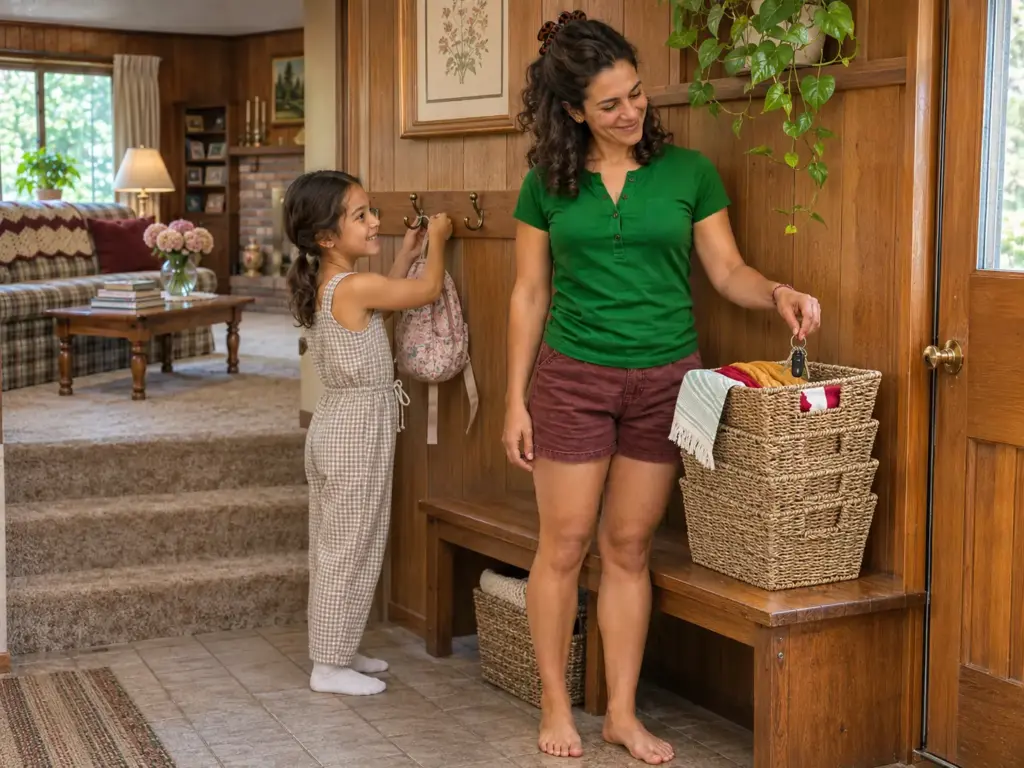
A trio of shelf baskets under a bench handles keys, mail and gloves, and that is the whole entryway drop zone. The Best Choice Products rustic seagrass basket set of four is the affordable way in: each basket measures 12.2 × 8.7 × 6.3 inches and holds 26 pounds, which is a stack of paperbacks, not tools. The set runs smaller than expected, so measure the bench clearance first. A thrifted set is the other budget route, and it gets the handmade look for free.
Benches and ottomans do double duty here, and benches and ottomans that hide a basket underneath covers the clearance that decides which one fits.
Bedroom and living room: the throw, the toys and the blanket basket
For blankets, a soft cotton rope basket is the right material. The danpinera 72L woven cotton blanket basket measures 22 × 17 × 11.8 inches, so it lives on the floor beside the sofa or the bed, not on a shelf. It arrives folded, and the sides keep the crease until steamed back.
The family version of toy storage is visible and hidden storage together: cubbies with visible baskets and lidded ones for the rest puts kid-height baskets in reach and the less-loved toys behind lids. A cotton rope basket suits the soft toys because there is no hard edge to splinter.
The closet nook: a concealed sorter
A tension rod with two or three fabric bags inside a closet nook is the cheapest version, and in a small apartment it also keeps the floor clear, and it does most of the job a furniture sorter does. For a piece that reads as furniture, the HOOBRO three-section laundry sorter comes in a greige tone that reads boho, with three 11.5-gallon bags, 31.5 inches wide and 30.3 tall. The bags are smaller than expected and the frame feels lighter than it looks, so give it a wall and not a doorway to lean in.
The kitchen wall: a magnetic strip and open jars
Open glass jars on a counter give a kitchen the same layered look as a living-room shelf, and a magnetic strip on the wall above clears a drawer. The Modern Innovations 18-inch magnetic knife holder is satin stainless steel and is screwed into the wall with anchors, which makes it an owner’s move, not a renter’s. The maker warns to keep it 6 inches from pacemakers and ICDs.
Boho Storage for Renters and Owners: What Needs a Drill
Picture a renter with a wall of baskets in mind and a lease that says no holes, and an owner who hangs a loaded basket from a screw that was never meant to hold it. Boho storage leans on wall space more than most styles, and almost all of it wants a drill.
The no-drill ladder: hooks, a tension rod and leaning pieces
The ladder runs from the lightest load to the heaviest. Removable adhesive hooks rated for the loaded weight, with the rating checked on the pack, carry the lightest. A tension rod carries light items across a closet or a window. Leaning ladders and freestanding shelves carry the rest, since they need no wall at all.
Hooks are where this goes wrong. A full basket weighs more than the empty one in the photo, and the hook has to be rated for the loaded weight, not the empty one.
Weigh the basket full, once, on a kitchen scale or a bathroom scale, then buy the hook rated for that number plus a margin. The weight you guess is almost always lighter than the weight you load.
Macramé from one ceiling hook
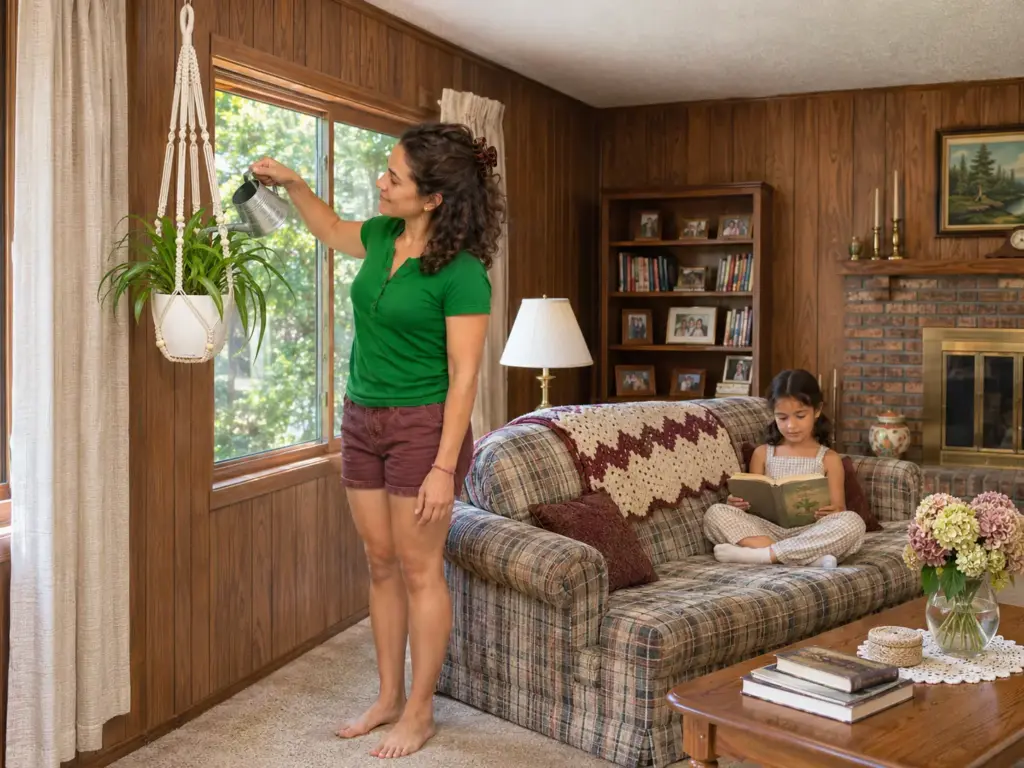
A macrame hanger asks for one small hole in the ceiling, which many leases tolerate and a few ban, so read the clause first. The Mkono macramé plant hanger is a cotton cord hanger with no tassels, 35 inches long, and it holds pots up to about 9 inches across. Each order is one hanger and the pot is not included, and the 35-inch drop is fixed, so measure from the hook to where the pot should hang. It is the cheap answer to the boutique hanger.
What belongs to owners: wall shelves, the magnetic bar and tall cabinets
Floating shelves and the magnetic bar are screw-and-anchor jobs. Floating shelves and their weight limits covers where the open-shelf half of boho storage comes from.
Tall woven-door cabinets deserve a strap.
According to the CPSC’s Anchor It! campaign, “Anchoring all furniture with drawers, doors, and shelves to the wall prevents tip-over injuries and deaths.” A clothing storage unit bought new today should arrive with an anchor kit, because a federal tip-over rule took effect on 1 September 2023. A renter who cannot drill is better off with a low piece than with a tall one left unanchored.
Show Some, Hide the Rest, and Check the Shelf Again Next Week
Boho storage works when the material fits the room’s moisture, the baskets are labeled by what they hold, every open shelf has one closed piece, each surface carries a single cluster, the shelf’s measurements are taken before anything is ordered, and every hanging piece is chosen by what the lease allows. Everything else is a matter of taste, and taste is the part boho forgives.
Next week, run a hand over the weave for dust, sniff the basket in the bathroom, and look for the empty third on each shelf. Do it again after the first damp season, because that is when a wrong material shows itself. Under-bed storage deserves the same check, since a woven box under a bed sits low where dust and damp collect.
Today, declutter one shelf down to a single cluster and one closed piece, and leave the rest of it bare. Over the next few days, notice whether you reach for things faster and whether the shelf still looks chosen.
Frequently Asked Questions
01What does a boho organization style look like?
A boho organization style looks like woven natural storage, warm wood tones and grouped objects, with a clear split between what is shown and what is hidden. Baskets and trays sit beside plants, books and ceramics, while cables, chargers and paper stay behind lids.
02What is the 3-5-7 rule in decorating?
The 3-5-7 rule says to group decor in threes, fives or sevens, because an odd count reads as arranged where a pair reads as matched. It is a rule of thumb, not a standard, so break it when a tray already frames the group.
03Is boho out of style for 2026?
Boho keeps cycling in and out of fashion, and the version that dates fastest is the one bought new, all at once and matching. The lived-in version, built from pieces with a history, keeps working whatever the year.
04Do woven baskets get moldy in a bathroom?
They can, because mold needs moisture and seagrass and water hyacinth are porous. The EPA advises keeping humidity below 60 percent and says moldy porous materials may have to be thrown away. Dry anything damp within a day or two.
05Can you do boho organization without drilling?
Yes: removable hooks rated for the weight, a tension rod for light items, freestanding and leaning pieces, and a macramé hanger on one ceiling hook carry most of it. Wall shelves and the magnetic bar are owner jobs.
Disclaimer: ClutterlessNest is a participant in the Amazon Services LLC Associates Program. As an Amazon Associate we earn from qualifying purchases. This article may contain affiliate links — if you buy through them, we may earn a small commission at no extra cost to you. We only recommend products we have tested or genuinely believe in.