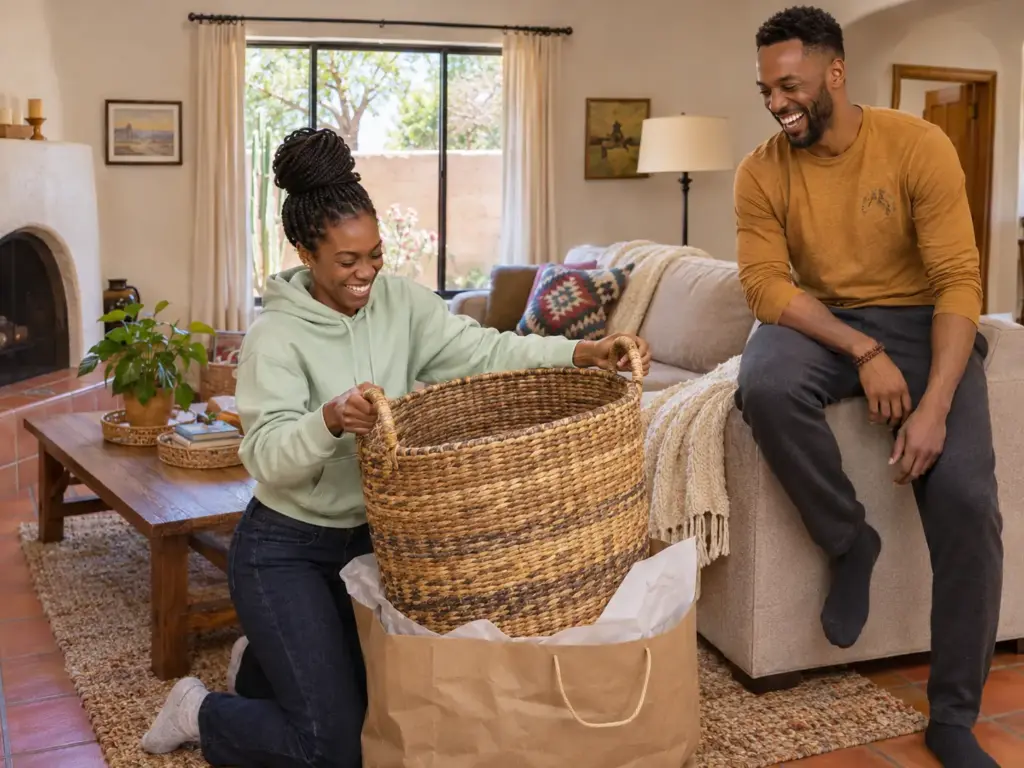
You saved the pictures, bought a few baskets, and now the room looks half styled and half dumped, because nothing told you which piece goes in which spot. These boho organization ideas run room by room, and each one comes with the number that decides whether it fits, a version that needs no drill and the way it quietly fails. For the thinking behind what makes boho storage read as deliberate instead of messy, the long guide covers it; this page is the catalogue. Three rules close it out because they decide whether the look lasts: where a weave can live (the EPA’s humidity limit settles that one), what each basket is for, and the weekly reset.
Quick Answer
Nine pieces cover the house, one per spot, each with the size that makes it work:
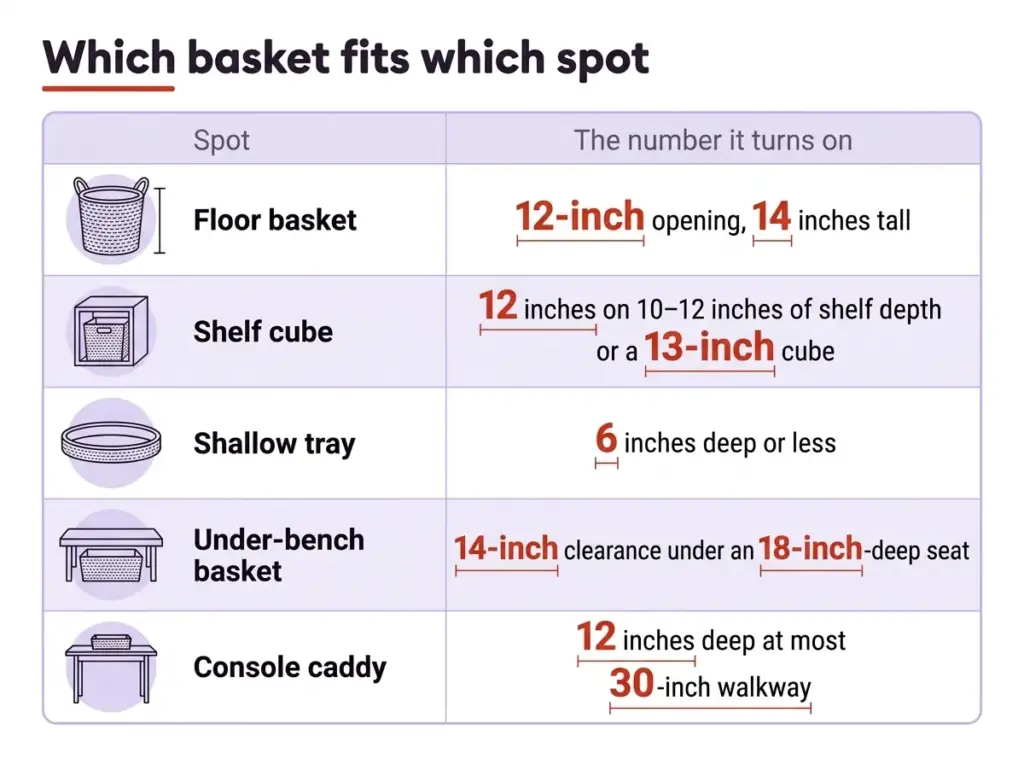
- Living room: a floor basket about 14 inches tall with a 12-inch opening for throws or a plant, a 12-inch cube on a shelf with 10 to 12 inches of clear depth, and a shallow tray on the coffee table.
- Entry: a slim five-slot caddy on a console no deeper than 12 inches, and baskets under a bench that clears 14 inches.
- Bedroom and nook: a cotton rope basket for throws and a lidded chest for whatever should stay out of sight.
- Wall and door, no drill: an over-door macramé pocket on a door with 4.3 inches of clearance behind it, and a leaning ladder.
- One placement rule: plant fiber stays out of the steamy bathroom, the sunny sill and the spot under a window.
Boho Organization Ideas for the Living Room Floor, Shelf and Coffee Table
Baskets bought for the look and not for the spot fail in a predictable way. A 12-inch cube hangs over the front edge of a 10-inch shelf, and the floor basket turns out too small for the throw it was bought to hold. Living room storage needs three working sizes, roughly an 18-inch floor basket, a 12-inch shelf basket and a 6-inch shallow tray, and they are three separate purchases. Nothing below needs a drill, whether you rent or own.
The floor basket for throws and the overflow plant (tall, with a 12-inch opening)
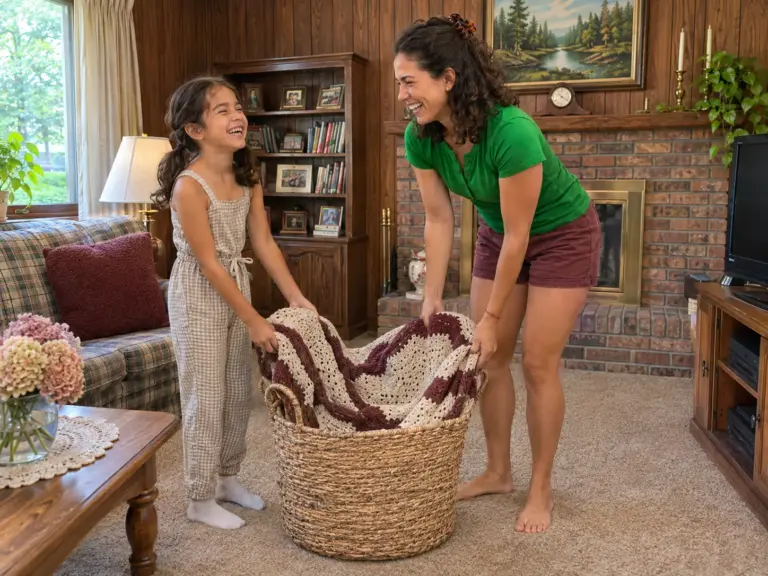
Throw blankets pile up on the sofa arm because a basket short enough to look tidy is too small to swallow one, and a basket tall enough to hold it is a floor piece, not a shelf piece. It needs floor space and height, not shelf depth. This is where the rule of choosing by the spot instead of the look pays off, the same rule behind baskets worth buying and the ones to skip. A cardboard box with a throw folded over its rim is the free test: if the throws really go back into it, a woven basket has earned the floor space.
The DOKOT Large Woven Seagrass Belly Basket is the tall answer, with a 12-inch top opening, a height of 14 inches and a belly 15 inches across at its widest. That opening is plant-pot size, so it takes a monstera in its nursery pot, a rolled throw or the laundry overflow while using height instead of shelf depth. It runs smaller than the photo suggests and it folds flat, so it keeps its shape only when something is in it; put the throw in the day it arrives. The medium size is the cheaper move compared with the largest, and for one sofa it is plenty.
In a big room this basket does more than it looks like it should, because it is what stops throws spreading across three sofas (a second one beside the reading chair beats one oversized basket). And the basket added just for the photo, the one with no job, is the first to start hiding things. The first week looks right, and then the household goes back to the sofa arm.
The 12-inch shelf cube and the depth it needs
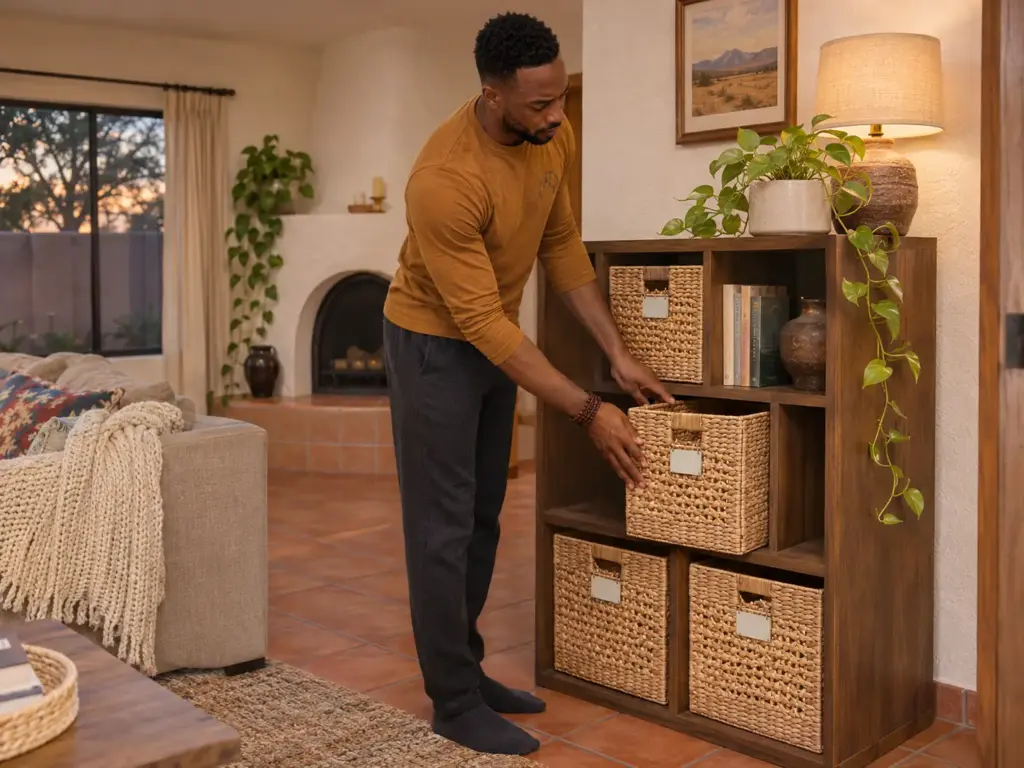
A shelf needs 10 to 12 inches of clear depth to carry baskets mixed with decor, so measure depth before width. On a 10-inch shelf a 12-inch cube overhangs the front edge, and the first elbow sends it to the floor. A standard cube organizer is a different case: its 13-inch cell takes a 12 x 12 x 12-inch basket with an inch to spare, which is just enough room for fingers to get it back out.
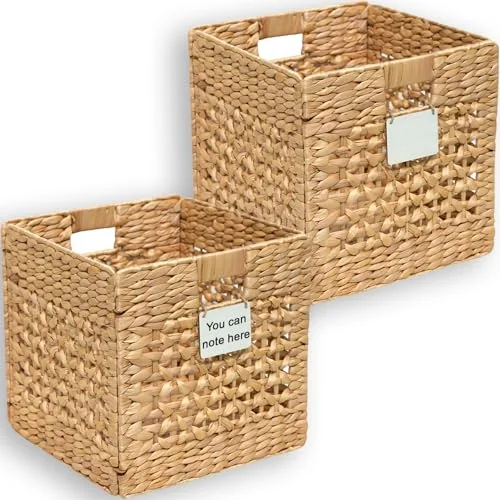
The Water Hyacinth Woven Storage Baskets set is already the budget end of woven baskets, and the paper-rope cube that costs less is a weaker weave. One basket from it covers an open shelf, a closet shelf and a bench top, which makes it the most flexible piece in this room. The set arrives with a strong smell that needs airing, and the weave can carry white mold if it was stored damp, so open it the day it comes and let it sit in a dry room before anything goes inside.
Cut a 12-inch square out of a cereal box and slide it onto the shelf. If any edge hangs past the front, that shelf is the wrong home for a cube, and the basket belongs on the floor or a bench top instead.
The coffee table tray that stops the remotes sliding
The coffee table is where remotes, coasters and the mail share one corner until somebody sweeps it into a bag. A catch-all tray only works with a raised edge and a rule for what lives on it: the remotes, the coasters and one candle, nothing else.
The Water Hyacinth Woven Serving Tray measures 16.1 x 11.4 x 3.2 inches, and that edge keeps the remotes from sliding off. It suits a coffee table and is too wide for a hallway console. For a small surface, a 10-inch hyacinth vanity tray is the cheaper version.
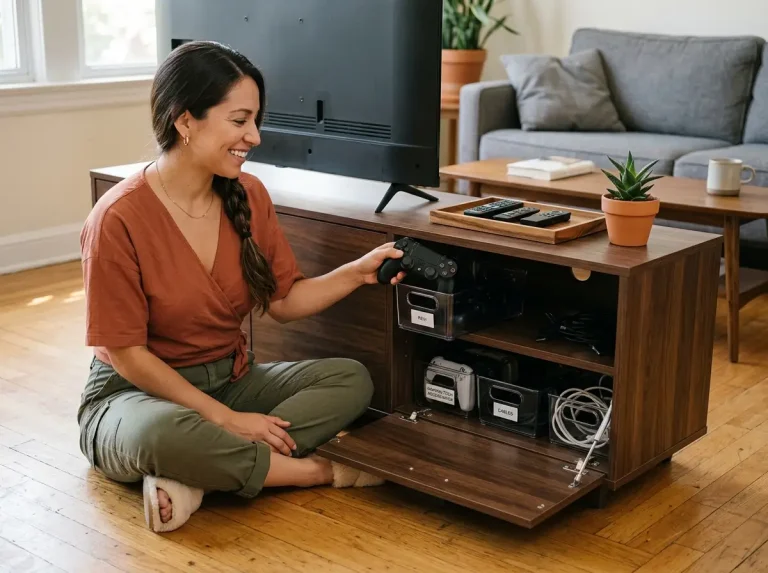
One tray per surface. A second tray on the same table turns the first into a stack, and the stack is the pile you started with. The same tray works on a console under the TV, and keeping a media console from filling up again comes down to the identical rule: one surface, one tray, one short list of what lives there.
Entryway and Console Ideas That Keep Mail and Keys Findable
A console table deeper than 12 inches turns a narrow hall into a squeeze, and the walkway clearance that keeps the hall usable is about 30 inches of clear floor. That is the working rule for this whole section, and it decides which of the two entry ideas can go in. Keys, mail and a charger land on the first flat surface inside the door every day, so the surface becomes a pile within a week unless each item has an assigned slot, which is all an entryway drop zone really is.
The five-slot caddy on a console under 12 inches deep
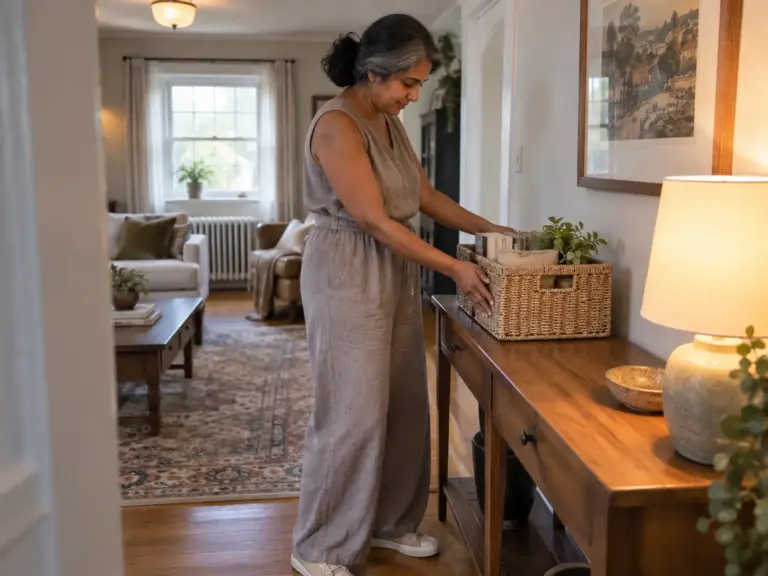
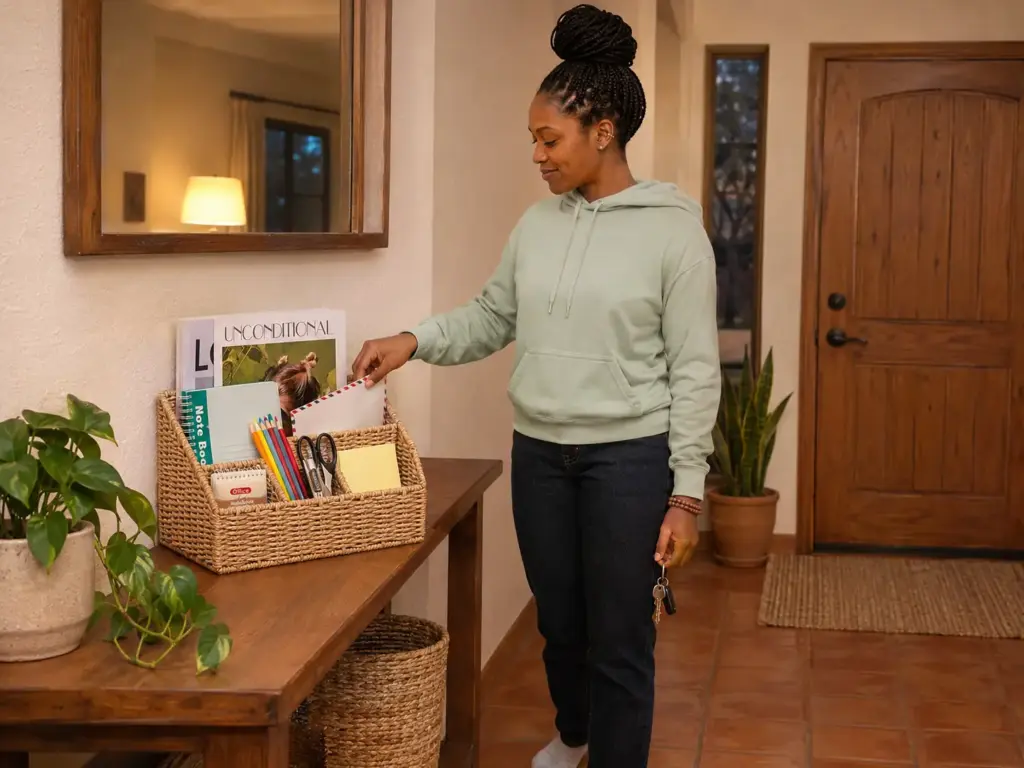
Mail, chargers, a notebook and keys need a slot each, or whatever lands first buries the rest. The DINGTAI Rattan Desk Organizer, 5 Slot Mail Holder gives them five assigned places in a 12.5 x 6 x 7.75-inch footprint, which suits a console under 12 inches deep and answers the no-drawer problem. It runs smaller than the photo suggests, so check the footprint against the console first.
Give each slot one kind of item, the way a key and mail drop zone that renters can set up does, and nobody has to dig. A plain paper-rope mail basket is the cheaper swap if five slots is more structure than the household will respect.
An open basket with no assignments swallows the charger, which is the same failure on a smaller scale. And in a home where one person uses the slots and the others toss, the slots fail inside a week; a small tag per person fixes what a printed category label cannot. The caddy is not tied to the hall either: the same caddy idea on a work desk does the job as a desk caddy for pens and cables.
Baskets under the bench: 14 inches of clearance, not the seat height
Under-bench clearance is the number that counts: the gap below the seat, not the seat itself. A typical seat is about 18 inches deep, and a basket 14 inches tall is the one that slides in. A 12-inch cube clears it with room to spare, and anything taller stays out.
Measure from the floor to the underside of the seat, and if the bench is still on the wish list, how much room a storage bench really leaves under the seat runs the same measurement. Nothing here is fixed to the wall, so it works in a rental as it stands.
Why the hallway console stops at 12 inches and 30 inches of walkway
Subtract the console’s depth from the width of the hall, and what is left is the walkway. Below about 30 inches, bags and elbows hit the caddy, the household stops using the console, and the idea has failed however good the caddy is. The living room tray does not travel here: at 16.1 inches wide it overhangs a hallway console, and a hallway tray tops out near 12 x 8 inches.
A wall-mounted rail above the console is an owner job, covered in the wall section below. For everyone else the console is freestanding and asks nothing of the wall.
Measure the walkway at the narrowest point of the hall, with the console’s depth already taken off. If what is left is under 30 inches, the console is too deep for the hall, and a shelf on the wall is the next option.
Bedroom and Reading Nook Ideas for Throws, Linens and Keepsakes
Plant-fiber baskets in a sunny reading corner dry out and shed, and an open basket for keepsakes shows everything that was meant to be tucked away. The bedroom wants two ideas for those two failures: a throw basket that survives the sun, and a lidded chest for what should not be on display. Both sit on the floor or a shelf, and neither needs a tool.
The cotton rope throw basket for a sunny corner
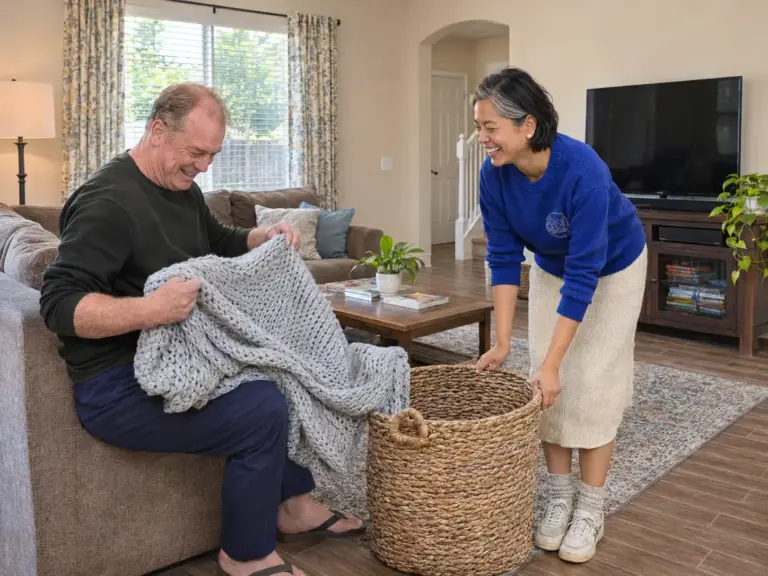
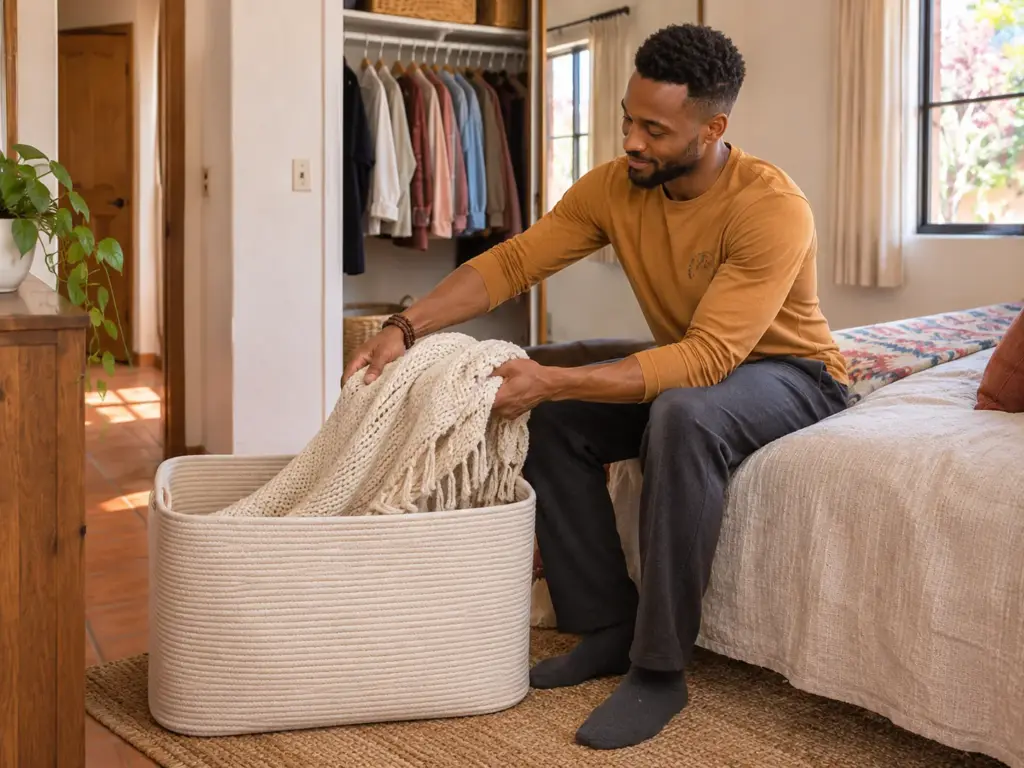
The bed with three throws on it is the symptom, and cotton rope is the material for the bright corner and for a room that gets steam. The OIAHOMY 75L Cotton Rope Blanket Basket measures 22 x 17 x 12 inches, so it is a floor-and-bench piece, not a shelf piece. Its soft sides slump when it is empty, so keep a throw or two in it, or stack it, and it holds its shape. Among the large baskets it is the budget pick.
Lidded chests for keepsakes, cables and what must stay hidden
The nightstand drawer that holds every cable and keepsake with nowhere else to go is the symptom here. A lid gives hidden storage inside a room that otherwise displays everything. The Best Choice Products Set of 2 XL Tapered Storage Chests with Lids puts keepsakes, jewelry and cables behind a lid: the large chest is 21.25 x 14.5 x 10 inches and the medium one nests inside it, so the pair takes up a single footprint when empty.
A single lidded shelf basket is the cheaper version if one is enough. A nightstand tray (a rattan tray works) keeps the daily things open and leaves the lid for the rest. A storage ottoman at the foot of the bed is the other lidded option. In a big bedroom the chest and the floor basket carry what a small closet cannot.
Why the lid belongs on only some of the baskets
Daily things stay open, because anything hidden stops existing in the household. Whatever you want out of sight goes into closed storage, which here just means a lid. A working rule is one lidded piece per open shelf, so the shelf shows texture and keeps its secrets, and a linen closet shelf with lidded baskets on it shows the closed half of the look done on a shelf you can copy. The other half of the rule is that a lid costs a second of effort every time, so it belongs on what is opened rarely.
Sort the nightstand drawer into two piles before buying a chest: what you reach for weekly, and what you only need once a season. Only the second pile goes behind a lid.
No-Drill Wall and Door Storage That Still Looks Boho
The wall half of the boho look assumes a drill, and adhesive fails on a rough or damp wall whatever its rating says. The owner has the opposite problem, with the drill in hand and everything hung too high to reach. So each wall idea below has a no-hole version, and a note on where it gives out.
The over-door macramé pocket and the 4.3 inches behind the door
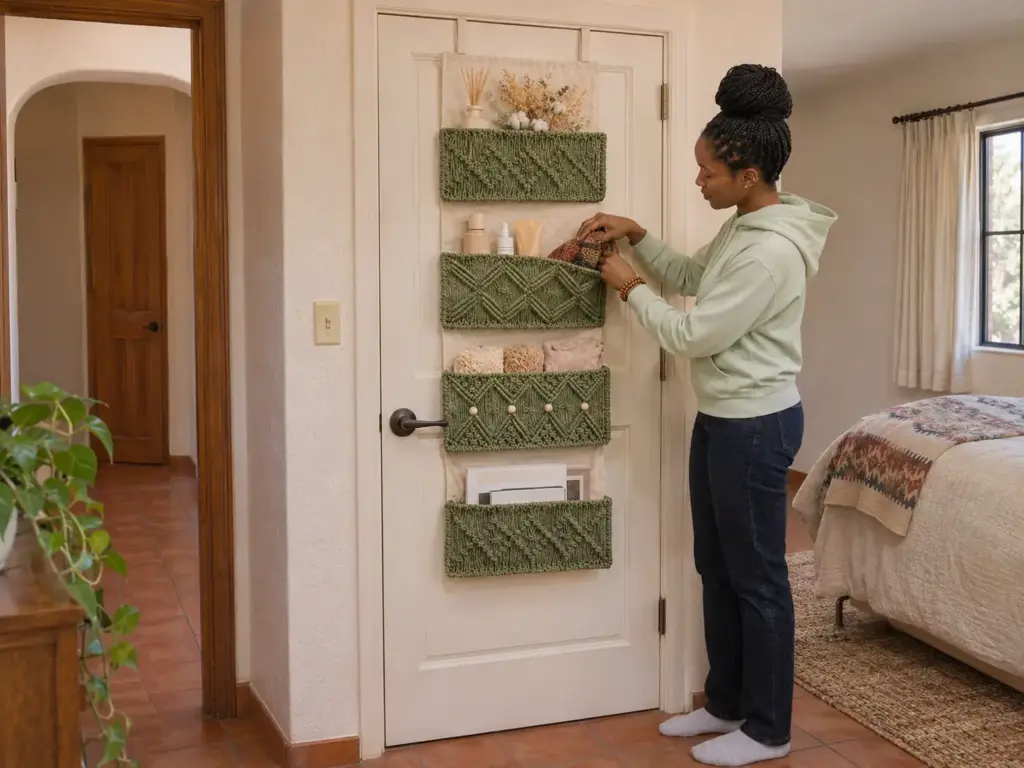
The wall problem is solved by moving off the wall. The GLDFI Boho Macramé Over Door Organizer (4 pockets) hangs on the door itself, so there is no hole, no adhesive and no deposit risk. It measures 12.6 inches wide, 33.5 inches tall and 4.3 inches deep, and it weighs 1.35 lb. That depth is the number that matters: the door has to close with 4.3 inches of clearance behind it, and most standard interior doors have it.
The maker gives dimensions and weight but no load rating, so treat this hanging pocket organizer as a pocket for hats, scarves, a notebook and small items, not a shelf. A loaded pocket on a hollow-core door with a weak hinge is where it gives out. Per unit of storage, it is the cheapest piece in this article.
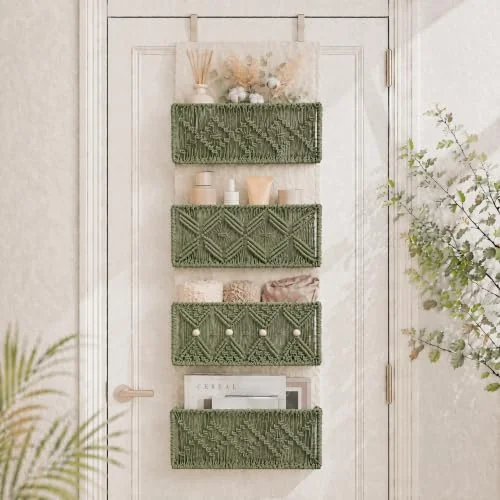
Close the door on the empty pocket before loading anything. If the latch catches cleanly, the clearance is real. If the door fights you, it was never a candidate, and the leaning ladder is the better pick.
The leaning ladder and freestanding pieces for walls that say no
A leaning ladder, the ladder shelf version of a wall rack, carries towels, throws or a row of baskets with no hole at all, and it uses height where the floor is already full; going vertical when the floor is already full covers the same move across a whole small apartment. Rung spacing is usually 10 to 12 inches, and that spacing decides what each rung can hold: a folded towel or a throw fits, a deep basket does not. Where even adhesive is banned, an open clothing rack with shelves or a bookcase does the wall’s job and leaves with you when the lease ends.
What the lease allows: adhesive hooks, rods and the owner’s version
Removable hooks belong only on a painted, dry wall, and the adhesive hook weight rating on the pack is a ceiling for a perfect wall, not a promise for yours. They let go on rough or damp surfaces, and pulling a hook straight out is what takes the paint with it, so pull parallel to the wall. On a wall that fails the test, the ladder or the door pocket is the better call, and a spring rod with a few S-hooks is the second no-drill hanger for light things; tension rod ideas with the weight they can really carry has the numbers.
The owner’s version changes the heights, not the idea. Pegboard wants about 6 inches between pegs and sits centered at eye level; any closer and baskets overlap, any higher and nothing is reachable. A kids’ rail goes at about 3.5 feet, high enough to clear toys and low enough that a five-year-old hangs their own bag.
A macramé hanger wants roughly a 16-inch drop from the ceiling to read as planned. Anything drilled follows the wall type, a floating shelf included, and a flat wall basket on a single hook is the lightest way to add texture. Wall shelves that hold real weight sorts out which fixing goes where.
Which Spots in the House Ruin a Woven Basket
Three places end these setups: the steamy bathroom, the sunny sill and the spot under a window. The weave is not weak in any of them; it is in the wrong room. Matching each material to a spot that suits it is the quietest fix in this catalogue.
The bathroom and the damp side of the kitchen
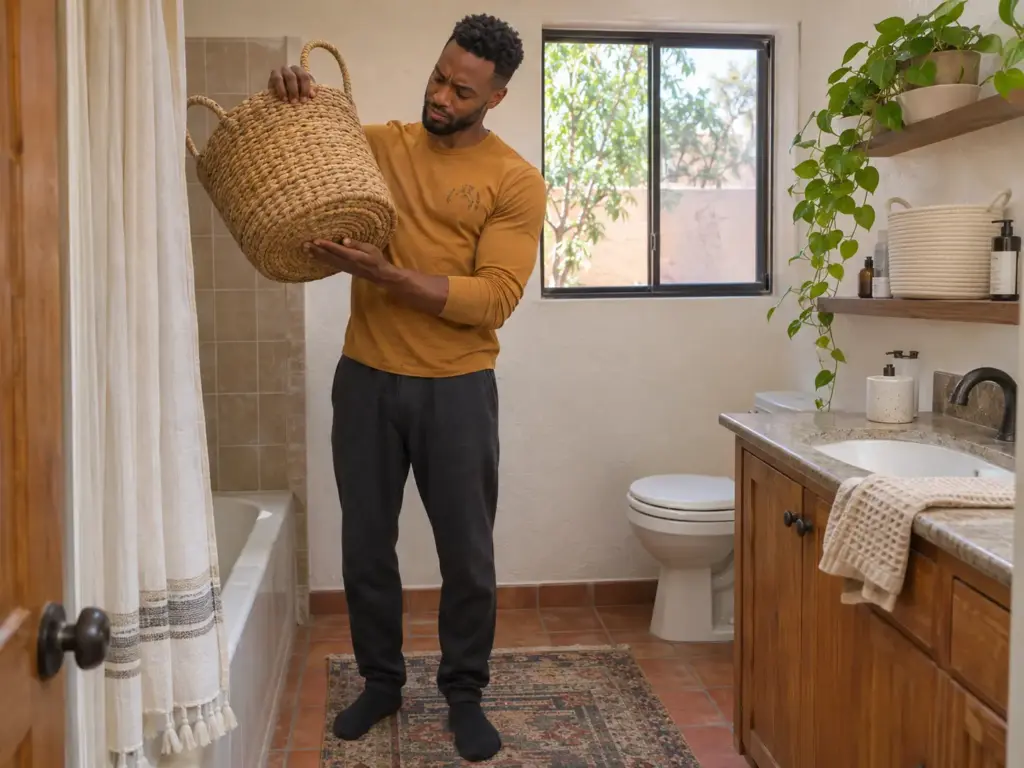
A seagrass basket under the bathroom window and a water hyacinth basket beside the tub go soft and smelly for a reason with a number on it. According to the EPA’s guidance on indoor humidity, “Indoor relative humidity (RH) should be kept below 60 percent — ideally between 30 percent and 50 percent, if possible.” The same guidance says mold can grow on virtually any organic material given moisture and oxygen, and seagrass, hyacinth, rattan, bamboo, cotton rope and jute are all organic. The material never resists damp; the placement does.
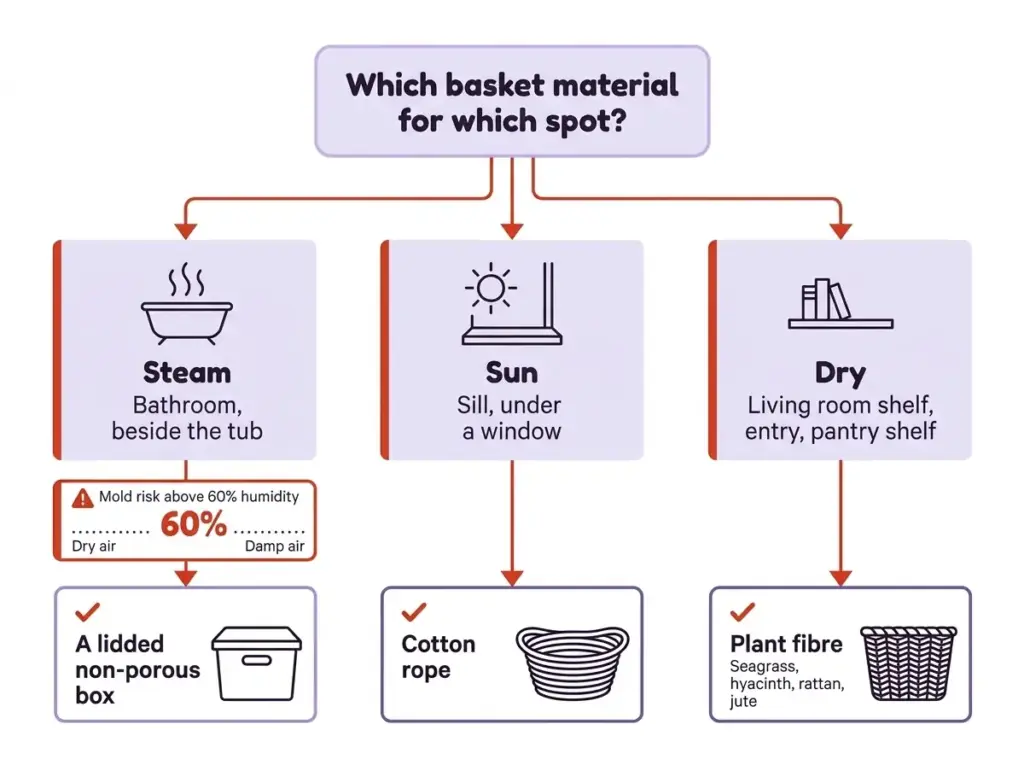
In a bathroom with a window and a shower the damp spot is under the window and beside the tub, so move plant fiber out of both. Cotton rope is organic too, so even there it needs to dry out between uses; a lidded box with a non-porous shell is the one with nothing for mold to eat. A tray or basket on the bathroom counter faces the same splash, and a bathroom counter that stays dry and neat keeps plant fiber off the wet edge. The kitchen works the same way: a basket beside the stove or sink gets steam and splash, and one on a dry pantry shelf is fine.
The sunny sill and the window wall
Sun does a slower version of the same damage. A wicker basket or any plant fiber on a bright sill dries out, fades and sheds, and the dust it leaves is a household job nobody signed up for. Cotton rope or a lined basket holds up there. Open weave is the other trap on a sill or a shelf: anything small and fine, like hair ties, chargers or pens, falls through it, so an open-weave bin only works for things bigger than the gaps.
What goes in those spots instead
Three swaps cover the house. For the steam, a lidded non-porous box or a cotton rope basket kept off the wet edge; for the sunny sill, cotton rope or a lined basket; for everything dry (the living room shelf, the entry, the pantry shelf), plant fiber is fine and is where seagrass and hyacinth belong. The EPA figure is the one hard number in this section, and the rest is placement judgment. For a no-drill swap in the bathroom, bathroom storage a renter can add without a deposit risk handles humidity and a no-hole lease together.
Why Boho Storage Turns Into the Basket of Doom
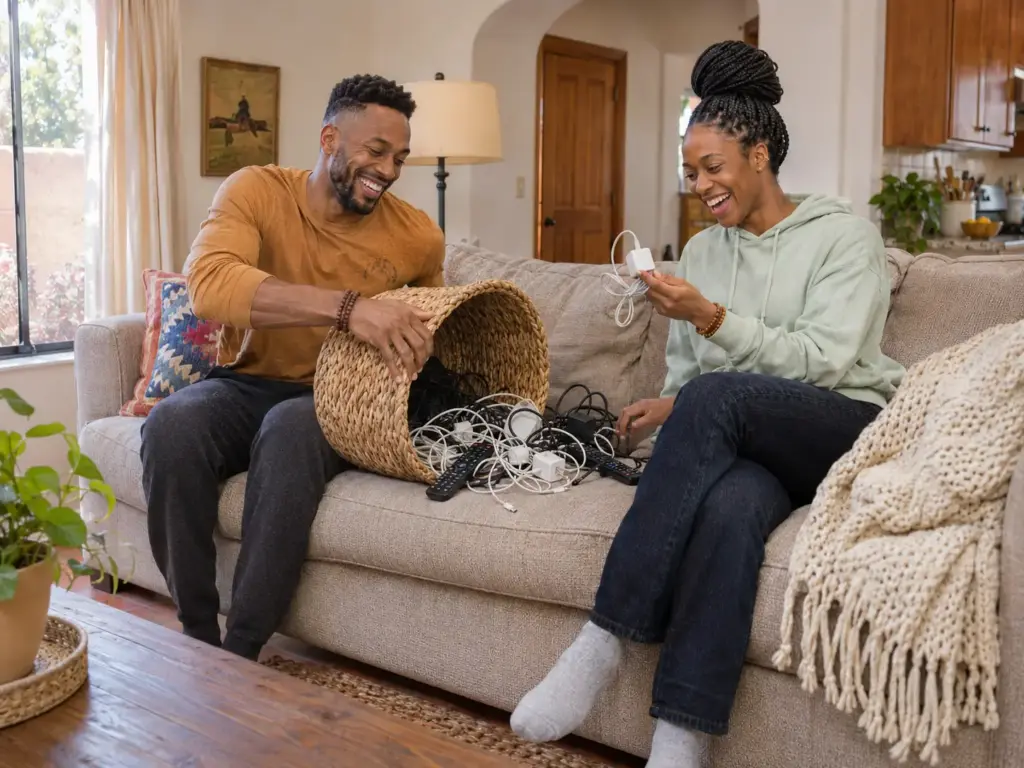
Call it the basket of doom: the basket with no assignment, which accepts everything and gives nothing back. The system built for the picture lasts a week or two, then the first time somebody needs the charger, the whole thing is a pile again. Baskets make a room look organized without making anything findable, and three rules fix that.
One basket, one destination, and the one label that earns its place
Each basket gets one destination: the throws, the remotes, the chargers, the mail. A lid goes on only where dust or looks demand one, and daily items stay in open baskets because anything hidden stops existing. Seasonal and sentimental things go behind a lid. For labels, one per household member beats one per category, and it should be a small tag or a color, never a printed word in the middle of the look.
A pantry sorted by category for the photo shows the failure in miniature: cans grouped with cans, and then the cook crosses the kitchen for tomatoes while making pasta. The grouping looked right and worked wrong, and the household quit the system within weeks. Group by task, and the basket keeps its job.
How many baskets are enough, and where the extras come from
Fewer than the shelves invite. A grouping in odd numbers looks deliberate, and the second basket is for a different job, never the same one.
Baskets also gather by accretion, so the wall fills one inherited piece at a time instead of from a shopping list, and thrift stores, flea markets, garage sale tables, estate sales and pay-by-weight outlets are where most of them should come from. A cloth basket liner fixes a rough interior that snags. And when the household would be better with fewer pieces, when fewer baskets is the better answer makes that case from the opposite style.
The open-and-closed split and the empty third of the shelf
Roughly half open and half closed works for most shelves, with about a third of each shelf left empty as negative space so the mix reads as chosen. A neutral base with patterned accents gives the shelf one color story and keeps layered texture from looking like noise.
These are rules of thumb, not standards. How to make boho storage read as lived-in carries the fuller reasoning, and open shelves that still hold real objects shows the styling side. In a large room, add one more basket per surface only when that basket has a destination.
The Five-Minute Weekly Reset That Keeps the Look
Open storage shows dust and disorder faster than any closet, and these setups are sold with an after photo and no upkeep. The shelf that looks right on Saturday shows every dust line and stray object by Thursday. A short weekly pass is how you maintain the boho aesthetic.
The five-minute pass: empty, return, wipe
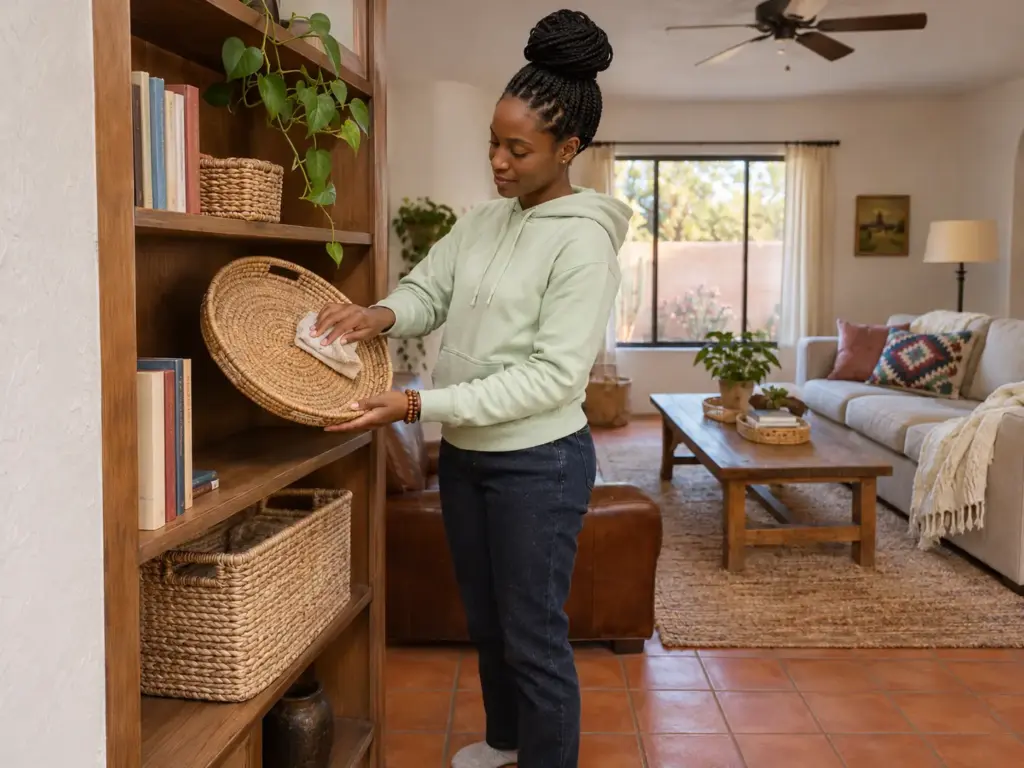
Put back what drifted, empty each tray, and check the one basket that turns into the pile. It is a small weekly job, not a project. Tie it to something the household already does that day, such as trash night, so it happens without a reminder.
Dust, damp and sag: caring for the weave
Wipe a cane cabinet or a rattan basket with a barely damp cloth and let it dry fully before anything goes back in. A sagging basket, such as a rope one that slumps when empty, gets a throw back in it. A damp one needs fixing within a day or two, because, as the EPA’s guide to mold and moisture at home puts it, “The key to mold control is moisture control.” Dry it in a ventilated room, away from direct sun, and it is back to normal.
Households with kids and pets need two adjustments: low baskets in a kids room for toy storage and the child’s own things, so the system survives without an adult, and woven pieces kept out of reach of a dog that chews.
One in, one out for display pieces
When a new basket comes in, one leaves: the one-in-one-out rule. It is the only rule that stops the shelf drifting back toward a pile of unrelated objects, and it works the same in a rental or an owned home, since it needs no tools at all.
Do the pass in the order the room gets used: coffee table tray first, then the shelf, then the floor basket. The tray is where drift shows up first, and an emptied tray makes the rest of the pass feel shorter.
Pick by the Spot, Keep Plant Fiber Dry and Give Every Basket a Job
Pick each piece by the spot it will live in and the number that spot sets: the depth of the shelf, the clearance under the bench, the walkway in the hall, the space behind the door. Keep plant fiber out of steam and sun, give every basket one destination, and leave a third of each shelf empty so the mix reads as chosen.
After a few weeks of ordinary use, run a hand over the weave in the damp spot, open the basket that was supposed to have a job and see whether it still does, and look at the shelf for its empty third. Whichever one has drifted is the one to fix first.
Today, carry the one plant-fiber basket out of the bathroom, or empty the basket that holds everything and sort it into two destinations. In a few days, notice where the first thing you needed ended up.
Frequently Asked Questions
01Is boho decor still in style in 2026?
Nobody can date a style with certainty, but boho storage built from pieces collected over time keeps working, while a set bought all at once dates fastest. Mix woven baskets with objects the home already holds and the look outlasts any trend.
02What is the difference between boho and hippie style?
There is no official definition, but boho storage leans on collected, layered pieces and woven natural materials, while hippie style points to a 1960s and 1970s counterculture look. For storage, the difference that matters is that boho can be built one piece at a time.
03What are bohemian style accessories for storage?
The core pieces are woven baskets and trays, macramé pockets and hangers, rattan caddies and lidded chests, each matched to one spot in the house. A floor basket and tray suit the living room, a caddy the entry, a chest the bedroom and a pocket the door.
04How many baskets does a room need?
A room needs as many baskets as it has destinations, which is usually fewer than the shelves invite. Give each basket one job and leave about a third of each shelf empty so the mix reads as chosen.
05Which boho organization ideas work without drilling?
The over-door pocket, a leaning ladder, freestanding racks and baskets, and a rod for light items all work without a hole. Adhesive hooks suit only a dry painted wall, pulled parallel to it; wall shelves and pegboard are owner jobs.
Disclaimer: ClutterlessNest is a participant in the Amazon Services LLC Associates Program. As an Amazon Associate we earn from qualifying purchases. This article may contain affiliate links — if you buy through them, we may earn a small commission at no extra cost to you. We only recommend products we have tested or genuinely believe in.