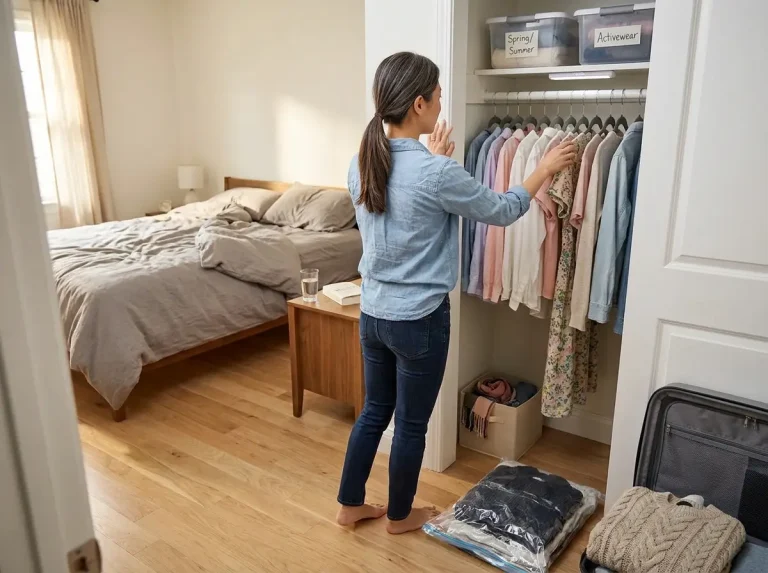

The pale cabinet comes out of its box, you carry it to the spot you picked weeks ago, and it is three inches too deep: the door hits it, or the shelf above refuses to let it in. Most modern storage solutions fail like this, and the piece is rarely the problem. The gap it has to go into, and the face it shows once it is there, are.
A standard base cabinet runs 24 inches deep and a kitchen work zone needs 36 inches of standing room, and those two numbers are the ruler for everything below. This guide gives the order to measure in, then the room-by-room pieces that pass.
Quick Answer
Modern storage solutions are plain-faced pieces in one material family: closed where nothing should show, open only for what you want seen. They work when you measure opening width, interior depth, door swing, toe kick and clear height first, and keep a written list of what lives behind each closed door.
What Makes Modern Storage Solutions Work, and Where the Look Breaks
What the modern look is made of
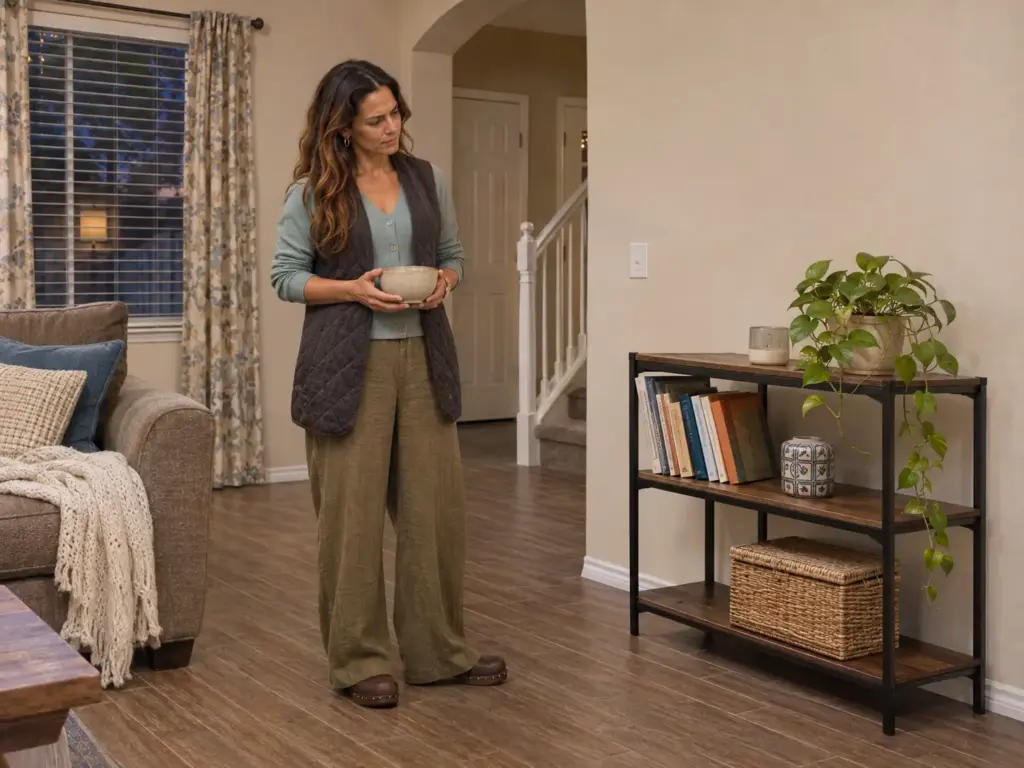
“Modern” in storage (what shops also label contemporary storage or neutral storage) is a short list of decisions, not a color. One material family (pale wood, white steel, soft felt) so the pieces read as a set. A closed face on anything that should not show, with handle-less fronts so no pull breaks the line. And one open shelf, styled with a few objects instead of filled to the edge.
That is the whole recipe, and it is why a room with ten different bins looks busy while a room with three matching boxes looks calm.
The palette, the container shape and the label style that tie a modern home together have their own guide, so this one stays with the piece and the measurement.
Where the look breaks first
It breaks in three places, and none of them show in the product photo. The first is the piece that is a few inches wrong: too deep for the shelf, too tall for the gap under the next one, too wide for the opening once the hinges are counted. The second is the closed face that hides the inventory, so the second bag of flour gets bought because the first sits behind a door. The third is the finish.
A dark matte finish shows every fingerprint, and a felt bin picks up hair from a bathroom floor. A room with real traffic sees both weekly.
Color and labels are a separate question. For what to do when a neutral set already in the house is not holding, start there; this article keeps to what fits and what does not.
Why one piece at a time beats a matching haul
Picture the cart of pale pieces saved over months and ordered in one afternoon. Three do not fit. One fits but swallows the shelf where something else was meant to sit. The stack of boxes in the hall becomes its own pile of shame, which is exactly the thing the order was meant to end.
The cheaper route runs the other way around. Put everything without a home into one “figure out later” box, and buy a container only when a category repeats. A lidded basket or a shoebox you already have, tested in the real gap for a month, tells you the depth, the height and whether you reach for it. Clear boxes work first while the categories are still being found; the matching set comes later, once the shapes are known.
The Five Measurements That Decide Whether a Piece Fits
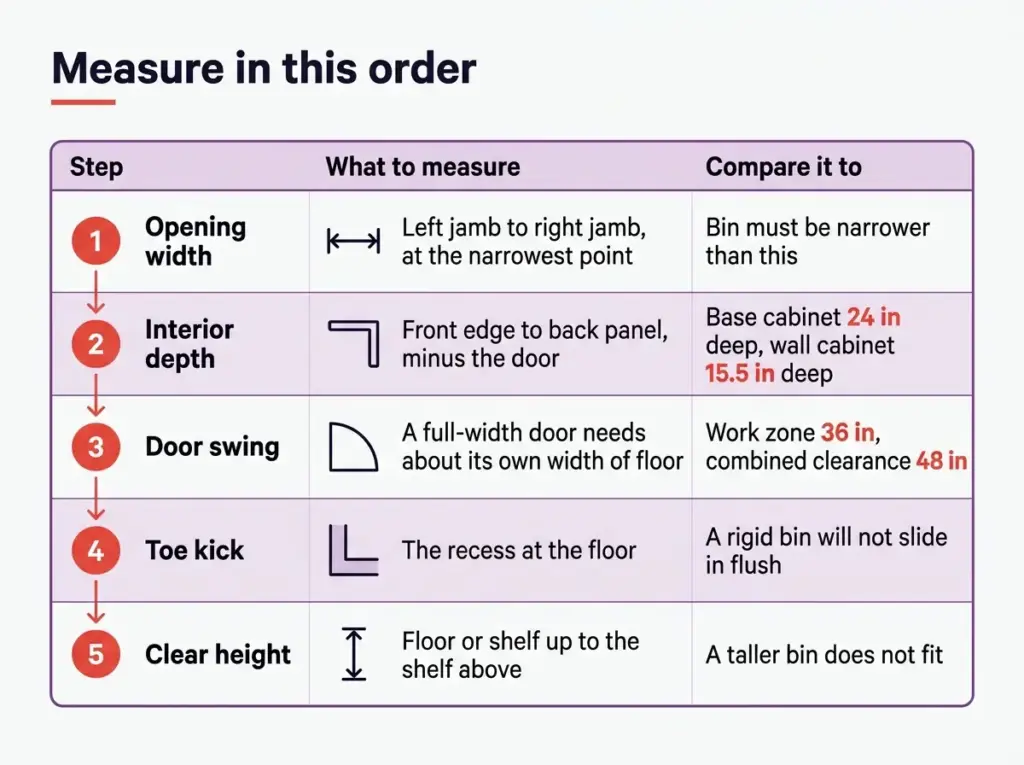
Measure in this order, because each number limits the next: opening width, interior depth, door swing, toe kick, clear height. Stand at the open cabinet with the tape in one hand and the product page in the other, and the page will say “24 inches” while the cabinet itself says something else.
Opening width, taken at the narrowest point
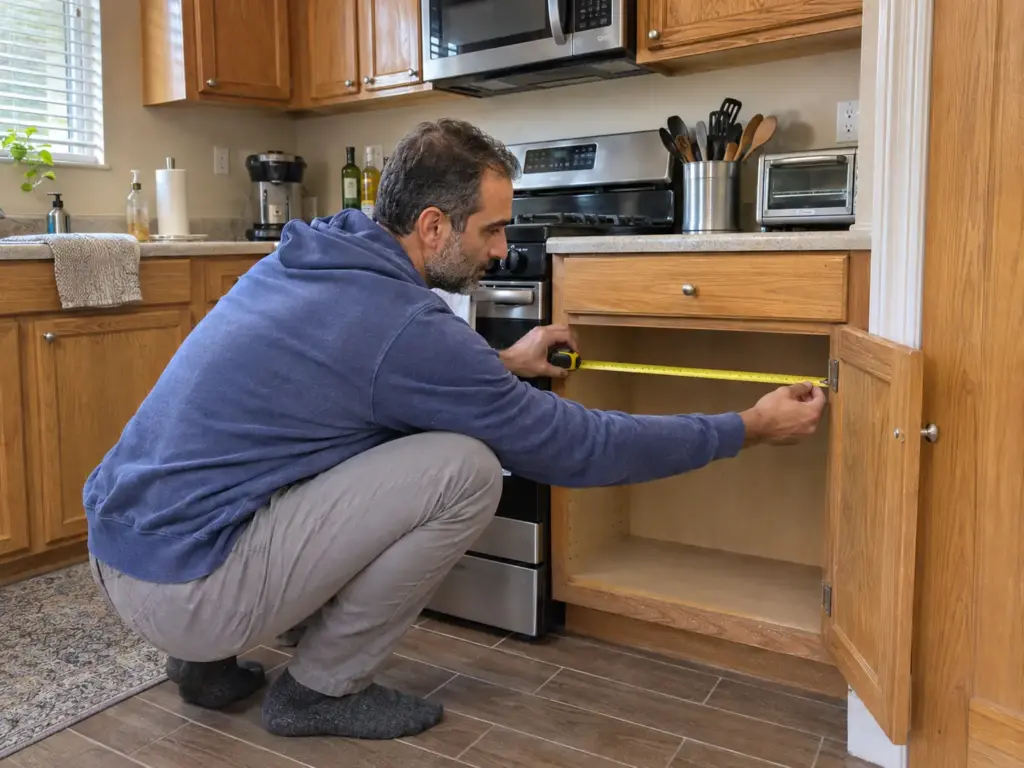
Measure from the left jamb to the right jamb, and take the narrowest reading, not the one at the top. Hinges, a face frame and the door itself eat width at the opening, and a bin that is as wide as the box inside will not pass through a narrower doorway. Write the number down and subtract the half-inch you need to get fingers around the piece when you slide it out. A piece that needs a shove to go in will be left on the counter by week two.
Interior depth, minus the door
Measure shelf depth from the front edge of the cabinet to the back panel, then subtract the thickness of the door, because a closed door sits in front of that space.
A standard base cabinet is 24 inches deep, and how deep a standard base cabinet actually is is the number most product pages quote. But “24 inches” is a nominal figure: an IKEA Sektion base measures 24.75 inches outside, with a 30-inch frame and a 36-inch counter height, so the inside is less than the label. Wall cabinets run 12 to 24 inches deep, and the Sektion upper is 15.5 inches. Anything deeper than about 11 inches in a wall cabinet starts to crowd the counter under it.
Deep spaces want the opposite check. A deep niche or a walk-in shelf swallows things at the back, so leave 20 to 25 percent of that shelf empty and the back row stays reachable.
Door swing and the walkway in front of it
A full-width door needs roughly its own width of floor in front of it to open, and that floor is shared with the walkway. The kitchen work zone needs 36 inches minimum, circulation runs 24 to 30 inches, and the combined minimum is 48 inches. A bench, a cart or a console that lands in that strip makes the door swing into a leg or a knee. Open the door fully before ordering anything that will stand in front of it, and mark the arc on the floor with tape.
The toe kick and the clear height under the shelf above
The toe kick is the recess at the floor, and it stops a rigid bin from sliding in flush: the front edge catches on the kick before the back reaches the wall. Measure how far it sets back, and how high it runs, then check the last number, the clear height from the shelf to whatever sits above it.
A bin taller than that gap does not “sort of fit.” The shelf above comes out, or the bin goes back. A bin much shorter than the gap wastes it, and a shelf riser is the cheap way to use the air above it.
If your taste leans lighter and warmer, the same shelf-depth method worked through for a pale Nordic look shows the chain carrying over unchanged.
Bins for cube shelves taper toward the base, so a bin sold for a 12-inch cube loses about an inch of usable width at the bottom while the shelf does not. Measure at the base of the bin, not the rim.
Closed Face or Open Face: What Each One Costs You
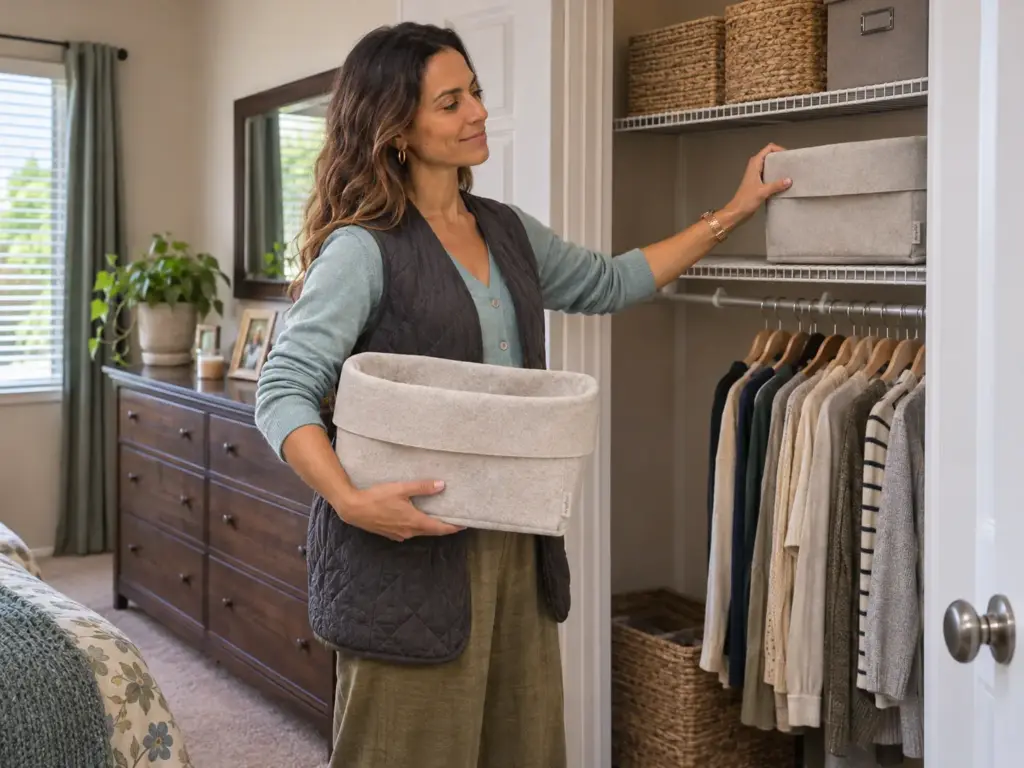
What a closed face hides, and the cost of not seeing
Modern storage is closed by default, and the cost of closed is that you stop seeing what you own. It is the apartment where everything looks clean and nothing can be found, because every drawer is full and nobody remembers where anything went. Out of sight, out of mind is the failure mode, said plainly: the bag of flour behind the door is gone as far as your shopping list is concerned.
What actually fixes it is not a prettier bin. It is a written location list, one line per closed shelf, taped inside the door or saved in a phone note. Keep 20 to 25 percent of every shelf empty too, because a packed deep shelf loses things whatever the face looks like.
Where an open shelf earns its place
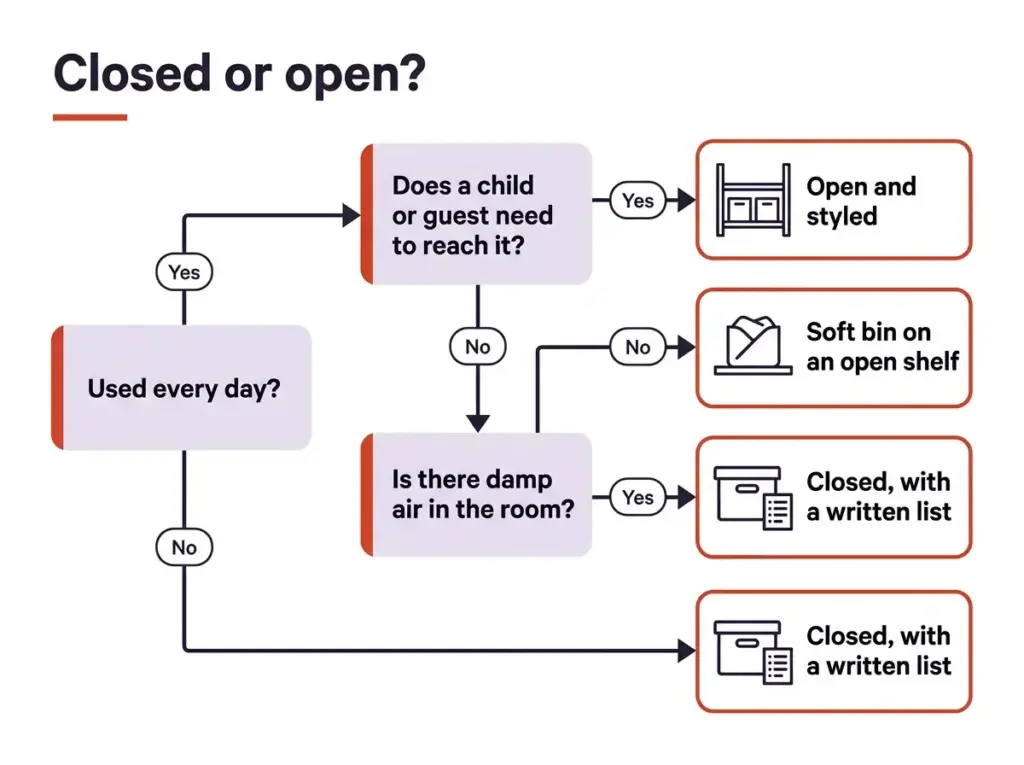
Display versus conceal is decided by how often the hand goes there, and open wins for the things used every day. Open-front or clear-front bins put the daily items where the hand lands without a door in between, and closed boxes are left for what rotates on a quarterly schedule. It also wins for a child who has to pull the bin out himself: in that house the open face is a feature, not a style choice.
The contradiction deserves saying out loud. Closed is the rule for a calm look, yet a closed face on the thing you use daily is the first to be abandoned, because opening a door twice a day is a tax. A modern home keeps a few open spots on purpose.
The list and the empty quarter that keep a closed shelf honest
The list says what lives where; the empty quarter keeps the back reachable. Together they are the whole maintenance system for closed storage. Boxes that are closed and rarely opened need a trip through them too, and a seasonal rotation that makes the boxes at the back get opened puts that trip on the calendar instead of leaving it to good intentions.
Start with clear boxes while the categories are still being found. Once the same category has filled the same box for a few weeks, you know it deserves an opaque one.
Felt and soft bins as a closed face on an open shelf
The middle path between closed and open is a soft bin. A lidded woven basket from the hall closet does the same job for free, so test that in the gap first. If the basket works and you want a set that matches, the SortJoy Small Flex Felt Storage Bins, a set of three in Stone, measure 14 x 7 x 9.5 inches each. At 7 inches deep they leave about 5 inches spare on a 12-inch shelf, and the 9.5-inch height sets the shelf gap you need.
They fold flat when empty. The catch is the soft sides: felt holds its shape only when the bin is full, so a half-empty one slumps.
Closed boxes that have to stack are a different buy, and which stackable bins keep their lip and which slide apart sorts them.
Bedroom: A Nightstand and an Under-Bed Space That Hide Everything
The nightstand that hides its own drawers
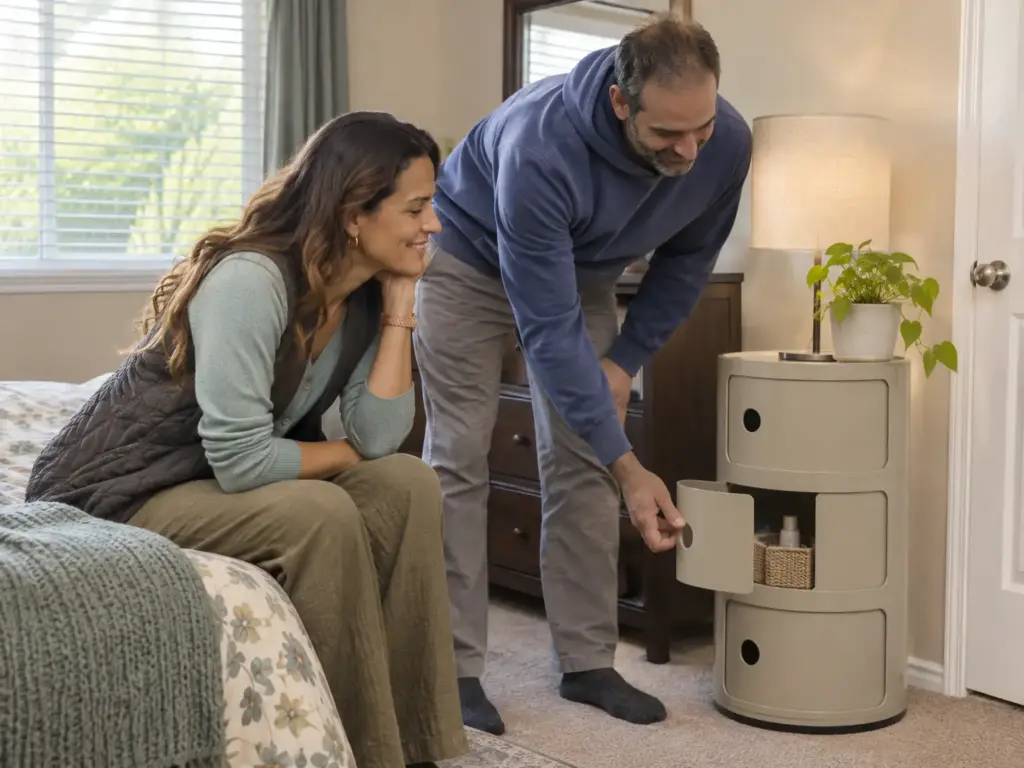
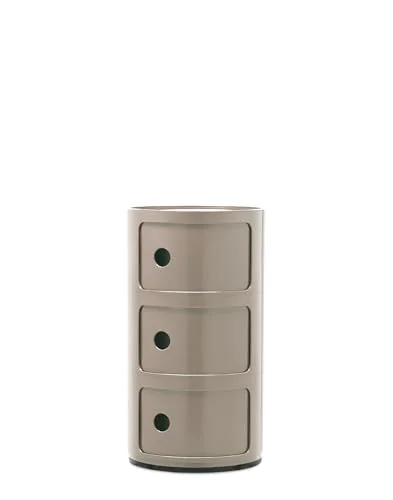
A bedside table turns into a landing zone for the things that had nowhere to go, and the fastest way out is a small lidded basket or box that fits the bedside gap. Do that first. A nightstand is the right buy when the job is a surface plus drawers, and the piece that does it with the plainest line is the Kartell Componibili.
Under the bed: measure the frame before the bin
Before any bin goes under the bed, measure the frame’s clearance, because the whole under-bed system, clearance first starts from that one number. The outer height decides whether a bin slides under; the inner height is what you can pack. The IRIS USA 50 Qt Long Under Bed Storage Bin is the clearance-first pick: 32.5 x 17.88 x 6.5 inches outside, 28.25 x 14.25 x 5.75 inches inside, with clear walls so the inventory shows and a latched lid.
Where it is weak is the plastic hardware. Handles can give out in the first week, and a lid now and then arrives with one side missing its latches, so check the latches the day it comes. A clear sweater bag is the cheaper alternative, softer and with no rigid walls.
The choice between the bin and the nightstand is really a choice between jobs. The clear bin hides things for less money and it is not a nightstand; it will not give you a surface to put a glass on. For low frames, container heights set against low bed frames lists what actually clears.
What to put where so the bed stays clear
Put the rarely needed things in under-bed storage (off-season bedding, a spare set of sheets) and the daily things within arm’s reach of it. A guest room with a tall frame and a deep platform gap takes the long, low bin on a sliding tray rather than a pile of loose ones, so nothing has to be dragged out on hands and knees. Leave the floor beside the bed clear. It is where your feet land first.
Kitchen and Bath: Closed Storage Where Water Lives
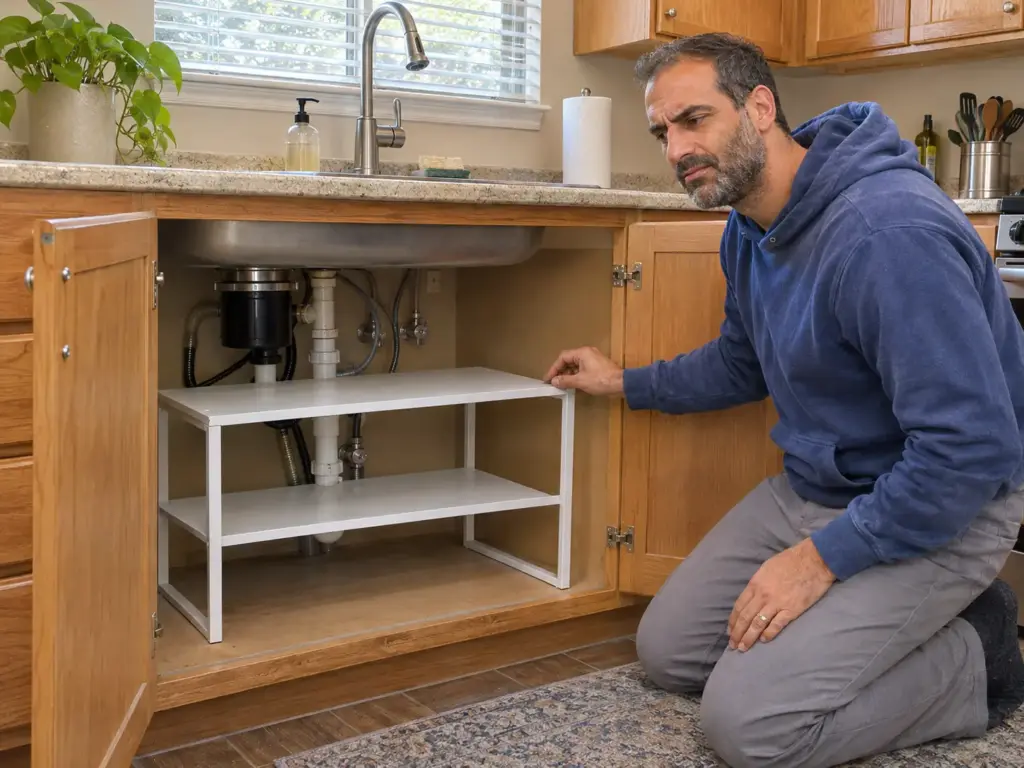
Under the sink: two tiers around the pipes
The cabinet under the sink has a problem the others do not: the pipes take the middle, and nothing can sit on the floor of it. Try a tension rod and a small bin you already have first. If that works but you want tiers, the Yamazaki Industries 2-Shelf Minimalist Under-Sink Organizer (model 3829) is a steel two-tier piece that works around the pipes, measuring 9.06 x 14.37 x 7.09 inches.
Steel holds the shape and the line is the plainest in the kitchen. The limit is that the height is fixed, so check the clear space under the sink before you order. A plastic two-tier rack tiers the same way, with less rigidity. A cabinet with no pipes through the middle can take a pull-out shelf instead.
Where the drain sits decides everything here, and the pipe measurements the under-sink pick depends on walks through taking them.
The vanity counter: fixed sections for the small things
A small bathroom is where the spare charger ends up in the drawer with the hair supplies, because the room is small and nobody decided otherwise. In a studio, the geometry of the space decides what goes where, not the name of the room. For the counter, the YAMAZAKI Home Skincare Organizer 2427-P in white gives fixed sections for swabs, tips and clippers, and the steel-and-white look keeps the palette.
Read the dimensions before you fall for the photo: 3.94 x 6.3 x 3.54 inches and a 2.2-pound capacity, much smaller than a vanity photo suggests, and the lid can pop off. A set of lidded jars or a plain drawer divider does the cotton-swab job without the brand.
In a bathroom, buy for the drawer you have, not the drawer in the photo. Measure its inside length and width, then pick a tray at least a quarter inch shorter so it comes out without scraping.
A wet room is a schedule, not a style
A closed cabinet in a bathroom or a laundry closet is where damp air sits against a panel. According to the EPA, “Indoor relative humidity (RH) should be kept below 60 percent — ideally between 30 percent and 50 percent, if possible.” So air the cabinet, do not pack it to the door, and look inside on a schedule. Ten seconds a week with the door open is enough to catch a problem early.
The finishes are what the eye catches: a dark matte panel shows marks, and a felt bin gathers hair, so match the finish to the traffic in the room and how often you will wipe it. For the bathroom cabinet, P-trap measurements and humidity-safe materials for the bathroom cabinet go further. In a laundry closet, see what damp air and lint do to storage in a laundry room. A guest bath nobody opens needs the opposite treatment: leave the door ajar to air.
Living Room: The Open Shelf and the Piece With a Lid
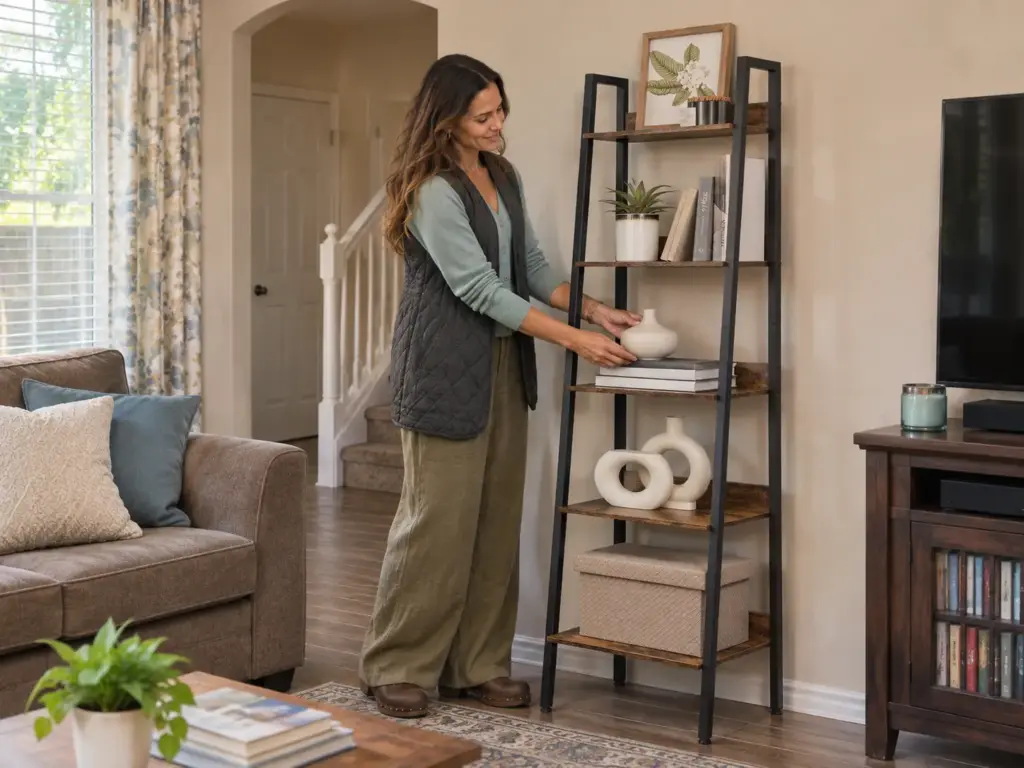
A narrow open shelf, styled instead of filled
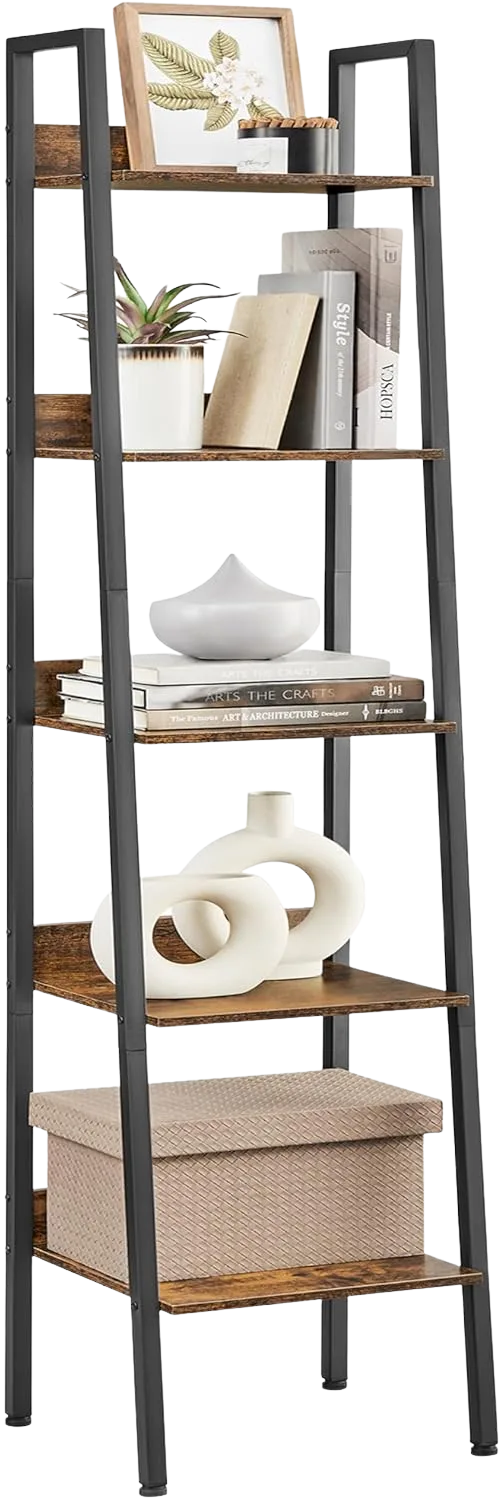
The tall shelf that looks light in the photo fills the wall once it is up, and depth is why. Styling open shelves is mostly subtraction: before you buy, edit a bookcase or ladder you already own down to a third of its contents and see whether the room feels different. If it does, the VASAGLE 5-Tier Narrow Ladder Shelf is a cheap way to get vertical display with real numbers. If the open face turns into a pile, how to keep a bookshelf from turning back into a pile covers the habit side, and the same closed-versus-open call on a TV stand is weighed in closed fronts against open fronts on a TV stand.
The bench with a lid: depth that stays out of the hallway
The ottoman sits at the end of the sofa until somebody has to open it and finds that the spot was the walkway. Fifteen inches of depth is the number that keeps a lidded storage bench out of a hallway; the 36 inches of standing room still has to be clear after the lid is up. The SONGMICS Storage Ottoman Bench measures 43.3 x 15 x 15.8 inches, holds 30 gallons, and carries 660 pounds, so the lid takes a person, and it has a removable divider.
The size runs mixed and the finish reads as budget, so treat the dimensions as a hard fact and the finish as a modest one. A lidded wicker basket is the budget version and carries no weight at all. To weigh it against other lift-top pieces, see the lift-top and ottoman decision worked out with clearances.
Anchoring a tall piece to the wall, and the version for a renter
Every tall cabinet with doors, drawers or shelves can tip, and a narrow cabinet that looks too slim to fall is no exception. According to the CPSC’s Anchor It campaign, “Anchoring all furniture with drawers, doors, and shelves to the wall prevents tip-over injuries and deaths.” So the anchor decision happens before the piece is bought.
Find the stud spacing with a stud finder first, because screws into a stud hold a tall unit, and adhesive holds light things only; what adhesive can and cannot hold draws the line. When the lease says no holes, choose the low piece instead of the tall one.
A family room wall in a big house can take the tall unit with a stud-anchored fix. The open face still needs the empty-quarter rule from earlier.
Making Loose Pieces Look Built In, and Keeping Them That Way
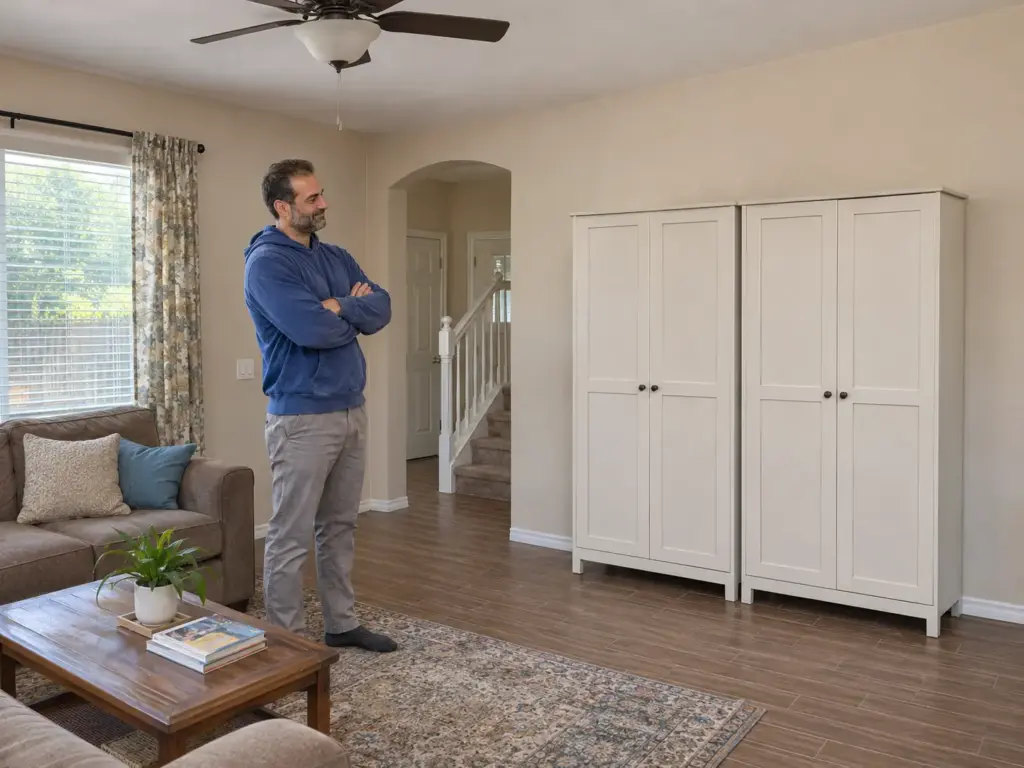
Four moves that make a loose piece read as built in
A pale cabinet is right in the shop and wrong against the actual wall when it sits two inches proud of the baseboard, in a slightly different white. The built-in look is geometry, not a claim about a material, and it takes four moves.
First, a flush front, lined up with the edge of the wall unit beside it. Second, paint matched to the wall. Third, a hidden or push-to-open pull so no handle breaks the line. Fourth, a toe kick that lines up with the baseboard.
Finish matters too, and the material decides how it ages: painted MDF chips at the corners, veneer lifts where water reaches it, acrylic scratches, and powder-coated steel is the one that shrugs off a wet cloth. Tie the finish to the traffic and to how often you plan to wipe it. The same eye for finish, applied to a desk, is in how to read the finish of a piece and hide the equipment.
The same look without a drill
For a renter, the loose piece has to read as built in without anything on the wall except light items. Pick a freestanding storage unit with a face the width of the wall, a base cut to line up with the baseboard, and nothing mounted that the lease objects to. A tall piece is anchored only where the lease allows; otherwise, go for the low piece. A long wall in a garage or family room takes the same four moves over more distance, and the work there is to keep the line, not to add pieces.
Hold a paint chip of the wall color against the piece in daylight before you commit. Two whites that match under shop lights can drift apart by the window.
One reset a year, so the set stays a set
The odd new bin enters the house in March and has company by June. Once a year, take everything out of one zone, throw out the odd one, check the written list against what is really on the shelf, and bring new bins in only if they match the set. The budget rule holds here as well: use the lidded basket you have before buying another box. That annual edit is what keeps a set a set.
Measure Once, Keep a List, and Check the Back of the Shelf
Modern storage solutions fail on the measurement, then on the closed face, and seldom on the piece. Take the five numbers in order, choose the face by room, keep wet rooms aired, anchor anything tall, and buy the next piece against a number instead of a photo. The look follows from that.
The check for later is simple. Pick one closed shelf and look at the back of it at your next yearly reset, with the written list in your hand, and see whether what is on the list is what is on the shelf. Missing things and doubled things tell you where the system slipped.
Today, take one closed shelf, put everything on it onto the floor, and compare it with the list in your head. Notice what is missing and what turns up twice.
Frequently Asked Questions
01How do you create storage space in a home that has no built-ins?
Start with the gaps already there: under the bed, the shallow wall, the end of the sofa and the cabinet under the sink. A piece measured for each gap adds more storage than a bigger room would.
02What is cheaper than a storage unit?
The space already inside your home costs nothing a month. Under-bed bins, a lidded bench and a narrow vertical shelf each hold what a rented unit would, without a bill that keeps arriving.
03Is closed storage or open shelving better for modern storage solutions?
Closed suits what should not show, and open suits what you use every day. The cost of closed is that you stop seeing what is there, so keep a written list and leave a quarter of the shelf empty.
04Do tall modern storage pieces need to be fixed to the wall?
Yes, furniture with drawers, doors and shelves should be anchored to the wall, as the CPSC advises. When a lease rules out holes, pick the low piece instead of the tall one.
05How do you make freestanding storage look built in?
Match the wall’s paint, line the base up with the baseboard, and choose a flush front with a pull that does not stick out. Those four moves read as built in even when nothing is fixed.
Disclaimer: ClutterlessNest is a participant in the Amazon Services LLC Associates Program. As an Amazon Associate we earn from qualifying purchases. This article may contain affiliate links — if you buy through them, we may earn a small commission at no extra cost to you. We only recommend products we have tested or genuinely believe in.