

The pale bins went up, the shelf looked calm for a few days, and now one container of the wrong size sits in the row and the whole look has slipped. That is where most neutral home organization ideas end up when they come from a tips list: the palette is the easy part, and the system under it is what gives way. Pantry shelving is sold in 12, 16 and 20 inch depths, and almost no neutral guide tells you which one a set of bins was built for, so the set fits one shelf and fights every other. Here is the order a real home forces on you: the cut before any container, the palette and materials, the clear, solid or woven decision, the shelf-depth fit, the budget and no-drill version, and the labels and weekly reset that keep it all in place.
Quick Answer
A neutral system holds when you build it in this order:
- Cut the stuff first, because a bin only moves clutter from one place to another.
- Pick one palette and one material family, so mismatched brands read as a single set.
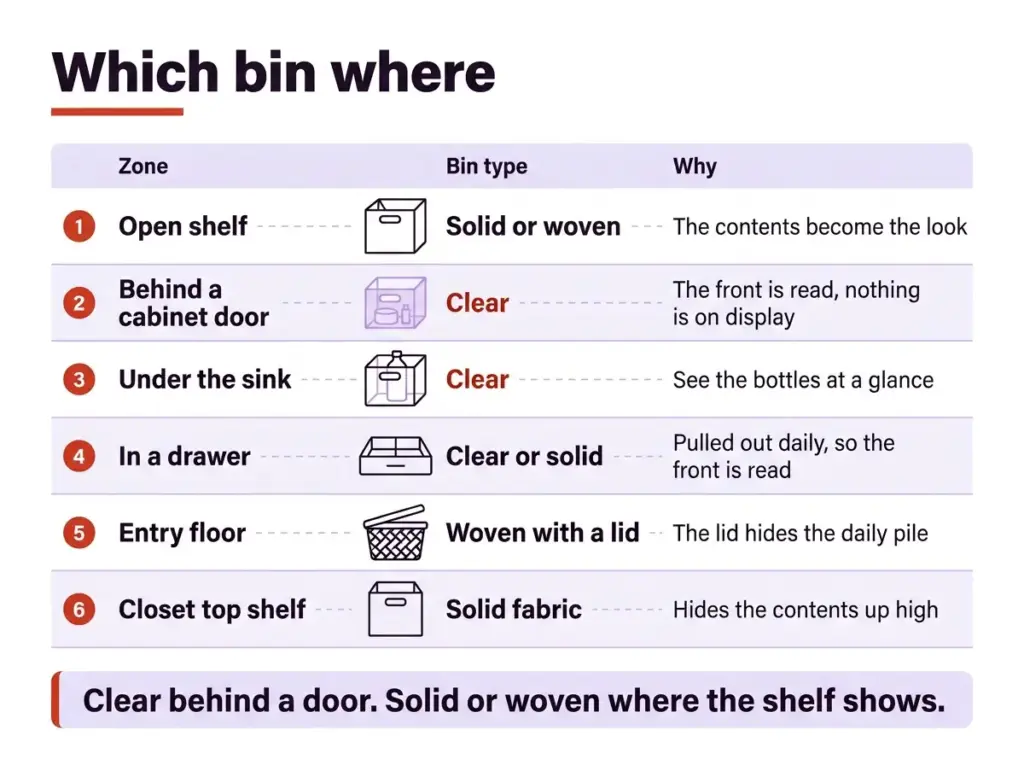
- Choose clear, solid or woven by how visible the shelf is: clear behind doors, solid or woven in the open.
- Measure the shelf depth and the tallest item first, since bins are sized for shelves, not for rooms.
- Label every container in one font, one color and one size, so twelve jars read as one system.
- Reset one shelf a week and keep one planned exception for the odd-sized item.
Neutral Home Organization Ideas Start With What You Cut, Not What You Buy
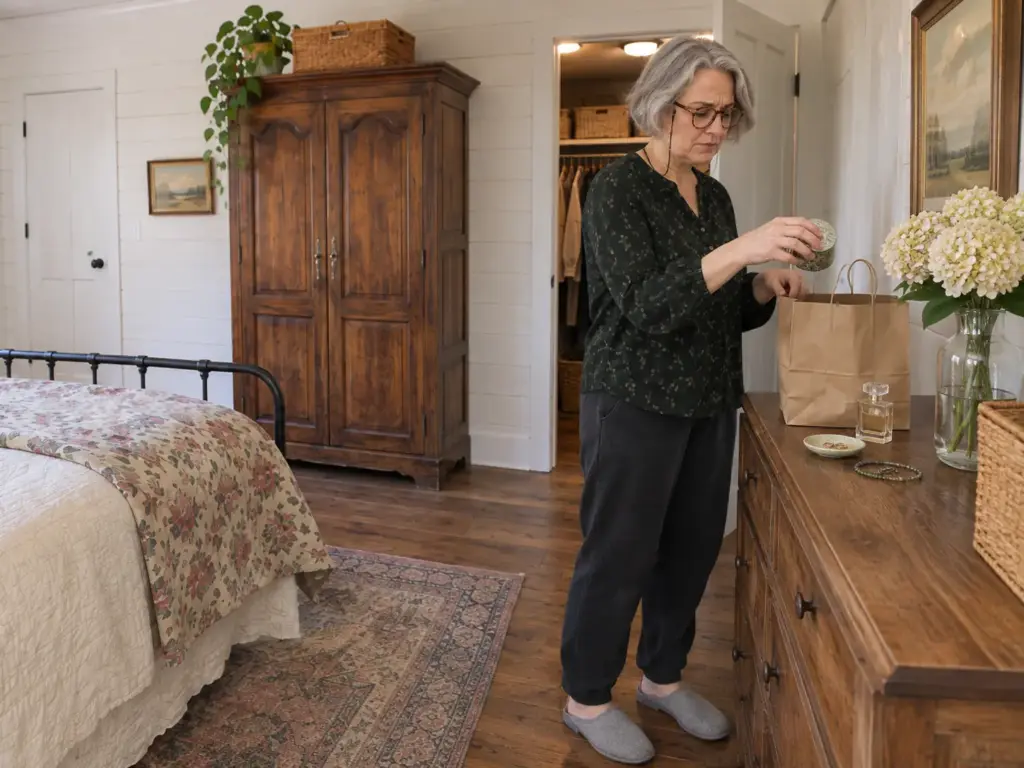
If your new matching bins are already packed to the rim and the shelf still looks busy, the bins did exactly what bins do. They hold what you hand them. A fabric cube that arrives on Friday and is full by Sunday has not organized anything; it has dressed the surplus in a better color.
The bin trap: containers bought before the stuff is cut
Treat every shelf, drawer and box in the house as a container. When one overflows, only two moves exist: a bigger container or fewer things inside it, and no bin on the market changes that arithmetic. It is how a home ends up with containers and bins abound, every one of them packed, and a room that still reads as a clutter warzone in a nicer shade of storage. A minimalist approach that skips the bin trap starts from the same point: declutter first, container last.
The quieter version of the failure is the closet that looks calm from the doorway and has the surplus in bags at the far end. That is tidy-looking overflow, and it is the same overflow, hidden. When a shelf system is at capacity, no basket fixes it.
One flat surface at a time
The cheapest neutral move costs nothing. Pick one flat surface (the kitchen counter, the top of a dresser, the entry table) and take everything off it. Decide item by item: it stays, it moves to a better home, or it leaves. Stop when that surface is done, not when the room is done.
Most storage complaints turn out to be stuff on stuff, one surface asked to be a shelf, a drawer and a bin at once. Clear it and you see what actually needs a container and what only needed a decision.
What the donation bag leaves you to buy
Bag and donate first, then buy the container for what is left. A donation bag that lives by the door keeps the outflow going after the first pass, because the second round of decisions arrives on an ordinary day when you pick something up and know you are finished with it.
The best first purchase is often nothing at all. A sink with five hairbrushes on it and no drawer is a zone with no home, and no matched set fixes that; it needs a spot for the brushes, and the spot might be a hook, one fewer brush, or a set of drawer dividers or drawer organizers. Once the cut is done the container list gets short, and every item on it has a shelf in mind. The look comes after that, and the wider guide to neutral and modern organization defines it in full.
Pick One Palette and One Material Story
Three bins in three slightly different whites look wrong together, and the reason is rarely the brand. A neutral set needs two decisions made once: a short list of colors and a family of materials. Make both and mismatched brands start to read as one coordinated storage set.
The palette: warm white, oat, taupe, sand and greige
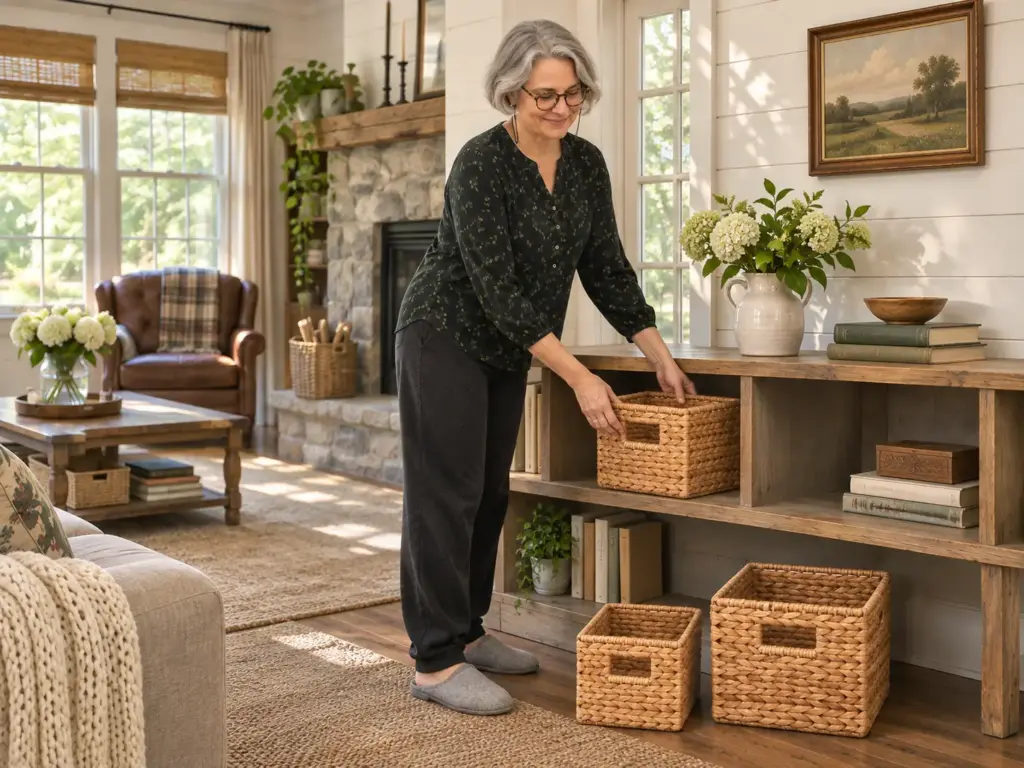
Warm white, oat, taupe, sand, greige and a muted clay all sit comfortably together because they share an undertone. What breaks a set is temperature. A cool, bluish white next to a creamy one looks like two shipments, even when both boxes say white. So choose the temperature before the color, and the shade follows.
Bright white is the obvious first pick, and I would steer most shelves away from it: it shows every scuff and it clashes with any cream nearby. Warm white is the safer base. And color is only half of visual calm, because the matte finish has to agree too: matte reads calm, while a glossy bin parked next to a matte one reads as a second set, however close the shade.
Set the bins on a windowsill in daylight before the palette is final. Whites that look identical under a bulb split into warm and cool in daylight, and the shelf will be seen in daylight.
The material story: woven, glass and matte plastic
A palette alone gives you a flat room. The material story is what makes a neutral home look finished instead of sterile: natural fiber for texture, glass and matte plastic for clean edges. In practice that means one woven family on the shelves people see, one glass family in the pantry, and plastic only where it is hidden or matte. The aesthetic guides run the same logic as one repeated material and one job per surface, which is a useful brake when a third material starts to sneak in.
Decanting is what turns packaging into one palette. The food stays the same, the container becomes the look, and glass jars with a bamboo lid are the pantry’s version of the story. Whichever fiber you choose, water hyacinth, rattan or seagrass, stay in that one family.
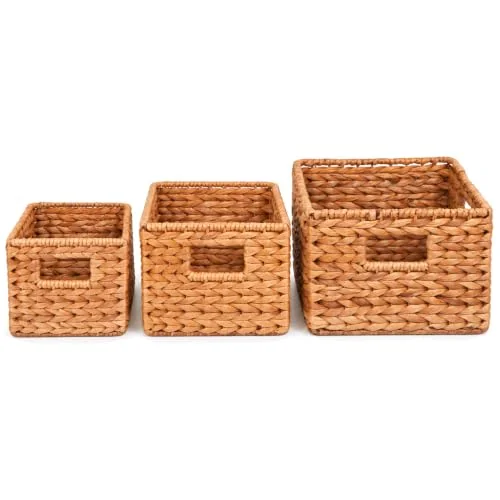
For the woven half, the Honey-Can-Do Woven Water Hyacinth Nesting Baskets come as a graduated set of three, 9, 10.5 and 12 inches square, enough to cover a bathroom shelf, a pantry shelf and a closet top shelf from one family. The largest takes up half of a pantry shelf, so tape its footprint on the shelf before deciding. A cheaper woven option comes up in the budget section.
Where one muted accent still fits
One deep tone fits inside an earthy neutral: the sage of a fabric bin on a high shelf, or a single clay-colored basket. Wood accents count too, so keep them to one tone.
Three accents are a different style, and the room stops reading as neutral. Test it by imagining the accent gone; if the shelf would not notice, it is the right accent. Japandi rooms use a tidy cap of their own, one wood tone and one weave per room, and it works as an accent limit for any neutral palette.
Clear, Solid or Woven: The Choice That Decides Which Bins Fail First
You bought clear bins because they photograph well, and now every half-empty bag, scuff and fingerprint shows from across the room. That is the clear bin doing its job in the wrong place. Where a container sits decides how opaque it should be, and that one decision makes a neutral system either calm or exposed.
Where clear bins earn their place
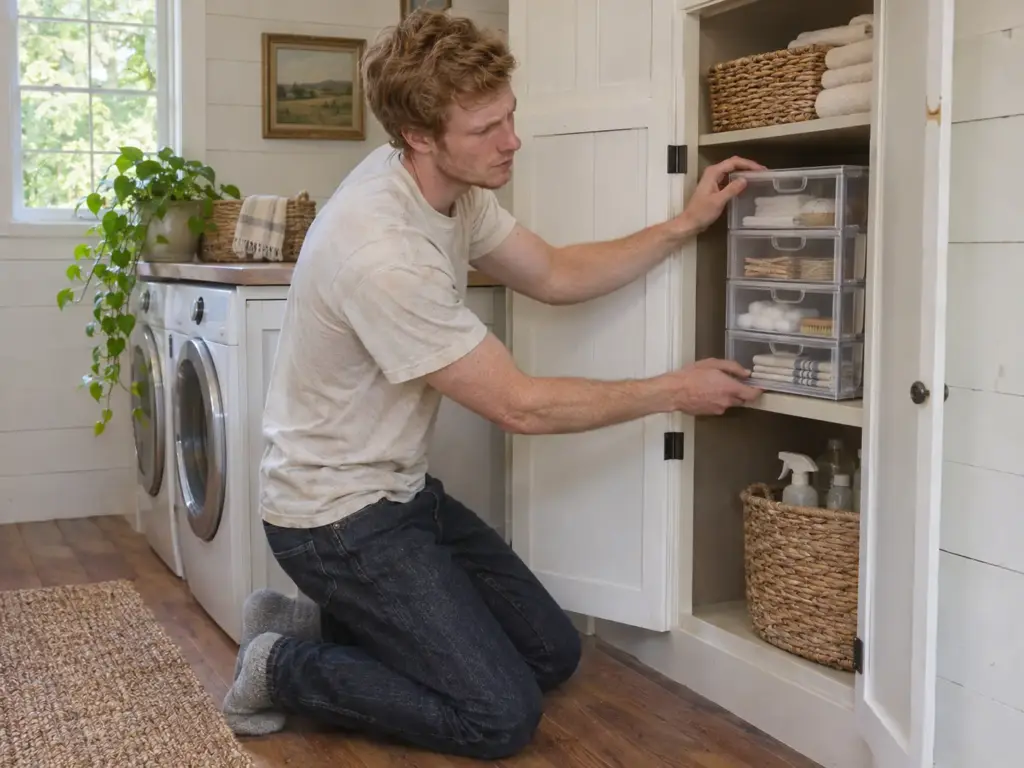
Clear works where the contents are uniform and the bin gets pulled out daily: behind a cabinet door, under a sink, in a drawer. That is hidden storage, so the clear front is read and nothing is on display. Clear trays from Dollar Tree or any dollar store do this job in a cabinet nobody sees, so try that route first.
For an under-sink bin that has to sit still, the Vtopmart 4 Pack Small Clear Stackable Storage Drawers are the clear pick: they stack without sliding, and the number that counts is the drawer opening of 6.9 by 5.4 by 3.7 inches, not the 7.5 by 6 by 4.4 inch outside. The inside is smaller than the photo implies, so tape those three measurements on the cabinet wall before ordering, and wash them by hand.
Measure the opening, not the box.
Why an open shelf of clear bins shows every bad week
On visible storage such as open shelving, the light hits the plastic and the contents become the palette. Every mismatched packet, every half-used bag of rice and every fingerprint turns into part of the look. An all-clear or all-white system has no place to hide a bad week: the week the groceries pile up, the shelf looks like it failed, even though the system is fine. One opaque or woven container in the row absorbs the overflow, while a clear one broadcasts it.
There is a flip side that explains why the look sometimes works. A closet sorted by color, the way a shop rail is, stops being dug through, and that is the look doing a job because the order is built in. A look with no order behind it is a facade, and a clear shelf shows the facade for what it is.
Solid and woven: where mess turns into texture
Solid fabric and woven fiber take the same mess and turn it into texture. A slightly overfilled woven basket looks lived in; a slightly overfilled clear bin looks like a mistake. Woven is also the one family that gets better with age in a neutral room, and it brings two flaws: dust settles in the weave, and there is no lid, so the basket suits things handled weekly, not stored for a year.
Solid fabric makes the opaque bins: linen bins or canvas bins hide the contents completely, which makes them the better call for a high shelf nobody looks into. If the type of bin is still undecided, how to choose bins and containers that last covers the choice material by material.
The one rule: never mix all three in one sightline
Put clear behind a door, solid or woven where the shelf is visible, and never use all three in one sightline. The eye reads the line from the doorway, and three opacities in one glance read as three different sets. Two at most in any single view, with the third kept behind a door.
A bathroom asks the same question with a second one attached: what the finish does when it is damp. Woven fiber holds moisture longer than a wipeable surface, so the open-shelf container in a wet room is usually solid and easy to wipe. The same decision in a wet room is worked through for bathroom shelves.
Match Every Container to the Shelf Depth and the Routine
Your basket sticks out past the shelf edge, or your bin sits so far back that the back row never gets touched. Both are the same mistake: a container bought for the room instead of the shelf it will sit on. Every number here is measurable, and a tape measure ends the guessing.
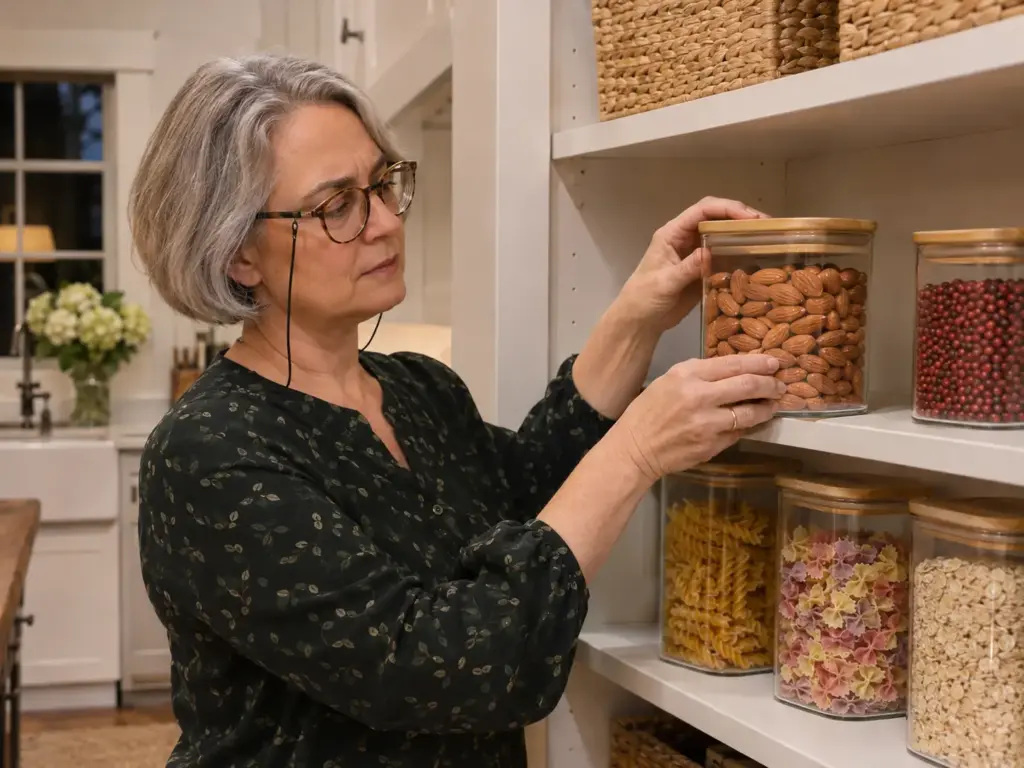
Pantry: the 12, 16 and 20 inch shelf problem
Pantry shelving ships in 12, 16 and 20 inch depths. On a 12 inch shelf one row of bins fits. On a 20 inch shelf the back row disappears behind the front one and the shelf becomes a cave of dead space.
Food storage is comfortable at 14 to 16 inches, and the usual instinct is to go deeper for more room; past 16 inches, though, the extra depth is mostly lost to reach, and the best storage is the part you can get your hand to. Buy bins 10 to 12 inches deep and leave a hand’s width at the front, because that gap is what lets you pull the bin out.
Shelf spacing is set by the tallest box, not the bin. Measure the cereal box first, then the bin.
Cut a piece of cardboard to the bin’s footprint and set it on the shelf. It shows the hand’s-width gap at the front, the clearance over the tallest box and whether the door still closes, and it costs nothing.
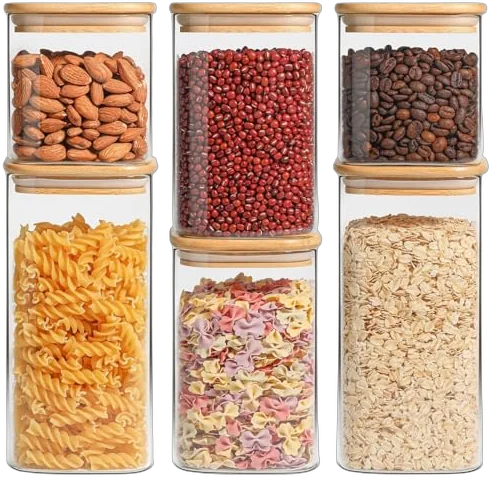
Square glass fits that geometry best. The ComSaf Airtight Glass Canister Set has a 3.9 inch square footprint in three heights, 0.7, 1.2 and 1.6 quarts, so two fit front to back on a 12 inch shelf with no wasted gap. Reused jars with the label on the lid do the same job for free, and the glass set earns its place for dry goods you decant every week. The seals draw mixed reactions, so test the lid on the first day before the jar holds anything that goes stale.
For the full shelf build, a pantry that works after the first week covers zones and routines, and the same depth logic runs through Nordic rooms in storage cut to real shelf depths.
Cabinets: shallow uppers and deep lowers
Kitchen upper cabinets run about 12 inches deep and lowers about 24, the standard in kitchen planning. Uppers swallow very little: a tall bin there blocks the door and ends up on the counter. Lowers are where deep bins earn their place, since a long bin still leaves room to reach past it.
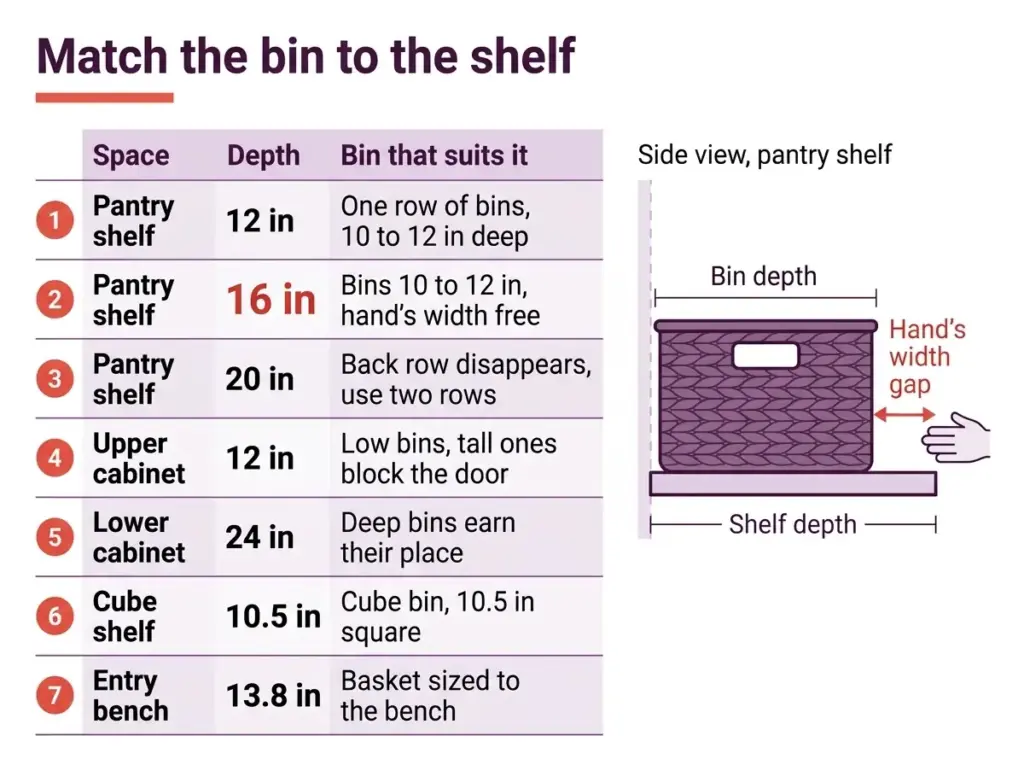
Take those two depths to organizers sized for each cabinet type, which runs the same fit math cabinet by cabinet.
Closets and cube shelves: the shelf is the limit, not the bin
Cube units and closet shelves flip the problem, because here the bin is rarely the weak part; the shelf is. A fabric cube holds about 11 pounds, so a shelf of six full cubes is around 66 pounds, and the shelf has to carry it. Cardboard boxes with kraft labels do the same job for the least money and make a good test of the layout.
When the layout works and you want one uniform finish, the DECOMOMO Storage Bins set of six in sage green measures 10.5 by 10.5 by 11 inches, takes 11 pounds per bin and has label holders on both sides, so the bin reads from either end of the shelf. Opaque fabric on a high shelf keeps the look and hides the contents, and the muted green is the single accent the palette allows.
Nothing should stand above the rim. A full bin reads as clutter even when it is tidy.
On the closet rod, uniform hangers do the same job as the bins: slimline hangers in one color make the whole rail read as a set.
This is also where the orphan bin first shows up: a wrong-sized bin lands on the shelf because it was the right size for one item. Measuring prevents it here, and the last section covers what to do when it happens anyway. For the closet itself, closet organization that holds up handles rods and shelf heights.
Get the Same Look on a Budget or Without Drilling
You priced a full matching set and nearly gave up on the look, or the version in the photos needs a drill your lease forbids. Neither is a wall: a budget-friendly version carries the same look. The look is carried by four cheap moves, and none of them is the price tag.

What the boutique version buys, and what it doesn’t
The four moves are one finish, one label style, containers that all reach the back of the shelf, and nothing above the rim. The boutique version charges more for none of them. What the pricier set buys is thickness and a lid seal, such as 2.3 mm borosilicate glass with silicone-ring lids, and that is a real upgrade for a canister that holds flour for a year. It does not upgrade the look: a budget rope basket and a pricier one read the same from a few steps away.
The free options come first: reused jars with the label on the lid, shoeboxes wrapped in plain paper, cardboard boxes with kraft labels, and tape and a fine marker cut to one height. For a cheap woven look, the Togous 3 Pack Small Woven Cotton Rope Baskets measure 7.09 by 7.09 by 3.15 inches each, round and shallow. They catch what a drawer catches (keys, remotes, hair ties), not folded towels. They arrive squashed flat and need round objects inside to hold their shape, so fill them the day they come.
Renting: lean, hang and stand, don’t mount
Renters get the look from adhesive and leaning pieces on the walls and freestanding boxes and benches on the floor. A closed cabinet earns its space only when the lease allows one more piece of furniture. Where two households share one run of shelves, a partner who moved in or a grown child back home, the work is closer to Tetris than to mounting: stack, nest and fit pieces together, and keep boxes out of the shared storage first, since half the shelf per person leaves no room for them. None of it needs a drill to look right.
Owning: closed storage where the mess shows first
Owners can close things in, and the entry is where the neutral look fails first: shoes in a dozen colors and shapes, none of them in the palette. A closed white bench hides them. The Homleke Shoe Storage Bench with four doors is 13.8 inches deep, 45.3 wide and 18.5 high, rated for 300 pounds of static load.
The 13.8 inch depth is about a shoe’s length plus the door swing, which is why it fits a hallway. It is the premium option here, so the no-purchase version comes first: a lidded basket on the floor beside a bench you already have does most of the job.
Sturdiness is the bench’s weak point, with some units coming apart inside the first month, so tighten every fitting at assembly and check them again after a few weeks. For the rest of the entry, an entry that stays neat covers the entryway drop zone.
Anything with drawers, doors or shelves has to be anchored to the wall. According to the CPSC’s Anchor It! campaign, “Anchoring all furniture with drawers, doors, and shelves to the wall prevents tip-over injuries and deaths.” A closed bin, cabinet or bench you add is a tip-over risk until it is strapped, and the strap comes in the box.
Label It, Then Reset One Shelf a Week So the Look Survives
You did everything right in week one. By week three one basket sits crooked, a bag stands where a jar used to be, and you cannot point to the moment it slipped. The cause is not discipline, and it is not that you stopped caring.

Why neutral systems revert: the orphan bin
The mechanism is arithmetic. The set is bought for the shelf as it looks on day one. Then an item arrives that the set has no size for, a bag of rice, a box of tea, a stand-mixer attachment, and it goes into the nearest bin that fits, usually one from a different set.
That single orphan bin breaks the match for the whole shelf, and the eye goes straight to it. It is the same system failure behind when a styled shelf goes messy: matching containers placed only where they show.
The obvious response is to hunt for a perfect match, and I would not. Buy one spare container in the set at the start, or plan one exception on purpose: a woven basket that takes the odd-sized item. A planned exception looks intended. A wrong-sized bin forced into the set looks like a mistake, so the exception holds the look together better than the match does.
The second mechanism is the one from the clear-bin section: a system with no place to hide a bad week reads as failed the moment it gets busy, and the woven basket is that place.
Stand in the doorway and squint at the shelf. Whatever breaks the line of color or height is the orphan, and it names the container size the set is missing.
Labels: one font, one color, one size
Labels are what make twelve different jars read as one set: one font, one color and one size across every container. Neutral labels, black on white or clear, keep the palette intact; the budget method is tape and a fine marker, cut to one height, and it works as long as the handwriting stays steady, while a label maker holds the font steady for you.
A pre-printed set does it faster. The Talented Kitchen 157-Piece Pantry Label Set is black print on clear vinyl, so it disappears into any palette, and the vinyl is water-resistant, which helps in a pantry’s damp. If a label peels anyway, labels that stay on in a damp pantry covers the failure.
The label also does a second job. According to a NAPO professional organizer, “If you place the item in the SAME place every time, it will always be there!” The label fixes the spot, and a fixed spot is the only rule a household of more than one person reliably follows (the drawer somebody swears they will remember is never the drawer they use).
The weekly reset and one-in-one-out for containers
Reset one shelf a week, not the whole pantry: pull everything off, wipe it, decide, put back. One shelf is short enough that it actually happens, and the week it does not, the loss is one shelf. Apply the one-in-one-out rule to containers as well as contents: a new basket comes in, an old one goes out.
Most of the maintenance is the donation bag by the door, because it keeps the outflow going. For a pantry in particular, why a styled pantry fails and what works covers keeping one container family per shelf.
Keep the Calm: Cut First, Reset Weekly, Watch the First Shelf to Drift
Neutral organization ideas hold when the order is right. Cut the stuff first, pick one palette and one material family, keep clear bins behind doors and solid or woven where the shelf shows, measure the shelf and the tallest item, label in one style, and reset one shelf a week. Each step protects the next, and the cut is the one whose absence costs you the whole shelf, because a shelf is never clutter-free while it is over capacity.
For later, watch which shelf drifts first over the next few weeks and what arrived on it that the set had no size for. That item names the container you are missing, or the planned exception you forgot to make.
Today, take everything off one shelf, put back only what gets used weekly and bag the rest. Then notice whether the bin you were about to order is still needed once the shelf is half empty.
Frequently Asked Questions
01Where do I start with neutral home organization ideas?
Start with the cut, not the containers: clear one flat surface, decide item by item, bag what leaves, and buy only for what remains. After that, choose one palette and one material family so every later purchase has a rule to follow.
02Are clear bins or solid bins better for a neutral home?
Clear works behind a door, under a sink and in a drawer, while solid fabric or woven fiber works wherever the shelf is on show. An open shelf of clear bins displays every scuff and half-empty bag, so it is the first system to look messy.
03What is the most affordable way to organize my closet in neutral tones?
The most affordable way is to cut first, then reuse boxes and jars, wrap shoeboxes in plain paper and label everything in one style. Buy fabric cube bins or baskets only for what is left, and only after measuring the shelf.
04Do all my containers have to match exactly?
No, your containers do not have to match exactly, they have to share a palette, a finish and a label style across the whole shelf. One planned exception, such as a woven basket for the odd-sized item, holds the look better than a wrong-sized bin forced into the set.
05Can I get a neutral look without drilling into the walls?
Yes, leaning, hanging and freestanding pieces carry the neutral look without a single hole in the wall, and adhesive hooks cover light items. Freestanding closed storage should still be anchored where a child could climb it, using the strap in the box.
Disclaimer: ClutterlessNest is a participant in the Amazon Services LLC Associates Program. As an Amazon Associate we earn from qualifying purchases. This article may contain affiliate links — if you buy through them, we may earn a small commission at no extra cost to you. We only recommend products we have tested or genuinely believe in.