























In this article
Every time you reach for the one coat you actually want, you shove past four you never wear. In a small space, that’s the whole problem in a single motion: coats are the bulkiest thing you own, and they fight for the least closet you’ve got. The fix almost never starts with buying an organizer.
It starts with admitting you wear the same two or three coats all winter, then building everything around that. It’s the same edit-first logic that runs through the whole clothing-organization system, just applied to your bulkiest layer, and you can pull it off in a tight closet, a no-closet studio, or a rental where you can’t drill a single hole.
Quick Answer
Coats are the bulkiest thing a small space has to store, so the order matters more than the gear:
- Edit down to the coats you actually wear.
- Split daily grab-and-go from off-season.
- Go vertical with no-drill hooks and a tension rod.
- Swap bulky hangers for slim velvet.
- Compress off-season coats, synthetics only, never down.
- Dry every coat fully before it gets stored.
Start by Editing the Coats You Actually Wear
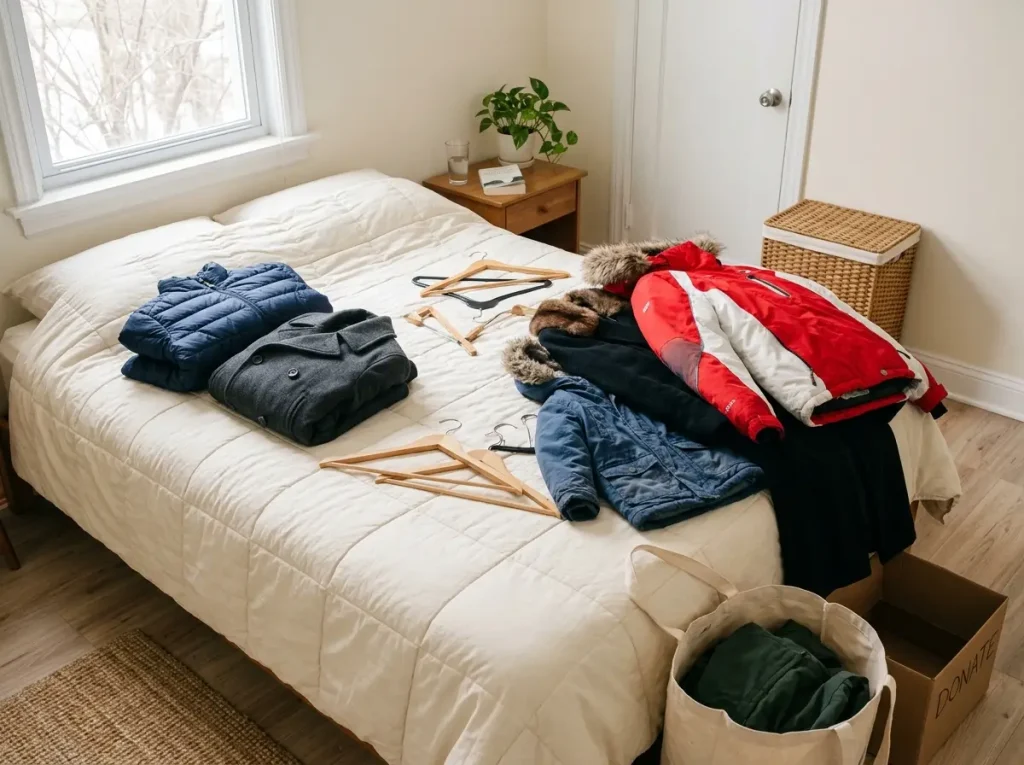
Before a single hook goes on the wall, count your coats and then count the ones you wore last winter. Decluttering your coats first is the step nobody wants and everybody needs, because the gap between those two numbers is why your closet is jammed. Professional organizers lead with this for a reason: a week has seven days, and most people rotate the same two or three coats while the rest just hold rod space hostage.
The “You Wear Three Coats” Reality
You own a coat for every hypothetical, and you dress for the actual weather. The dressy wool coat for an event you attend twice a year, the ski jacket from that one trip, the backup puffer in case the main puffer is wet, all of it lives in prime closet space it hasn’t earned. I used to think the answer to a stuffed coat closet was more storage. It’s almost always less coat.
A Fast Keep, Donate, or Repair Sort
Don’t agonize over a perfect system. Pull every coat out, then make three fast piles: keep, donate, and repair-or-toss. The only question that matters is “did I wear this last winter,” not “might I wear this someday.” Someday is what filled the closet in the first place.
From here on, run a one-in-one-out rule: a new coat comes in only when an old one goes out.
Where the Edit Always Stalls
The sort goes fine until you hit the sentimental and just-in-case coats, and that’s where most people quit. The donation bag stalls at the coat from a trip you loved and the one a relative gave you. Be honest that those are exactly the coats eating a small closet. Every one you remove is rod space you don’t have to build with hooks, bags, or bins, which makes the donate bag the cheapest organizer in this whole article.
Split the Collection Into Daily and Off-Season
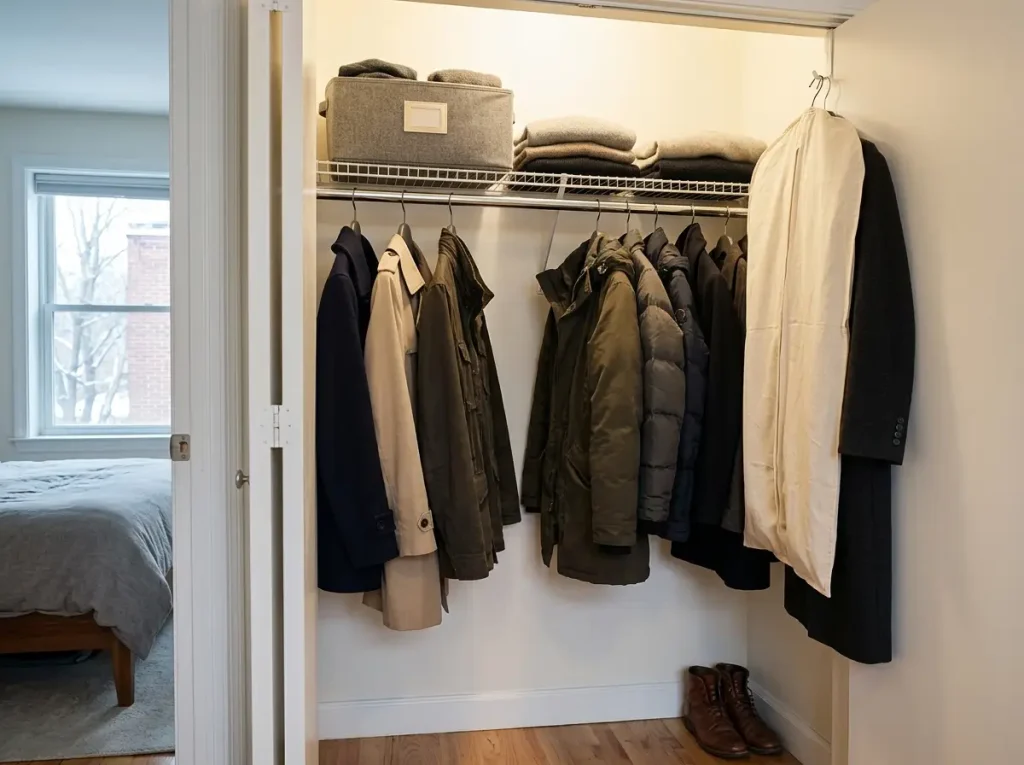
Here’s the move competitors imply but rarely name outright: the mistake isn’t where you store coats, it’s storing all of them the same way. The two or three you wear this week need to be grabbable. Everything else should be out of the prime zone entirely, and treating both groups identically is why a small rod feels full when you only wear a fraction of it.
Pull the Grab-and-Go Two or Three to the Front
Give your daily coats the best real estate you have: the front of the rod, the eye-level hook, the spot by the door. These are the grab-and-go coats, the ones your hand should land on without thinking. Everything you reach for on a normal Tuesday belongs here, and nothing else does.
Send Everything Else to Deep Storage
Off-season and overflow coats lose their right to prime space the moment they’re out of rotation. They move to compressed storage, under the bed, the top shelf, or another room entirely. The goal is simple: when you open the closet on a cold morning, you see only what you’d actually wear today.
Why the Split Is the Real Small-Space Move
It helps to know what you’re fighting. A standard reach-in closet is only about 24 inches deep, built for shirts, not parkas, so a single puffy coat on a hanger eats most of that closet depth and can stop the door from closing.
A small space punishes mixed zoning harder than a big one. When daily and off-season coats share one rod, you fight past wool overcoats every morning to reach the single puffer you want, and that daily friction is what makes the closet feel hopeless. Split the two and the same closet suddenly works. Every later step here, the hooks, the hangers, the vacuum bags, the drop zone, serves one side of that split.
Tape a sticky note inside the closet door with the date you did the edit. When you open it next fall and the note is older than a year, that’s your cue to re-sort before the season buries you again.
Go Vertical Without Drilling a Single Hole
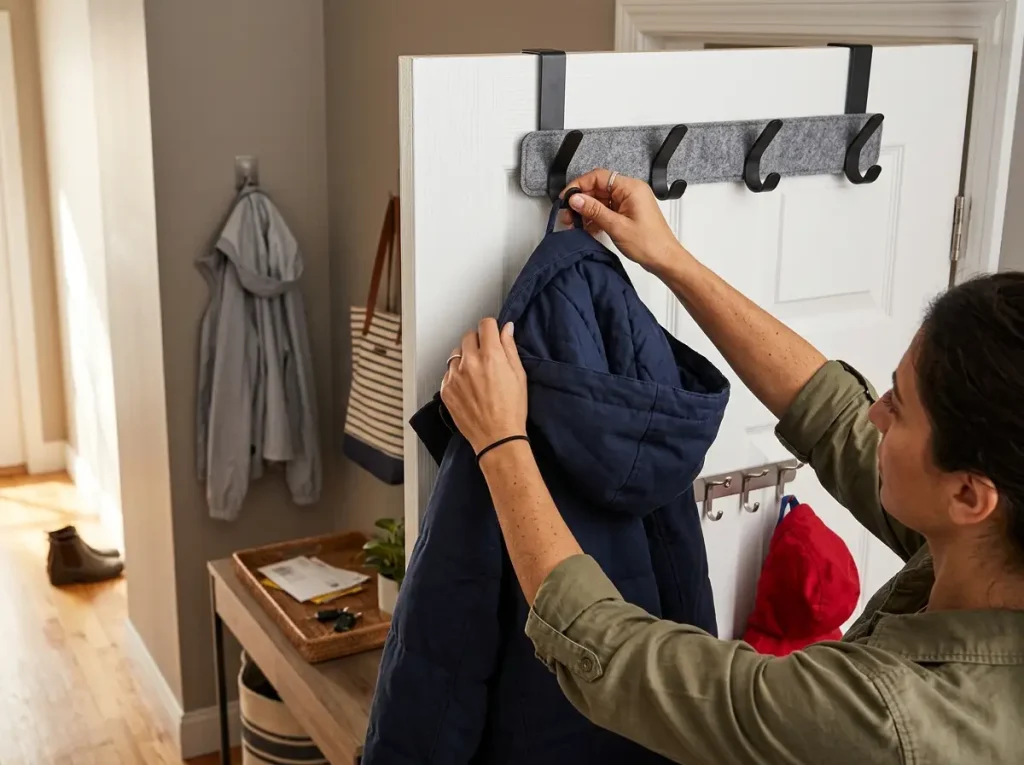
Vertical storage is the highest-value move once your floor and rod are full, but most guides point you at wall-mounted pipes and designer hook rails that need a drill, a stud finder, and a landlord who doesn’t exist. You don’t need any of that. Two rows of hooks fit in about two to three feet of blank wall, enough for a whole household’s daily coats, with no holes at all. Set one row at adult height and one lower for kids.
Over-the-Door Hooks (the Renter Hero)
The back of a door is the most wasted vertical space in any small home, and it’s where the renter solution lives. The 4smile Adjustable Over-Door Hooks hook over a standard door with zero hardware, and the felt lining means they won’t scratch it when you move out. Two strips give you an adult row and a kid row in a doorway you were ignoring. The one catch: the door still has to close over a bulky coat, so hang shorter jackets there and keep long parkas on the rod.
If you own the place and can drill, the Amazon Basics Wall Mounted Coat Rack is the permanent coat rail, but it needs holes, and the over-door route does most of the same work without them.
Adhesive Wall Hooks for a Real Coat Wall
For a true coat wall on bare drywall, adhesive hooks rated for real weight do the job. The Command 7.5 lb Jumbo Utility Hook holds a genuine coat’s weight on removable adhesive strips, and a few Command hooks spaced along a wall become a no-drill rack. For lighter jackets at a friendlier price, the Command Large Wire Hooks come in a bigger pack. Wall-mounted rails get recommended constantly, and they do work, unless you rent, in which case they cost you your deposit.
Rate every hook to the wettest, heaviest coat it will ever hold, not the lightest. A cheap adhesive hook that’s fine with a dry jacket is exactly the one that lets go under a soaked parka at 2 a.m. and takes the paint with it.
A Tension Rod for a Second Hang Zone
A spring-loaded tension rod turns any nook, alcove, or gap between two walls into an instant second rod, no tools required. The ALLZONE Tension Curtain Rod wedges in with spring pressure and gives you a whole extra place to hang overflow or off-season coats. Just don’t load a row of wet wool on it, since tension holds light to moderate weight, not a soaked wardrobe. If you’d rather double up the closet you already have, the STORAGE MANIAC Rod Doubler clamps onto the existing rod and adds a lower row, which is perfect for a kids’ coat zone.
These no-drill picks lean on the no-drill weight ratings that actually hold, so check those before you load anything up.
Switch to Slim Hangers and Reclaim the Rod
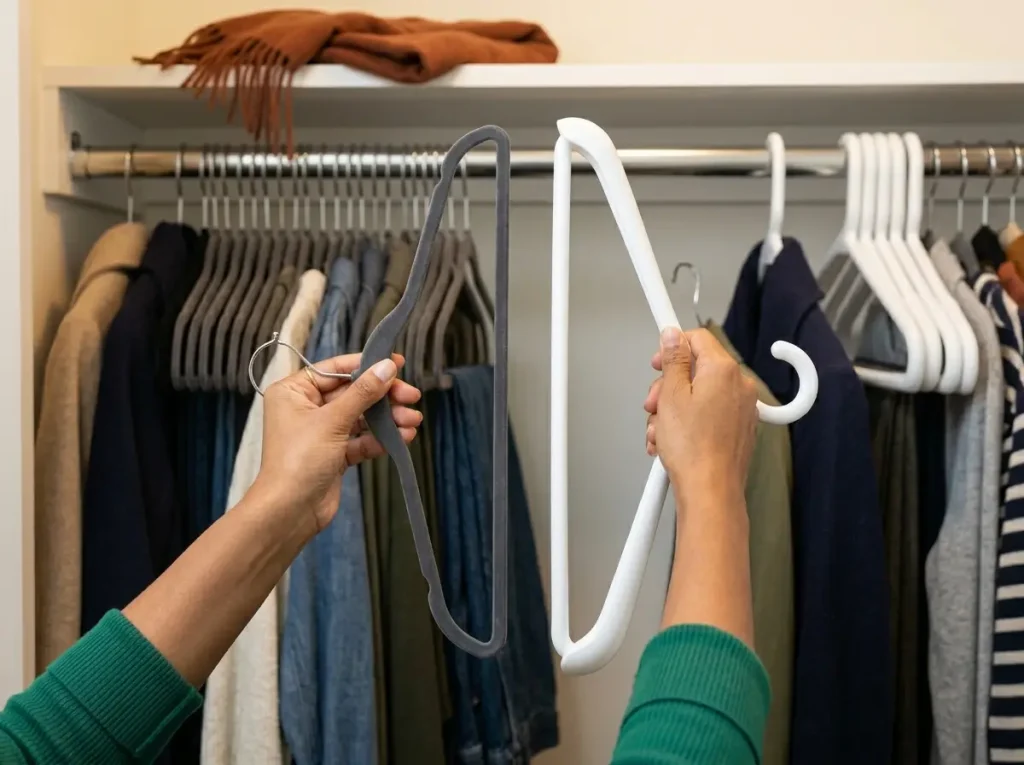
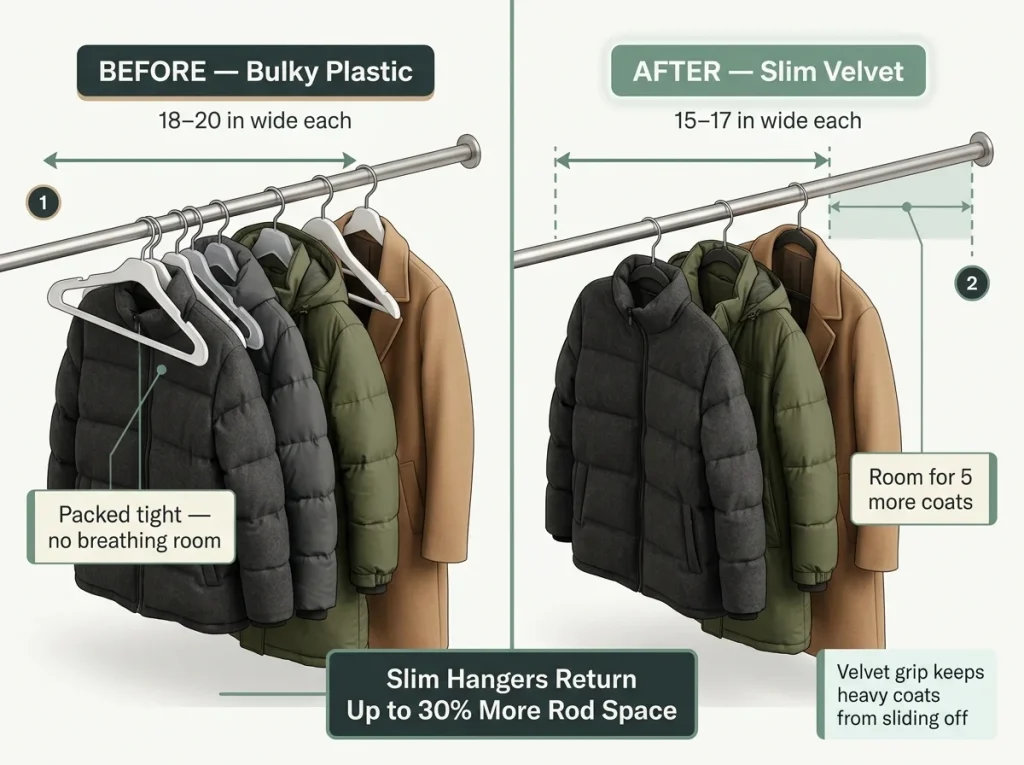
This is the most boring move in the article and the one with the biggest payoff. Swapping bulky hangers for slim velvet buys you rod space without buying any storage, and the numbers are bigger than people expect.
The Math on Slim Versus Bulky
Standard plastic and tubular hangers run about eighteen to twenty inches wide. Slim velvet hangers run closer to fifteen to seventeen. Each one is only two or three inches narrower (barely a knuckle), which sounds trivial until it compounds across a full rod. Swap roughly thirty bulky hangers for velvet and you free up around seven and a half linear feet of rod, enough for about five more coats, and slim hangers reclaim up to thirty percent of your rod space overall.
If you want the receipts, here’s a side-by-side test of slim hangers.
Which Hangers Heavy Coats Actually Need
Slim velvet shines for the everyday rotation, but it isn’t right for everything. A structured wool overcoat or a heavy leather jacket wants a broad wood or padded hanger to hold its shoulders, or you’ll find shoulder dimples by spring. Use velvet for the coats you cycle through and save the broad hangers for the tailored pieces. The Zober Premium Velvet Hangers are slim and non-slip, which matters more for coats than for anything else in your closet.
Velvet’s real edge for coats isn’t just the slim profile, it’s the grip. A heavy wool coat slides off a smooth plastic hanger and pools on the closet floor by morning. The flocking holds it where you put it.
The Cheapest Version of This Move
Before you spend anything, reuse the velvet hangers you may already have shoved in a back closet, the most budget-friendly move in this whole list. If you’re buying, one multi-pack converts a small rod, and you should skip the padded “designer” hangers entirely.
Store Off-Season Coats Compressed (But Never Down)
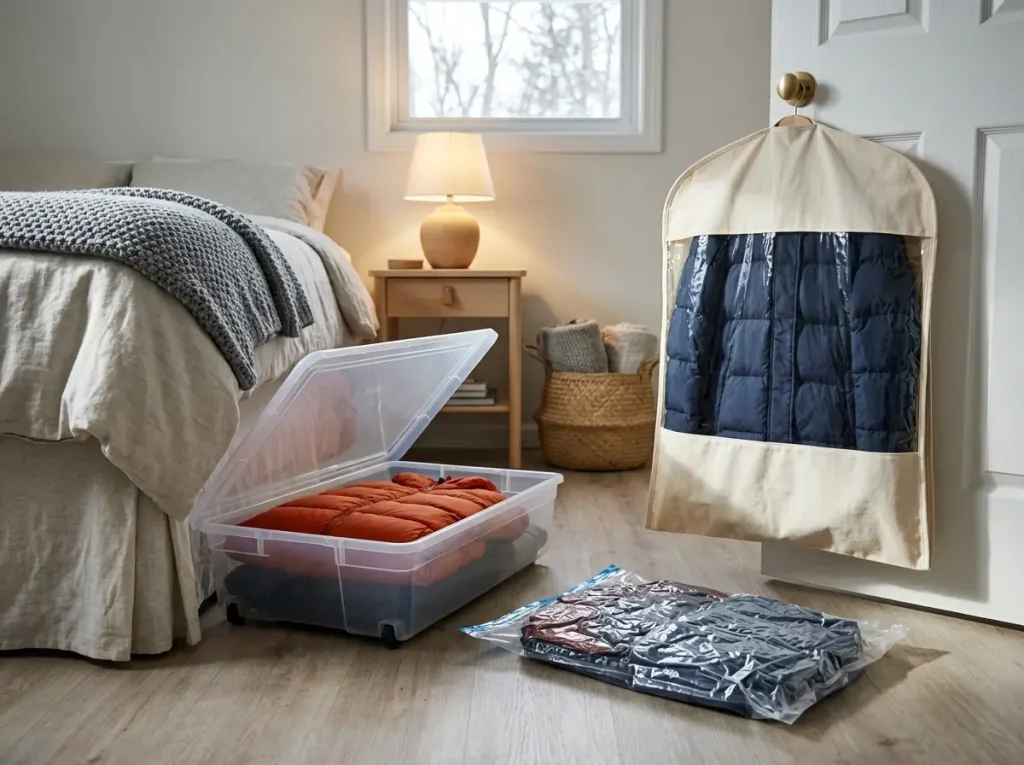
Once the off-season coats are separated out, the instinct is to vacuum-bag everything flat. Hold on. That advice is right for some coats and genuinely damaging for others, and the most expensive coat you own is usually in the second group. Sort by fill before you seal anything.
What You Can Safely Vacuum-Compress
Polyester and poly-fill coats, plus many sturdy wool pieces, handle a vacuum seal fine and shrink down to a fraction of their size. The ZOBER Vacuum Storage Bags come in a variety pack and pull out roughly eighty percent of the air, which is ideal for the synthetic puffer you won’t touch until November. A cheaper route is the Ziploc Space Bag, or honestly a flat tote with no vacuum at all. The hard rule: bag the synthetics, never the down.
What Must Breathe — Down, Feather, and Leather
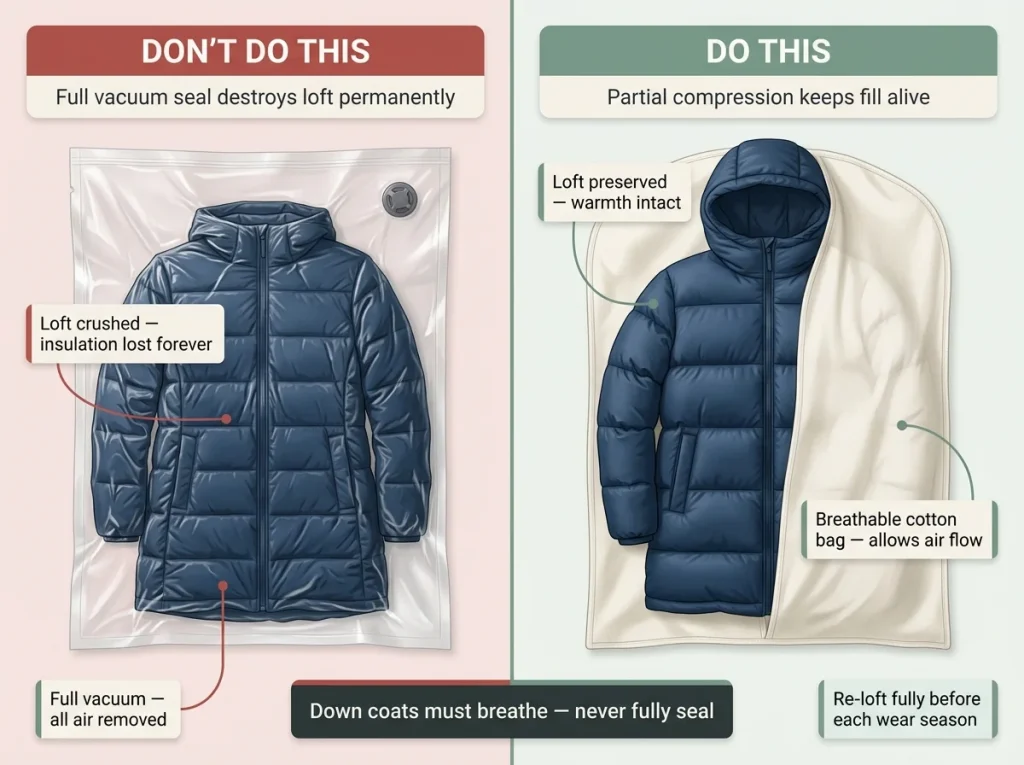
Down and feather-fill coats lose their loft permanently when you keep them fully vacuum-compressed. The trapped air is the insulation, and once it’s crushed flat for a season, the warmth doesn’t come back. Leather and structured wool don’t belong in a vacuum bag either. The conventional wisdom is to vacuum-bag everything, and in practice that’s the fastest way to ruin a good parka.
Store down clean, fully dry, and breathing: the MISSLO 60″ Cotton Breathable Garment Bag keeps a down or wool coat lofted and mildew-free on a hanger, and the clear window means you can actually find it. A free version works too, an old cotton pillowcase over the shoulders, just never sealed dry-cleaner plastic.
If you absolutely must vacuum a down piece to fit it somewhere, pull only enough air that it shrinks but still looks padded, never flat. Then shake it out and let it re-loft every four to six weeks.
Where the Stored Coats Should Live
The back of the top shelf is where off-season coats go to become a graveyard, shoved up high and pulled out months later creased and musty. Give the stored set somewhere intentional instead. Under the bed is dead space in a small bedroom, and the StorageLAB Under Bed Storage Containers roll out on wheels so you’re not wrestling a bin from under the frame, with enough clearance under most beds to fit. A softer, cheaper option is the Amazon Basics Collapsible Fabric Storage Bag, or a suitcase you already own.
For the deeper system behind all this, see the full seasonal rotation system.
No Coat Closet? Build a Drop Zone or Borrow Space
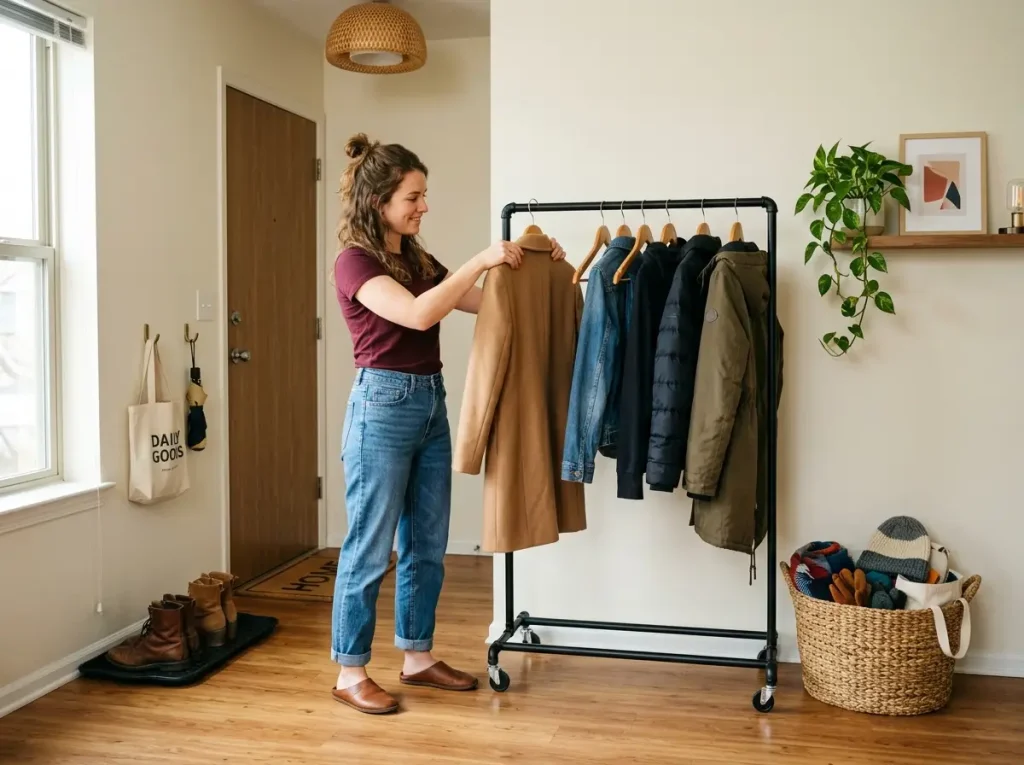
Plenty of small spaces, especially studios and apartments with no mudroom, have no coat closet at all. The answer is to claim a vertical strip of wall or a corner and make it the official coat home before the nearest chair becomes it by default. You know the chair. It isn’t for coats, and by February it’s holding four.
Claim a Blank Wall by the Door
A two-to-three-foot strip of wall by the door, with hooks at adult and kid height, handles a household’s daily coats with no closet involved. The rule that keeps it standing is one hook per person. The same logic behind the one-hook-per-person entryway setup applies here: the moment one hook is “everyone’s,” it becomes a pile.
Catch the Accessories Before They Spread
Coats aren’t usually what wrecks a drop zone. Accessories are. The loose hats, gloves, and scarves migrate onto every surface within reach (the radiator, the bench, the back of the couch) until the whole zone reads as chaos. One open basket fixes it, and the Large Woven Seagrass Basket sized for the spot catches all of it by the door.
It hides nothing, since it’s a catch-all rather than a sort system, but that’s the point. A ventilated dollar-store bin does the same job for less.
When There’s No Wall to Touch
If you can’t mount anything at all, a freestanding rack or coat tree becomes your coat closet. The SONGMICS Rolling Garment Rack holds an intentional row of everyday coats and rolls away when you need to vacuum behind it. It does take floor space and it stays visible, so put it somewhere it can live as part of the room. Beyond that, borrow dead space wherever you find it: the back of a bedroom door on existing hooks, an under-stairs nook with a tension rod, a repurposed suitcase for the off-season set.
Make the System Survive Real Life
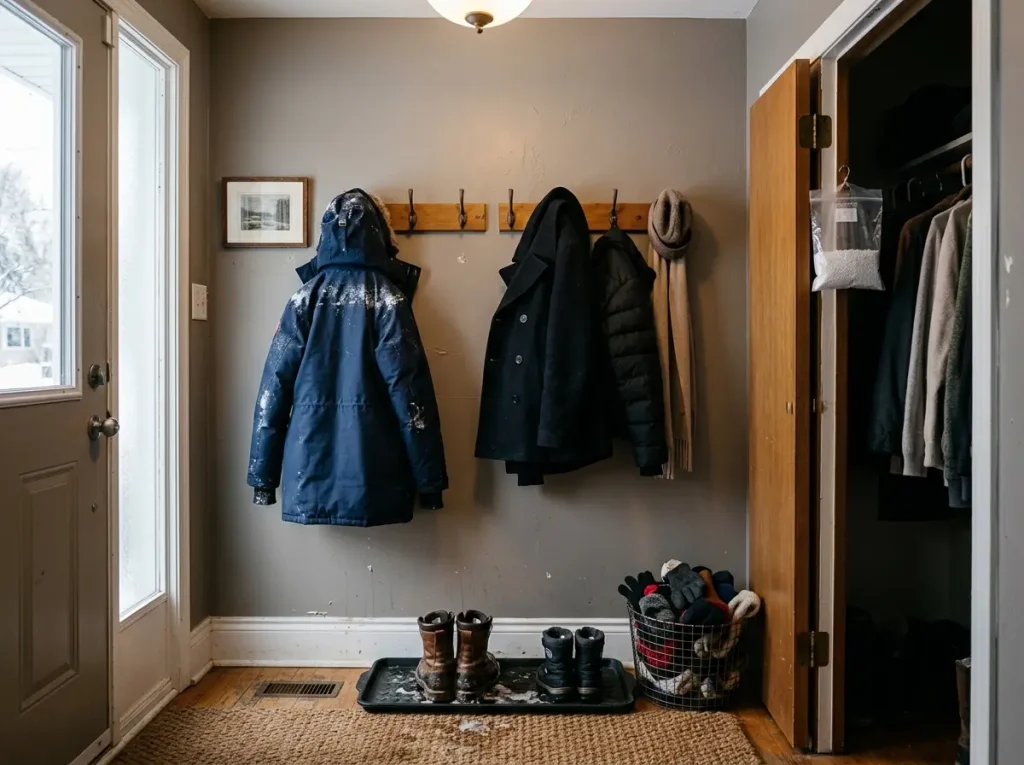
Any coat system looks great the day you build it. The real test is whether it survives February, with wet coats, a partner, and kids who don’t read your labels. This is where most setups quietly fall apart, so build for it from the start.
The Drop Zone That Reverts to a Pile
The drop zone reverts because there are more coats than hooks and no edit happened first. The pile isn’t a personality flaw, it’s a math problem. Assign one hook per person, and when the pile reappears anyway, read it as the signal to re-edit, not as a failure. In a shared space, the friction is usually two people and one zone, which is the same tension you hit when splitting a coat zone with a partner: give each person a defined spot and set the kid row low enough that kids actually use it.
The Wet Parka and the Musty Closet
A damp parka hung in a sealed small closet doesn’t dry, it molds, and it passes the smell to everything around it. Closets against a cool exterior wall are the worst offenders. According to the Nevada public-health guidance, storing clothing dry and clean is what actually prevents closet mold, so dry every coat fully before it goes back, watch the humidity, and give the rod some breathing room.
In a tight closet against an exterior wall, hang a cheap moisture-absorber bag from the grocery or hardware store among the coats. It costs almost nothing and buys you insurance against the musty-closet smell every winter.
The Three-Month Check
Three months in, the predictable things happen: the top shelf becomes a graveyard, the over-door hooks sag, and the daily row overflows. None of that means the system failed. It means it’s time for a seasonal reset. Walk the zones every few months, pull what crept in, and re-edit the daily set, and the setup resets instead of collapsing.
Start With the Coats You Wear This Week
Three things carry the whole approach. Edit first so you store less. Split daily from off-season and give each a fixed home. And go vertical and no-drill before you ever pick up a drill or splurge on a rail.
When the daily hooks overflow or the pile creeps back, that’s not a setback, it’s your three-month cue to re-edit and reset the zones, not to buy more hooks. Start with the two or three coats you actually wear this week. Get those grabbable. Then deal with the rest.
Frequently Asked Questions
01Can you store down or puffer coats in vacuum-seal bags?
Not fully. Down and feather coats lose their loft permanently when fully vacuum-compressed, because the trapped air is the insulation. Use a breathable cotton bag instead, or remove only enough air that the coat shrinks but still looks padded, and re-loft it every few weeks.
02How do you store winter coats in a small apartment with no closet?
Claim a small strip of wall by the door with no-drill over-the-door or adhesive hooks at two heights, or use a freestanding rolling rack. Keep only daily coats there, and send off-season coats under the bed or to another room so the entry stays clear.
03What hangers are best for heavy winter coats to save space?
Slim non-slip velvet hangers save the most space and keep heavy coats from sliding off, giving you up to about thirty percent more rod room than bulky plastic. The exception is structured or tailored coats, which hold their shoulders better on a broad or padded hanger.
04How do you keep winter coats from molding in a closet?
Store coats only when clean and fully dry, and give them breathing room. A damp coat in a sealed small closet molds and spreads the smell to its neighbors. In a tight or exterior-wall closet, a cheap hanging dehumidifier bag absorbs the excess moisture.
05How many winter coats does one person really need in a small space?
Most people wear the same two or three coats all season and store the rest unused. In a small space, keep the everyday rotation grabbable and be honest about the rest, because the “just-in-case” coats are usually what jam the closet.