





















In this article
In a small closet, you hang your sweaters because the rod is the only open space you have. Then one October you pull down your favorite wool pullover and there they are: two pointed bumps where the hanger sat, stretched into the shoulders for good. After every fold-versus-hang argument, knit-care threads land in the same place: sweaters are not shirts, and storing them is really about protecting a soft, lofty fiber from gravity, moisture, and moths. The good news is you don’t need a dresser or a walk-in to do it right. You need a fold, a shelf-depth bin, a little space under the bed, and a couple of habits that keep stored sweaters in the shape you bought them.
Quick Answer
The best ways to store sweaters, in order of what matters most:
- Fold knits flat. Never hang them, or the shoulders stretch.
- File-fold into drawers, or stack low on a shelf with the heaviest on the bottom.
- Store them in breathable fabric bins, never sealed plastic.
- No dresser? Use a shelf-depth bin plus a low under-bed box.
- Clean every sweater before off-season storage, then add cedar.
Fold, Don’t Hang (How to Store Sweaters Without Stretching)
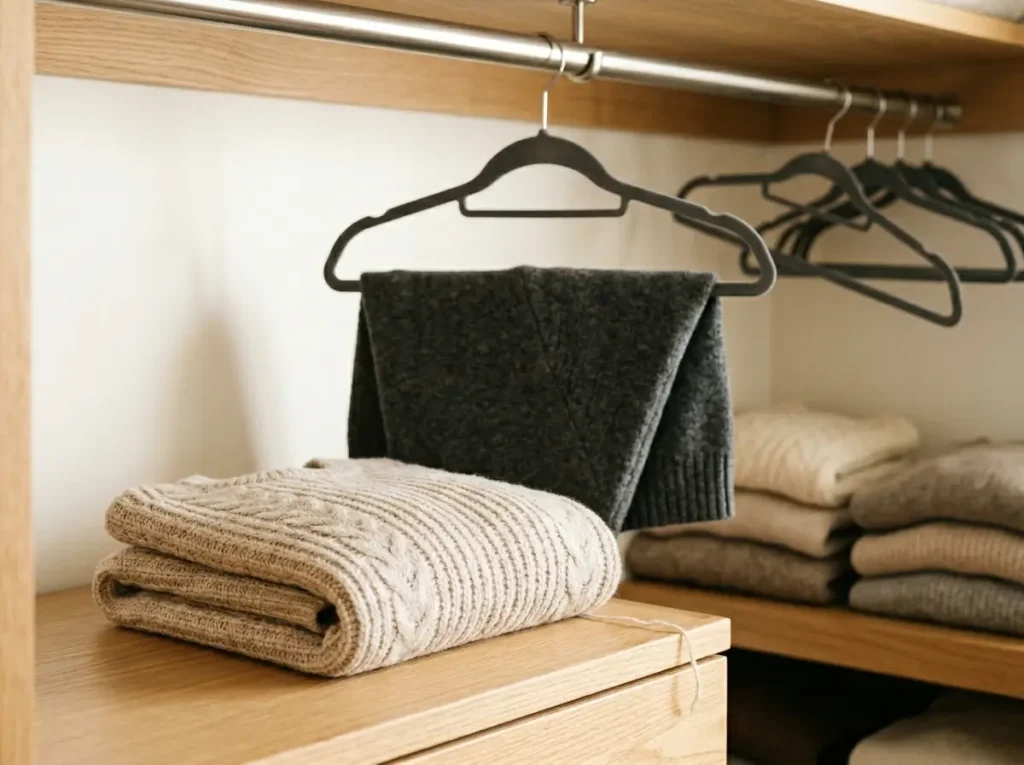
Almost every sweater problem starts at the hanger. Get the fold-versus-hang call right and most of the rest of this is just choosing where the folded pile lives.
Why hanging stretches knits out of shape
A sweater is a loose grid of loops, not a woven cloth. Hang it and the entire weight of the knit pulls straight down on the few loops sitting over the hanger’s edge. Wool, cashmere, merino, and angora take the worst of it because their fibers are elastic and lofty, so they keep stretching for as long as they hang. The community even has a name for the result: shoulder bumps, those pointed dimples that no amount of ironing brings back.
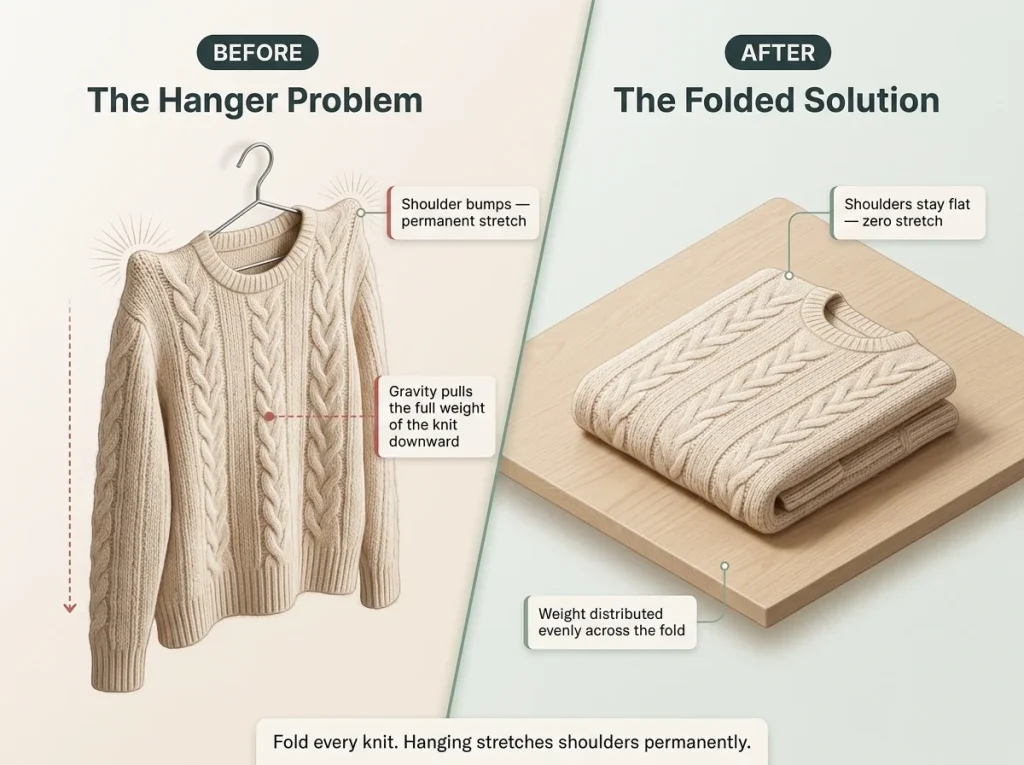
Folding takes the load off completely. A folded sweater rests on itself, flat, with no single point carrying the weight. That is the whole reason every method below starts from a fold and not a hanger.
The one time it’s OK to hang a sweater
If your closet truly has no shelf and no drawer, there is a way to hang without the damage. Fold the sweater in half lengthwise, then drape it over the bar of the hanger so the weight rests on the fold instead of the shoulder seams. Use a padded or velvet hanger that won’t dig into the shoulders; a bare wire hanger from the dry cleaner is how the dimples start in the first place.
Even then, treat it as the exception, not the plan. And fold your most delicate knits inside-out so the surface fibers face in, away from snags.
File-Fold in Drawers So You Can See Every Sweater
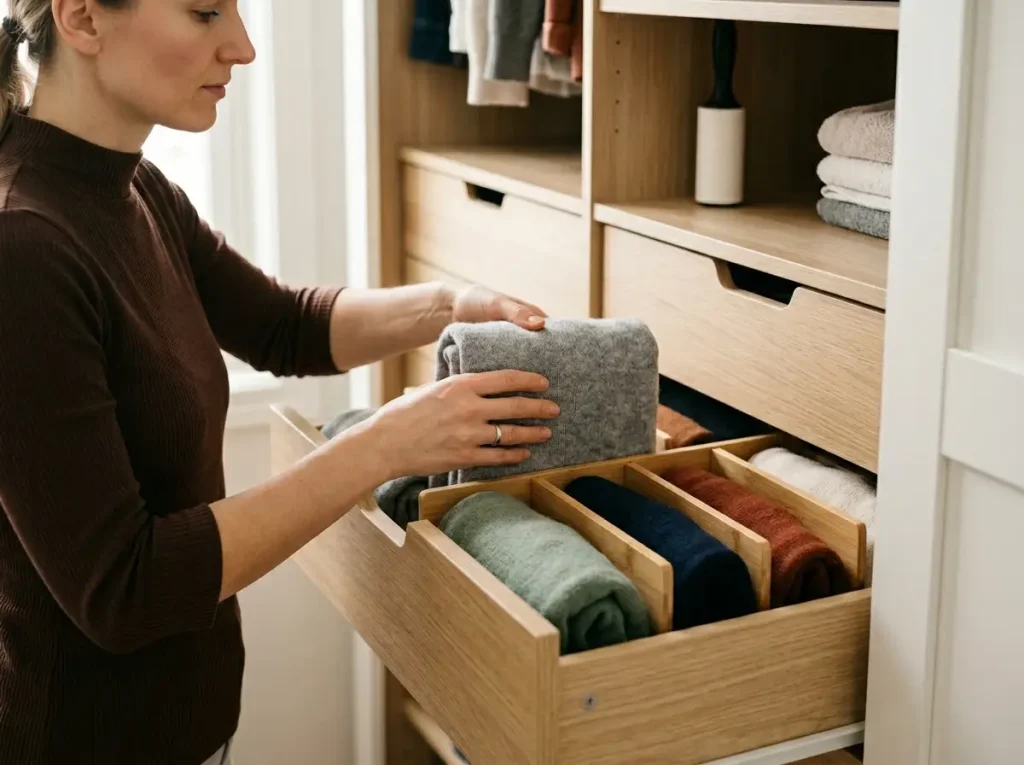
If you have any drawer at all, this is the method that survives daily use instead of reverting in a week.
How to file-fold so every sweater stands up
Stacked sweaters have a built-in problem: you only ever wear the top two. The rest get excavated, re-folded, and buried again, so the pile reverts fast. File-folding fixes that. You fold each sweater into a compact rectangle and stand it on edge vertically, fold-side up, so the whole row is visible at a glance. It’s the KonMari fold, the same file-folding idea Marie Kondo uses for drawers. Pull one out and the rest stay standing. And skip rolling them. Rolling sweaters saves a little room in a tight bin, but it presses creases into the knit over a long season, where a flat vertical fold keeps the fibers relaxed.
Deep drawers take a full standing row. Shallow drawers might fit only one row on edge, so match the method to the drawer you actually have, not the one in the photo.
Dividers that keep the rows from slumping
A standing row works right up until the drawer empties out, and then the survivors slump sideways into a heap. Before you buy anything, a couple of cereal boxes cut down to the drawer’s height make free lanes that hold the rows upright. If you want something sturdier, Bamboo Drawer Dividers spring-fit across a standard drawer and adjust to its width, keeping each file-folded row standing. One honest caveat: bare dividers can slide when the drawer opens, so stick a small adhesive bumper under each end if yours drift.
Stack on Shelves Without the Lean-and-Topple
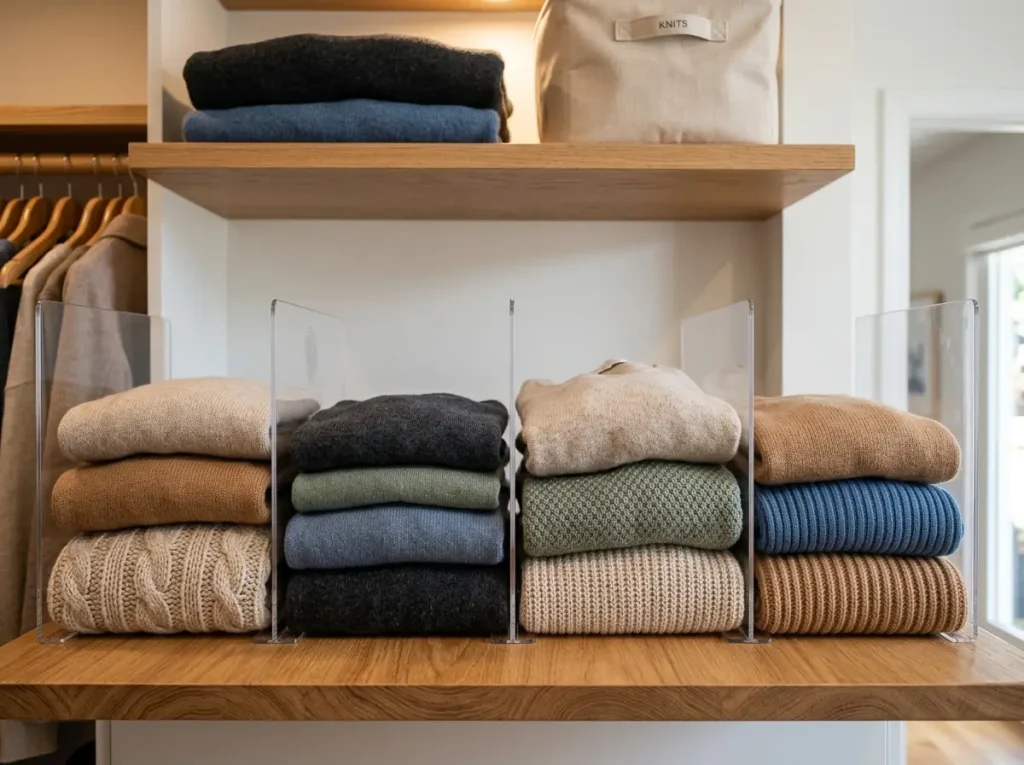
No drawers, just a shelf? Stacking works fine. The piles only collapse for two fixable reasons.
Keep stacks low and load heavy on the bottom
A shelf stack looks great on Sunday and avalanches by Wednesday. The cause is almost always height. Build the tower too tall and the bottom sweater gets crushed into permanent crease lines while the top slides off the side. Cap each stack at around five sweaters and put the heaviest, thickest knits on the bottom so the whole thing stands square.
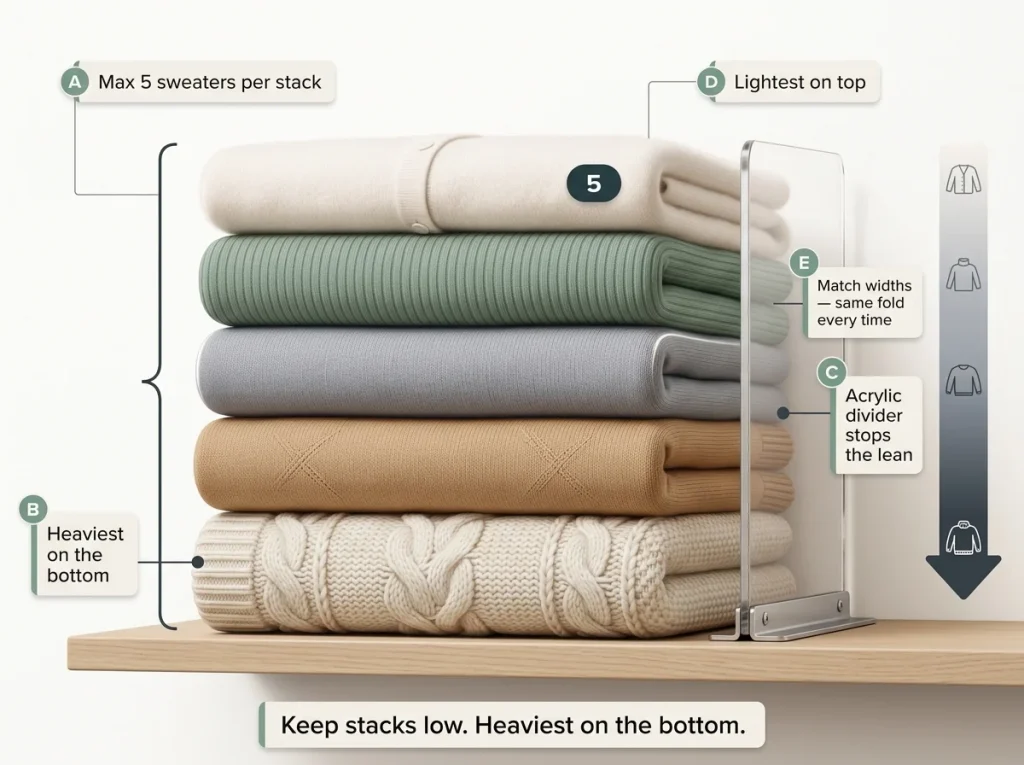
A consistent square fold is the other half. Uneven folds are the real reason piles lean, because each sweater meets the next at a slightly different edge. If your folds wander, a folding board keeps every sweater the same size, and you don’t need to buy one. A cereal box cut flat works as a free folding board (some people call it a stacking board), and matching rectangles are what keep a shelf or linen closet stack standing square.
Fold every sweater to the same width, roughly the width of your folded forearm, and the stacks stop leaning. Matching folds, not matching bins, are what actually make a shelf look tidy.
Dividers stop the lean-and-topple
One wide shelf lets stacks drift into each other every time you grab something. The free fix first: a sturdy shoebox lid stood on its edge walls off a stack at no cost. When you want it to look deliberate, HBlife Acrylic Shelf Dividers slot onto a shelf and split it into separate columns, so folded sweaters stop sliding into the neighboring pile. They grip best on shelves around three-quarters of an inch thick; on a much thicker shelf they can wobble, which is the one complaint worth knowing going in. If your shelf piles never seem to hold no matter what, it’s worth understanding why your closet shelf piles keep falling over before you add a thing.
Breathable Bins and Baskets, Not Sealed Plastic
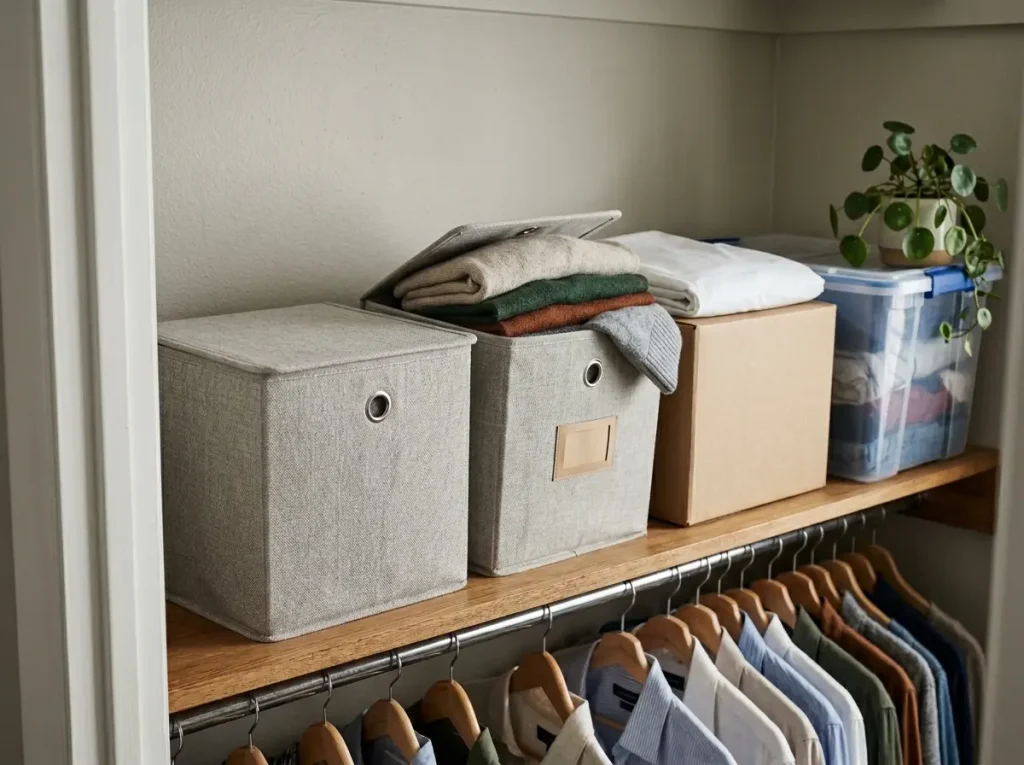
Bins are the natural move when there are no drawers. The only real decision is what the bin is made of.
Why the bin has to breathe
The wrong bin is exactly how sweaters come out smelling like a basement. A sealed plastic tote traps every bit of humidity around the knit, and with no airflow that moisture slowly turns musty over a season. Breathable fabric does the opposite. It lets the fibers air out while still keeping dust and light off them.
Label and sort so the bin is usable later
The other bin failure is the one nobody photographs. You box sweaters in whatever’s handy, and come fall you can’t tell which bin holds what without unstacking all of them. Sort by weight, type, or color as you pack, and label the front. A clean cardboard box, or a cotton pillowcase for your softest knits, does the breathable job for free. Use what you own before you buy a thing. A sheet of cardboard slipped between the layers also keeps heavier knits from creasing the ones below. When you want them to stack neatly and stay findable, Fabric Storage Bins are collapsible, breathable, and come with label holders on the front; the trade-off is they hold their shape less than a rigid box once they’re packed full. It’s the same fold-and-bin approach that works when there’s no closet at all.
The Small-Closet, No-Dresser Sweater System
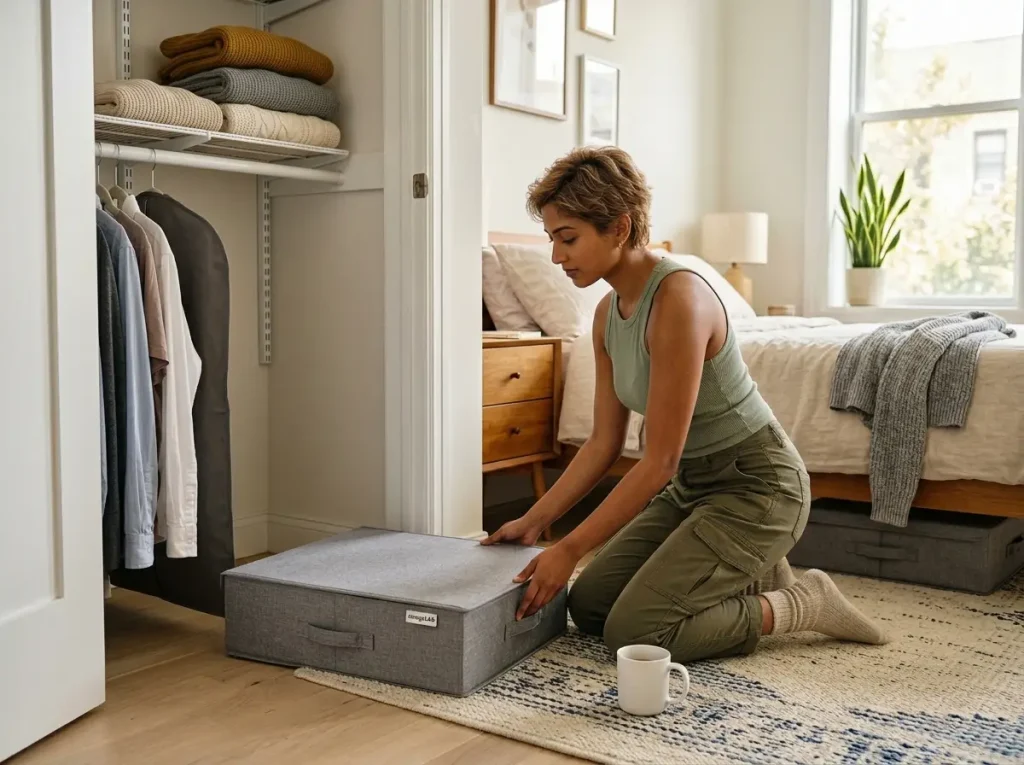
This is the part most guides skip. They assume you own a dresser or built-in shelves. Here is what to actually do with one rod, one shallow shelf, and a bed, as one piece of the rest of your clothing organization.
Buy for shelf depth, not closet depth
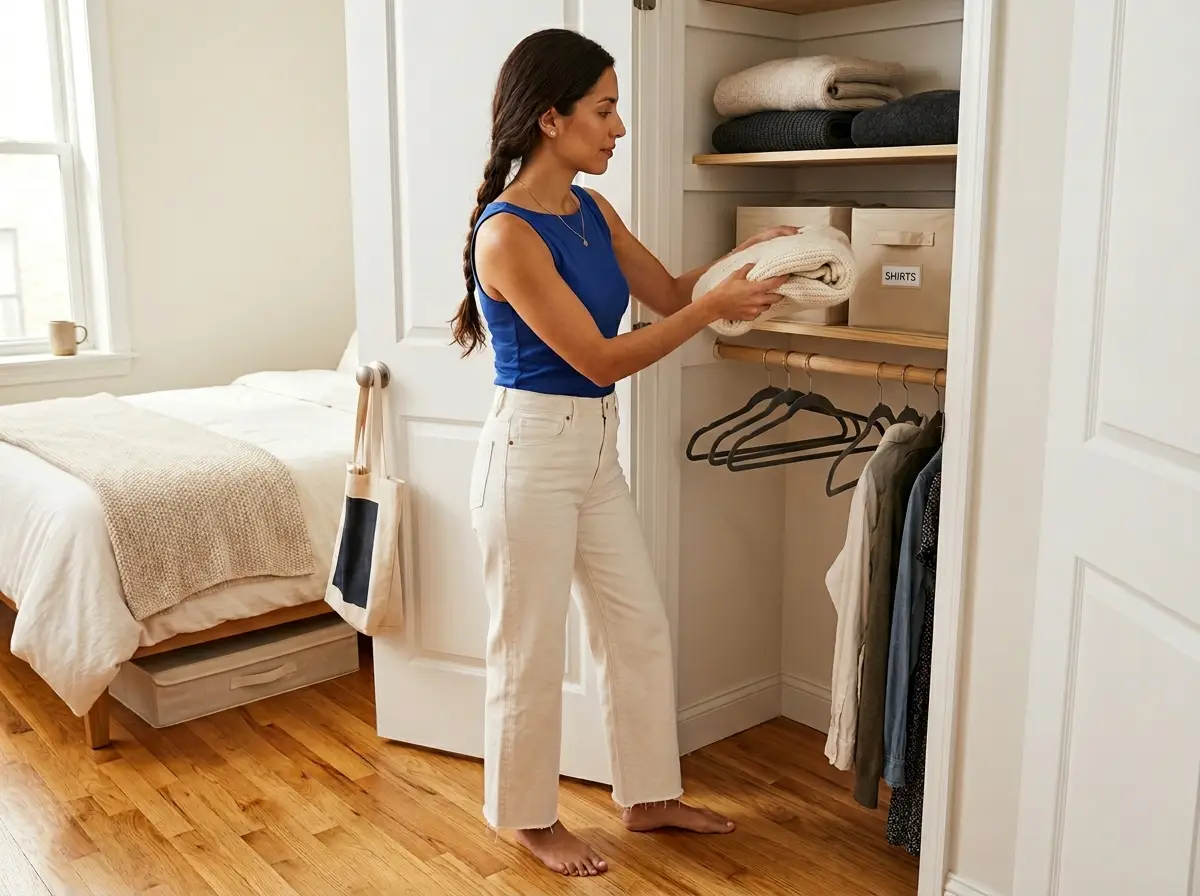
Here’s the trap that sends renters back to the store with the wrong bin. A standard reach-in closet is deep, but the usable shelf above the rod is shallow, often only deep enough for cans two rows back. Grab a generic closet-depth storage tote and it overhangs the shelf edge by a wide margin, so the door won’t close and the front sweaters spill onto the floor. Measure the shelf, not the closet, and buy a bin sized to the shelf.
Measure your shelf depth with an actual tape measure before you order a single bin. Eyeballing closet depth is the fastest way to end up with a tote you have to box back up and return.
Add a low second shelf above the stacks
Folded sweaters are short. A stack needs only about a hand’s-width of clearance above it, yet most closet shelves leave a foot or more of dead air overhead. Drop a second low shelf right above your stacks, either a no-drill stacking shelf or a sturdy riser, and you double the storage in the same footprint. Current-season knits go at eye and hand level, and nothing gets hung.
Send off-season knits under the bed
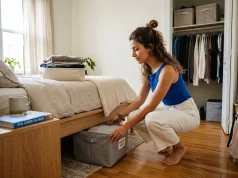
When the shelf fills up, the bed becomes your dresser substitute. The catch is height, since most under-bed totes are too tall to clear a low platform frame. A low-profile box solves it. The storageLAB Under Bed Storage Container is shallow enough to slide under a platform bed and holds a season’s worth of folded sweaters; just pair it with cedar and don’t seal it shut on knits that aren’t fully dry. If you’re weighing options, a low-profile box that clears a platform-bed frame is the spec that matters most. And air it out every couple of months, because that dark, undisturbed corner under the bed is exactly where moths like to settle in.
Clean Every Sweater Before You Store It
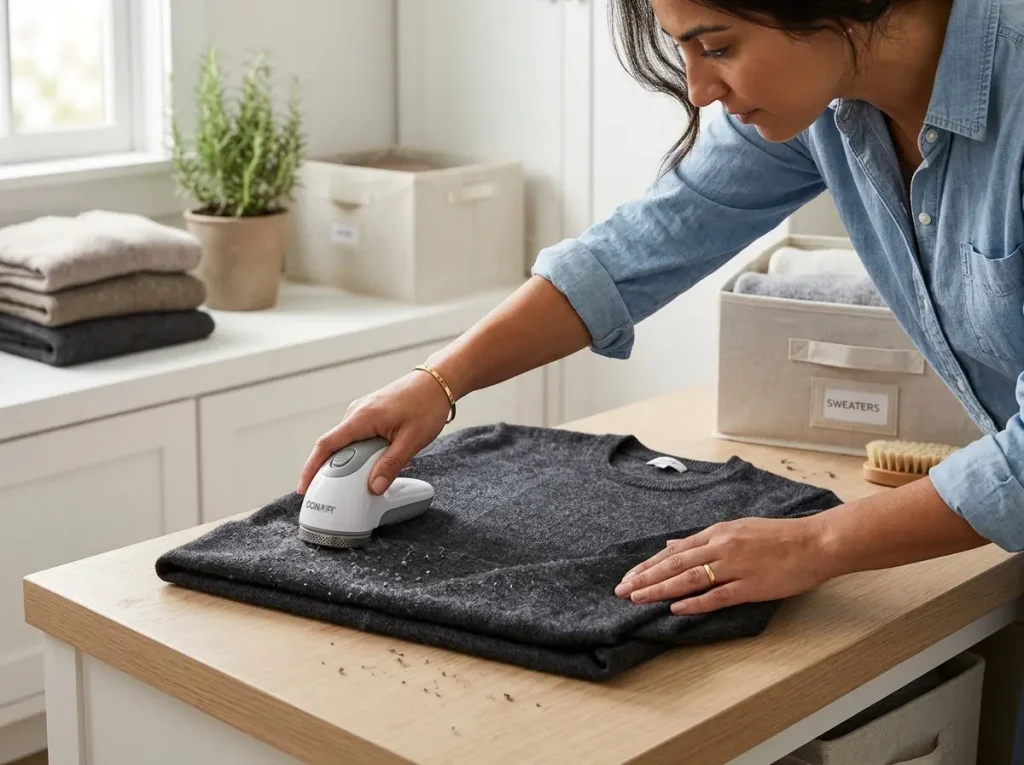
The prep step everyone skips is the one that actually prevents the damage. Store the clean pile somewhere cool, dry, and out of direct sun, since UV slowly fades color and weakens fiber over months.
Why clean wool survives and dirty wool gets eaten
The sweater that “looks clean” is the one that comes out with holes. It turns out clothes moths are drawn to the oils and food residue on worn wool, not the fiber itself. Store one worn-but-fine-looking sweater and you’ve baited the whole bin with an invisible dinner of sweat and skin oils. Wash or dry-clean every piece per its care label before it goes into storage, and make sure each one is bone dry, because trapped moisture invites mildew just as fast as oils invite moths.
The easiest moth fix isn’t cedar or lavender. Well, those help, but the real first move is simply never storing anything dirty.
De-pill and dry before it goes away
Knits pill where they rub, and a fuzzy sweater that goes into storage only comes out fuzzier. Clearing the pills before you pack means it’s ready to wear the day you unpack it, not after a grooming session in October. A disposable razor dragged lightly over the flat knit works in a pinch; for a faster, cleaner job, the Conair Fabric Shaver lifts pills off the surface quickly, and it’s already the budget tool rather than a splurge. Go gently on delicate cashmere, since aggressive shaving can thin the knit over time.
Off-Season Storage Without the Musty-Bin Smell
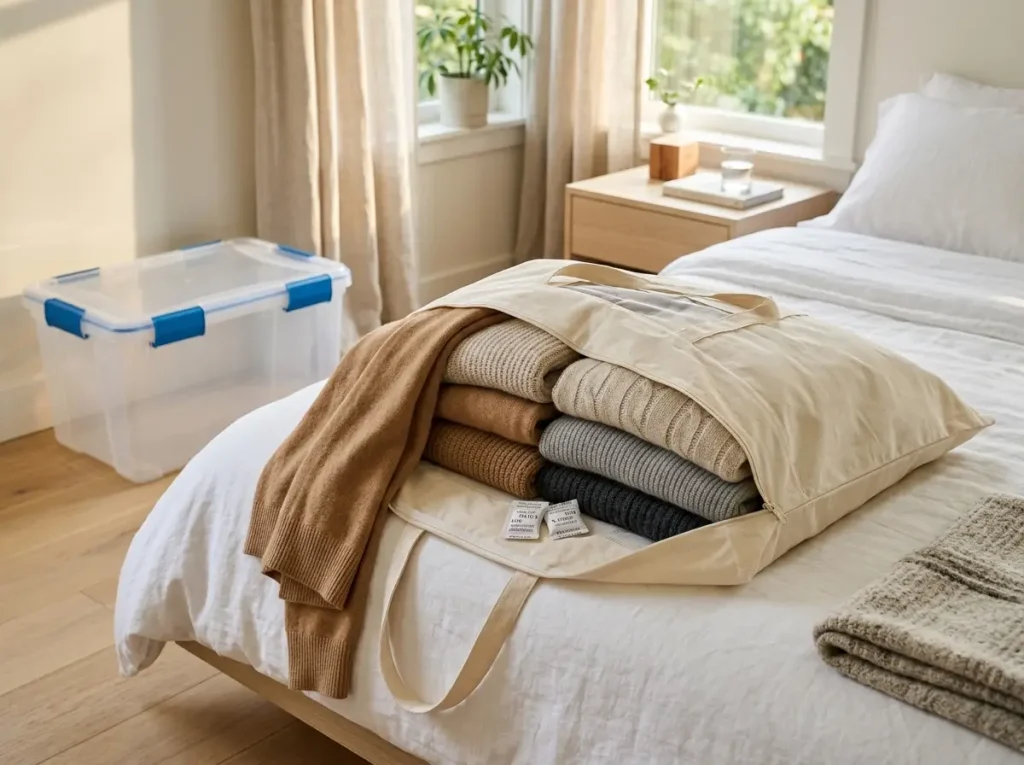
Two off-season failures get repeated more than any others: the sealed tote that smells like a basement in fall, and the cashmere that comes out flat as a deflated balloon. Both come down to the container.
Breathable beats airtight, every time
For natural knits, breathable cotton is the answer. A MISSLO Cotton Breathable Garment Bag lets the fibers breathe while blocking dust and moths, and it covers both folded off-season stacks and the rare sweater you have to hang. I used to think a garment bag was a garment bag. The cotton-versus-plastic difference is the whole story, and a clean cotton pillowcase does a similar breathable job for free if you only have a sweater or two to put away.
Why vacuum bags wreck wool but not synthetics
The conventional move is to vacuum-bag everything for the season. And it works, right up until you open the bag. Wool, cashmere, and angora get their warmth from crimped, lofted fibers that trap air; suck that air out and the compression flattens the loft, and recovery can take as long as the sweater was stored. Sometimes it never fully comes back. Fine fibers also set permanent wrinkles under that kind of pressure. The nuance most guides skip is that sturdier cotton and acrylic blends tolerate short-term compression just fine, so vacuum bags aren’t banned outright, only wrong for delicate natural knits. It’s the same caution that applies to bulky down and wool outerwear.
If plastic is your only option
Sometimes a plastic bin is all you’ve got, and you can make it survivable. Add rechargeable Dry & Dry Silica Gel packets to pull the trapped humidity that causes the musty smell and mildew, and never seal sweaters away even slightly damp. The indicating beads change color when they’re saturated, so you know exactly when to recharge them in the oven. It’s a workaround, not the ideal, since fabric still breathes better than any sealed box.
If you’re stuck with a plastic bin, leave the lid cracked instead of snapping it airtight. A little airflow beats a perfect seal for anything made of wool.
Keep Moths Out and Check on Them Through the Season
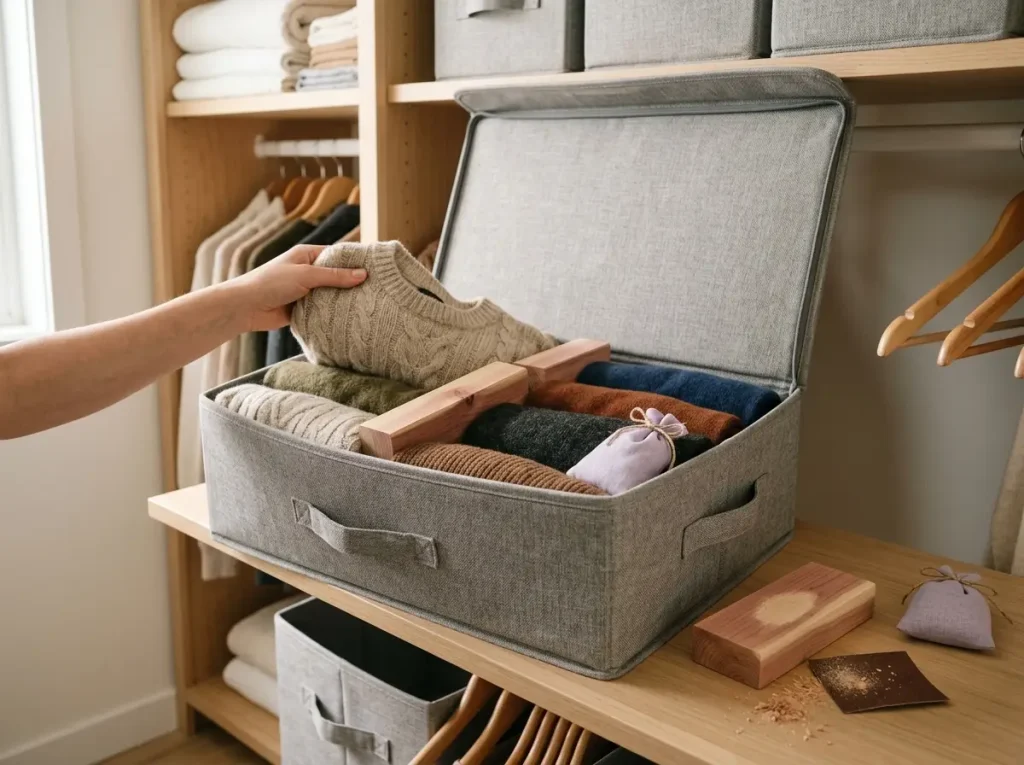
Putting the sweaters away isn’t the finish line. The bin in the dark corner is exactly where moths and mildew take hold, so a little upkeep is what makes the whole system stick.
Cedar and lavender (and why cedar quits working)
Cedar blocks and lavender sachets both repel moths with natural oils, and they’re cheap insurance. The catch with cedar is that it only works while you can still smell it; the day the scent fades, it’s just a block of wood. Homode Cedar Blocks come with a small piece of sandpaper for exactly that reason, since a light sanding reopens the grain and brings the scent back, so the blocks keep earning their place all season. Lavender sachets are the no-cost alternative if you already keep dried lavender around the house.
The every-couple-months check
The single most effective thing you can do costs nothing: open the bin and shake the stack out every couple of months. Moths prefer dark, undisturbed spots, so simply disturbing the storage is half the defense. While you’re in there, run the three-symptom check that ties this whole system together. A musty smell means trapped moisture, so move to a breathable container. A crease line means you folded the same spot too long, so refold along a different line. A hole means something went in dirty, which sends you back to washing first. Make it part of how you fold it into your seasonal wardrobe rotation and the system holds for years.
Set a phone reminder for the midpoint of each storage season. A two-minute shake-out and sniff test in January is the difference between fresh sweaters in fall and a moth-hole surprise.
Your No-Dresser Sweater System in Three Moves
Strip it all back and the system is short. Fold, never hang, because gravity is what stretches the shoulders, and a fold takes the load off entirely. No dresser is not the problem it feels like, since a shelf-depth breathable bin plus a low under-bed box replaces every drawer you don’t have. And clean first and let the knits breathe, because that combination is what beats moths and the musty smell, not any single gadget you can buy.
Call it the three-month test. Halfway through the off-season, open the bin or under-bed box, shake the stack out, and check for a musty smell or a set-in crease. Two minutes in January saves a sweater in fall.
Start with the stack you reach for most. Fold it right, give it a shelf-depth bin, and build out from there.
Frequently Asked Questions
01Should you fold or hang sweaters?
Fold them, almost always. Hanging lets gravity stretch the shoulders into permanent bumps, especially in wool and cashmere. Only hang if you have no shelf space, and then fold the sweater over the bar on a padded hanger instead of hanging it by the shoulders.
02How do you store sweaters without a dresser?
Fold them into a breathable fabric bin sized to your shelf depth, and push the off-season set into a low-profile box under the bed. Between a shelf bin and an under-bed box, you get the function of a dresser without owning one, and without drilling anything.
03Can you store sweaters in plastic bins or vacuum-seal bags?
Skip airtight plastic and vacuum bags for wool and cashmere. Compression crushes the lofted fiber that gives knits their warmth and shape, and sealed plastic traps musty humidity. If plastic is your only option, add rechargeable silica gel and never seal sweaters away damp.
04How do you store sweaters so they don’t get moth holes?
Clean every sweater before storing it, because moths are drawn to the oils and food residue on worn wool, not to clean fiber. Then add cedar or lavender, use a breathable container, and air the storage out every couple of months.
05How do you keep stored sweaters from smelling musty?
The musty smell is trapped moisture with no airflow. Store knits in breathable cotton bags or fabric bins instead of sealed plastic, make sure each sweater is fully dry before it goes away, and add silica gel if you must use a plastic bin.