You hang the caddy, line up the bottles, and the shower looks finished, right up until the first bumpy stretch of road puts every bottle on the floor. RV bathroom organization is a different job from organizing a house bathroom, because the room is small, wet and moving all at once, and RV bathroom storage nobody has loaded and shaken is still only a guess. This guide to camper bathroom storage starts with the type of bathroom you have, then covers the shower, the door and walls, the cabinet, the bath with no cabinet at all, and a load test to run before you drive. All of it sits inside a bigger plan for organizing the whole rig, so if the bathroom is only one of several rooms giving you trouble, begin there.
Quick Answer
Match the storage to the bathroom you have, then test it the way the road will.
- Name your bath type: wet bath, separate shower, or no cabinet.
- Cut shower bottles to a week’s worth and move the rest to a crate.
- Give each person one hook at their own height, away from the spray wall.
- Measure the cabinet around the drain pipe before choosing an organizer.
- Load every hook, pocket and rod with real weight, then shake it before driving.
Why RV Bathroom Organization Fails on the First Travel Day
A shelf that looked solid on a campground pad can be on the shower floor by the first bumpy stretch. Nothing about the shelf changed. The room did.
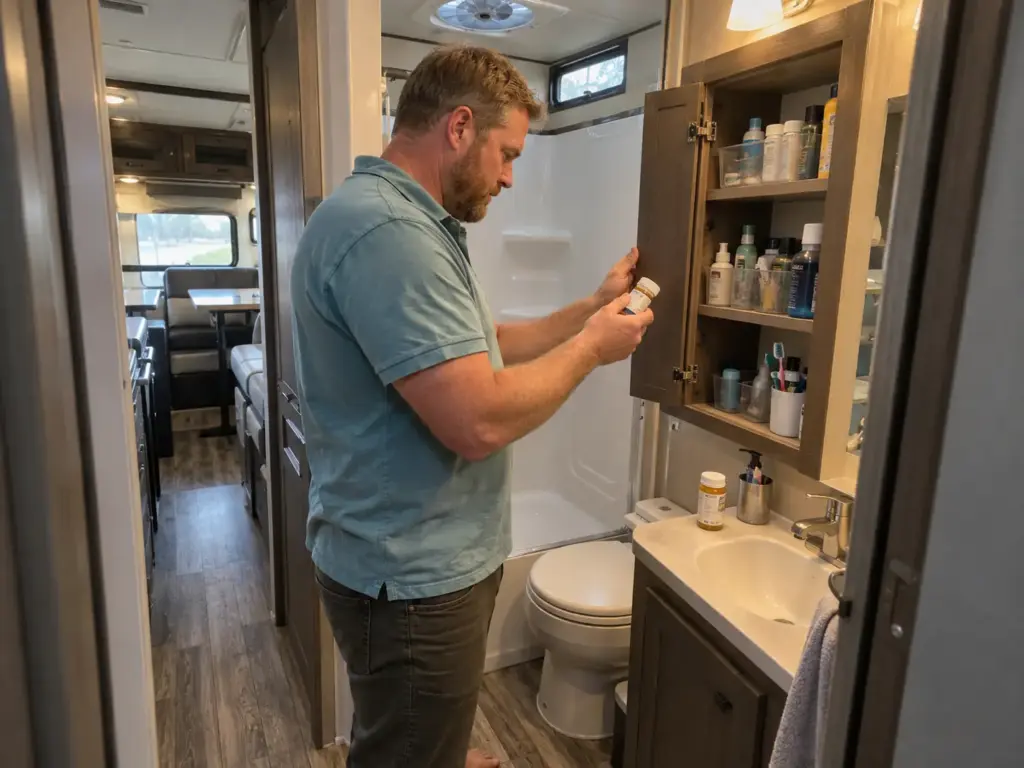
What Moves While You Drive
Everything hung from a rod or stuck to a wall is moving load, not static load. Parked, a hanger on a bar just sits there. Under way, the bar vibrates, and hangers and bags walk toward the end of it and drop off, most of all from a rod with no lip to hold them in.
A glass shower door shows the same thing at larger scale: one that latched properly can still come apart on a rough road. The cheap fixes are low-tech, a bath towel tied around the top frame, a hook-and-loop strap as backup, a length of shock cord, and some rigs end up with a curtain and a rod in place of the glass and like it better.
Why the Walls Can’t Take a House’s Hardware
RV walls and cupboards are not built to a house’s standard, so the tricks that work on drywall and studs need a second look. The back wall of a shower surround may be held in place by little more than a handful of snaps, which means it flexes with the road, and any weight hung on it flexes along. A tension rod runs into a different problem: the curve of the roof.
A caddy hung from a rod that fights that curve never sits right, and shims plus a block of wood do not fix it. Suction cups have the same weakness, since they grip smooth, flat panels and let go on anything slightly uneven.
The Humidity That Stays in a Closed Rig
Damp towels are the quiet problem. A closed rig has nowhere to send moisture, so a wet towel on a hook is a small humidifier on the wall, and mildew follows. According to the EPA’s mold guidance, “The Key to Mold Control is Moisture Control”.
Wet things dry best outside the rig, and the only reason to hang them inside is a rig so dry that it needs the moisture back. Keep that in mind for every hook and rod below, because each one is either helping a towel dry or helping it sit.
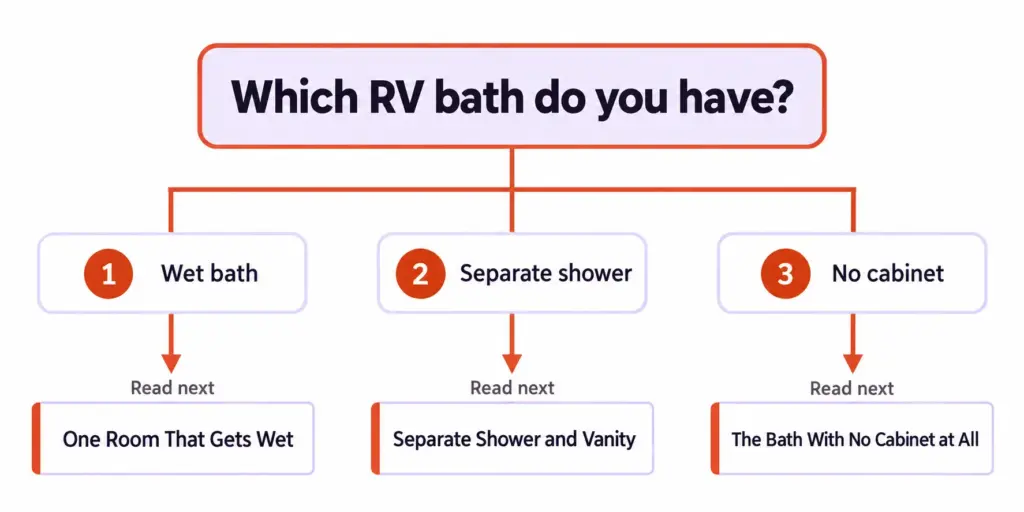
Find Your Bath Type Before You Buy Anything
Open a catalog of bathroom organizers and nearly every one is sold as if every travel trailer bathroom, fifth wheel bathroom and motorhome bathroom were the same room. They are not, and the layout of yours settles most of the storage questions before any product does.
Wet Bath: One Room That Gets Wet
A wet bath puts the shower and the toilet in one room, so the spray reaches everything in it. Winnebago’s own description of the layout is blunt about the result: “the entire area will be wet after showering.”
That sentence decides where things go. The towel hook sits in the spray zone, the toilet paper sits in the spray zone, and nothing on a wet wall stays dry. Every item in a wet bath has to tolerate water or live where the spray cannot reach, which means the outside of the door or a basket inside a cabinet.
Wet baths also have very little storage. There is no vanity and no drawer, so the walls and the door are the storage, and the layout of those surfaces needs planning first. The shower itself is a choice, not a given: some rigs, the Winnebago Revel among them, drop the shower and use that space for storage. Plenty of people weigh that trade and keep the shower, because the alternative is a campground shower and the shelf is easier to give up.
Separate Shower and Vanity: More Room, Same Road
A dry bath has a separate shower or tub shower, and RV Living points out that it gives you more storage than a wet bath. The spray stays in the shower stall, so the problem moves to the vanity and the cabinet under it. More room means more places to put things, not more places that hold on a road: the same rods, hooks and shelves ride through every bump.
Toiletry storage is also among the most criticized features of RV bathrooms, which is a reason to plan the towels now. Either the bathroom has space for linens or a linen closet sits conveniently nearby. The mess in a roomier bath comes back the same way it does in a house, and why small-bathroom storage drifts back to a mess explains the mechanism.
The Bath With No Cabinet at All
Some bathrooms hold a sink, a toilet and nothing else: no medicine cabinet, no cabinet under the sink. The family’s bottles have nowhere to live, and the towels need a linen space somewhere else in the rig. The ranked wall ladder in the section on baths without a cabinet is built for this room. If yours has a cabinet, the cabinet section is your next stop, and if it is a wet bath, go to the shower and door sections first.
Shower Storage That Survives the Road
RV shower storage starts where a family’s shampoo collection meets a shower with one corner and a thin back wall, and something has to give. Usually it is the collection.

The Corner Caddy and Where Adhesive Stops Working
Free first: declutter the toiletries and cut the bottles down to the ones used in a week. Smaller refillable travel-size bottles keep the daily set compact. The rest travel in a crate, a toiletry bag or a caddy that goes to the shower with the person using it and leaves with them.
A rule keeps the shelf honest: anything untouched for two weeks leaves the shower and goes into a bin under the sink or a cargo bay. One bar of soap, one shampoo, one shower gel and maybe a conditioner covers more days than most families expect. Half the bottles on a shared shower shelf never get used, but each one has a defender.
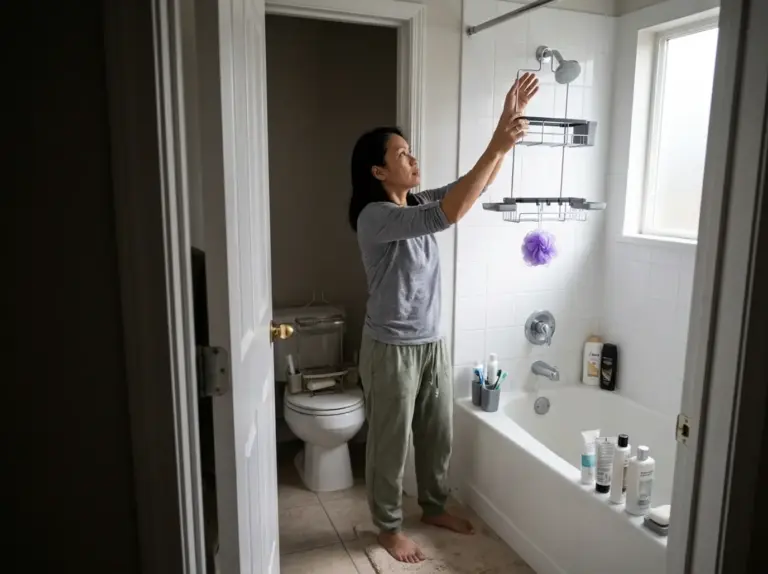
With the bottles cut, a corner caddy is the shower option that does not depend on a tension pole fighting the roof. Tension-rod caddies get named first on most lists, and in a rig that stays put they are fine. In one that drives, the roof curve and a flexing panel make the rod the weaker pick, so the corner caddy moves up, provided the corner is square. It fits true 90-degree corners only, and shower corners are not always 90, so check yours with a square or the edge of a book.
The AKTECKE Corner Shower Caddy, 2 Pack Adhesive Shower Corner Organizer Shelves, No Drilling is a stainless pair built for those corners. The adhesive is where any adhesive shower caddy gives out, most often on a wall that is not flat or a surround that flexes, and this one is no exception. Press it to the flattest, cleanest patch of the corner, load it with what you will really carry, and look at it again after the first rough stretch. Caddy styles you will find in a house shower, from corner shelves to hanging mesh, are compared in a longer look at shower caddy types, though the road changes which of them survive.
A Curtain Rod Above the Spray Line
If the corner is not square, go higher. A curtain rod mounted above the spray line can carry lightweight plastic baskets or a mesh shower caddy hung from a couple of shower curtain rings, and the bottom of the rod’s holders can rest on the lip of the surround. Set the rod where it cannot slide, ideally with a lip to catch it if it does.
A tension rod can do this job for light things only, a second rod shares the load, and overloading is the usual way to lose one. The no-drill logic here is borrowed from renters, and no-drill bathroom ideas that skip the deposit risk shows how far adhesive and pressure-fit hardware can go in a bathroom that is not allowed to take screws.
Stick a small circle of shelf liner to each end of a tension rod. On a smooth surface like the inside of a shower, the liner gives the rod something to grip, and it costs a scrap of the roll.
Drying Towels Without Hanging Weight on the Surround
A rod at the back of the shower gives towels, swim trunks and a bath mat a place to dry, and it keeps wet things where the water already is. The cost is humidity: a wet towel hung inside a closed rig releases that water into the rig, so the rod is a drying stop on the way outside, not a storage spot. And keep the weight off the surround itself. A panel that flexes with the road should not carry a soaked towel, and the load belongs on a rod that spans wall to wall.
The Back of the Door and the Wall Beside the Toilet
Four people, four towels, and one wall that gets splashed. In a shared family bathroom this small the arithmetic only works if the system says who gets which hook.
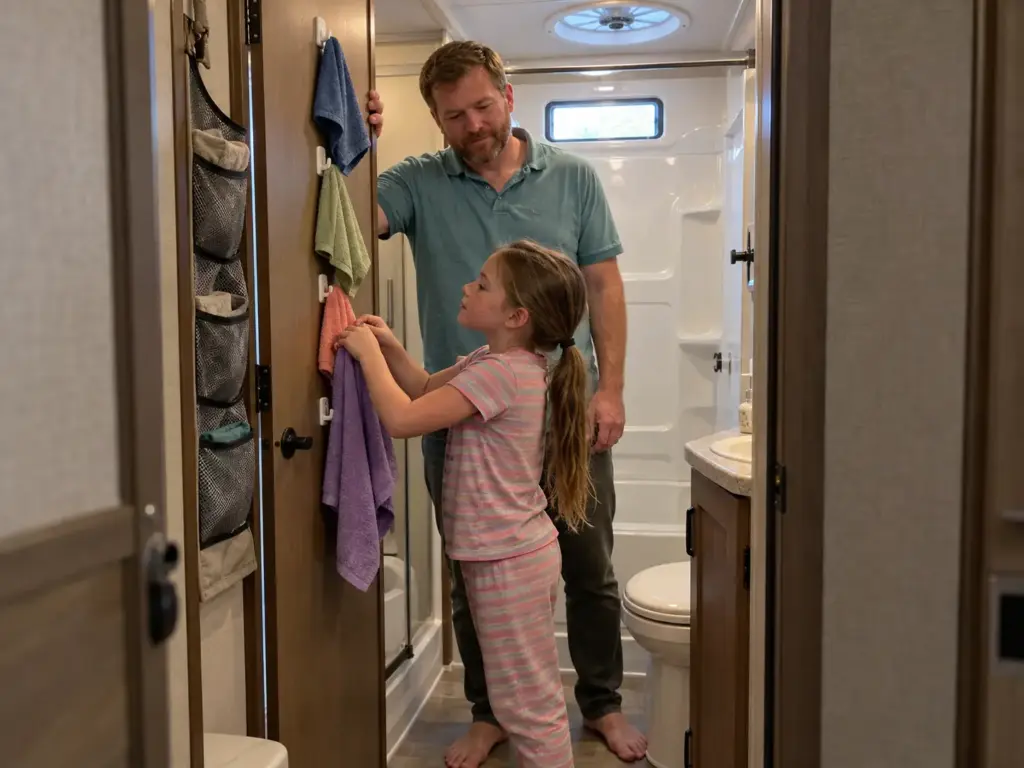
One Hook per Person
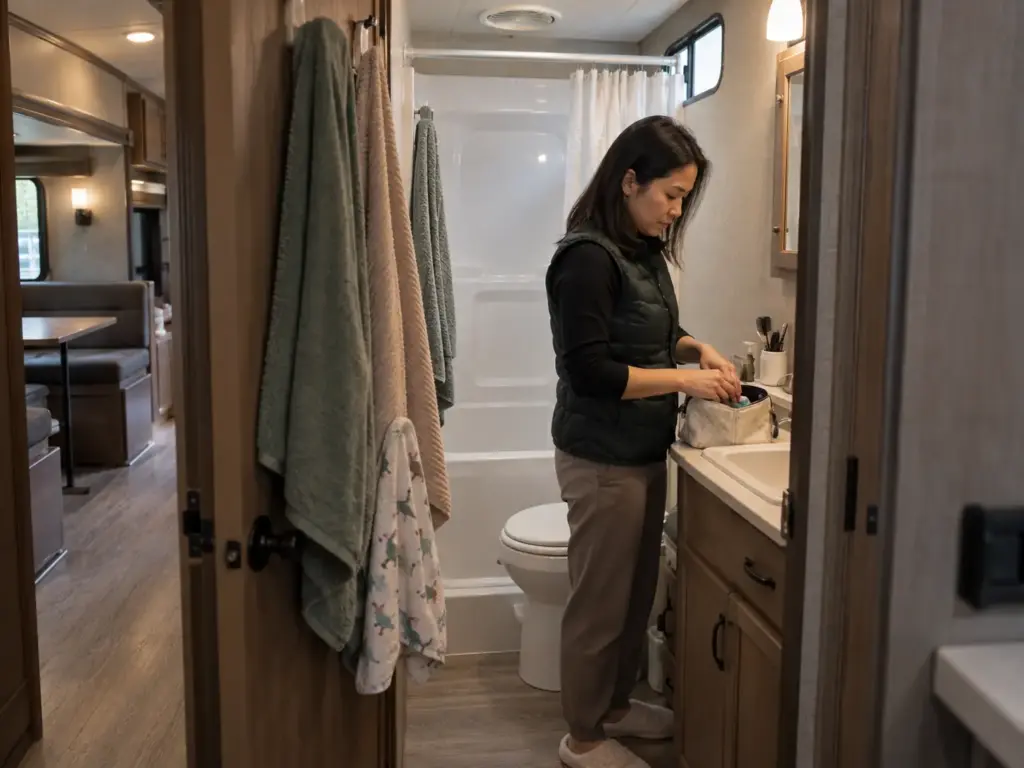
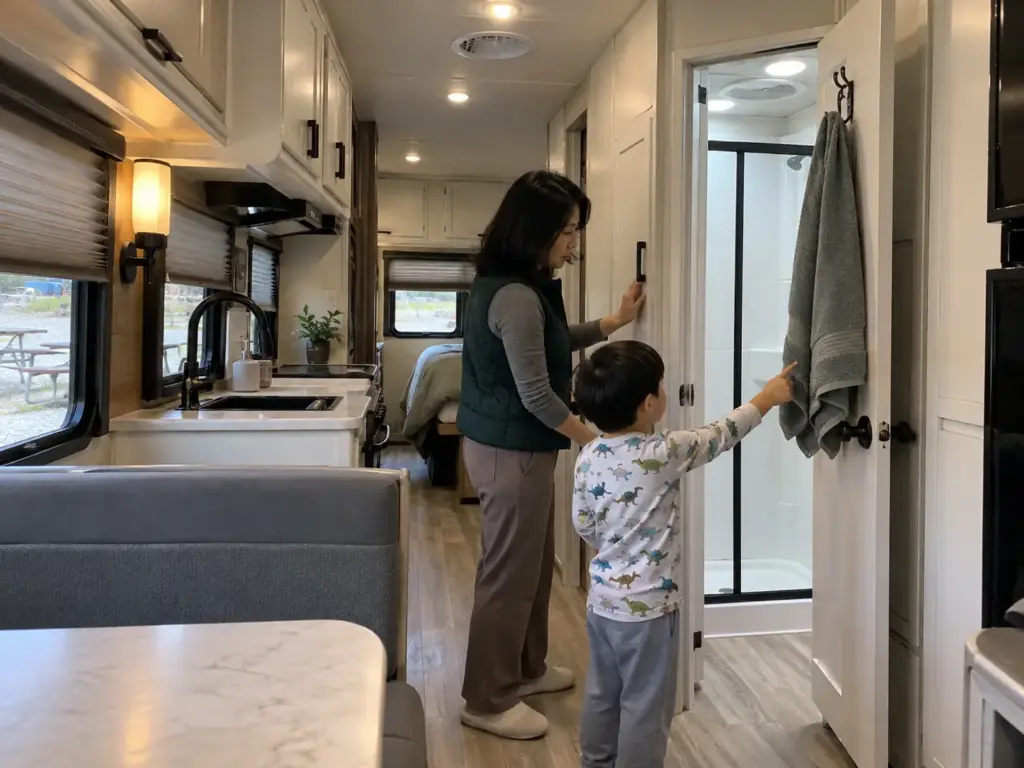
Give each person one of the door hooks, mounted at that person’s height. Hooks per person should equal towels per person, and a hook at the wrong height does not count. A child gets a low hook, because a towel lands where a child can reach, and that is the floor unless a low hook exists.
Towel count follows the trip, not the household: one towel per person per trip and a short stay in the wash cycle beats a full set hanging on the wall. Folding matters too, and folding towels so a small stack stays upright keeps the clean spares from collapsing in a bin.
For mounting tape in place of screws, pair a light hook with Command Water-Resistant Adhesive Refill Strips, Large (Pack of 16), made for bathroom hooks and caddies in humid areas. Adhesive hooks suit light loads, and a wet towel weighs more than the dry one you picture (the first thing to forget), so load the hook wet before trusting it. Hanging wet things on it keeps the humidity inside, so treat the hook as a stop for a towel on its way to dry and not a place to leave it.
It also does not stand in for a rod that moves. Hollow-core doors and painted walls change what an adhesive hook can hold, and hook and weight checks for adhesive hardware walks through both.
The Over-Door Pocket and Airflow
A pocket sleeve on the bathroom door, the over the door organizer of choice here, works if it is mesh, since mesh lets bathroom moisture pass through. RV bathroom towel storage goes on the outside of the door, where moving air dries them, and use the pockets for small things: toothbrushes, a razor, rolled clean towels. A purse organizer works for the rolled ones. The deeper over-door setup and the rest of the rig’s cargo bays are covered in the over-door organizer and the bay storage, so this section stays on the bathroom side of the door.
Toilet Paper and the Wall Above or Beside It
In a wet bath, keep toilet paper out of the spray zone. One roll on the toilet paper holder, the spares in a basket in the cabinet or on the dry side of the room, and nothing stacked on the tank top where the shower reaches. In a dry bath, the wall beside the toilet can take a holder and a small over toilet shelf, dead space in most rigs, since the stall keeps the water inside it.
Under the Sink and Inside the Cabinet
The organizer that fit the picture rarely fits the P-trap. This section is for the reader with a cabinet, and the tape measure does more of the work here than the product.
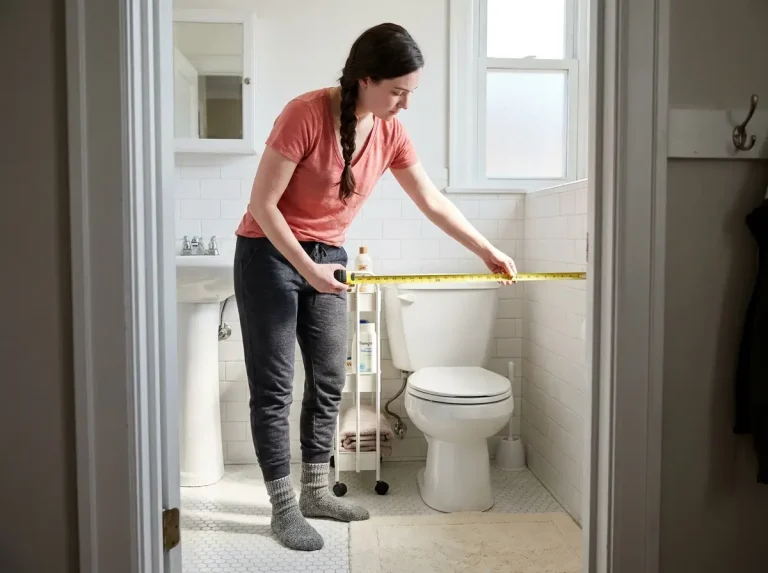
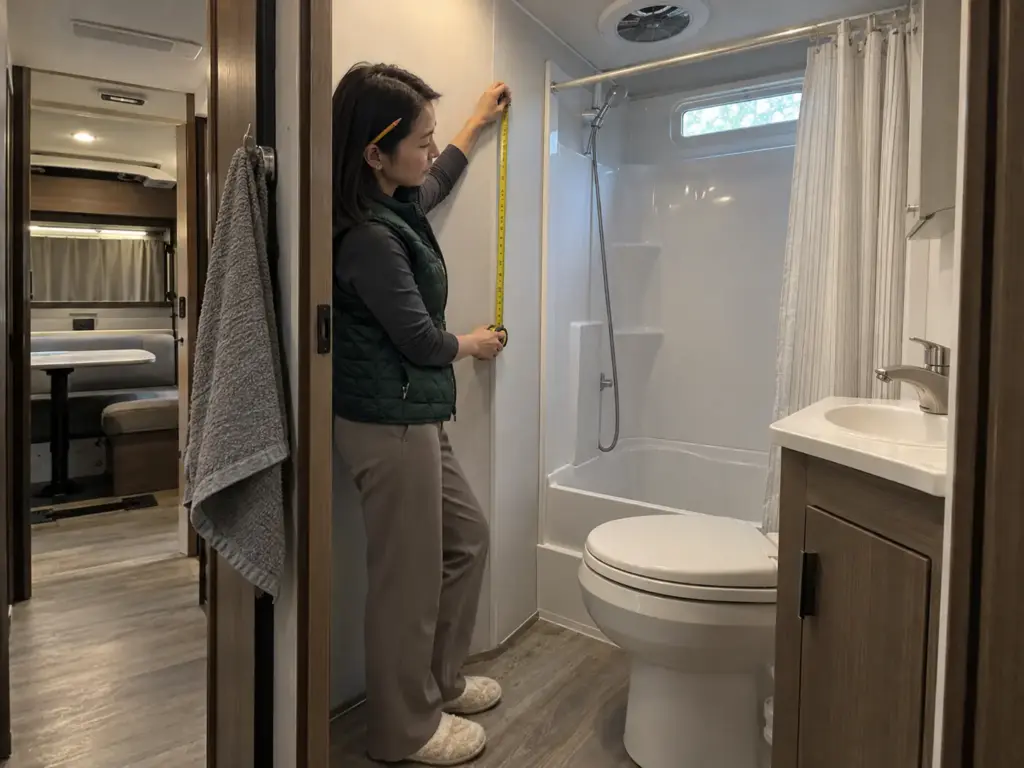
Measure the Cavity Around the Drain
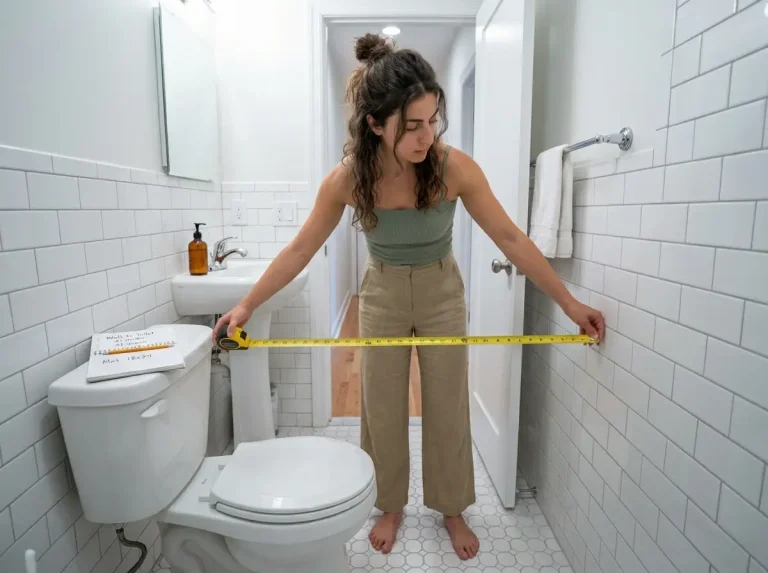
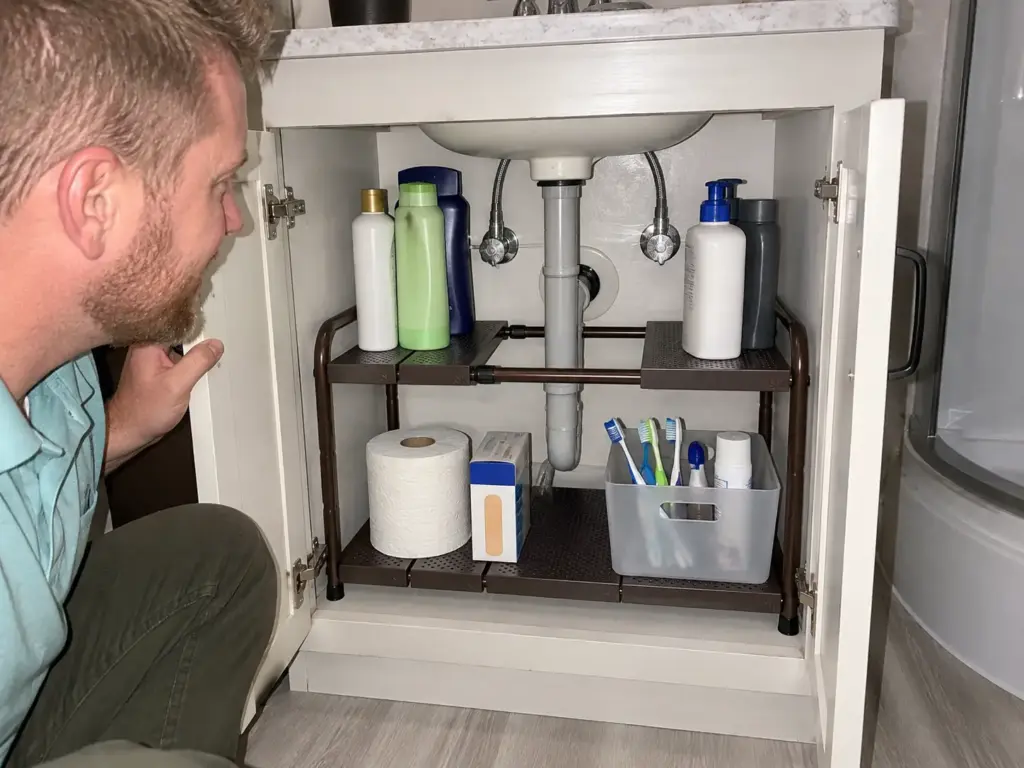
Many RVs have only one enclosed cabinet in the bathroom, and it takes the bottles that cannot live in the shower. Before choosing an under sink organizer, measure the cabinet depth, the width and the height of the open space beside the drain pipe, and note the swing of the door and where the shutoff valve and the water lines run. The pipe sets the real room, not the outside dimensions of the cabinet. A listing’s width and depth describe the product on an empty shelf (yours has a pipe through the middle of it).
Trace the open floor of the cabinet on a sheet of cardboard, mark the pipe and the shutoff valve, cut it out and drop it in. If the cardboard sits flat and the door still closes over it, a shelf of that footprint will fit.
Two-tier expandable organizers get recommended for exactly this cabinet, and the idea is right for a shallow space. But how wide a shelf expands means little until the pipe is measured, and an organizer that straddles the drain on paper can end up sitting on it. Once the room is measured, sorting what goes in follows the same steps as in a house, covered in the step-by-step sort for an under-sink cabinet.
Two Levels in a Shallow Cabinet
A second level doubles the usable height without touching the footprint. Tall bottles go on the floor level, short items such as small tubs and spare soap go on the upper tier, and the drain and the shutoff stay reachable without emptying anything.
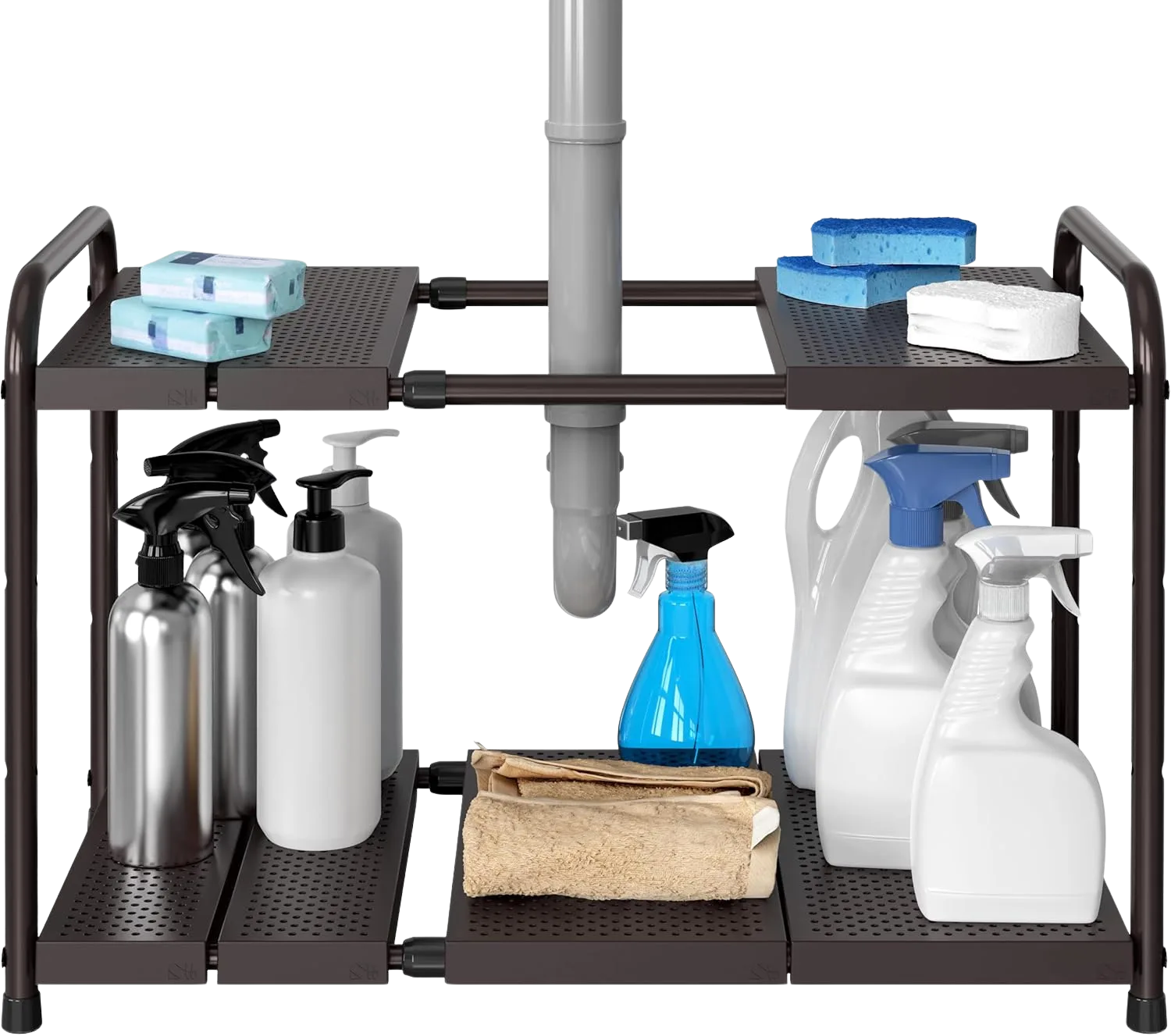
If the cabinet still feels cramped after the shelf goes in, other designs are compared in other under-sink organizers for a bathroom cabinet, and the pipe measurement applies to every one of them.
A Liner and a Latch Check
Bottles slide on a road, and the wire tier of an expandable organizer is exactly the surface they tip on. The GORILLA GRIP ShelfGuard Wire Shelf Liner, Set of 4, 14×36 Clear gives them grip: lay a sheet on each tier before the bottles go back. It only grips what sits flat on it, so a tall bottle with a narrow base still wants a bin around it.
Then check the cabinet latch. Factory cabinet hardware is often a plastic roller catch or a weak magnetic strip with only a few pounds of holding power, and a door that opens on the road dumps whatever you organized. Test it before the first trip by closing the door and shaking it by hand.
Behind the mirror, a medicine cabinet has its own problem. Small items roll, so clear acrylic bins keep them in place (dollar store bins do the job), and steam is the same issue it is in a house bath, with a different set of fixes covered in medicine cabinet ideas that handle steam.
A Bathroom With No Cabinet: The Wall Ladder
A room with a sink, a toilet and nothing else, and a family’s worth of bottles. These rungs are ordered by cost and by how well they survive driving: try them in sequence.
Rung One: Take Most of It Out of the Bathroom
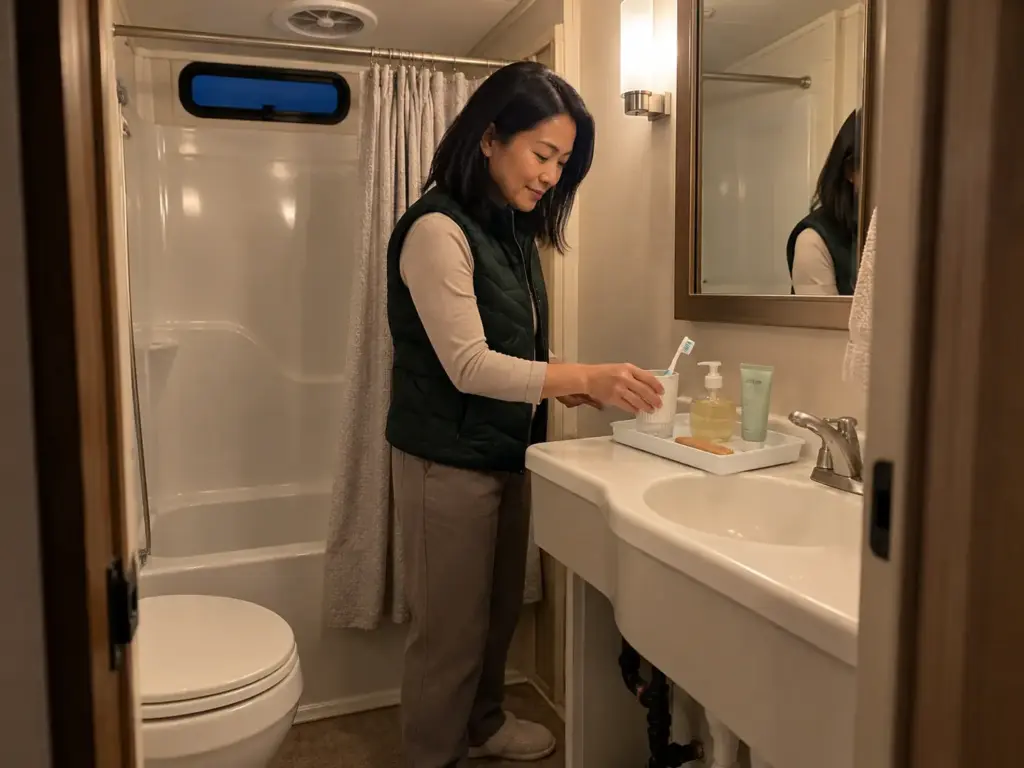
Rung one costs nothing. Pass-through and undercarriage storage hold a surprising amount, and in rigs set up that way the bathroom ends up holding almost nothing but a broom. Only the daily items stay: toothbrushes, soap, a hand towel.
The rest follows the shared-load rule: it rides in a crate in a bay or a kitchen cabinet and comes to the shower with whoever needs it. Towels and linens follow the same logic. If the bath has no room for them, they live in a linen space nearby and arrive on the day they are used.
Rung Two: The Door and the Wall Beside the Mirror
When the bathroom can’t give anything up, the walls are next, and a longer system for a bathroom without cabinets maps the zones of a room like this one in a house. In a rig the choices narrow to three: a mesh pocket sleeve on the door, the narrow strip of wall beside the mirror for adhesive hooks, a wall mounted toothbrush holder and light shelves, and a mesh hanging organizer on a rod, the same rod used in the shower. Mesh is the common thread, because it lets moisture out and weighs next to nothing.
Rung Three: A Raised-Edge Tray on the Counter
A small counter still holds one thing well: a tray with a raised edge. The mDesign Plastic Storage Organizer Tray for Bathroom Vanity Countertops measures 12 x 8 x 2 inches, and the lip keeps the daily bottles from sliding when the rig moves. Get one tray, not three, because a small counter loses its usefulness once it is crowded.
The two-inch edge stops sliding but will not catch a tall bottle that tips, so keep the tall ones in the crate. Keeping a small counter clear is its own discipline, and keeping a small counter clear lays out the habit.
The Travel-Day Load Test and Keeping Humidity Down
On travel morning the bathroom is the room with a wet towel in it and a checklist nobody has finished. A short test makes the checklist real.
The Load Test Before the Drive
This is the blog’s method, a kind of bump test and not a standard, and it is simple. Run it the morning you leave:
- Load every hook, pocket and rod with what it will really carry: a wet towel, a full bottle, the caddy with its usual bottles.
- Tug each one downward and sideways, then shake the wall or panel it hangs from by hand.
- Close the door and the cabinets, then take a slow loop on the campground road with the bathroom closed.
- Anything that moved gets moved, tied down or removed.
Check the latches on the cabinet and the medicine cabinet while you are there. What stays in the bathroom on a travel day is only what is secured before driving, and the rest rides in the crate. Kitchen cabinets get the identical treatment, load first and drive second, as the same travel-day logic in the galley shows.
Photograph the bathroom after it passes the test. On the next travel morning the photo is the checklist, and any hook or bottle that is missing from it tells you what has crept back.
What to Check After the First Rough Road
After the first rough stretch, look at three things. Adhesive edges: a lifted corner is the early sign. Rod ends: a rod that has crept from its spot or left a mark is telling you where it slid.
And the surround: any panel that flexed should carry less. Hardware that never has to travel is a different design problem, and built-ins that never move at all shows what fixed storage looks like when the road drops out of the equation.
Drying the Bathroom Before It Closes Up
Before the rig closes up for the day, dry what you can. According to EPA’s mold cleanup guide, “Places that are often or always damp can be hard to maintain completely free of mold.”
A small RV bathroom is that kind of place. Towels go outside to dry when the weather allows, the shower walls get a wipe, and the exhaust fan runs if the rig has one. A bathroom that is dry when the door shuts is the one that is still fresh at the next stop.
Run the Shake Test Before Every Drive
The type of bathroom picks the storage, and the road tests it. Wet baths lean on the door and a corner caddy, a separate shower puts its effort into the cabinet, and a room with no cabinet moves its bottles out into a crate. Nothing rides on a wall until it has carried a wet load.
For the check later, look at the adhesive edges, the rod ends and the latches after the first rough road and again after the next couple of trips. That tells you which pieces held and which were optimistic.
Today, take the damp towel off the shower wall and hang it on the outside of the bathroom door. Notice in the morning whether the room feels drier and whether the hook still holds, then use that hook as the standard for the rest.
Frequently Asked Questions
01What are some good ideas for bathroom storage in a camper?
Match the storage to your bath type: a corner caddy or curtain rod in the shower, a mesh pocket on the door, a two-tier shelf under the sink and a raised-edge tray on the counter. Test every piece with real weight before driving.
02What is a good organizer for the bathroom of an RV?
A two-tier expandable shelf is the strongest pick for the one enclosed cabinet most RV bathrooms have. Measure the open space beside the drain pipe first, and add a mesh pocket on the door for small items.
03How do you organize an RV bathroom with no cabinet?
Move most items out of the bathroom into pass-through storage or a crate, and keep only the daily ones. Use a mesh door pocket and a raised-edge tray for those, and store towels in a linen space nearby.
04Will adhesive hooks and caddies hold on a moving RV?
They hold on a flat wall with a light load, and they let go on uneven or flexing surfaces. Load each one with a wet towel or full bottles before the drive, and check the edges after the first rough road.
05How many towels does a family of four need in an RV bathroom?
Plan one towel per person per trip, so four for a family of four, and wash on a schedule instead of carrying a full set.
Disclaimer: ClutterlessNest is a participant in the Amazon Services LLC Associates Program. As an Amazon Associate we earn from qualifying purchases. This article may contain affiliate links — if you buy through them, we may earn a small commission at no extra cost to you. We only recommend products we have tested or genuinely believe in.