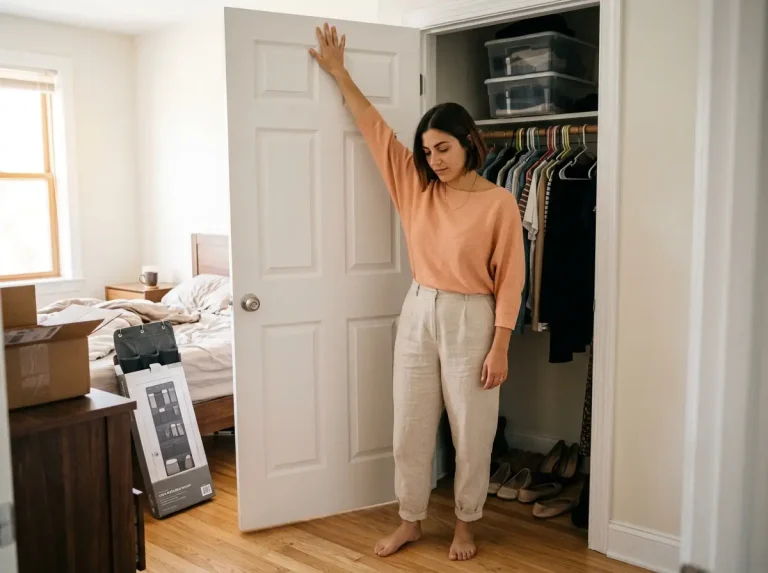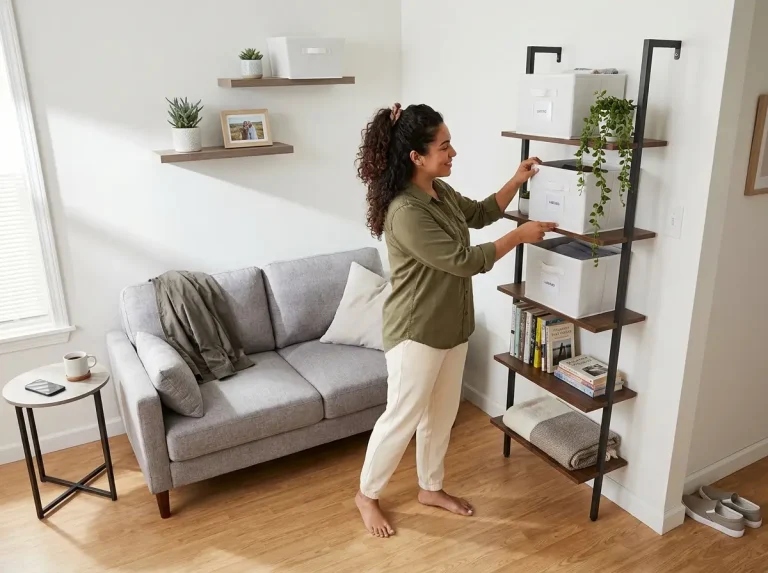

The rack looked perfect at the campground. Then the first washboard stretch of highway did its work, and at the next stop a jar has rolled against the cabinet door and a hook lies on the closet floor. Most RV organization ideas are photographed parked, and a parked rig is the easy case: once the wheels turn, a hook, a shelf or a bin has to put up with a load that swings, a wall that flexes and a door pushed from the inside.
Two checks sort the ideas that last from the ones that don’t: what grabs the thing and how much it carries, and whether the measured opening takes the product. The ten below run through both, from the door to the outside bay, and the method for measuring every opening and securing a rig’s storage for motion is in the full guide to organizing an RV or tiny home.
Quick Answer
The RV organization ideas that last are the ones that pass a road check as well as a fit check:
- Door backs: an over-door organizer for thin doors, removable hooks for light loads.
- Shelves: a tension-rod shelf sized to the measured opening, plus liner so nothing slides.
- Collapsibles: lidded bins, a trash can and a hamper that fold flat.
- Latches: clear bins that latch for food, and real catches on cabinet doors.
- Under the bed: flat fabric bags that clear the gap at its lowest point.
- Exterior bay: lidded bins by job, heavy gear low.
RV Organization Ideas for Door Backs and Hooks
The back of a door is the first free storage a rig hands you, and door back storage fails in two different ways. One is limited by the door. The other is limited by the adhesive.
The Over-Door Organizer Is Limited by the Door’s Thickness
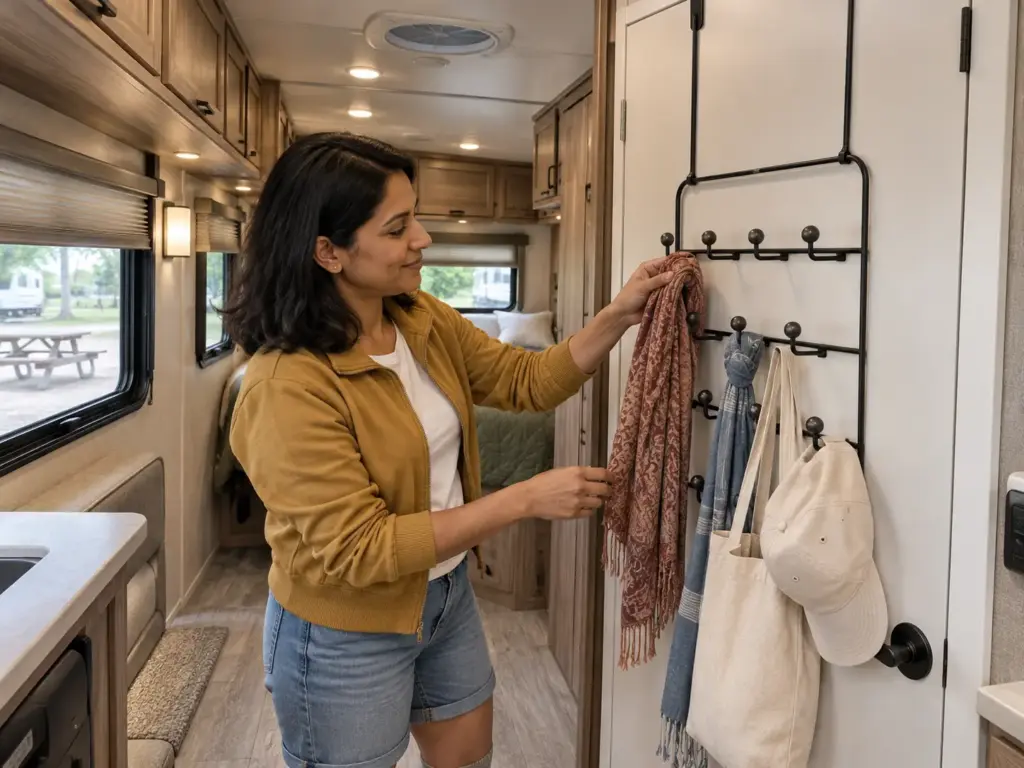
An over-door organizer, also sold as a behind-the-door hanger, hangs from the top edge of the door, so the first measurement is the thickness of that edge. The bedroom and bathroom doors in a travel trailer tend to be thin hollow panels, nothing like the solid door of a house, and an organizer built for a thicker door sits crooked or never settles at all. The Umbra Estique over-the-door organizer has 14 hooks and is listed for doors up to 1.5 inches thick, so run a tape across the door’s edge before the product goes in any cart. That one number decides whether the organizer hangs straight or fights the frame.
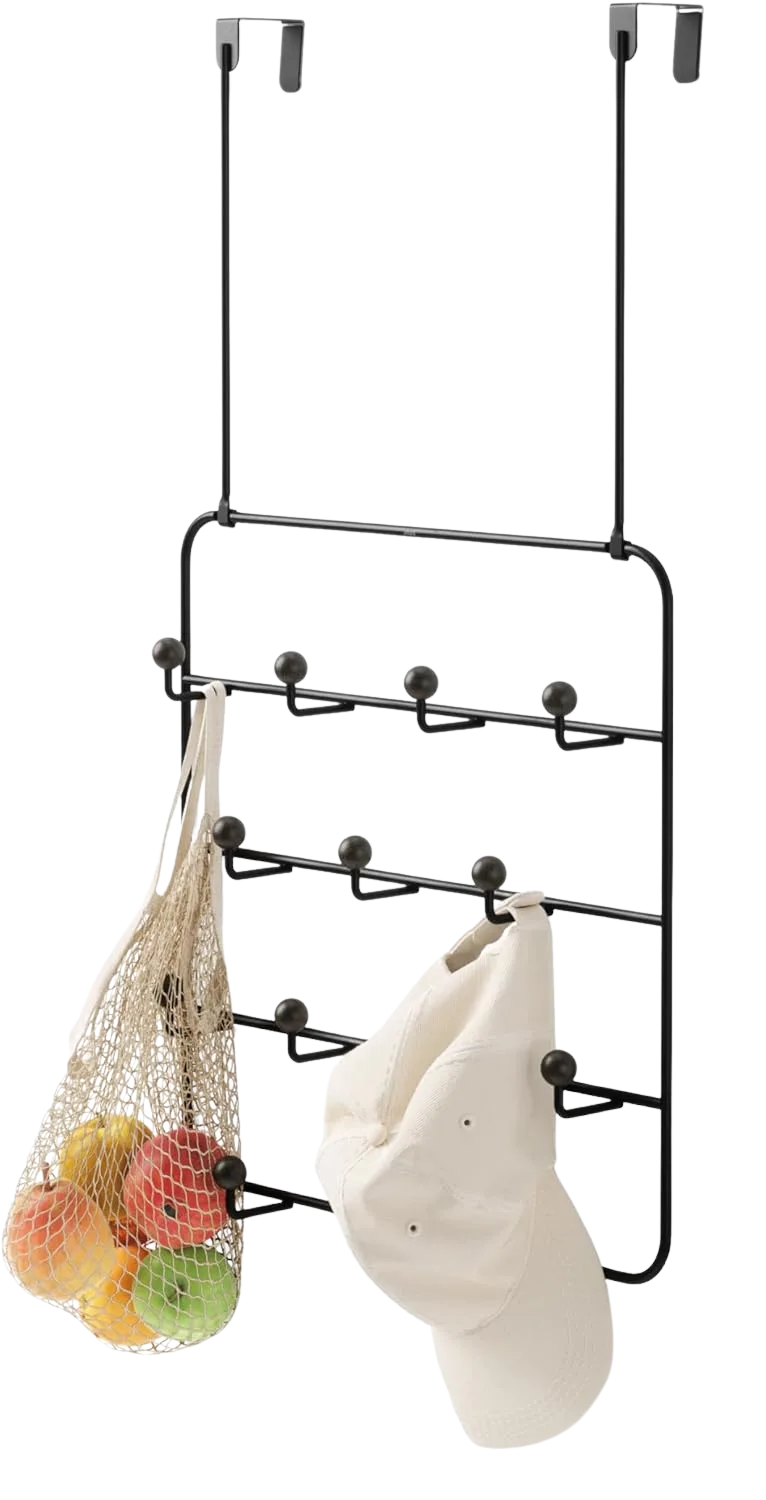
The weight on a door back also swings with the door. Whatever hangs there should be light and soft, and the door should be latched open or shut during the drive so it is not slapping its own load against the frame. If the thickness of your doors is the open question, this breakdown of how door thickness and clearance decide which over-door organizer fits covers the measuring in more detail.
Removable Wire Hooks Work Until the Heat Gets to the Strip
Adhesive hooks such as Command hooks are the no-drill RV storage answer for a wall or a door back, and they are removable, which is why they turn up in so many rigs. The failure is slow. A two-pound pan on a strip hook is the classic way to learn the lesson: it hangs happily for about two months and then comes down on the first hot day. Strips have also let go in hot climates after the surface was cleaned with alcohol and the hook was pressed firmly, so careful installation helps but does not cancel the heat.
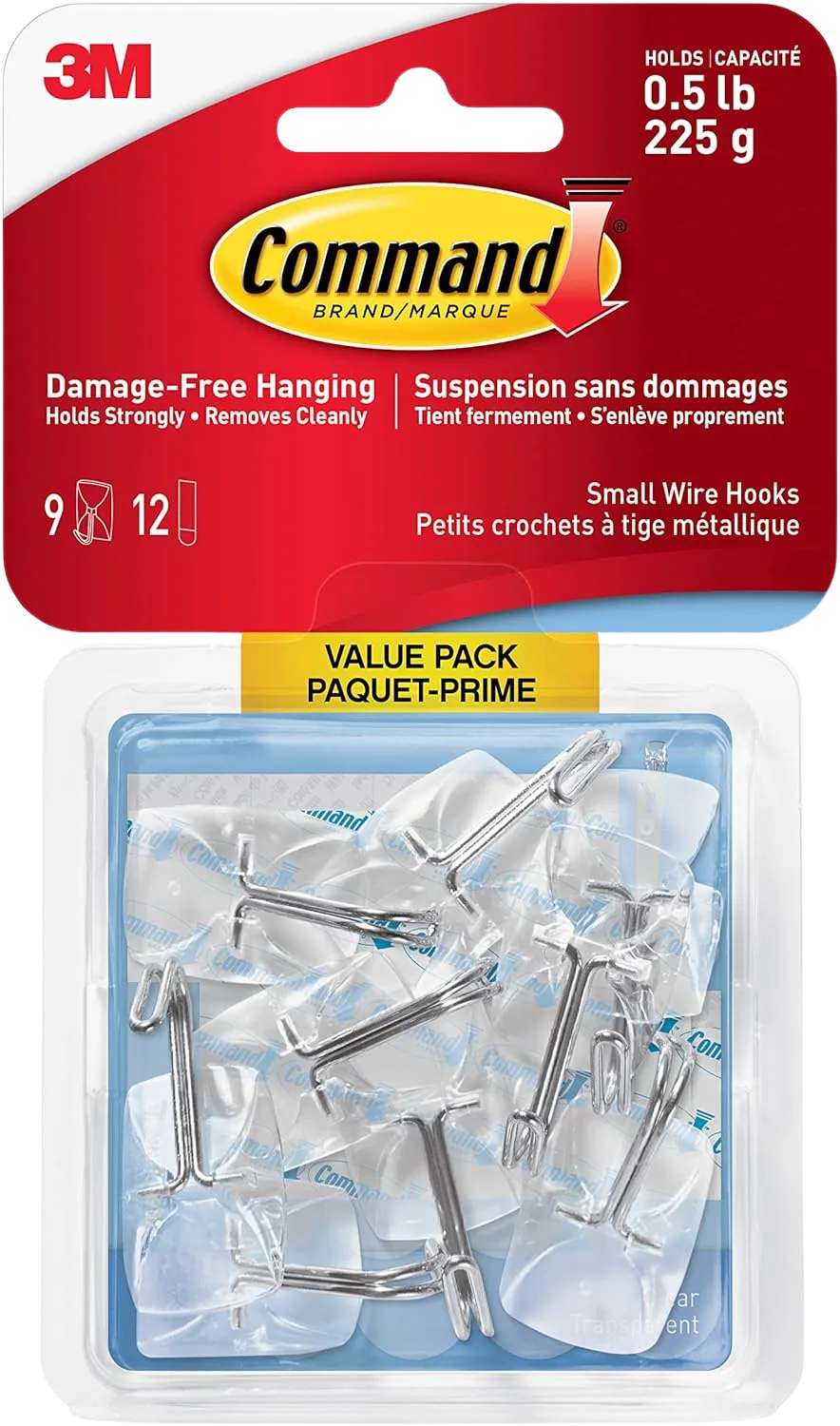
Here is the rule of thumb that survives a moving rig: plan on a quarter of the rated weight, so a hook rated for a few pounds carries under two. That is a working rule, not the maker’s spec, and it is deliberately conservative. And if the thing you want to hang is light, skip the adhesive entirely and use a plain over-door hook, which has no strip to soften. The wall hooks above are for the spot where a door back won’t do, and the same limits that apply to thin walls are laid out in vertical storage that stays inside a hollow door’s limits.
What a Moving Rig Should Never Hang on Either One
Anything heavy, anything breakable and anything that swings far on its hook belongs somewhere else. Cast-iron and aluminum pans, glass, a wet bath towel and a bag of tools all have the same problem: the hook sees the weight multiplied every time the rig dips. Light and soft is the whole list of what goes on a door back or a strip hook during the drive. Everything else rides in a cabinet, low, with something around it.
A useful routine for the hooks you keep: take the heavier items down and stow them before a travel day, and rehang them at the next stop. A hook that only carries light things and gets emptied before the wheels turn lasts a lot longer than one that hangs a full load through a hot week.
Shelves That Hold When the Rig Moves
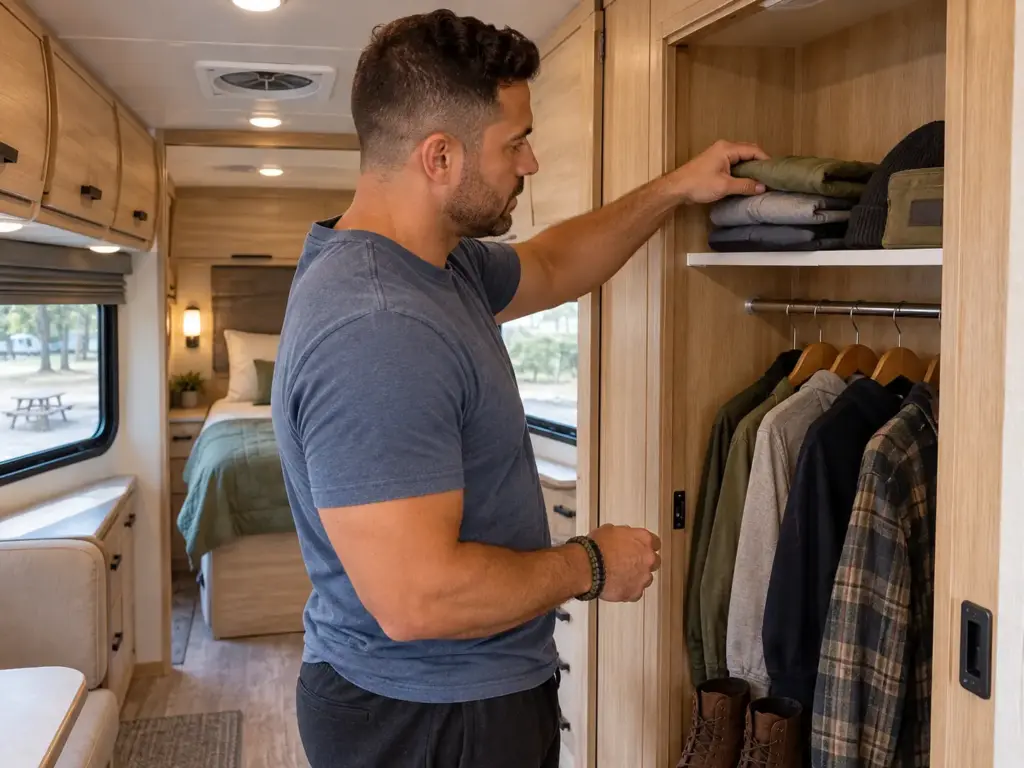
A second shelf in a cabinet or closet opening doubles the stowage, and it is the cheapest way to use the height most RV cabinets leave empty. The opening math and the load decide whether the shelf survives the first long drive.
A Tension-Rod Shelf Starts With the Width of the Opening
A tension shelf holds by pressure against two walls, so everything depends on the distance between those walls, measured at the height where the shelf will sit. Measure the opening, compare the number with the range listed for the product, and only then order it. The Home in Bold tension rod shelving is expandable and needs no drilling, which suits a closet or cabinet that was built for one shelf; the range is the product’s own, so the tape measure has to come first. Measure at the shelf height, because RV walls are not always square and the width at the top can differ from the width at the bottom.
A rig also flexes its walls on the road, and a pressure-held shelf feels every bit of that. Keep it for light, soft items such as linens, snack boxes and the spare roll of paper towels, and never put on it anything that shifts as one block. If you want to know how much a pressure shelf can hold before it slips, a closer look at tension-rod shelving and its weight limits goes through it.
Write the opening’s width on a strip of masking tape and stick it inside the cabinet door. It is the one number you will want in the store aisle and again at the checkout, and it is easier to read than a note buried in a phone.
Soft Shelf Liner Costs Almost Nothing and Stops the Slide
Shelf liner is the budget answer, and it earns its place in every cabinet.
Cut it into strips and lay it between bowls and plates so the stack stops clinking, and spread a sheet on every bare shelf so the things that sit on it stop sliding toward the door. The logic is simple: friction, not force, keeps a dish where you put it, and a soft liner gives a bare shelf something to grip. The liner reduces the slide, but it does not replace a latch on the door, because a stack that creeps still ends up against the door when the cabinet is packed too full. A cabinet shelf riser works on the same terms: it earns its place only when it sits on liner and carries light things.
Why the Upper Cabinets Get the Light Things
The screws holding an overhead cabinet in place bite the thin skin of the wall, not a framing member, and a heavy load pulls them out as the cabinet moves with the rig.
What stresses the screw is not the weight at rest. It is that weight swinging on the screw each time the rig dips and bounces. So the heavy items go low, in the floor-level cabinets and the bay, and the uppers carry the light ones: cereal, bags of chips, towels, the lightweight dishes you use most. The step-by-step method for how much weight overhead storage can take is in the full guide, and the mechanism above is the reason it works.
Collapsible Gear That Folds Away When It Is Not Working
In a rig, the cheapest square footage is the footprint a thing frees when it folds. The risk is what a folding thing does in transit.
Collapsible Lidded Bins Give Back Their Space on the Move
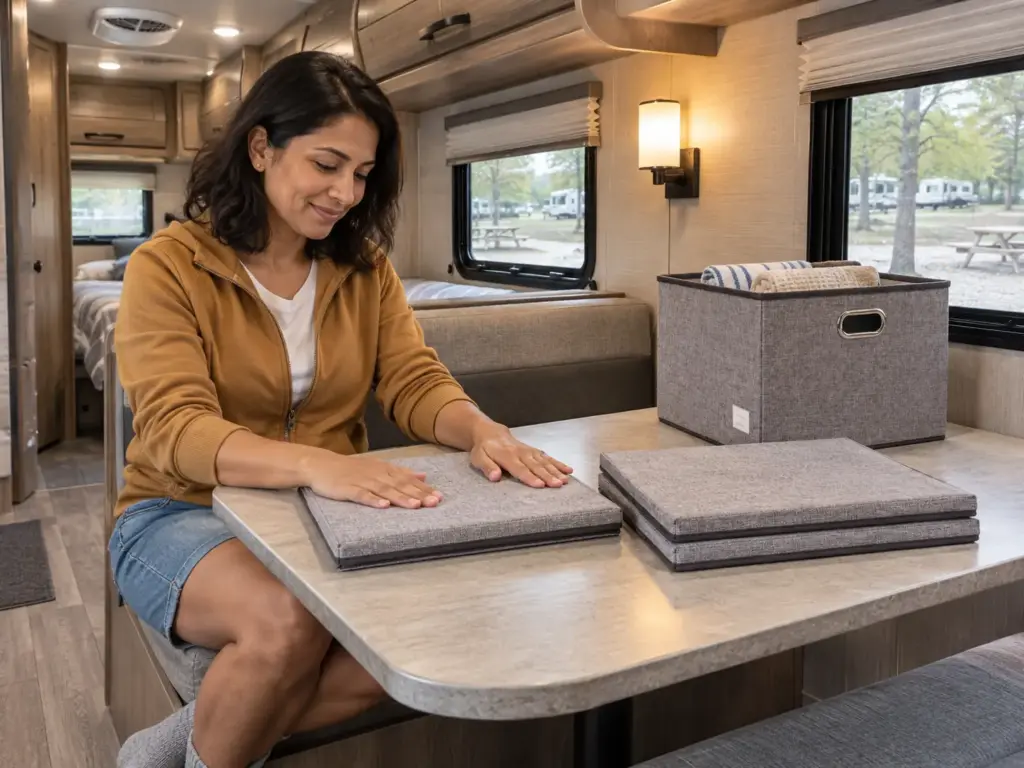
A rigid bin takes the same room empty as full, which is a bad trade in a space measured in inches. The PRANDOM large collapsible storage bins with lids come as a pack of three and fold flat when the trip empties them, then pop open at the campground when the pantry needs a second home. The lid matters more than the folding: a lidded bin keeps its contents in when the load shifts, for the same reason a closed cabinet beats an open shelf. Check that the folded stack fits where it will live, not just that the open bin fits where it will work.
The failure to expect is quiet. The bin fits the pantry on day one, the pantry gets restocked, and the lid no longer closes over the top of what you loaded. At that point a collapsible bin has stopped being a lidded bin, so leave a little air under the lid when you load it.
A Collapsible Trash Can and a Pop-Up Hamper Fold Flat
These two items live at the door and in the bathroom, the places a rig needs a bin that exists only while it is in use. A collapsible trash can opens for the stay and folds flat for the road, and a pop-up hamper does the same for the laundry. If a fold-flat hamper is new to you, hampers that actually fit in tight spaces are worth a look before you pick one, since the width and the fold style are what decide the fit in a small bathroom or closet.
Where a Folding Item Loses to a Rigid One
A folding item has a seam and a frame, and both flex. A full collapsible bin on a rough road bows at its sides, and what is inside it presses against whatever is next to it. So the rule for the folding gear is simple: light and bulky goes in the collapsibles (linens, towels, spare clothes, cereal boxes), and the heavy, dense or fragile things ride in rigid bins. Put differently, folding saves space when the thing is empty, and rigid wins whenever the thing is full and the road is rough.
Clear Bins and Latches That Keep the Galley Shut
The galley fails first on the road. A latching clear bin keeps the food in one piece, and a real latch keeps the door closed on top of it.
Latching Clear Bins Make a Fridge and a Pantry Cabinet Readable
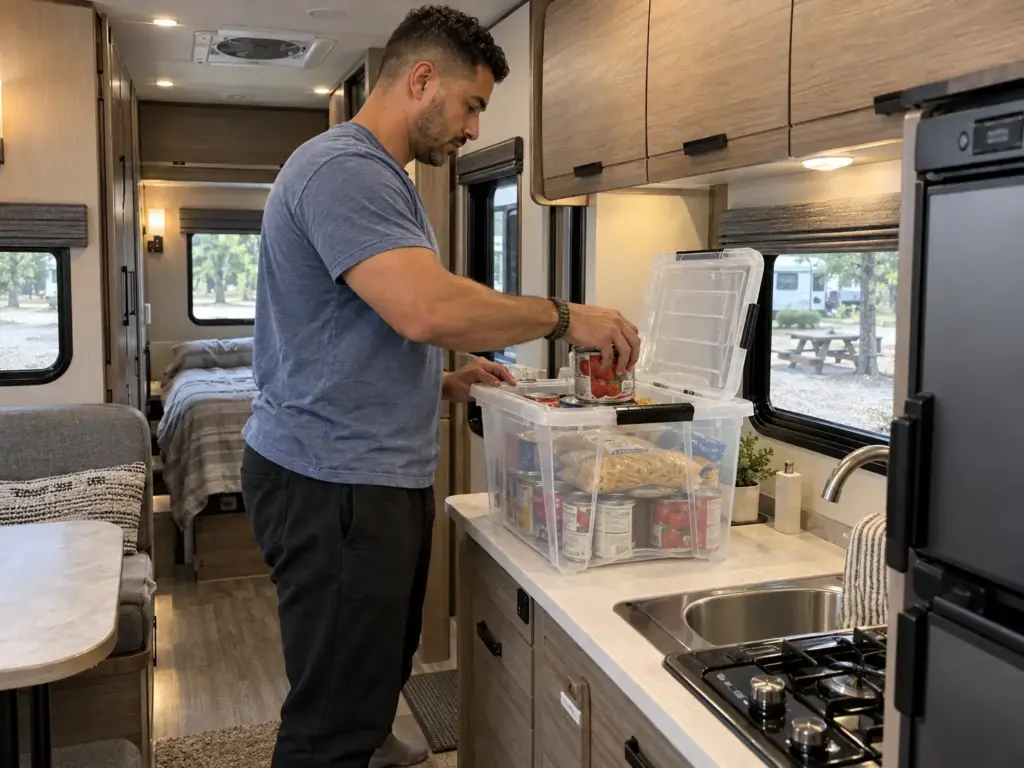
Clear gets you readability, and the latch gets you a lid that stays on when the box moves. The IRIS USA 32 Qt latching clear storage box comes in a pack of four, and a spill stays inside the box instead of spreading across the shelf.
Its job here is clear fridge bins and one food cabinet, not the whole rig. Heavy cans go in the bottom bin and soft items such as bread and snack bags go above, and the fridge shelf and the cabinet opening both need a tape measure before the boxes come in. Tall clear bins only suit a cabinet tall enough to clear them with the lid up, so measure the height as well as the width. Fridge shelves are usually shallower than a house fridge, and fitting bins into a small fridge is mostly an exercise in measuring depth and height.
The same goes for the shelves. A bin that clears a rental-sized shelf by a finger is the right one, and clear bins that fit shallow shelves are a short list because the depth ruling-out takes most of the options.
A Roller Catch or a Locking Latch Does What a Bungee Cannot
Cans in a cabinet are what push the door open on a rough road. The factory gas struts on many cabinet doors hold a door open, not shut under a load, and the little catches that come with some rigs need aligning before they hold anything.
The fixes that work are roller catches on doors that lack one, and hidden locking or magnetic-release latches, the kind sold as child locks. A bungee cord does not hold a cabinet door shut, however many times it gets tried. The cord stretches, the load shifts, and the door opens anyway.
Until a real catch goes on, there is a budget stopgap: a rubber strap from handle to handle, or a strip of Velcro with a pull tab. It is a stopgap because it needs your hands every time. And a jar of marinade breaking on the floor after a cabinet flew open is the kind of event that ends the “it will be fine” phase for good.
Test a catch the way the road will: load the cabinet, close the door and give the front a firm shove with your palm. If the door gives, the catch is not doing the job yet, and you found out in the driveway instead of on the highway.
Why the Gas Strut Is Not a Latch
A strut is a spring in a cylinder. Its job is to hold the door up once you have lifted it, and to stop it crashing down. It was never designed to resist a weight pressing outward from inside the cabinet, so asking it to keep a door shut on a full shelf is asking for a job it was not built for.
The latch is the part that carries that load. Put the catch on first, then look at the strut only as a way to keep the door up when you are loading the cabinet.
Flat Storage Under the Bed, the Bunk and the Seats
The biggest void in most rigs is the space under the sleeping platform, with the bunk and the dinette seats close behind. The idea is flat storage, and the check is the height of the gap and how the base opens.
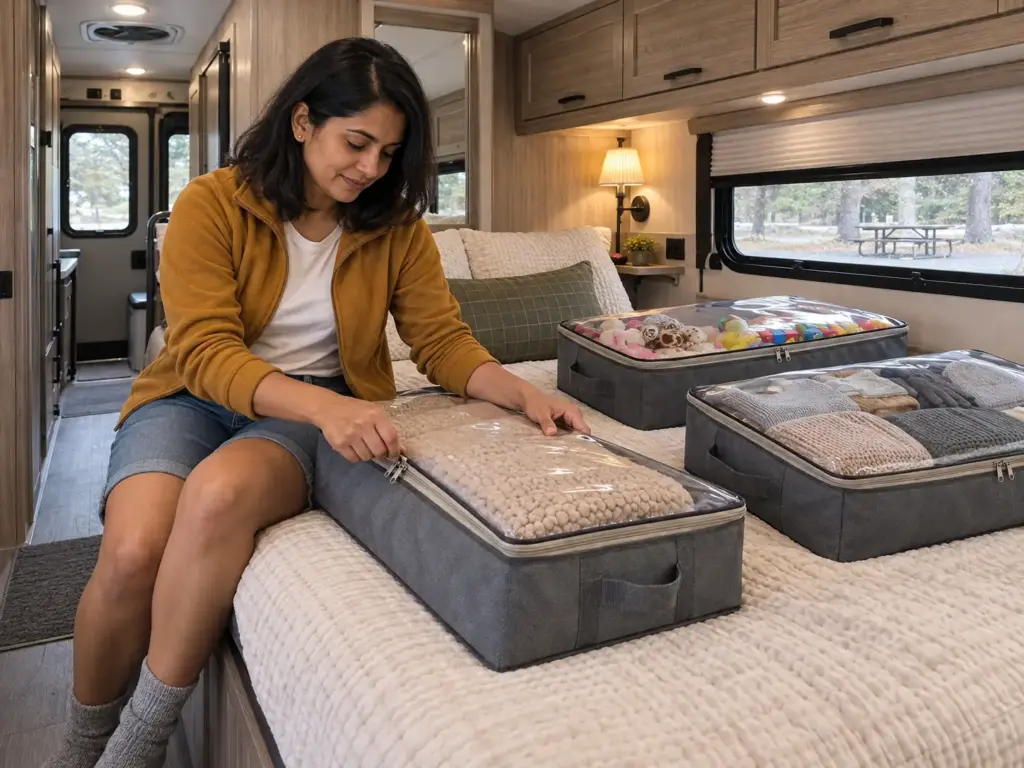
A Flat Fabric Bag Fits the Gap a Rigid Box Does Not
Under-bed platform storage works only when the container is flatter than the gap, and a rigid box stops against the platform’s lip, leaving the rest of the space empty above and behind it. The Nest Neatly SmartCubePlus under bed storage bags are flat fabric, three in a pack at 30 by 19 by 5.5 inches, and the low profile is the point. They suit off-season bedding and spare clothes, the things you reach for twice a season. For a quick look at what else fits the gap, under-bed ideas for low platforms goes through the options.
A bedside caddy handles the small things a flat bag never will, since it hangs where the hand already reaches. The bag that fits by length and not by height is the one that ends up on the closet floor. Check the 5.5 inches against the gap before anything else.
Slide a thin hardcover book into the gap before ordering anything. If the book catches on the lip, a bag the same height will catch too.
Measure the Gap and Check How the Base Lifts
Measure the gap at its lowest point, not the average, because a platform base has a lip, and sometimes a pipe or a wire run along one edge. The bag height has to be under that smallest number.
Then check how the base opens. A hinged or lift-up base needs room for the bag and clearance for the lift, so do not store anything over the struts, and keep heavy items out of any space where the platform has to be raised overhead. A lifted platform plus a heavy load is a hazard you can avoid with one measurement. The same gap-and-lift check applies to bunk storage and to seat storage under a dinette cushion: measure the void, and keep the contents light enough to lift with one hand.
Vacuum bags look like the obvious answer for a low platform, but they get flatter and harder, not lower, and the stiff block they become is what catches on a lip. The reasons are in why vacuum bags fail under low beds, and the short version is that a soft, flat bag is the better fit.
Bay and Tow Storage Outside the Door
The exterior storage compartment, the bay, holds the gear that does not belong inside, and it is the one place where what you load changes how the rig tows.
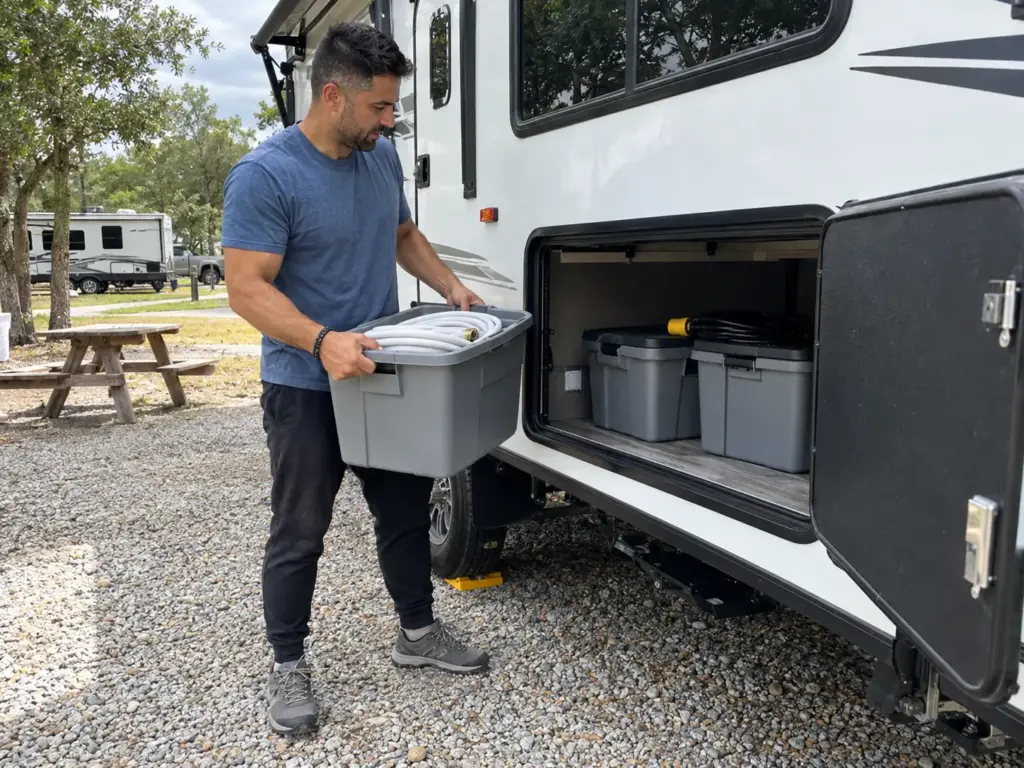
Lidded Bins Keep Hoses and Cords From Becoming One Pile
Sort the bay by job: one lidded bin for water hoses, one for power cords, one for leveling blocks and wheel gear. Each job gets one box, so on arrival you pull out the box you need rather than untangling a pile. The lid is what stops cords from turning into a knot on the road, and it keeps a dirty hose away from a clean one. A hose storage bag is the soft version of the same idea for a hose that coils, and a small cords and charging organizer keeps the power cords from tangling with it.
Heavy Low, Light High, and Check the Rig’s Own Ratings
A rig with its weight in the wrong place tows badly, so heavy gear goes low and close to the axle line and light gear goes high. The rig’s own weight ratings are printed on its data plate, and they should be checked before the bay gets loaded; the full weight method is in the full guide. Keep the bay doors latched too. Loose gear pressing against a door is how that door ends up open on the highway.
The Kitchen, Bath and Closet in One Line Each
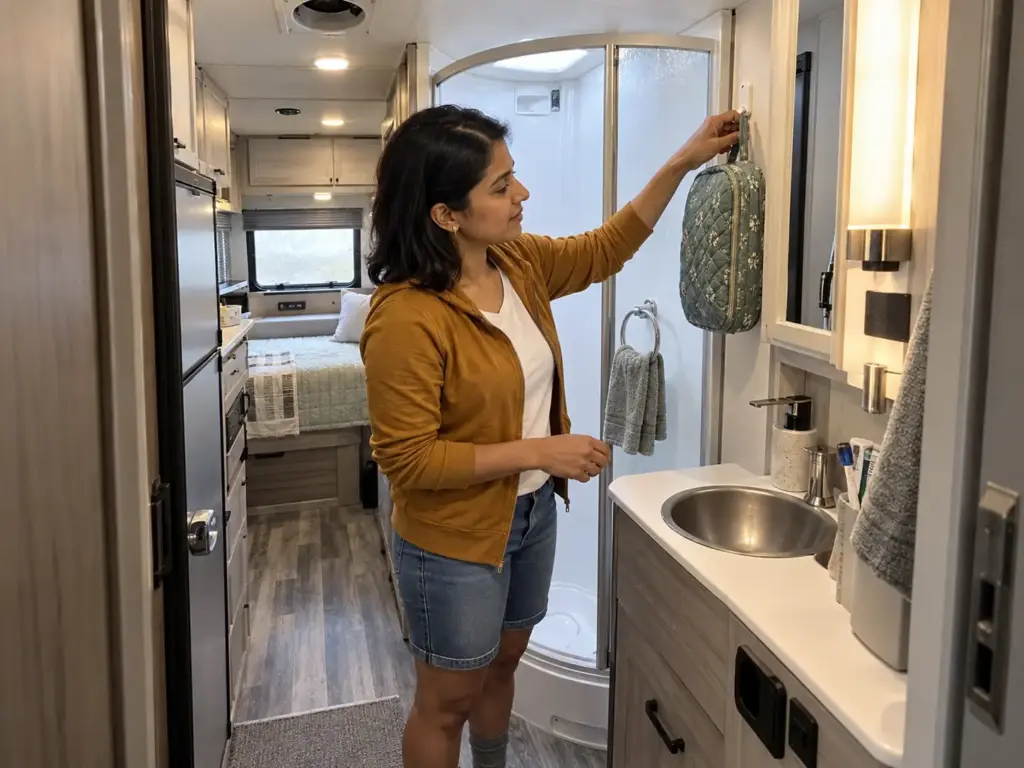
For RV kitchen organization, the latches and clear bins above do most of the work, and drawer dividers keep the utensils from sliding once the drawer is shut (check the drawer height first so the dividers clear the front); the rest is cutting the inventory to what the galley can hold. For RV bathroom organization, hang a hanging toiletry bag or a shower caddy on a removable hook and keep the heavy bottles low; bathroom storage that goes up without drilling covers the removable options that leave no marks. RV closet organization is a camper closet depth problem: a tension-rod shelf and slim hangers fix it without touching the walls, rolled clothes in a shelf bin use the depth that hangers waste, and closet storage that needs no drilling explains the rest.
Which Ideas Survive the Road, and Why
Ten ideas, and almost every failure comes down to one of three mechanisms. That is a short list to check against, and it works for camper organization, travel trailer organization and motorhome storage alike, because the road does the same three things to all of them. The same checks carry over to tiny home storage on wheels.
The Three Ways an Idea Fails Once the Wheels Turn
The first is an adhesive that softens in heat, which takes down the strip hooks. The second is a screw that grips a thin skin and loosens under swing, which takes down overhead cabinets that were loaded as if the rig were a house. The third is a door that opens against a load because only a strut is holding it. Everything else in the ten is a variation on one of those, and it is why the cheapest fixes are the ones that act on the mechanism: lighter loads, lower weight and a real latch.
The Ten Ideas, One Verdict Each
| Idea | What holds it | How it fails on the road | Verdict |
|---|---|---|---|
| Over-door organizer | Hangs over the door edge | Door too thick, or a swinging load | Holds with a check |
| Removable wire hooks | Adhesive strip | Heat softens the strip over months | Holds only if the load is light |
| Tension-rod shelf | Pressure against two walls | Wall flex and heavy loads slip it | Holds with a check |
| Soft shelf liner | Friction under dishes | Doesn’t stop a packed cabinet from creeping | Holds |
| Collapsible lidded bins | Frame and lid | Sides flex when full, lid stops closing | Holds only if kept light |
| Collapsible trash can and hamper | Folds flat when stowed | Seam and frame wear with use | Holds |
| Latching clear bins | Latched lid | Overpacked bin pushes its own latch | Holds |
| Roller catches and locking latches | A real catch on the door | Catch out of alignment, or missing | Holds |
| Flat fabric bags under the bed | Low profile in the gap | Gap smaller than the bag, or a lifting base | Holds with a check |
| Lidded bins in the bay | One box per job | Heavy gear too high or too far back | Holds with a check |
The Walk-Through Before Every Trip
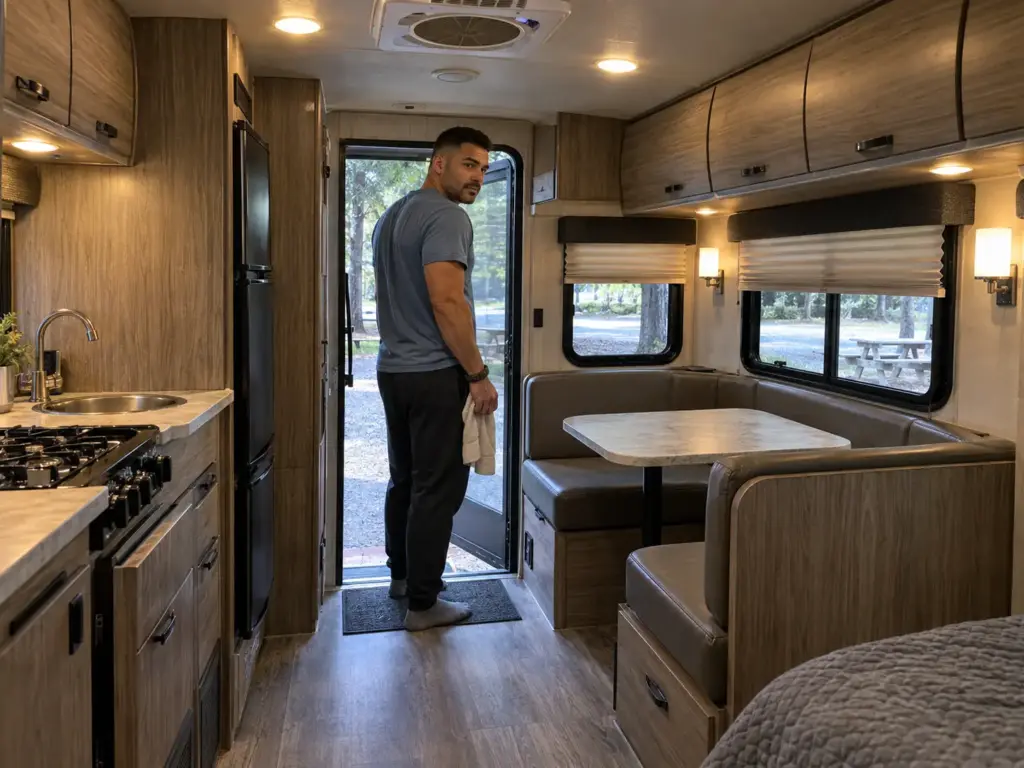
Before the wheels turn, walk the rig once from the front door to the bay: tug each latch and catch, lift the hooks to see that nothing heavy is left hanging, push on the bins on the shelves, and shut and latch the bay doors. Two minutes of that finds what the road would have found for you. For the sequence of the whole rig, in order, the step-by-step plan for the whole rig picks up where this page stops.
After the first few trips, recheck what shifted. Strips and catches wear in use, and the first week on the road shows which ones needed more than the tape measure suggested.
Fix One Latch Today and Watch What Moves on the Next Drive
The four moves that change a trailer the most are the door back, the shelf, the latch and the flat bag. Every one of the ten RV storage ideas passed the same two tests: whether it survives the road, and whether the opening takes it. Light things go on hooks and in the uppers, heavy things go low, and a real latch does what a strut and a bungee cannot.
Recheck the strips and the catches after the first few trips and again each season, since heat and use are what wear them. Today, pick the one cabinet door that opened on the last drive and put a roller catch or a Velcro strap on it, then watch how that cabinet behaves on the next one.
Frequently Asked Questions
01What are some good ideas for organizing my RV?
The best RV organization ideas are the ones that hold up while the rig is moving: an over-door organizer, a tension-rod shelf, a real cabinet latch and flat bags under the bed. Add shelf liner and lidded bins for the rest.
02What does every RV owner need?
From the organizing side, every owner needs a tape measure, a few real latches, shelf liner and lidded bins. They cover the three things a moving rig does to storage: slide it, shake it and open it.
03How do you keep things from falling out of RV cabinets while driving?
Put a roller catch or a locking latch on every door, because a gas strut and a bungee will not hold a door shut against a load. Line the shelves with liner and keep the heavy items low.
04Do adhesive hooks hold in a hot RV?
Heat is what makes them fail, and they fail after weeks or months of hanging rather than at once. Plan on a quarter of the rated weight, keep them out of direct sun, and use them for light things only.
05What is the best way to use the space under an RV bed?
Use flat fabric bags that clear the gap at its lowest point. Measure the lip and any pipe or wire run first, and never store heavy items where the platform has to lift overhead.
Disclaimer: ClutterlessNest is a participant in the Amazon Services LLC Associates Program. As an Amazon Associate we earn from qualifying purchases. This article may contain affiliate links — if you buy through them, we may earn a small commission at no extra cost to you. We only recommend products we have tested or genuinely believe in.