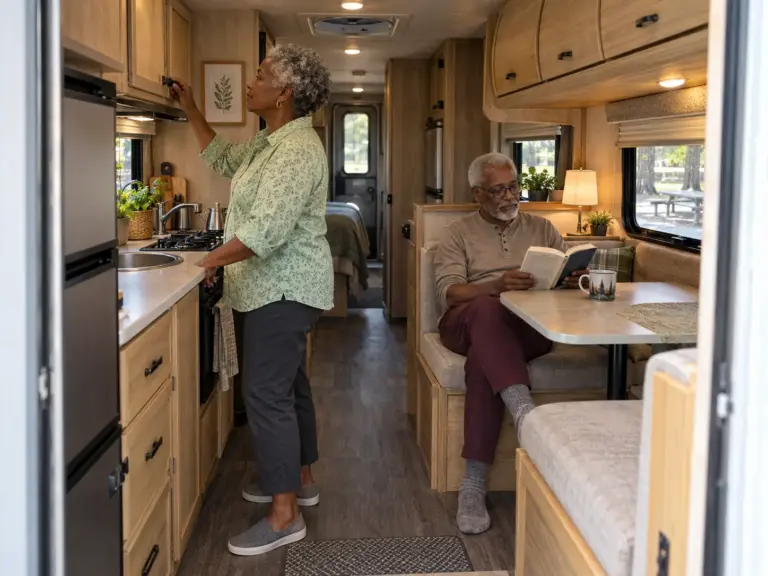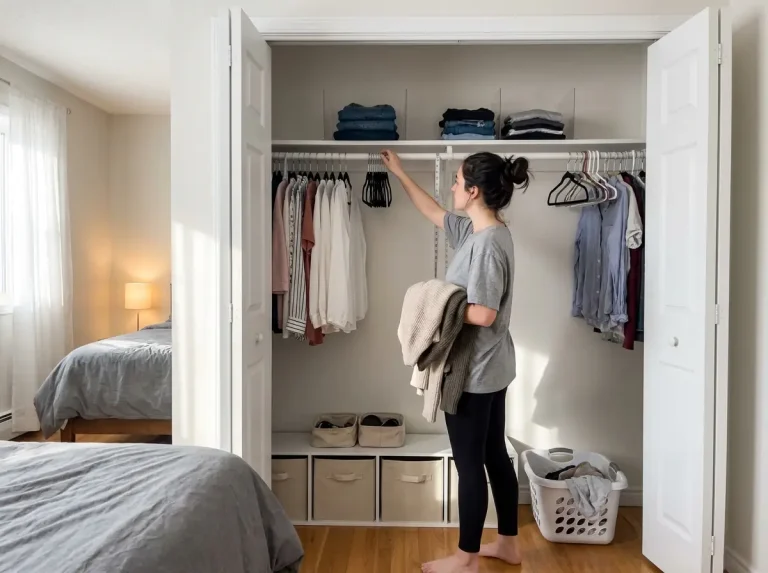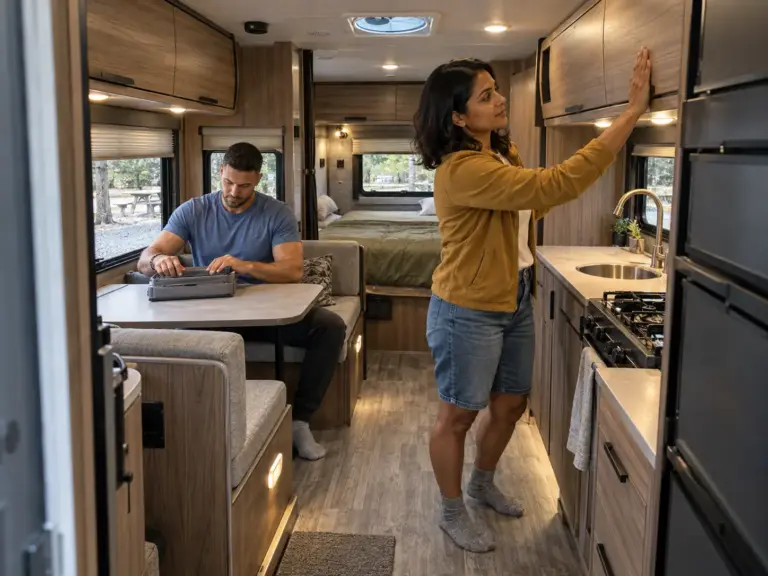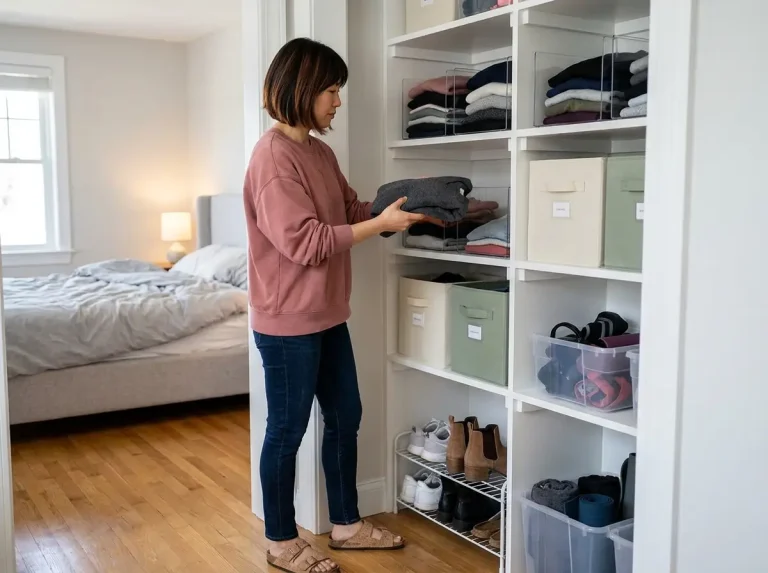
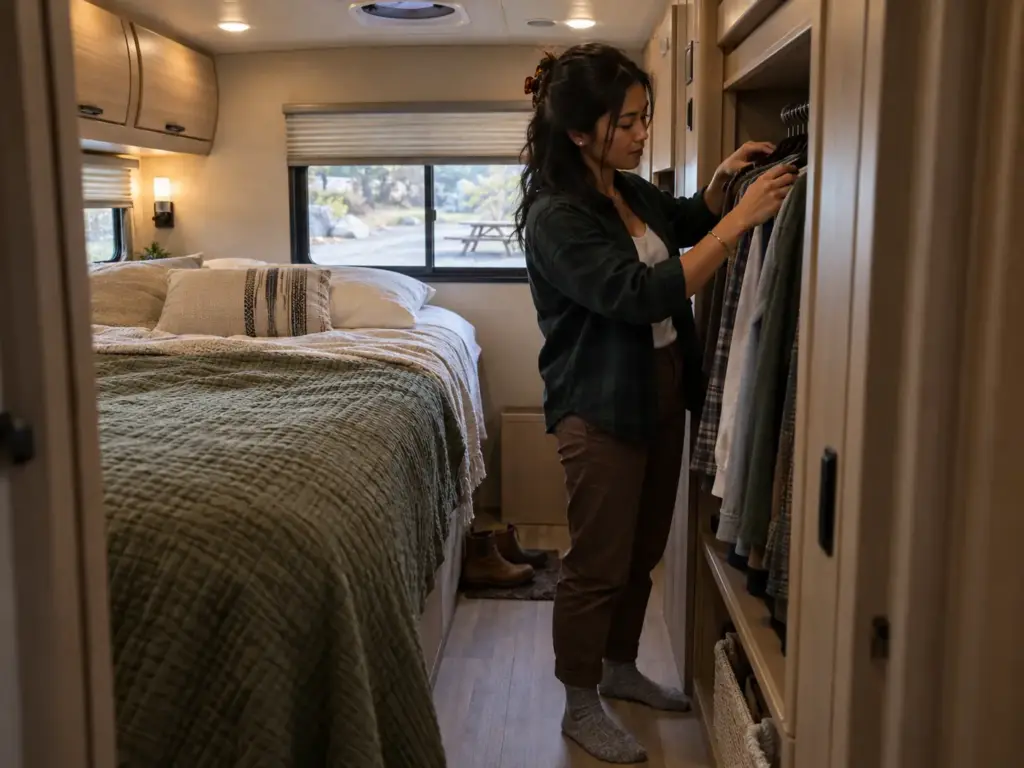
You open the bedroom closet at the campground and the last stretch of rough road is all over the floor: shirts, a tangle of hangers, and a fabric organizer lying on its side. The closet is not badly organized. It was laid out like a house closet and it rides in a vehicle, so RV closet organization starts with what the road does to a rod, a shelf and a hanging cube. This guide measures the space first, then stops the spills, then puts each kind of clothing where the bounce can’t reach it; the rest of the rig is covered in the full guide to organizing an RV or tiny home that holds up.
Quick Answer
A closet that survives the road gets fixed in this order, and most of it costs nothing.
- Measure depth where the clothes hang, at the narrowest point, not at the door.
- Turn the hangers backwards, or switch to velvet hangers that grip.
- Swap open hanging cubes for shelves with a front lip.
- Roll soft clothes into bins and keep only wrinkle-prone pieces on the rod.
- Check the rod, the shelf stacks and the door catch before every drive.
RV Closet Organization Starts With Three Measurements, Not One
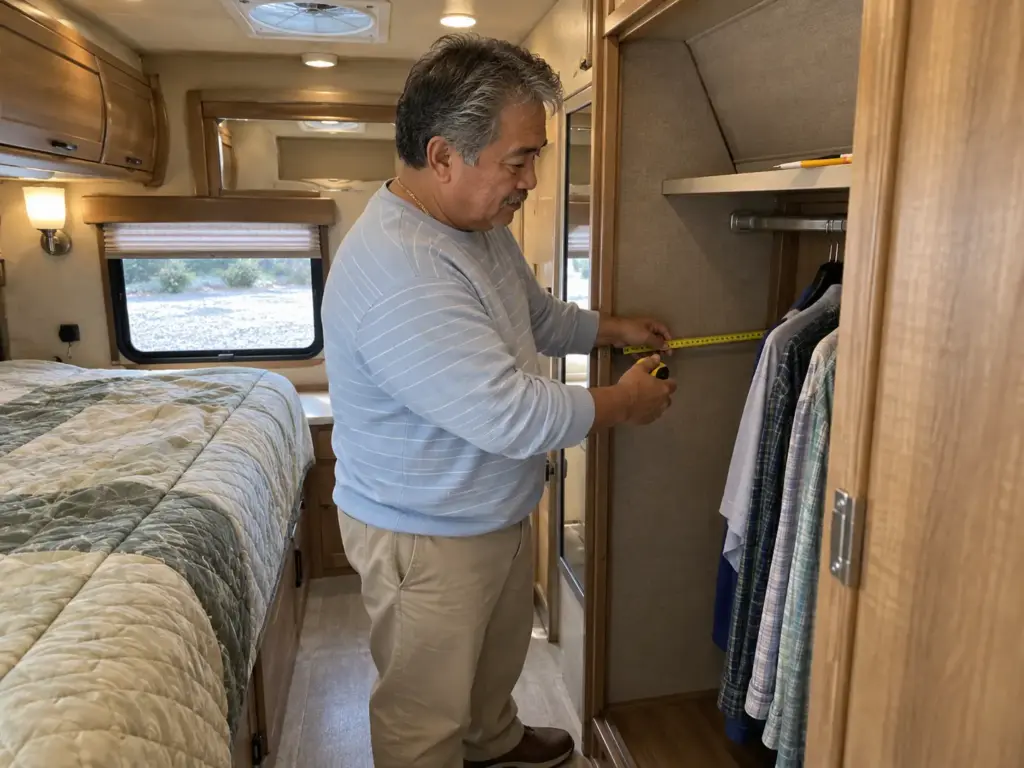
Before anything goes in the cart, the closet gets measured in three places, because a tape answers more than a product listing does. The three are the depth at the narrowest point, the drop from the closet rod, and the width of the opening.
Depth Is Lost Where the Wall Curves
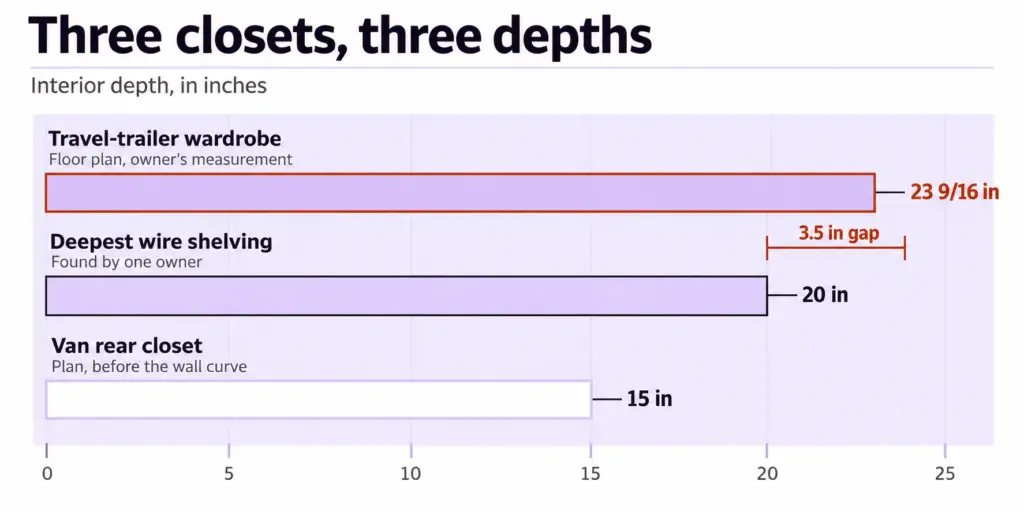
Depth is the number every organizer is sold against, and it is the one an RV closet reports wrong. A rear closet drawn on a van plan as roughly 24 inches wide by 15 inches deep gives you less than that where the wall curves, so a hanger low or high in the closet has less room than the drawing promises. An angled closet wall does the same thing higher up.
Take the reading where the clothes actually hang, not at the door frame. A narrow closet that tapers toward the top also limits how many hangers fit on the bar, so a tape held at rod height tells you the hanger count in advance.
Then there is the number that depends on the rig. The wardrobe in a Forest River Roo 21DK travel trailer floor plan is about 23 9/16 inches deep, while wire shelving for a retrofit tops out around 20 inches. That leaves a gap of 3.5 inches, which is my arithmetic and not a spec-sheet figure, and it means one shelf cannot reach from the back wall to the front of the opening.
Even one wardrobe can hold two depths. In a Roo 23SS the shelving had to follow the shallower of the two, an inch or two less deep than the space itself. A tape at the door would have missed it. Closets that waste depth this way are common outside RVs too, and why reach-in closets waste half their space follows the same logic of a shelf and a rod built for a depth the space doesn’t have.
Hang Length Decides Whether Hems Wrinkle
The second measurement runs from the closet rod to the floor. If the drop is shorter than the longest thing you hang, the hem folds against the floor of the closet and everything ends up wrinkled below the waist. No rod-height standard exists for RVs, so there is no number to quote here: hold the tape against the longest shirt or coat you own and let that decide whether the rod stays or gives way to shelves.
The third is the width of the opening, because it sets how many hangers fit across and whether a hanging organizer clears the door frame. Write all three numbers on a card and keep it in your phone. Every purchase after this one gets checked against it, and most returns stop right there.
Rear Closet or Front Closet: Where Yours Sits Changes the Fix
The back of the coach is the bounciest part of the rig, and a closet there behaves differently from one up front. A rear closet under a full load can bend its rod, and the stock RV closet rod is the first thing to suspect when clothes arrive on the floor. A front, full-width closet, packed snug, keeps its hangers on the rod across miles of very rough road. If yours sits in the rear, plan around the weak point instead of assuming it will hold.
The shape of an RV wardrobe follows the rig class, and there is no size standard across them. A Roo 19 has a wardrobe about half the width of the one in a 21DK, and in a wardrobe like that one half can hang coats and shirts while the other half takes shelving. A bumper-pull trailer can have a corner closet built from an L-shaped pipe that takes twenty to thirty hangers in about two feet by two feet. That comparison across rig classes is a pattern, not a published rule, but it explains why advice written for one closet fails in another.
Why the Hanging Cube Spills on the Road and What Holds Instead
An organizer that works fine in the driveway can fail on the first stretch of road, and the failure has a cause you can fix cheaply. Start with the cause, then spend money only where the free fixes run out.
Why the Fabric Hanging Cube Slides
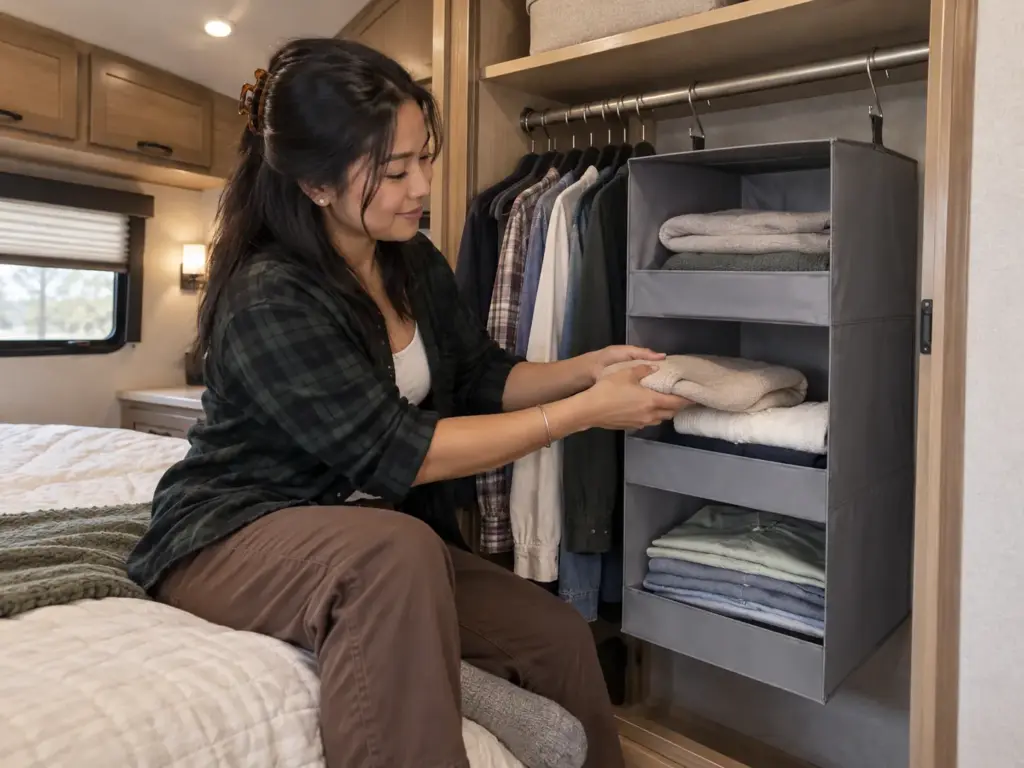
The cloth organizer worked in the driveway and failed on the highway because the driveway never moves it. The reasoning runs like this: a fabric hanging organizer, the hanging cube, has open sides, no front edge, and nothing holding its base, and it hangs from a rod that is itself swinging. The rig’s motion gives each shelf a small push outward with every bump, and with nothing to stop the push the contents slide to the open edge and drop. The cube slides and stuff falls out during travel, which matches what the format does on any rough stretch.
The shelf that holds has a lip, a strip along the front edge of each shelf that gives items a wall. A shelf lip is what separates a shelf that holds from a shelf that dumps, and it is worth looking for before color or tier count.
Free Fixes Before Anything Goes in the Cart
Start with the hangers, since they cost nothing, and DIY RV closet organization begins there. Turn each one backwards so the open end of the hook can’t wander up onto the rod. Alternating them, one forward and one reversed, does half the job at best, so the better test is to turn every hanger and drive a rough road before you decide anything else is needed. Bending a hook slightly so it won’t leave the rod without some force helps too, and a Velcro band wrapped around the base of the hooks while you travel keeps a whole row together.
A tension or expanding rod pressed in just above the hangers, after they are all hung, stops them jumping. The clothes still sway, though. It is a partial fix, not a cure, and it belongs next to the backwards hooks, not in place of them. A padded board on hinges above the rod works on the same principle, since the hangers can’t lift when something sits over them.
For an over-door organizer, shelves and the rest of the free fixes in the rig, ideas for the door backs, shelves and collapsibles that survive the road cover what this closet article leaves alone.
Put the heaviest pieces on the lowest shelf of any hanging organizer. Weight near the bottom swings less far from the rod, so the same bump that sends a top-heavy organizer sideways barely moves a bottom-heavy one.
The Shelf With a Lip and the Hanger That Grips
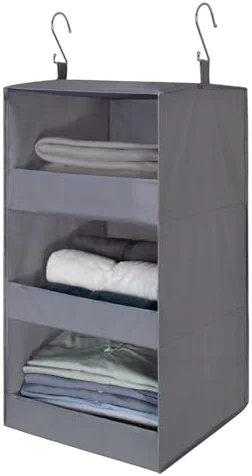
If the free fixes don’t settle it, buy the two things the road actually punishes. The first is the hanging organizer itself, in the version with a front edge on every shelf. The second is the hanger, because wire and plastic slide where velvet doesn’t.
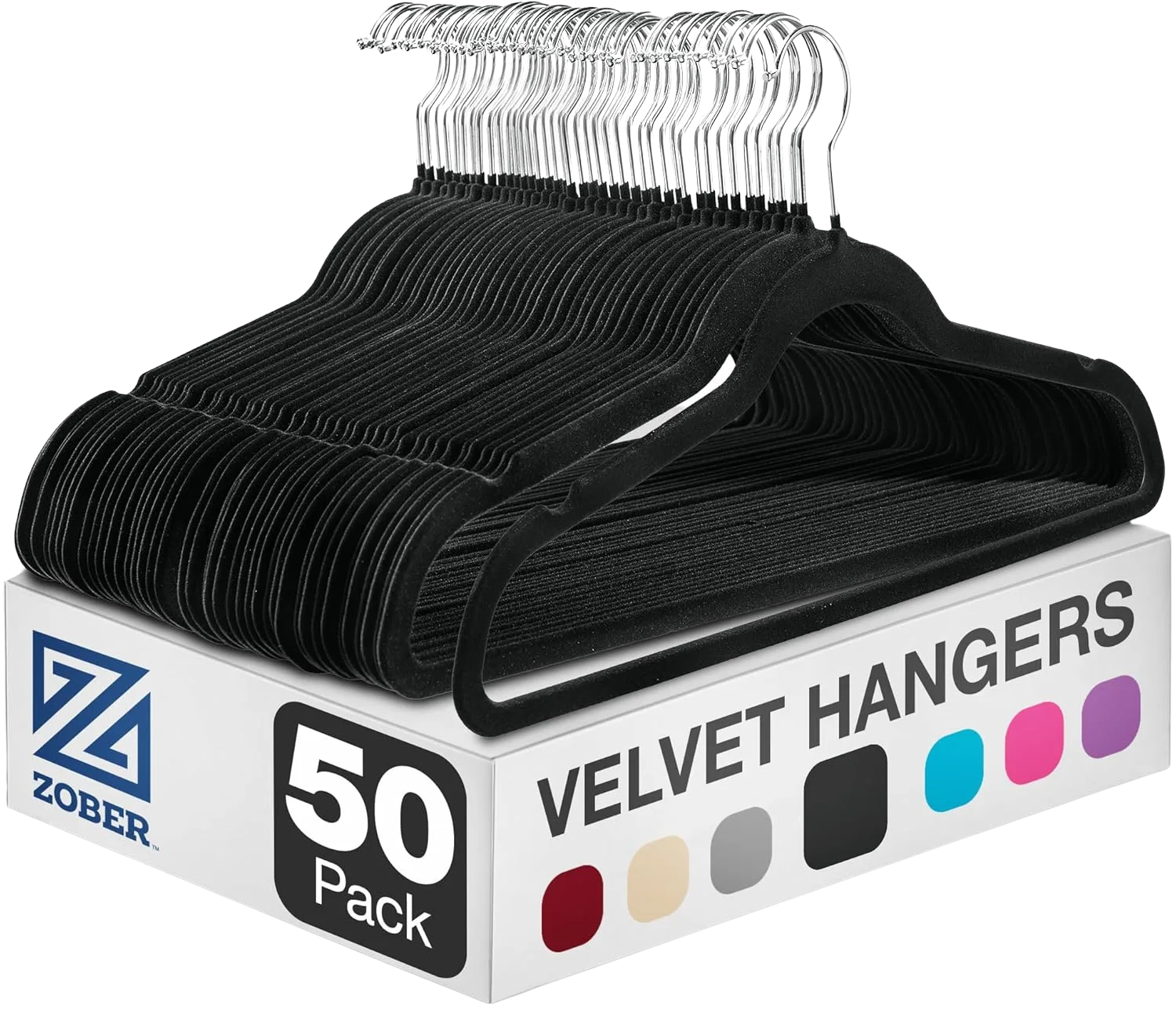
Velvet is the cheap upgrade for the rod itself. The flocked surface grips a shoulder seam where bare wire and slick plastic let it glide, which is the job on a rough road. Match the hanger to the closet before you commit to a full pack: the width of the hanger has to clear your opening, and the numbers you wrote down in the first section already tell you that.
Above the Rod: Stacks That Stay Where You Put Them
The shelf above the rod moves with everything else in the closet, with less holding it in place. A little wall around each stack settles most of it.

What Belongs on the Shelf Above the Rod
A stack of sweaters on a flat shelf behaves like a deck of cards on a table in a moving car: each bump nudges the pile a little and the pile fans out. Give the shelf above the rod the light, soft, rarely needed pieces and keep heavy folded things low. That split is a rule of thumb, not a standard, and it works because a lower weight has less leverage to topple. RV closet shelves take the same push as the rod does, so a pile that is simply heavy still needs a wall.
The same fanning-out happens in a house closet, where closet shelf piles keep falling over even without a vehicle under them. In the rig the movement is just stronger, so a stack that survived years in a bedroom can collapse on the first trip.
Dividers Instead of a Front Edge
If the shelf has no lip, a divider supplies one. A clear divider every few folded pieces gives each stack a wall, so a push moves one small pile and not the whole shelf. The HBlife Acrylic Shelf Dividers come as a 6-pack of clear shelf dividers, each rated for 15 pounds by the maker, which is far more than a stack of folded shirts. A divider is a wall, not a strap, so it keeps stacks apart but does nothing about a stack that rises above its own height.
Stack no higher than the divider stands. A pile that rises above its wall slides over the top, and the divider only looks like it is working.
Shelving That Doesn’t Hang on Thin Walls
The walls of a wardrobe are often thin paneling over very little structure. Shelf supports in that kind of wall can bite only about half an inch deep, so the first heavy load pulls them out. People rebuilding these closets end up in one of two places: a freestanding unit that stands inside the closet and leans on nothing, or flimsy framing replaced with real 2x4s. Both are about where the weight is carried, and neither is a job to improvise from this page.
For homes, the principle behind it is the same one the CPSC writes down. According to the CPSC’s Anchor It! campaign, “Anchoring all furniture with drawers, doors, and shelves to the wall prevents tip-over injuries and deaths.” That guidance is written for houses and not for motorhomes, but the idea carries: tall furniture is held by real structure, not by thin paneling.
If screws are off the table because the rig is borrowed or rented, renter-friendly closet options that need no drilling are the starting point, and a freestanding unit is the one that comes closest to a real shelf.
Roll or Fold: Deciding What Gets to Stay on the Rod
Not everything belongs on the rod. Sorting what hangs from what rolls frees rod length and takes the swing out of most of the closet.
What Stays on Hangers
The rod is the worst place for a knit and the best place for the one jacket that wrinkles. Coats and the few pieces that crease badly stay on hangers, ideally the velvet ones. Everything soft and stretchy leaves the rod, which also frees rod length for the things that need it.
That edit is why a small closet re-clutters the moment the rod is asked to carry everything, and the hanger math in small closets shows how few hangers it takes to jam a rod.
What Rolls Into Bins
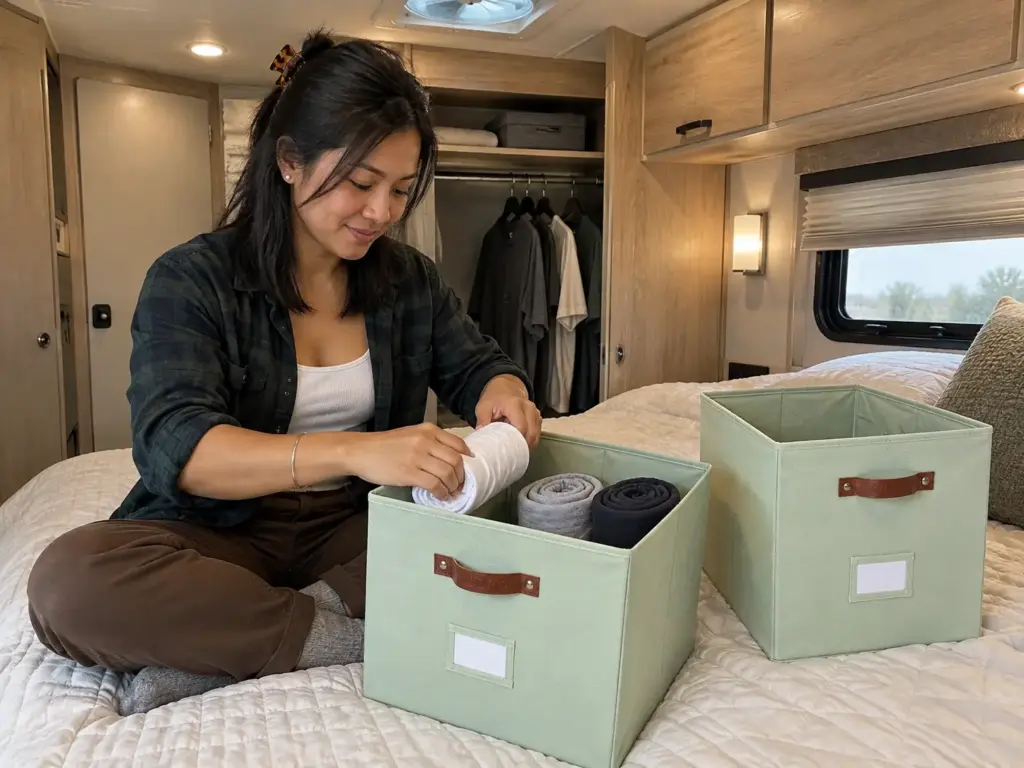
Roll clothes that don’t crease (tees, knits and sweatshirts) and stand the rolled clothes upright in bins on the shelf. Whatever is too stiff to roll, fold clothes flat and keep them behind a divider. A bin sits on its base and has walls on every side, so a rolled tee doesn’t swing the way a hanging cube does. The bin removes the two things that made the cube fail, the open side and the loose base.
Labeled, collapsible fabric bins fit this job, fabric storage bins with labels, and the label means you pull the right bin on the first try instead of emptying three. Check how many come in the pack before you order, and measure the shelf depth you wrote on the card, since a bin that sticks out past the front edge is the first thing a swinging door will catch.
Thin quick-dry clothing travels best in this system, and cotton jeans and sweatshirts bulk up fast. Plan on doing laundry more often so fewer clothes have to ride at all.
What Leaves the Rig Altogether
Out-of-season pieces go into a vacuum bag, or off the rig entirely if there is a home base to leave them at. A capsule wardrobe sized to the closet is the version that keeps working, and if you downsize clothes before the move, a closet with room to move is a closet that holds on the road. Fewer clothes is the cheapest system on this page. If the wardrobe is the real problem, editing a closet that has too many clothes comes before any rod or bin does, and a clothes count for a home with little or no closet sets the number you are working toward.
The Floor and the Bed Platform Take the Overflow
Below the clothes, the closet floor and the space under the bed platform take whatever the rod and the shelf can’t. They are also the calmest places in a moving rig.
Cubes That Stand on the Floor
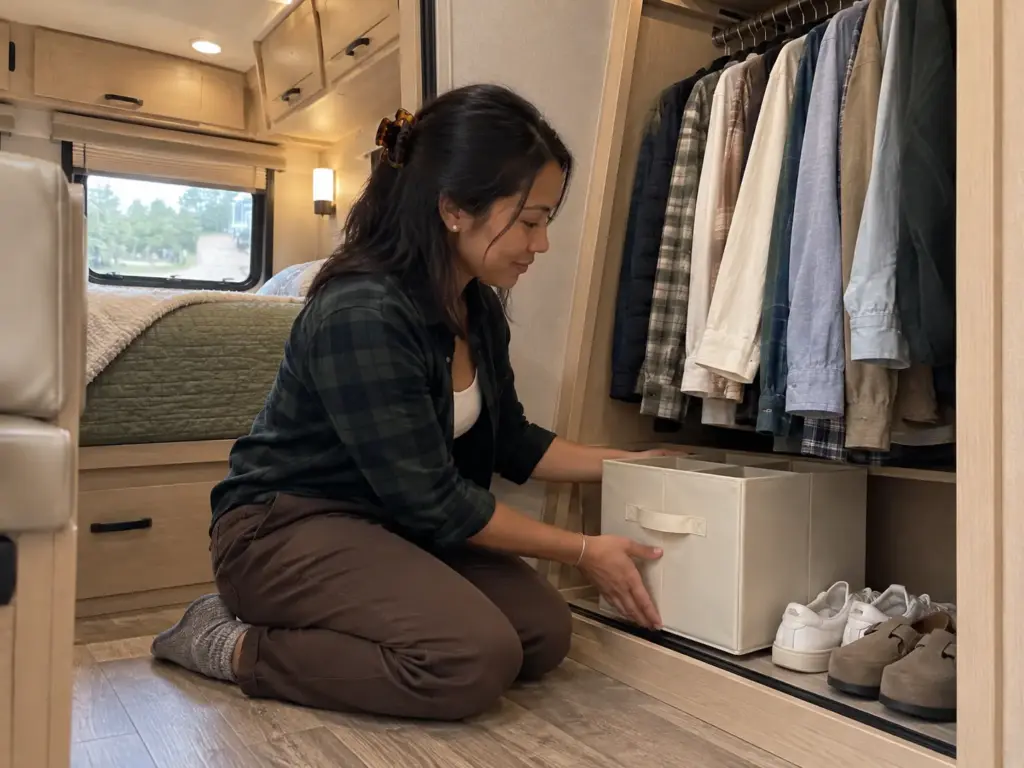
Whatever sits on the floor of a moving closet has one direction to go, and that is nowhere. A cube on the floor stands on its base and can’t swing from a rod, so the hanging-cube failure doesn’t apply to it. That is reasoning, not a tested result.
The Amazon Basics Collapsible Fabric Storage Cubes are the budget answer to the labeled bins above: a 6-pack of 13-inch fabric cubes, each 13 by 13 by 13 inches. That is a fair amount of floor, so tape out a cube’s footprint before you order and leave the door a clear swing.
A closet packed full to the door is a closet someone empties onto the floor. Leave a hand’s width of gap.
Shoes: Low and Out of the Way
The closet floor is the shoe zone, below the hanging clothes where the sway can’t reach. A bar low in the closet with a curtain across the front keeps shoes in without anything swinging above them. A hanging shoe organizer inherits the cube’s problem, since it swings from the same kind of hook, so a shoe organizer belongs on the floor or not at all. Shoes on a closet floor that won’t pile up again covers the sorting side.
Under the Bed Platform
The bed platform is a second closet. Bed platform bins keep bulky, seldom-used things in the space under it, and the space under the bed in a small bedroom is worth measuring for clearance before anything is bought for it. And if your rig has no closet at all, living without a closet is a different system altogether.
The Two-Minute Check Before Every Drive
A closet that held on the last trip can still fail on this one, so the last job is a short check you repeat before the wheels turn.
The Rod and the Hangers
The closet that held last trip can fail this trip, because a fix that lives on the rod gets undone the first time someone grabs a jacket. Check in this order: hangers turned or gripping, rod seated and not bowed, the divider in place on the shelf, bins pressed in, and the door shut with its catch. A door that opens in transit puts everything on the floor.
The Shelf and the Latch
Packing tight works, since nothing moves and what does can’t go far, with one catch: a heavy load at the rear can bring the whole rod down. So heavy items go low and forward. A rear closet needs its stock rod checked first, because that rod is the weakest part.
Leave the Velcro band looped on the end of the rod between trips. A fix that has to be hunted for gets skipped, and one that is already hanging in plain view gets re-set.
What Gets Redone Every Time
Tie-downs and bungee cords on a closet get redone whenever someone needs a jacket, and a fix that is never re-set stops being a fix. Build the check into the same two minutes you spend closing the cabinets.
The same road logic runs through the rest of the rig. The galley cabinets and what the road does to them are the next stop, and a bathroom shelf in a moving rig is its own kind of problem.
Turn the Hangers, Measure the Narrow Spot, Check Before You Drive
What you leave with: the closet is a hang space that moves, so measure it where it is narrowest, stop the cube from swinging, give every stack a wall, put soft things in bins, and re-check the same short list each time you pack.
For a check later, look at the closet after the first long drive and again each time you repack: whether the rod is still straight, whether the stacks held their dividers, whether the bins stayed pressed in. For closets that keep working past a single trip, a closet setup that still works months later is the longer read.
Today, turn every hanger backwards and take one measurement of the narrowest part of the closet. Then drive somewhere bumpy and open the door.
Frequently Asked Questions
01How do I keep clothes from falling off hangers while driving?
Turn the hangers backwards, or use velvet hangers that grip. A rod set above the hangers stops them jumping off, but the clothes still sway, so it works best alongside the backwards hooks.
02How deep is an RV closet?
It depends on the rig. One travel-trailer floor plan has a wardrobe about 23 9/16 inches deep, and a van plan shows 15 inches before the wall curves. Measure at the narrowest point where the clothes hang.
03Can I add shelves to an RV closet?
Yes, but the walls are thin, so a freestanding unit or reinforced framing carries the weight better than supports in paneling. Wire shelving tops out around 20 inches deep, which can fall short of the wardrobe.
04Does a tension rod above the hangers work?
It stops the hangers from jumping off, but the clothes still sway. Press it in just above the hangers after they are all hung, and keep turning the hooks backwards as well.
05What is the cheapest RV closet organization fix?
Turning the hangers backwards costs nothing. Bend the hook slightly, then add a lipped shelf or a clear divider before anything else gets bought.
Disclaimer: ClutterlessNest is a participant in the Amazon Services LLC Associates Program. As an Amazon Associate we earn from qualifying purchases. This article may contain affiliate links — if you buy through them, we may earn a small commission at no extra cost to you. We only recommend products we have tested or genuinely believe in.