




















In this article
You spent a Saturday on the bedroom. You cleared the dresser top, made the bed, and stood in the doorway feeling like you’d finally cracked it. Three weeks later the nightstand has a water-glass ring, two chargers, a paperback you finished in March, and a hair tie that isn’t yours. A minimalist bedroom that slides back like this is almost never a discipline problem. Ask anyone who has reset the same room twice and they’ll tell you the same thing: it’s a systems problem, and the fix starts with understanding why the surfaces filled back up before you buy a single bin. This guide walks through why your room reverted, then a room-by-room fix built for small spaces and rentals, plus the two-minute habit that keeps it minimal past week three. It’s the bedroom slice of the broader minimalist reset, narrowed to the one room where clutter feels the most personal.
Quick Answer
A bedroom reads minimalist when surfaces stay clear and everything has a home. Build it in this order:
- Declutter before you buy a single bin
- Use the space under the bed (measure clearance first)
- Stop the closet from overflowing back into the room
- Give every flat surface one job, or remove it
- Keep a neutral palette and let light do the work
- Run a two-minute daily reset so it lasts
Why Your Bedroom Doesn’t Feel Minimalist Yet
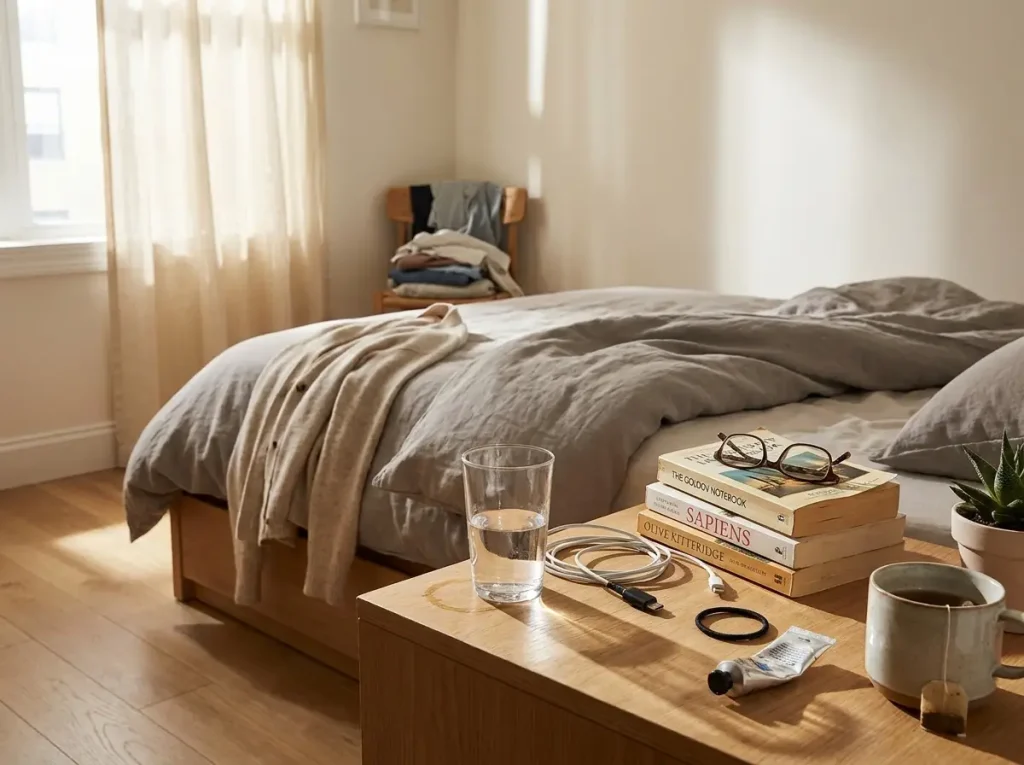
Most minimalist bedroom ideas skip straight to the pretty part. You’ve already tried pretty. What nobody tells you is why a bedroom you genuinely cleaned still feels cluttered two weeks later, and the answer is almost always the same three mechanisms working against you. Name them first, because you can’t fix a reversion you can’t see coming.
The flat-surface landing zone
Every horizontal surface without an assigned job becomes a place to set things down. The nightstand is the first domino, then the dresser top, then the windowsill. It’s not that you’re messy. It’s that a flat, empty surface is an open invitation, and your brain treats it as temporary parking that quietly becomes permanent.
The fix isn’t a tray to corral the chaos. It’s deciding what each surface is actually for and removing the ones that exist only to collect. A nightstand holds a lamp and a book. A dresser top holds nothing, or one thing. The moment a surface has a defined purpose, the random deposits stop feeling allowed.
“Surface creep” and the chair that becomes a staging zone
Organizers have a name for the slow spread: surface creep. One day the dresser top is clear, and over the next week a receipt, a set of keys, a folded shirt, and a charging cable migrate across it. It happens so gradually you don’t register it until it’s a pile. According to professional organizers at NAPO, a cluttered bedroom adds stress and makes it harder to wind down, which means these surfaces cost you more than floor space.
The single worst offender is the chair. You know the one. It starts as a place to drape the jeans you’ll wear again, and within a few days it’s a soft mountain of worn-once clothes that never quite make it back to the closet. The chair is where minimalism quietly goes to die, and almost every reverted bedroom has one.
The closet that spills back into the room
Here’s the test that predicts everything: can you close your closet door easily? If the answer is no, your bedroom will never stay minimal, because an overstuffed closet has nowhere to put the overflow except back into the room. The clothes land on the chair, the floor, the dresser, anywhere but the rod they no longer fit on.
This is why surface-level tidying fails. You can clear the bedroom ten times, but if the closet runs at over capacity, it refills the room on a loop. Fix the closet and the bedroom holds. Skip the closet and you’re signing up to reset the same surfaces every three weeks. The visual heaviness you feel isn’t square footage either, it’s the number of things in your sightline, which is why clearing surfaces matters more than adding storage.
Start by Subtracting Before You Buy

The instinct when you want a minimalist bedroom is to buy matching bins and a coordinated set of baskets. That instinct is the trap. The look you’re chasing comes from owning less, not from containing more, and the order you do things in decides whether the whole project sticks or unravels by the end of the month.
The bin trap
Buying storage before you declutter just rearranges the clutter into tidy-looking boxes. You feel productive for an afternoon, then realize you’ve spent money to relocate things you didn’t need in the first place. Organizers call this the bin trap, and it’s the most common reason a bedroom looks organized in photos but feels just as heavy to live in. The boxes are full of stuff you’d have thrown out if you’d sorted first. This is the same declutter-first order that keeps the rest of the house minimal, and it matters most in the bedroom because the bedroom is where “I’ll deal with it later” goes to hide. If you want the full system, the same declutter-first order that keeps the rest of the house minimal lays it out room by room.
One honest keep-donate-toss pass
Before any container enters the room, do one pass with three destinations: keep, donate, toss. You don’t need a method to start, but naming one helps if you stall. The KonMari “does it spark joy” question works for clothes and sentimental items. The four-box method gives indecisive sorters a clear structure. The one-in-one-out rule keeps the room from refilling after. Pick whichever gets you moving and don’t overthink the framework.
Keep one permanent donation bag living on the closet floor. When it fills, it goes in the car, then to the donation center. A standing bag turns decluttering from a once-a-year event into a slow drip that never lets the room overload again.
What’s left usually fits what you own
Here’s the part that surprises people. Once the excess is gone, a good chunk of what was sitting on your surfaces was never intentionally placed there, and the furniture you already own usually handles what remains. You may find the look you wanted is half-built before you’ve bought anything. And if decision paralysis is the real obstacle (it usually is for a first apartment), don’t start with the whole room. Start with the single surface that annoys you most. Get that one right, feel the difference, then move to the next.
The Bed Is Your Biggest Storage Win
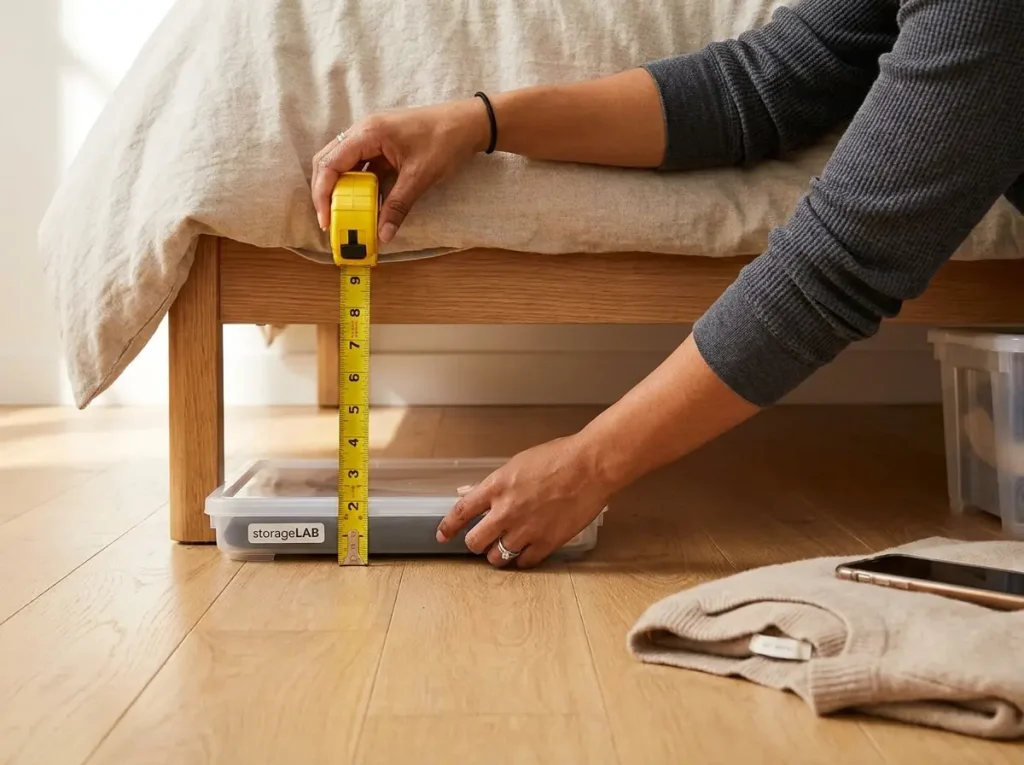
The largest patch of dead space in your bedroom is the rectangle under your mattress, and most people waste it or fill it with an unmeasured pile that becomes inaccessible by month two. Done right, the under-bed zone swallows your seasonal clothes and spare bedding and gives you back the closet space that was causing the overflow. Done wrong, it’s just a hidden version of the chair.
Measure your clearance before anything else
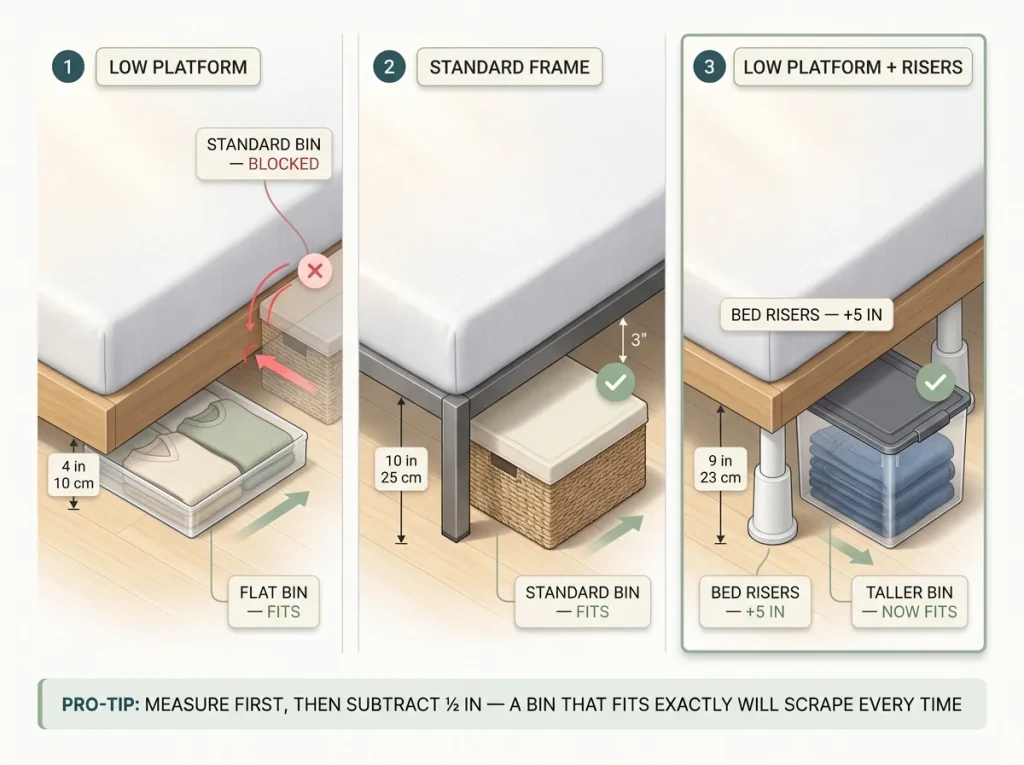
Before you buy a single container, get on the floor with a tape measure and check the gap between your frame and the floor. This one number decides everything, and it varies wildly. Low-profile and platform beds run roughly four to seven inches of clearance. Storage platform beds give you twelve to eighteen. Standard metal frames usually land between seven and thirteen. A low Japandi platform bed looks beautifully minimal and offers almost no usable storage, which is the kind of trade-off nobody mentions in the inspiration photos.
The reason this matters: at around a foot of clearance, a queen bed yields roughly 230 liters of hidden storage underneath, about three large moving boxes’ worth. That’s your off-season wardrobe and your spare duvet, gone from the closet that was overflowing. For the dimension-by-dimension version, under-bed storage that fits a small bedroom breaks down which container height matches which gap.
Measure the clearance, then subtract half an inch before you shop. A bin that technically fits at the exact height will scrape every time you slide it out, and a container you have to wrestle is a container you’ll stop using by week two.
Thin bins for low platform beds
If your clearance is in that four-to-seven-inch range, the standard bin on the shelf at the store will not fit. Most under-bed containers are built around six or seven inches tall, which is fine for a metal frame and useless under a low platform. You need a genuinely flat container, and there are fewer of them than you’d expect.
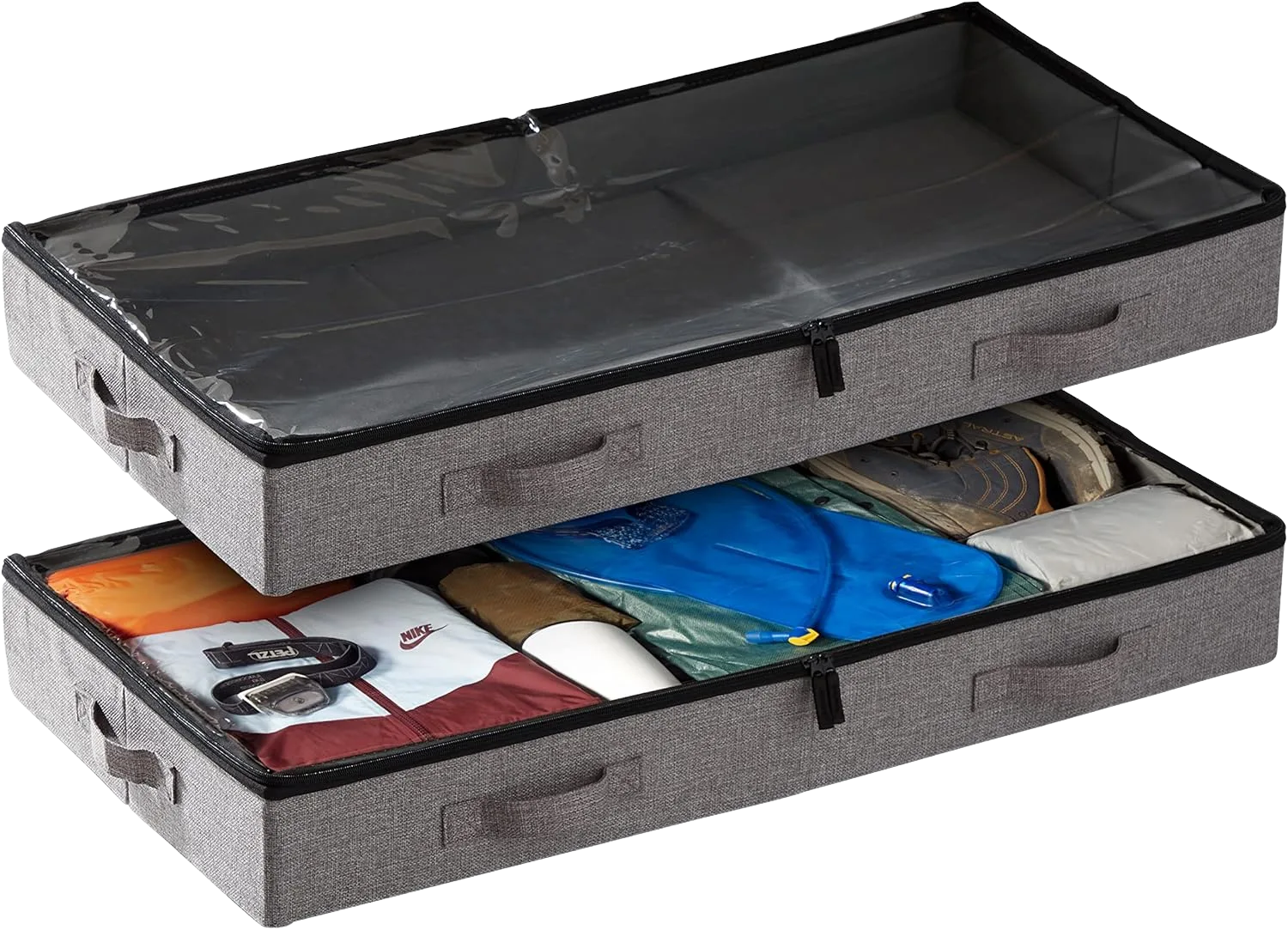
If your clearance is generous enough for a taller box, the IRIS USA Under Bed Box holds more for less and fits anything with six-plus inches underneath.
Risers and vacuum bags when you need more room
What if your bed sits too low and you can’t replace the frame? You lift it. A set of bed risers like the EclatBain Bed Risers adds three, five, or eight inches without modifying anything, which turns a useless four-inch gap into real storage and is completely renter-safe since nothing gets drilled or glued. Bed risers used to read as a dorm-room move, but adjustable ones quietly solve the single biggest under-bed problem in small apartments.
For bulky off-season bedding, vacuum bags compress a duvet down to a fraction of its size so it fits even a shallow gap. The ZOBER Vacuum Storage Bags come in a mix of sizes and flatten a comforter enough to slide under almost any frame, though there’s one rule: skip them for anything wool, down, or cashmere, which need to breathe and lose their loft when crushed for months. A budget option that works just as well for synthetics is the SpaceSaver Bags 10-pack. And honestly, if you have a hard-shell suitcase already living under the bed, fill it before you buy bags at all.
Tame the Closet Before It Spills Back
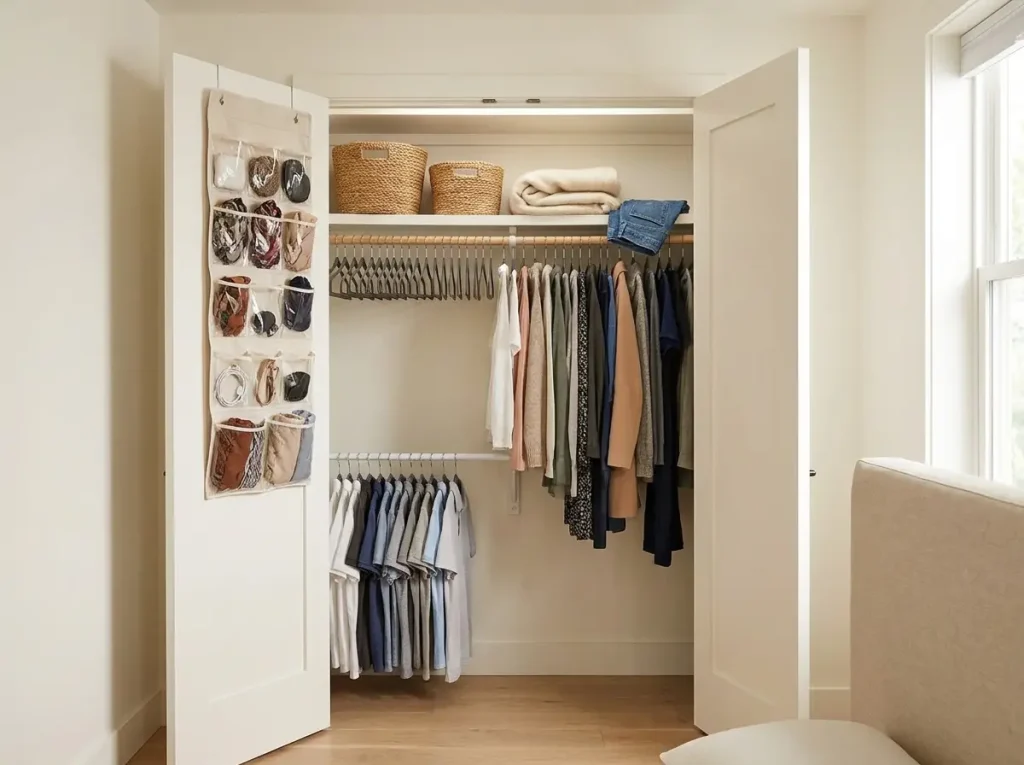
If the closet is the engine of bedroom clutter, this is the section that actually stops the reversion. You don’t need a custom closet system or a weekend of installation. You need to get the closet back under capacity and keep the small stuff from migrating onto bedroom surfaces.
Swap the hangers first
The highest-return move in any closet is also one of the cheapest: replace the mismatched plastic and wire hangers with slim velvet ones. Wire hangers from the dry cleaner waste space and let silky tops slide to the floor, where they become more chair clutter. A set of slim velvet hangers grips fabric and runs much thinner, so a standard reach-in rod holds noticeably more without you removing a single garment. The Zober Premium Velvet Hangers reclaim something like a foot of rod space across a full closet, which is often the difference between a door that closes and one that doesn’t. The one downside is uniformity: for what it’s worth, a half-swapped closet looks worse than one you left untouched, so buy enough to do the whole rod at once.
Double your hanging space without drilling
A reach-in closet usually wastes half its height. There’s a tall band of dead air above your hanging shirts doing nothing. Add a second hanging level and you double the capacity for anything short, like folded-length pants, skirts, and shirts. A tension-mounted or hung second rod does this with zero drilling, which keeps it renter-safe and reversible.
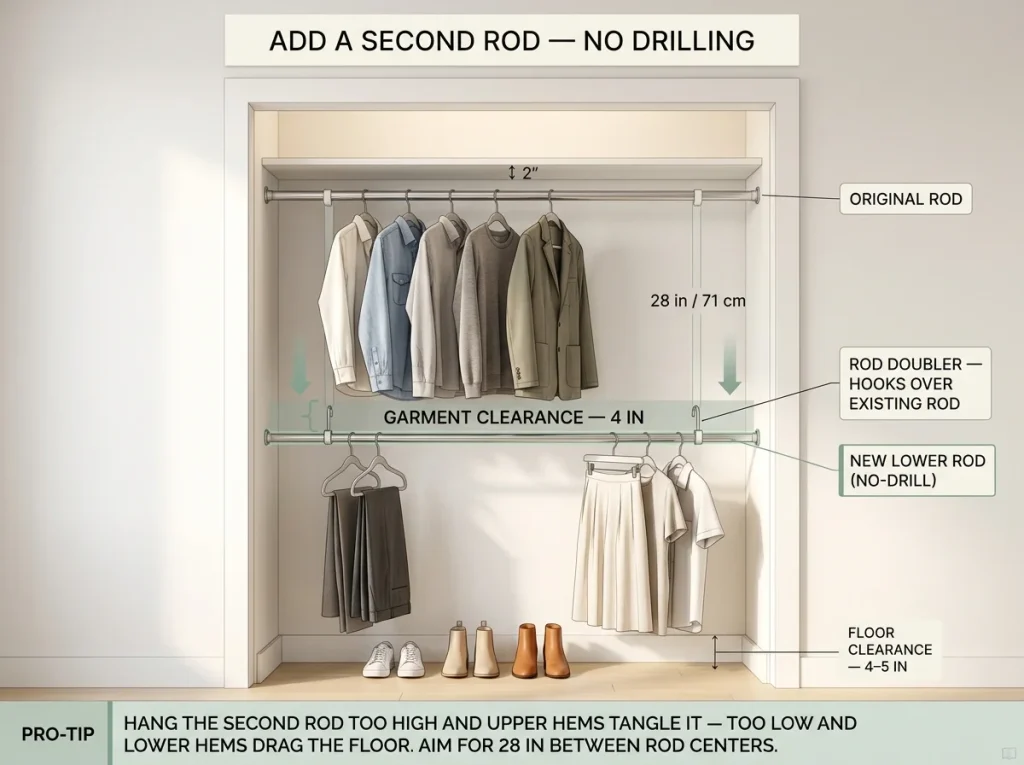
The renter-specific playbook for this (tension rods, hung rods, and what holds weight without damage) is laid out in a no-drill closet setup that won’t cost your deposit. And if you’re renting a room with no real closet at all, a freestanding open wardrobe or a simple clothing rack does the same job and moves with you, as long as you commit to a capsule wardrobe so it never overflows.
Catch the small stuff on the door
The accessories, chargers, and odds and ends that end up on your nightstand often have no closet home, so they default to the nearest surface. Give them one on the back of the closet door. An over-the-door organizer like the SimpleHouseware Over-The-Door Organizer hangs in seconds with no drilling and turns wasted door space into pockets for the exact small items that cause surface creep. It’s not glamorous, and on a hollow-core door you’ll want to make sure the hooks sit flush so the door still closes, but it intercepts the clutter before it ever reaches the bedroom.
Turn every hanger backward at the start of a season. When you wear something, return its hanger facing forward. Three months later, the backward hangers show you exactly what you never touched, and that pile is your donation bag, pre-sorted with zero guesswork.
Furniture That Earns Its Footprint
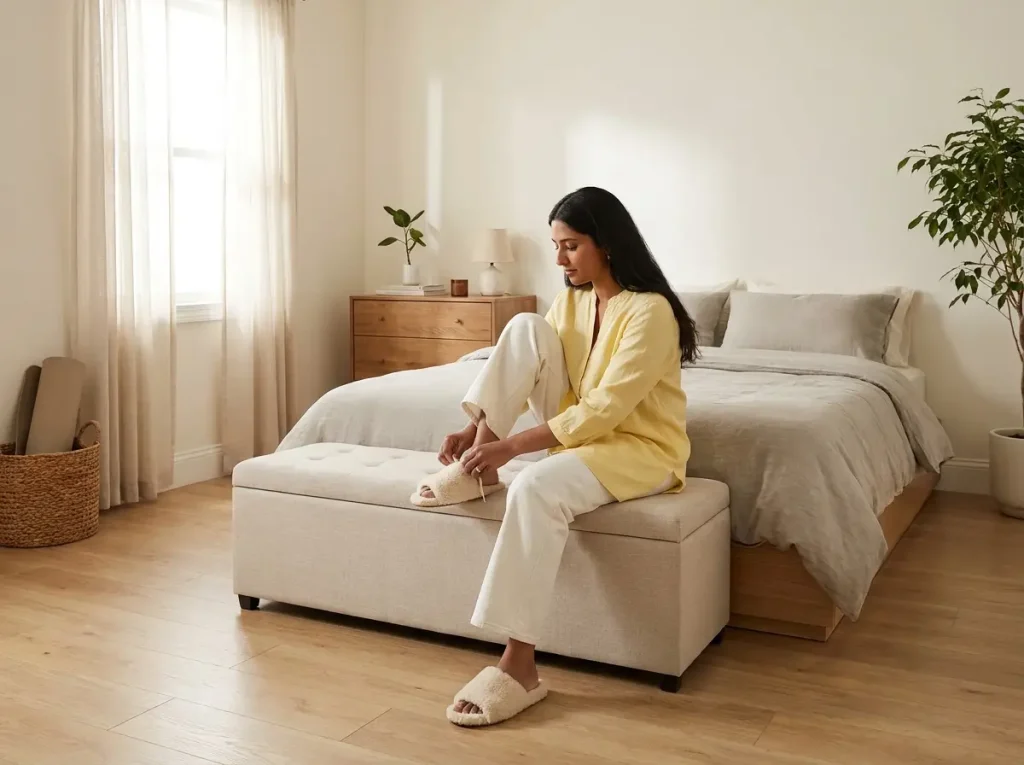
In a small bedroom, every piece of furniture has to justify the floor it stands on. The open floor is half of what makes a room read minimal, so the goal is fewer pieces, each doing more than one job. A blanket chest that only holds blankets loses to a bench that holds blankets and gives you somewhere to sit.
One piece, two jobs
The clearance rule sets the ceiling: you want roughly thirty inches of walkway around the bed so you can open drawers and move without turning sideways. Below that, the room feels tight no matter how restrained the styling. So the furniture you keep has to pull double duty. A storage ottoman at the foot of the bed replaces a single-purpose blanket chest, hides your spare bedding, and gives you a place to sit and put on shoes. The SONGMICS Storage Ottoman Bench spans the foot of a queen without crowding the walkway, which is the detail that matters as much as how much it holds, because a bench that blocks the path just creates a new pinch point. In a tighter room, the SONGMICS 30-inch ottoman does the same job in less width.
Inside the drawers
A dresser is only as minimal as its drawers. Folded clothes collapse into a pile within days unless something holds the rows apart, and a chaotic drawer pushes the overflow up onto the dresser top, restarting surface creep from the inside. Drawer dividers keep folded stacks vertical so you can see every item, which is what makes KonMari-style file folding actually hold. The SpaceAid Bamboo Drawer Dividers adjust to fit different drawer depths and the bamboo suits a minimalist palette better than white plastic. For narrower drawers, the 12-to-17-inch version fits where the larger set won’t extend.
What to skip
The anti-buy list is as important as the buy list. Skip the decorative chair, because you already know what it becomes. Skip the second nightstand if one side of the bed hugs a wall, since it’s just another surface to collect things. And skip the trunk or basket that only stores and doesn’t earn its footprint a second way. The conventional advice is to add storage furniture until everything has a spot. In practice, removing a piece of furniture does more for a small bedroom than adding one ever will.
Clear the Surfaces, Then Calm the Color and Light
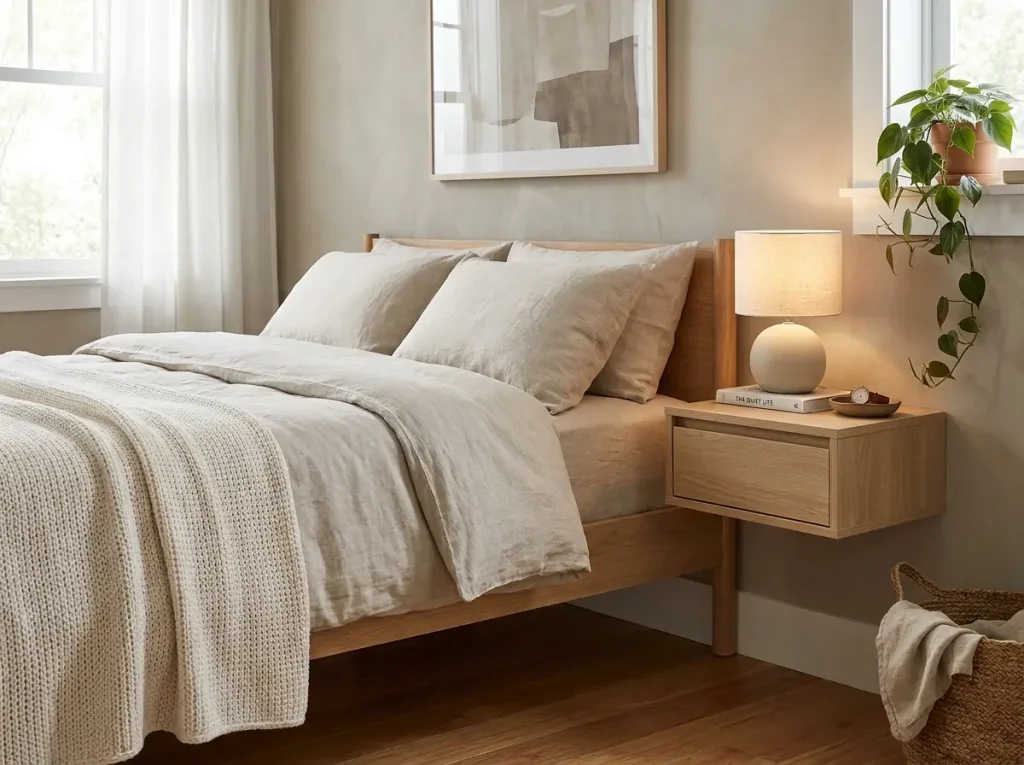
The “look” people pin and chase isn’t built from expensive decor. It’s clear surfaces, a quiet color range, and good light. Get those three right and the room reads minimal even if your furniture is secondhand. This is where the aesthetic finally comes in, but notice it comes last, after the systems that keep it that way.
Float the nightstand off the floor
The nightstand is ground zero for surface creep, so the strongest move is to shrink the surface and lift it off the floor entirely. A wall-mounted floating nightstand keeps the floor open underneath (open floor is what your eye reads as spacious) and puts a hard limit on how much can pile up, because there’s simply less surface to fill. For renters, the worry is always mounting, and the good ones solve it with included drywall anchors so you don’t need to find a stud.
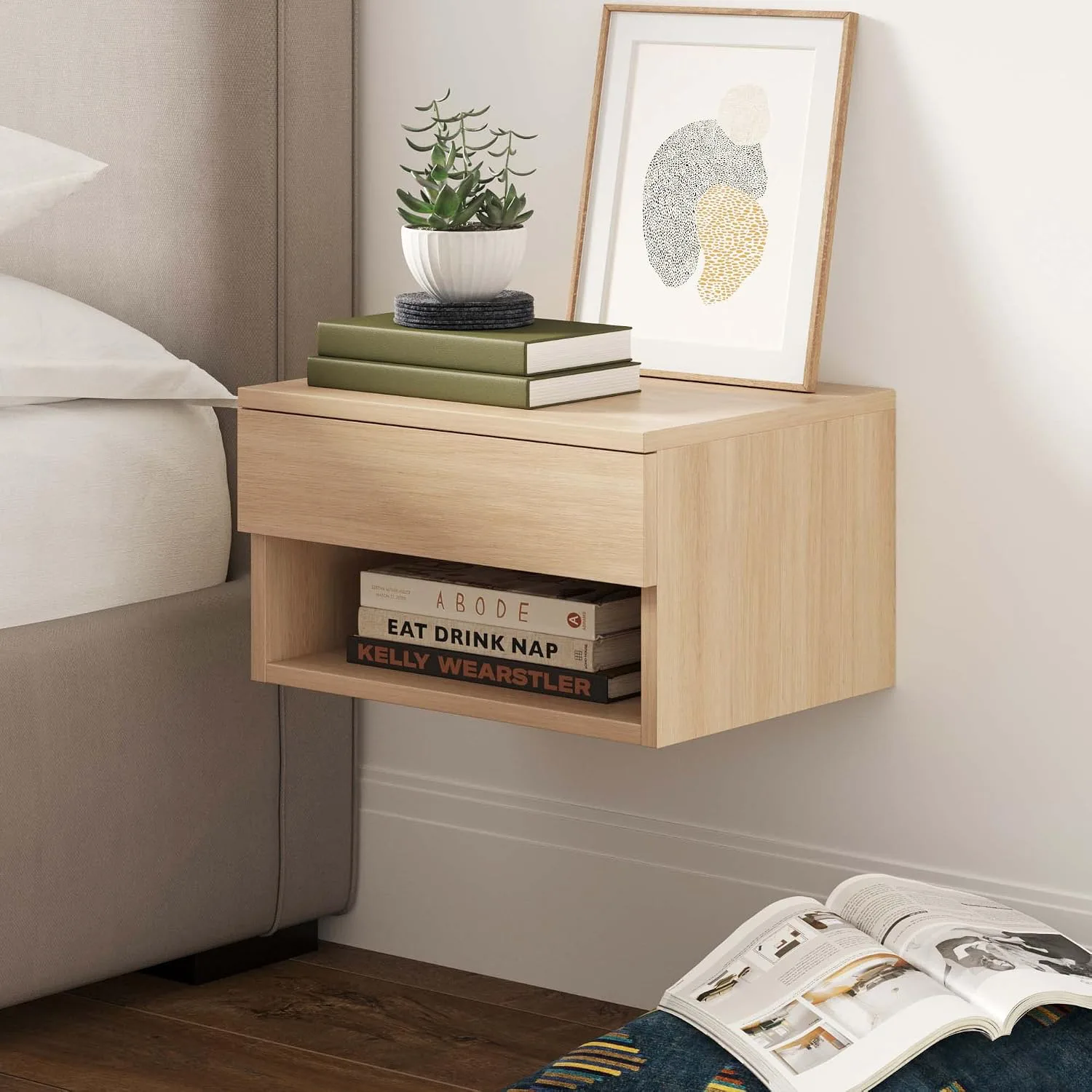
If you’d rather skip a drawer entirely, a pair of plain floating shelves gives you the same off-the-floor surface for less, just without a place to hide the charger.
Let the palette and light do the work
A tight neutral color palette does more for a minimalist bedroom than any amount of decor. Pick a small range (a soft white, one warm greige, a single wood tone) and let it run across the bedding, the walls, and the furniture. Clutter shows most against busy color and competing tones, so a calm range quietly forgives the occasional stray item and reads serene by default. You don’t buy this. You just stop adding to it.
Light is the other half. Prioritize natural light with sheer curtains during the day, and at night keep to one warm bedside source, a single wall sconce or a pendant, instead of a cluster of decorative lamps. A room with good light and clear surfaces looks finished. A room with great decor and cluttered surfaces never does.
One or two things you actually love
Minimal doesn’t mean empty, and a bedroom stripped to nothing reads cold, not calm. The warmth comes back through texture and a tiny number of personal pieces: a linen throw, a woven rattan basket, one plant, one framed photo. The rule organizers come back to is restraint by count, not by removing everything. One meaningful object on a clear surface reads intentional. Five small objects read as the start of a pile. If you want to push the off-the-floor idea further, a seasonal rotation that doesn’t fall apart keeps the decor you’re not using out of sight instead of crowding a shelf.
Give the nightstand a five-item limit: lamp, book, water, charger, and one small tray for everything else. The tray is the trick. When it overflows, that’s your signal to clear it, instead of letting the whole surface slowly disappear under stuff.
Keep It Minimalist Past Week Three

Every guide shows you the setup and none of them tell you why it’s gone by week three. The answer is there’s no reset cadence built in. A minimalist bedroom isn’t a state you reach once, it’s a small set of habits that take less time than scrolling your phone in bed. Here’s the smallest version that actually holds.
The two-minute daily reset
Each morning, make the bed and clear the nightstand back to its five essentials. That’s it. The made bed sets the visual tone for the entire room, so even if the dresser drifts a little, the space still reads calm. Two minutes, every day, is what stops surface creep before it starts. Skip it for a week and you already know what the nightstand looks like.
The Sunday sweep and the donation bag
Once a week, spend ten minutes on a full surface sweep. Everything goes back to its assigned home, and anything that doesn’t have a home goes straight into the donation bag on the closet floor. This is the step that catches the slow drift before it becomes a full reset job. The evening version is even shorter: worn-once clothes go on a single Command hook or back in the closet, never the chair. Designate one hook for this and the chair never gets the chance to become a staging zone.
The monthly and seasonal check
Once a month, pull the under-bed bins to make sure they still slide easily and you can still reach what’s in them, and run the backward-hanger audit in the closet. Once a quarter, do the seasonal swap: trade what’s under the bed for the current season and run a quick wardrobe edit to thin what’s on the rod. The three things that quietly break every minimalist bedroom are no worn-once hook, no donation bag, and no weekly reset. Build those three in and the room holds on its own. Leave them out and you’ll be back here in three weeks, resetting the same surfaces again.
Anchor the two-minute reset to something you already do. Make the bed right after you turn off the alarm, before the coffee. Habits that piggyback on an existing routine survive. Habits that need their own reminder don’t.
Conclusion
A minimalist bedroom isn’t built from a shopping list. Subtract before you buy and the look is half-finished once the excess is gone. Win the bed and the closet first, because that’s where the room is actually lost: measure your under-bed clearance, get the closet back under capacity, and the overflow stops feeding the surfaces. Then let clear surfaces, a calm palette, and good light carry the rest.
In three months, run the two tests that tell you whether the system is holding: does the closet door close easily, and can you still reach every under-bed bin? If both are yes, you’re done resetting this room for good.
Start with the nightstand tonight. Clear it to five things. Get that one surface right, then move to the next.
Frequently Asked Questions
01How do I make a small bedroom feel minimalist without it looking empty?
Clear the flat surfaces and keep a tight neutral palette, then add warmth back with texture: linen bedding, one woven basket, a single plant. The calm comes from clear sightlines, not bare walls.
02How do I keep a minimalist bedroom from getting cluttered again?
Run a two-minute daily reset, making the bed and clearing the nightstand to five essentials, plus a weekly surface sweep into a donation bag. Most bedrooms revert because there’s no cadence, not because of one big mess.
03Can I create a minimalist bedroom as a renter without drilling?
Yes. Use a floating nightstand with included drywall anchors, an over-the-door organizer, bed risers, and a tension rod for a second closet level. All of it is reversible and deposit-safe.
04How do I add personal touches to a minimalist bedroom without overcrowding it?
Limit yourself to one or two pieces you genuinely love and give each room to breathe. One framed photo or one plant on a clear surface reads intentional, while five small objects read as clutter.
05What furniture do I actually need in a minimalist bedroom?
A bed, one dresser or storage bench, and a single nightstand is usually enough in a small room. Choose pieces that do two jobs and skip the decorative chair, since it becomes a clothes-staging zone.