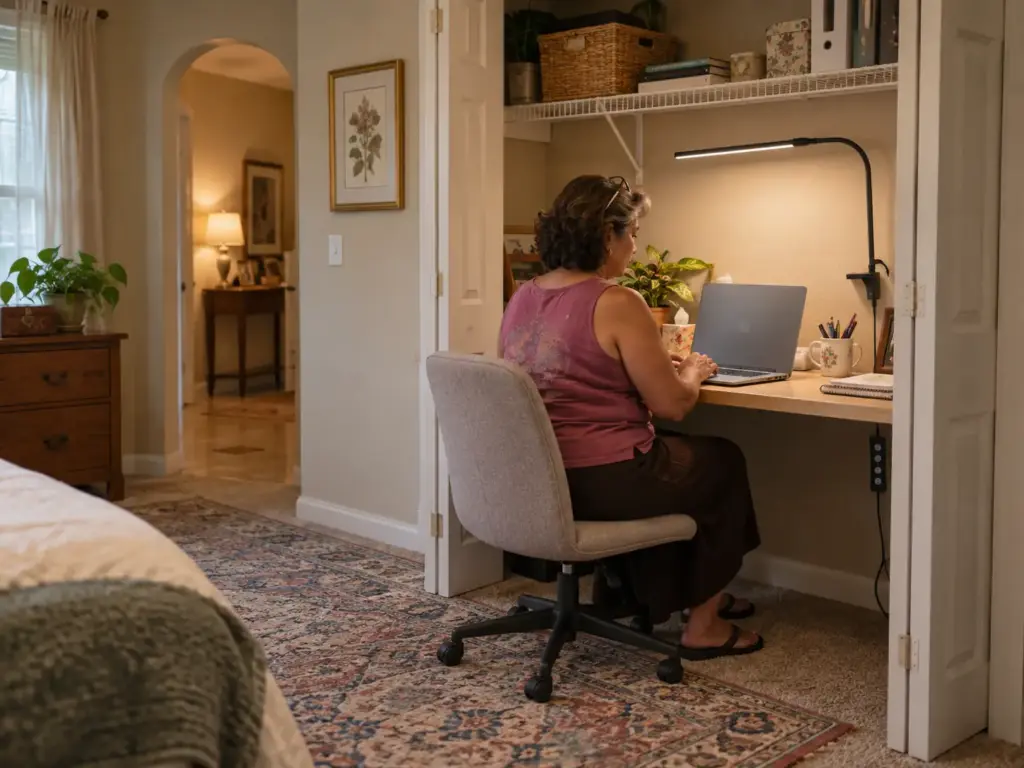
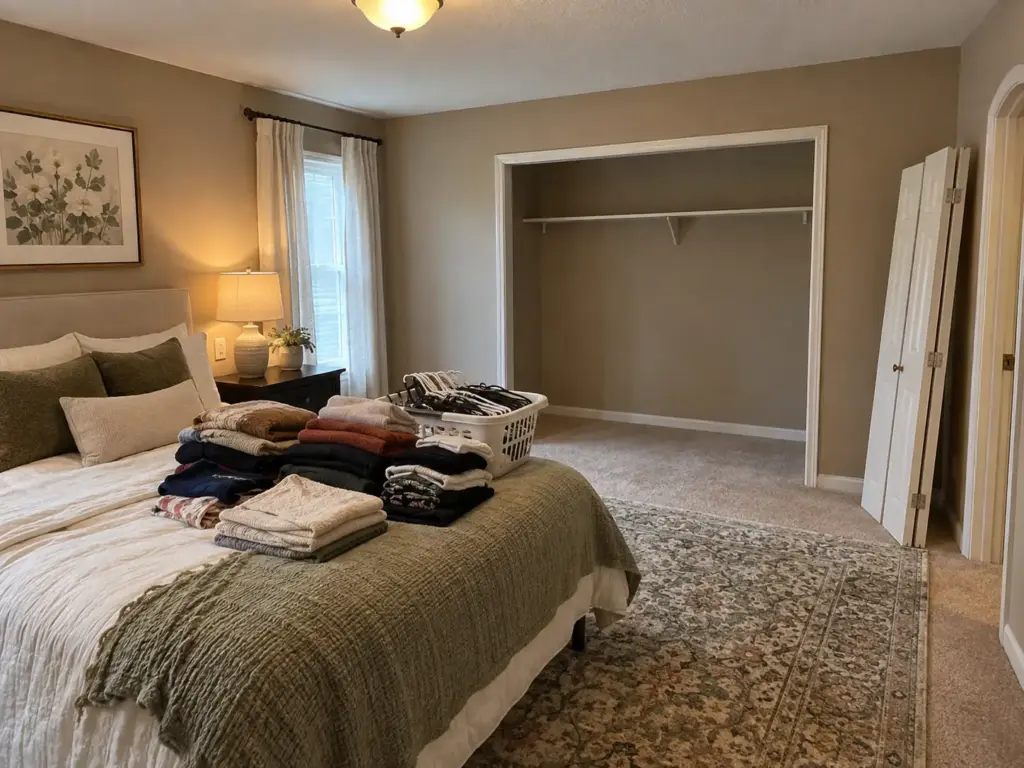
You cleared the shelf, propped the laptop on it and dragged a chair up to the opening. Now the screen is the only light in a dark box, the chair stops the doors from closing, and the clothes that used to live in there are piled on the bed. A home office in a closet can work, but the ones that get abandoned almost always skipped the light, the doors or the chair, and the measurements that prevent it come from closets other builders documented, the University of California’s workstation standards, and people who actually worked in them. Here is the order that holds up, from the tape measure to a check three months later (and if your closet fails at the measuring stage, there are other places a home office can go in a small space).
Quick Answer
To create a home office in a closet, settle the space before you buy furniture:
- Measure the depth, the width and the door opening separately.
- Match the layout to the closet size, including where the chair goes.
- Decide whether the doors stay, come off or become a curtain.
- Get light and a safe power source in before the desk.
- Install the desk surface at 28 to 30 inches, with a shelf above.
- Give the cords a protected route and the clothes a new home.
Where a Home Office in a Closet Works, and What to Measure First
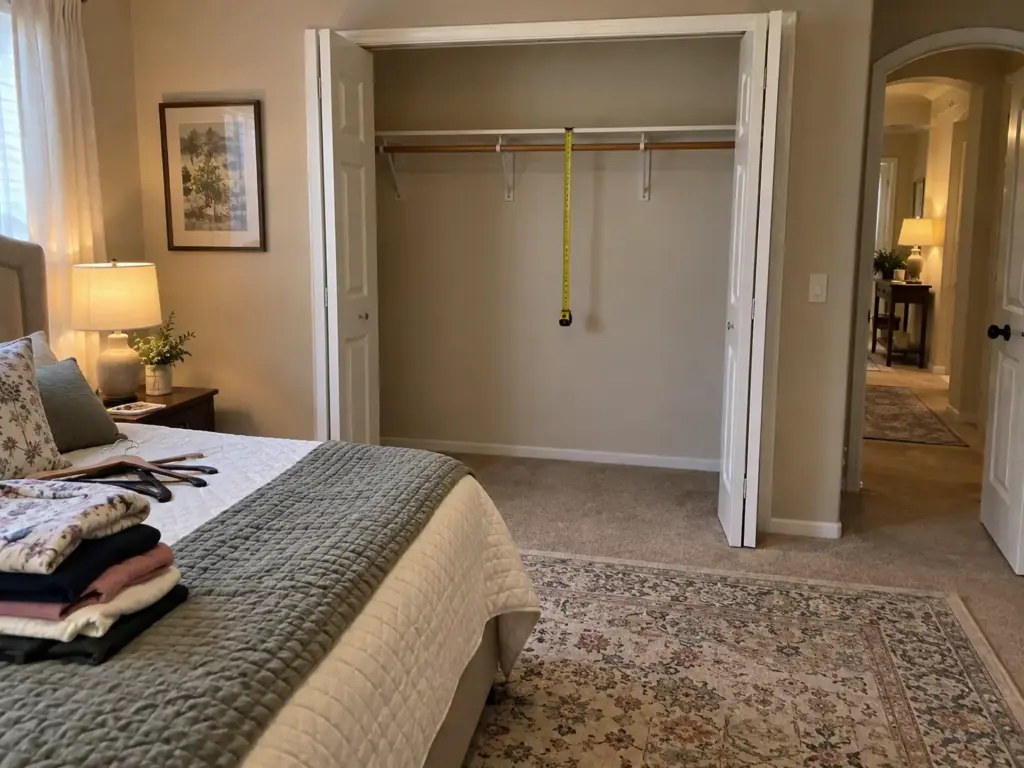
Most people start a cloffice by shopping for a desk. The closet decides what desk you can have, though, and it decides it with three numbers you can get in five minutes with a tape measure.
Which closets qualify (reach-in, walk-in, hall or linen, entry)
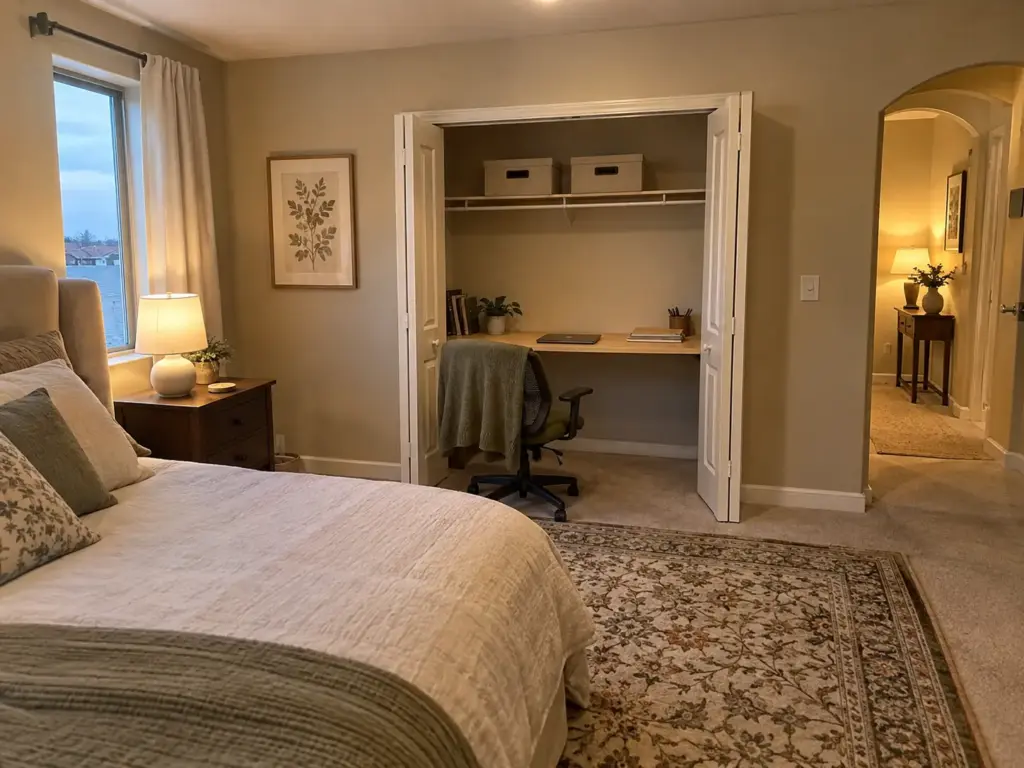
A bedroom reach-in closet is the usual candidate, and its closet depth of about 24 inches is the depth of a modest desk and nothing more. A walk-in closet has room for the chair too. A hall closet, linen closet or entry closet works if it sits near an outlet and you can live without what it stored. Before you claim a reach-in, see how a standard reach-in closet wastes space, because that dead space is what the desk takes over.
Light qualifies a closet too. One remote worker said their closet desk felt “kinda dark” because it “wasn’t near a window,” so note where the nearest natural light and the nearest outlet are before you choose.
The three measurements: depth, width, and the door opening
Write down three numbers: depth from the back wall to the frame, width from side wall to side wall, and the clear door opening with the doors fully open. Closets other builders measured show the range: a reach-in of roughly 24 by 72 inches, a deeper one of about 53 by 64 inches with 11.5-inch shelves, and a narrow one of 24 by 44 inches behind a 30-inch opening. Standard desk height is 28 to 30 inches, so note where the existing shelf sits as well.
Why the door opening is not the closet’s width
Width is the number everybody measures, and it’s the wrong one to plan around. In that 24 by 44-inch closet, everything has to pass through a 30-inch opening, so a board cut to the full inside width won’t go in. The opening also decides whether a chair with armrests rolls in at all. All three numbers come before the desk, the chair or the paint.
Cut a piece of cardboard to the desk size you have in mind and carry it into the closet. If you can’t get it through the opening flat, you’ll need a board in two pieces or one that’s narrower than the closet’s inside width.
What Fits in a Narrow Reach-In, a Wide One, and a Walk-In
A closet desk that works in a 72-inch reach-in can be useless in a 44-inch one, and what changes most between them is the chair, and the chair decides whether the setup survives a month.
It’s worth starting from a full-size desk. According to UC’s ergonomics requirements for computer workstations, the work surface should be at least 48 inches wide, and they list “Depth of top work surface – at least 30 inches deep (minus 1 inch pinch point).” The same standard asks for 30 inches of leg-clearance width, 17.3 inches of depth at knee level and 23.6 inches at floor level.
A 24-inch reach-in doesn’t reach that 30-inch depth, so a closet desk is a compromise. It suits a laptop or a low-profile screen on a riser for focused stretches, not a three-monitor station you sit at for ten hours.
| Closet | Size | What fits | Where the chair lives | The catch |
|---|---|---|---|---|
| Narrow reach-in | 24 x 44 in, 30 in opening | Laptop, one board, a lamp | Outside, rolled out when you stand | Below the 48 in width and 30 in depth standard |
| Wide reach-in | About 24 x 72 in | Laptop or slim monitor, plus a storage zone | Tucked under, or outside with doors open | Still 24 in deep |
| Deep closet or walk-in | About 53 x 64 in | Desk on a side wall, shelves above | Inside, facing sideways | The clothes need a plan |
| UC standard (yardstick) | 48 in wide, 30 in deep surface | A full workstation | 30 in of leg clearance | Most reach-ins fall short of it |
A narrow reach-in: laptop, a board, and a chair that rolls out
In a narrow reach-in, the desk board takes up the full depth and the chair spends the workday half in the closet and half in the room; when you stand up, it rolls out and stays there. One commenter who gave up on a closet desk called the setup “too impractical, having to move the chair back and forth.” Plan for the chair to live outside the closet from the start, with a clear patch of floor behind it, rather than hoping it tucks away.
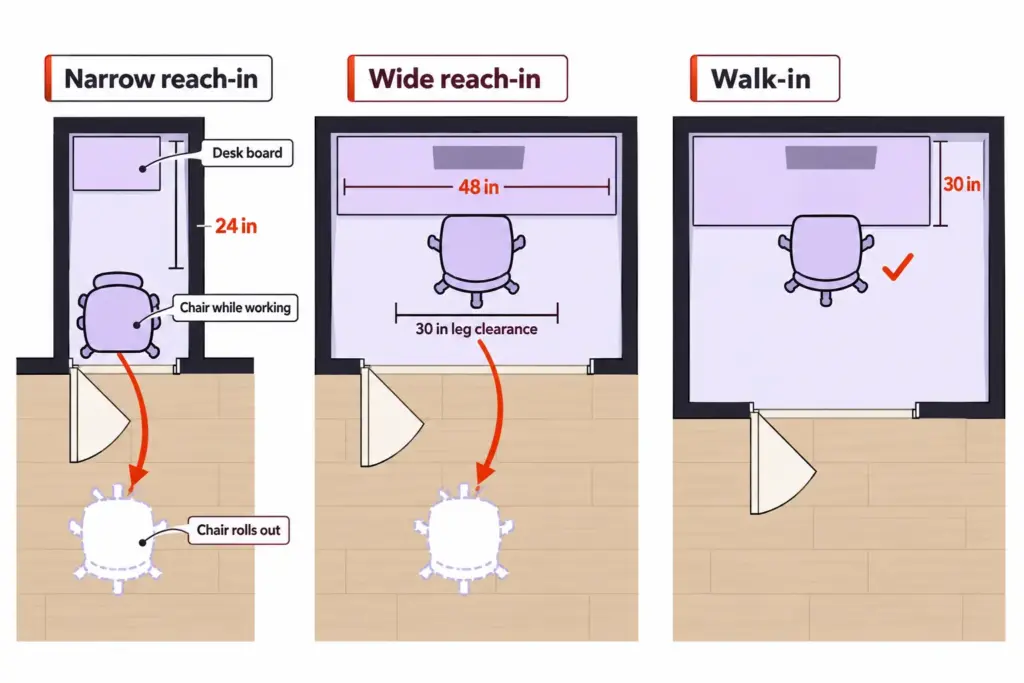
The UC numbers explain why this layout can work at all. A board that fills a 24-inch depth leaves about 24 inches for your legs at floor level, just above the 23.6 inches the standard asks for. But that only holds if nothing sits under the desk. Slide a bin or a printer underneath, and your feet lose the clearance first.
A wide reach-in: room for a monitor and a second zone
A 72-inch reach-in clears the 48-inch width with room left over, so you can split it into a work zone in the middle and a storage zone at one or both ends. The depth stays at 24 inches, so a slim screen on a riser is the realistic ceiling, and the chair can tuck under the board.
A walk-in: the only size where the chair can stay inside
A walk-in is the one size with room for a 30-inch-deep desk and the chair behind it, so the chair can stay inside. A commenter with a deep closet put the desk on the short side wall and sat sideways to the door, chair fully inside. The tradeoff is that the clothes still live in there, which is exactly what zoning a walk-in is for: see how to organize a walk-in closet by zones before you commit a wall to the desk.
In every size, folding doors get in the way. A remote worker who tried bifold and accordion doors said they “would be in the way,” and that leads straight to the next decision.
Clear the Closet and Decide What Happens to the Doors
Closet-office owners split into two camps. Some find the doors so annoying they never close them; others say shutting the door when work ends is the most satisfying part of the setup. Know which camp you’re in before the furniture goes in.
Which doors get in the chair’s way (bifold, accordion, sliding, swing)
A swing door needs its full arc of floor, the same floor the chair rolls out onto. Bifold doors and accordion doors fold into the opening and eat the inches the chair’s armrests need. Sliding doors always cover half the closet, so you work in one half or keep sliding. Small daily obstacles like these are what make people quit.
Keep them, take them off, or swap in a curtain
One commenter’s advice was to commit and take the doors off. For a swing door, though, keeping it is often the better call, because a door that shuts lets you close off the workday, and in a bedroom that work-life boundary matters. Bifolds that block the chair can go. A closet curtain on a tension rod gives you the same closing moment without the swing.
For renters, removing doors is reversible if you store them flat, bag the hardware and ask the landlord first (a yes is easier to get before the doors are in the basement). For everything else, there are no-drill ways to reorganize a closet, and removable wallpaper gives the back wall some color without touching your deposit.
What leaves, and where the rod and shelf stand
Empty the closet, then work in it with the doors open for a week before you buy anything. That free trial shows whether the chair, the light or the doors will be the problem. Take the closet rod down only if the desk needs the height, and leave the shelf if it sits well above desk level, since it’s about to become the shelf over the desk.
During that trial week, put a strip of painter’s tape on the floor where the chair ends up each time you stand. If the tape lands where a door swings or a bifold folds, you’ve learned which door has to change before you’ve spent anything.
Power and Light for a Closet With No Window
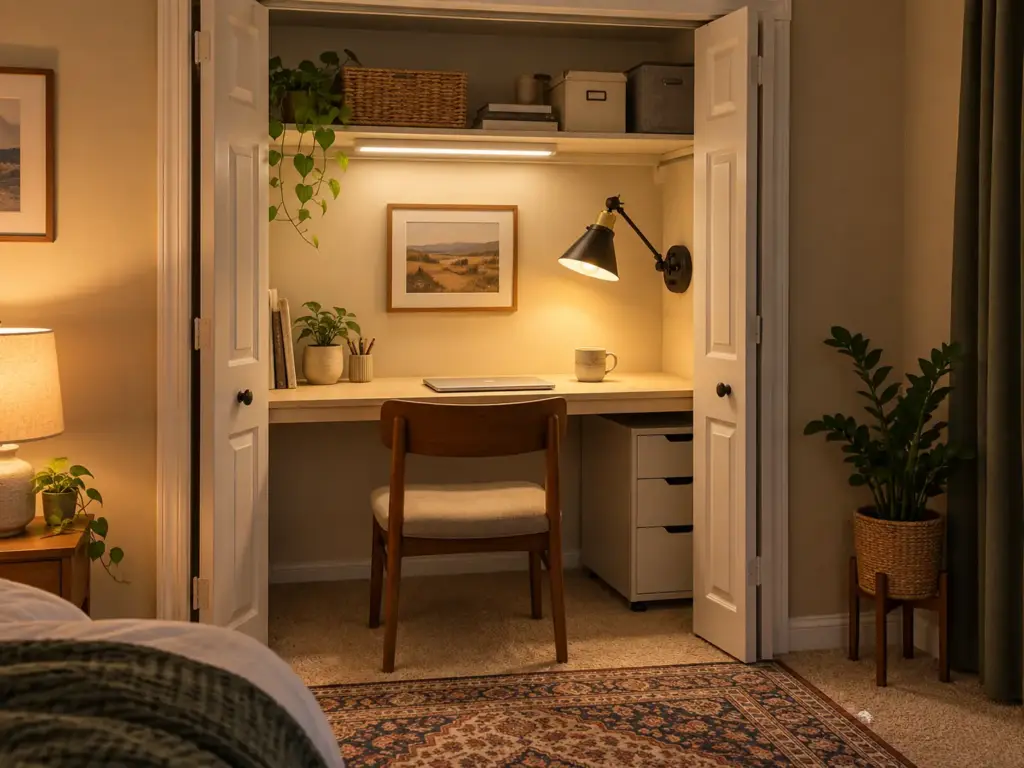
A dark closet doesn’t stop working on day one. You notice it a few weeks in: tired eyes by mid-afternoon, a screen glaring in a box with nothing else lit, the laptop slowly migrating back to the kitchen table. A builder who wrote up a closet office in r/Workspaces said “the hardest part is getting the lighting right,” and that was someone who had already sorted out the desk. So light and power go in before the desk, while you can still reach the walls.
Light first: the cheapest fix for a dark closet
Start with a lamp you already own. Set it on the closet shelf, point it at the wall rather than the screen, and work under it for a few days. A commenter whose closet “wasn’t near a window” said a single small lamp was enough, and for a laptop setup it often is.
If you don’t have a spare lamp, the Lepro Clip on Desk Lamp is the cheapest real fix. It clamps to the shelf edge and runs on USB, so you can power it from the laptop and skip the outlet question. Two things to check: the USB adapter isn’t included, and the clamp opens only to 1.97 inches, which handles a 3/4-inch plywood shelf but won’t fit a thick butcher-block top. You can see the Lepro clamp lamp here.
When the closet has a single bare bulb overhead, the step up is a pair of wall lights with a cord. The TRLIFE plug-in wall sconce comes as a two-pack with dimmer knobs and 6-foot cords, so it gives you task light on both sides of the desk without hiring an electrician. It mounts with screws, though, so it isn’t a true no-drill pick for renters, and the cord hangs down the wall unless you cover it.
For the dark corners under the shelf, battery-operated lights need no wiring at all, and they do the job people usually buy puck lights for. The rechargeable LED motion sensor light bar attaches magnetically and comes in a two-pack, which is enough for the underside of the shelf and the back corner where supplies end up. Being rechargeable, it goes on the charger now and then, which is the trade for having no cord.
Power: the owner path and the renter path
If you own the place and there’s no outlet near the closet, have a qualified electrician add one. The National Fire Protection Association says all electrical work belongs with a qualified electrician, and an outlet inside a closet that will run a computer every day is not a weekend project. If you rent, the same question goes to your landlord. The renter’s fallback is a properly rated cord from the nearest outlet, routed so nothing crushes it (more on that below).
The NFPA also lists the signs that should send you to an electrician or your landlord right away: breakers that trip often, an outlet that’s hot or discolored, flickering or dimming lights, a burning or rubber smell, or sparks. Any of those in or near the closet means the desk waits.
Cord safety in a closet
A closet doubles the risk of a cord getting pinched, because both a door and a chair are moving over it all day. The Consumer Product Safety Commission’s extension cord guidance explains that cords without the minimum wire size, strain relief or proper polarization carry a risk of shock or fire, and says of those safety features that “The presence of these characteristics reduces the risk of electrical shock or fire.” In practice, that means a UL-listed cord or power strip, never the thin unlisted one from the junk drawer.
Plug only the laptop, the lamp and maybe a phone charger into the closet setup. NFPA guidance is to plug one heat-producing appliance into an outlet at a time, so a space heater never shares one.
The Desk, the Chair, and the Shelf Above Them
The cheapest closet desk anyone has documented is a 120 by 30 cm board, about 47 by 12 inches, bought at a local hardware store and set on short IKEA legs. It works, and it shows how much the depth matters: a 12-inch-deep board leaves a lot of closet behind it, while a board that runs the full 24 inches changes where your knees and the chair go.
The desk surface: owner build and renter board
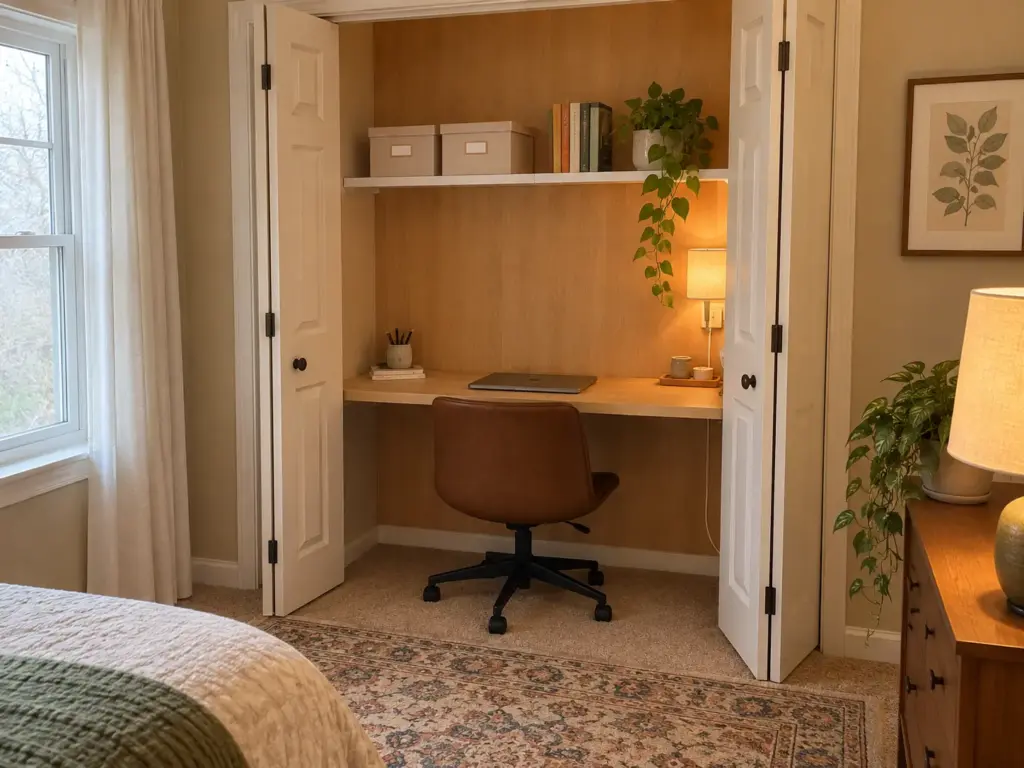
An owner can run a floating desk of plywood, MDF or butcher block on cleats or shelf brackets screwed into the studs, which keeps the floor clear for your legs. Set it at 28 to 30 inches and follow the bracket maker’s fastening instructions (and remember the clamp lamp won’t grip thick butcher block).
A renter, or anyone avoiding holes, can slide in a freestanding board on short legs that leaves with them. A board across two stacked bins costs nothing if you own the bins, though it parks something where your feet go.
Then there’s the screen. A monitor looks like the obvious upgrade, but in a 24-inch closet it usually isn’t, since that depth is 6 inches short of what the UC standard wants for focal distance. One remote worker added that a monitor on show in a bedroom “might look awkward,” while a laptop is “easy to put away in a drawer.”
In a reach-in, a laptop on a desk riser holds up; in a walk-in, a monitor makes sense again. For raising the screen, see desk organizers worth buying.
A chair that tucks in
The chair either slides fully under the desk or lives outside the closet. Nothing in between survives daily use. With doors, pick a rolling chair without armrests, or a stool or ottoman low enough to tuck in under the board. A seat that sticks out an inch stops a swing door just as a protruding bin would.
The shelf above the desk
The free version is the shelf already there. If you took it down, a board across two stacked bins at the back of the desk makes a riser shelf for the router and a notebook.
For a real shelf without holes, the Home in Bold tension rod shelving expands to press between the side walls, so it needs two solid walls facing each other, and a reach-in has them. These tension rod shelf ideas that hold real weight cover loading and layouts. That vertical storage works best with daily things at eye level and spare cables up high.
Before you set the shelf height, sit at the desk with the laptop open and raise your hand straight up from the keyboard. Keep the shelf above that point, or your knuckles will find it whenever you tilt the screen back.
Cords, Clothes, and Everything Else That Needs a Home
Before it was an office, the closet was probably where things went when they had nowhere else to go; one builder opened the closet-office write-up by admitting exactly that. A catch-all refills the moment something lacks a home, and here the usual suspects are the cord, the clothes and the paper.
Route the cord so the door does not pinch it
NFPA figures put this in perspective: cords or plugs were involved in starting 1% of home structure fires but 6% of the fatalities in those fires, and most of those fires involved extension cords. Its guidance, on NFPA’s electrical safety guidance for the home (Spanish-language page), is that extension cords are for temporary use and shouldn’t run through doorways or under rugs. A cord that a closet door shuts on every evening is precisely the permanent arrangement that guidance warns about.
So the plug and the route both matter. The Sleek Socket flat outlet concealer with an 8-foot cord kit replaces a bulky plug with a flat one that sits flush against the wall, so a pushed-in chair or a closing door can’t crush it, and it’s UL listed. Before ordering, check your outlet: the listing for this variant says it fits inverted outlets only, the kind with the ground pin on top.
Then run the cord along the baseboard, not across the floor. A 157-inch paintable cable raceway kit hides it in a channel you can paint to match the trim; renters should use the adhesive version and test it on a hidden spot first. Cord management on the desk itself is its own job, covered in cable management solutions for a desk.
Where the clothes go
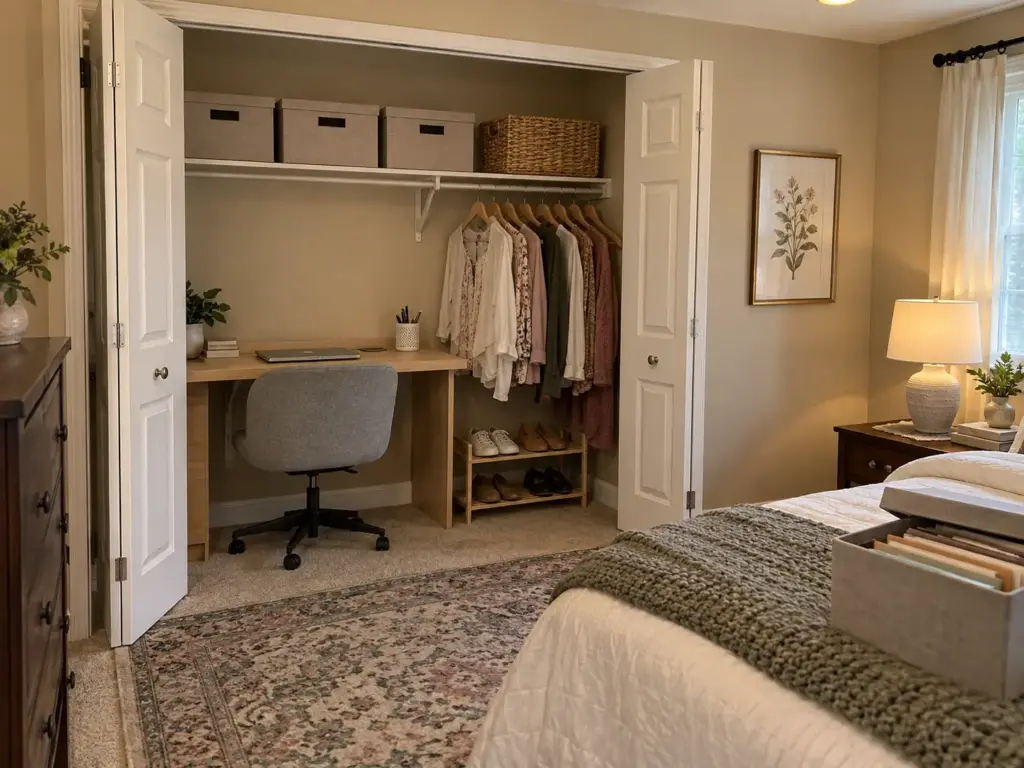
A walk-in keeps its rod and gives the desk one wall. A reach-in usually gives up the rod, and the clothes move to a dresser, a freestanding rack or another closet.
An over-the-door organizer can take light overflow; one commenter used an over-the-door shoe pocket for craft supplies and found it “a bit wobbly.” If the wardrobe outgrows what’s left, start with how to organize a closet with too many clothes. If some of it stays beside the desk, treat it like sharing a closet with someone else’s clothes, except the roommate is your job.
Paper, supplies, and the filing question
Paper refills a closet office fastest. Lidded file boxes on the shelf handle a light load, and a small rolling filing cabinet works if it lives beside the desk rather than under it, where your legs need the room. Weigh the options in filing systems for home compared and choose for the shelf you have.
Why Closet Offices Stop Getting Used, and How to Catch It Early
The pretty after photo gets posted in the first week. The real test is month three, when the novelty has worn off and the desk either still gets used or has turned back into a shelf for laundry. The closet offices that get abandoned tend to fail in three ways, and each one shows up early if you know what to look for.
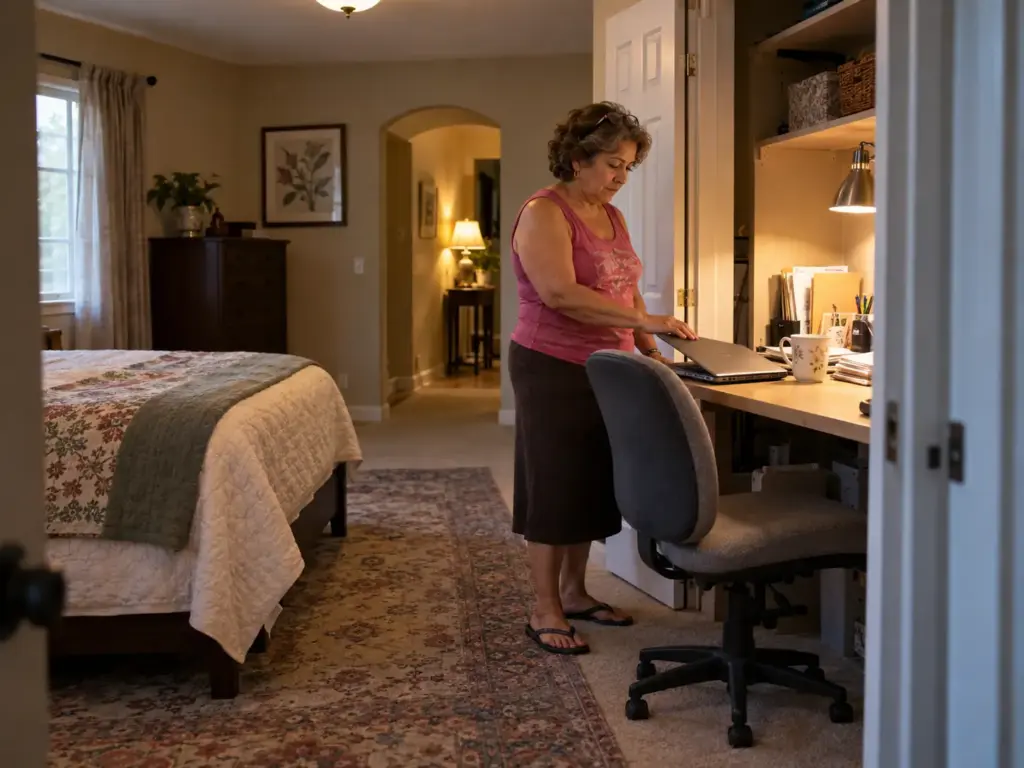
Heat and dark
A closet often has no window or air vent, and a computer and a person both put out heat. One builder in a windowless closet with no HVAC described it as “crazy hot in here during the summer so all the fans are on.” Fans move the hot air around, but without ventilation to the room there’s nowhere for it to go, so the closet keeps climbing through the afternoon.
A laptop is the safer choice in a small closed space. A desktop tower in a shut closet is a different matter: hardware forums repeat the same advice, either cut vent openings near the top and bottom of the closet or leave the door open a crack so air can move. Take that as what people in those forums do, not as a spec. And if the closet is already warm on a mild day, it will be worse in July.
Darkness creeps up the same way: you won’t decide the closet is too dark, you’ll find yourself working at the kitchen table more often until the closet desk is just storage. If that’s happening, change the light first.
Chair in, chair out
The chair is the one reason that comes up in the threads: “too impractical, having to move the chair back and forth,” as one commenter summed it up. The answer is design, not discipline: a chair that slides fully under the desk, a door that doesn’t fold into the chair’s path, or a layout that accepts the chair living outside the closet and leaves clear floor for it. If you’re dragging the chair over a rug, past a bed corner and around a bifold every morning, the office will lose to the couch within weeks.
When the closet fills back up
The catch-all habit comes back slowly. First it’s a shopping bag on the floor “just for today,” then a pile of laundry on the chair, and eventually the desk itself turns into a shelf. Agree on one rule with yourself (and anyone you live with): nothing goes on the desk or the floor of the closet that isn’t work. If the closet already has a history of filling up, read why budget closet makeovers revert, because the reasons are the same.
If you’ve measured, tested and still can’t make the closet work, that’s useful information, not a failure. Look for how to find the dead zones in a small apartment and compare the other options in home office ideas for small spaces, compared by footprint.
Light, Doors and the Chair Decide Whether You’ll Use It
Three things decide whether a closet office lasts. First, measure the depth and the door opening, not just the width, because the opening decides what fits through and the depth decides what kind of screen makes sense. Second, get light and safe power in before the desk, because the closet is hardest to fix once the furniture is in. Third, the chair and the doors decide whether you actually use the space, so plan where the chair goes when you stand up.
Three months in, ask whether the chair still goes in and out without a fight, whether the light is on when you work, and whether the closet floor is still clear of the old pile. Any no tells you what to fix.
Today, empty the closet shelf, set your laptop on it with the doors open and a lamp you already have, and work there for an afternoon. By the end you’ll know whether the light, the chair and the doors work for you, and you’ll know it before you’ve bought anything.
Frequently Asked Questions
01Can a closet be a home office?
Yes, a closet can be a home office if it is at least about 24 inches deep, near an outlet, and you can add light. A reach-in suits a laptop setup with the chair rolling out; a walk-in can hold a full desk with the chair inside.
02Can I create a walk-in closet and office combination?
Yes, a walk-in is the easiest closet for an office because the chair can stay inside with the door shut. Give the desk one wall, often the short side wall, and keep the rod and shelves on the others so the clothes and the work zone do not overlap.
03How do I build built-ins in a closet?
Closet built-ins usually start with a plywood, MDF or butcher-block desk on cleats or brackets fastened into the studs, at 28 to 30 inches high. Follow the bracket manufacturer’s instructions for fastening. Renters can get a similar result with a freestanding board on short legs and a tension rod shelf.
04What do I do with the clothes that were in the closet?
In a reach-in, the clothes usually move to a dresser, a freestanding rack or another closet, because the desk takes the rod’s space. A walk-in can keep its rod on the walls the desk does not use. Sort the clothes before the move so only what you wear needs a new home.
05Will a closet get too hot to work in?
A closet with no window or air vent can get very hot in summer, especially with a computer running. A laptop produces far less heat than a desktop tower. If you use a tower, forum advice is to vent the closet high and low or leave the door slightly open.
Disclaimer: ClutterlessNest is a participant in the Amazon Services LLC Associates Program. As an Amazon Associate we earn from qualifying purchases. This article may contain affiliate links — if you buy through them, we may earn a small commission at no extra cost to you. We only recommend products we have tested or genuinely believe in.