





















In this article
There is a chair in your bedroom, and you know the one. It started as a place to sit and became the place where worn-once-but-not-dirty clothes go to live, a soft archive that never quite makes it back to the closet (organizing communities even have a word for the floor version of this, the floordrobe). Clothes pile up in the same spot for the same reason every time: nothing in your closet was set up for the way you actually get dressed. So this is how to organize clothes in a way that survives a normal week. Good clothing organization starts with one universal system that works for any wardrobe, then branches into your exact space, whether that’s a walk-in closet, a shallow rental reach-in, a dresser and nothing else, or no closet at all.
Quick Answer
The system is the same for every wardrobe. Your space only changes the last step.
- Declutter first: keep, donate, sell, toss.
- Sort what’s left by category.
- Decide what to hang and what to fold.
- Arrange it with matching hangers, most-worn in front.
- Match the setup to your space: closet, reach-in, dresser, or none.
- Reset it for ten minutes a month so it holds.
Start by Clearing Everything Out

Every guide tells you to start with bins. They’re wrong. The first move is to declutter clothes you no longer wear, because you’re organizing the keepers that survive an honest edit, not the whole overstuffed pile, and you can’t see what that is until everything is out where you can look at it.
Empty the whole wardrobe out first
Pull it all out. The closet, the dresser, the chair, the bag of stuff behind the door. Put it on the bed so the only way to finish is to deal with it. Seeing the full volume in one heap is the only honest inventory you’ll get, and it’s usually a shock, the kind that does more for your motivation than any matching-bin photo ever will. This is also where you discover you own fourteen black tops and can’t find a single clean pair of socks.
Sort into keep, donate, sell, toss
Now make four piles, and keep them physical: keep, donate, sell, toss. Physical piles force faster decisions than a vague mental “maybe.” Speaking of maybe, that’s the pile to ban. The doom pile, the catch-all heap of things you can’t decide on, is where every system quietly starts to fail, because “I’ll deal with it later” is how the chair got full in the first place. If you genuinely can’t decide, the honest answer is usually toss or donate.
Where your old clothes actually go
The toss pile deserves a second look before it hits the trash. Americans throw out about 103 pounds of textiles a year, and most of it gets landfilled, so anything still wearable is worth donating or reselling on Poshmark or eBay instead. And the best part of this whole step is the price. It costs nothing. You need floor space and four bags, not a single product.
Sort What’s Left Into Categories
With the keep pile cut down, the next move is the one that turns a heap into a plan: group like with like before you decide where anything lives.
Group like with like
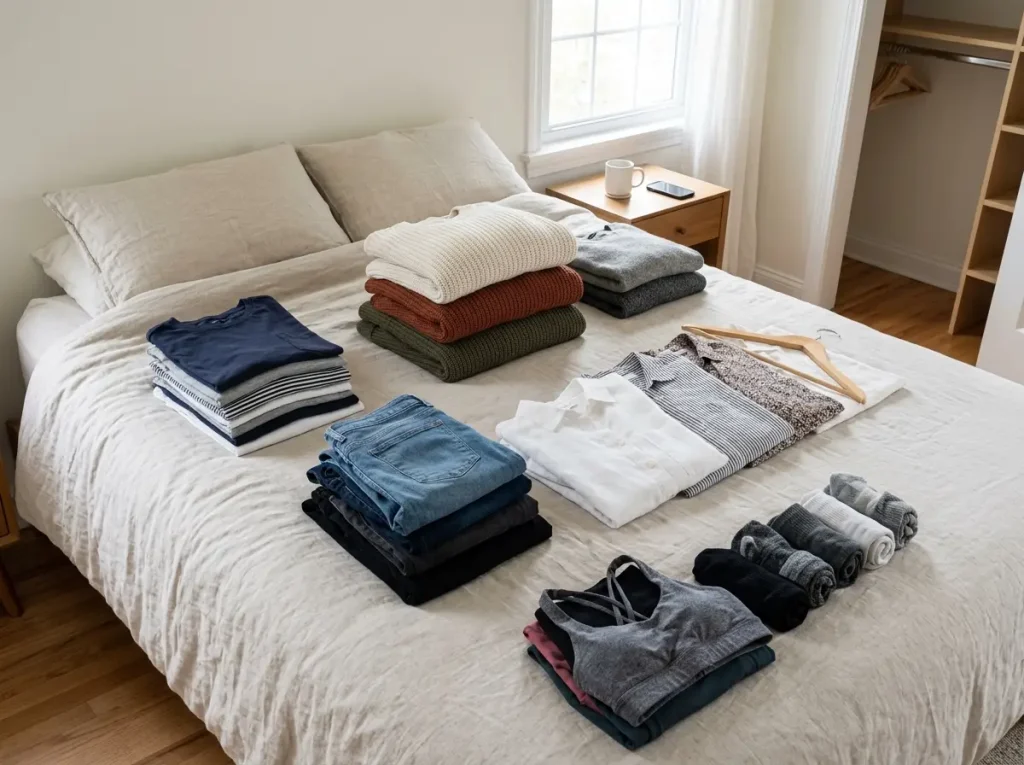
Sort by category, not by outfit: tops, bottoms, dresses, sweaters and knits, activewear, undergarments, accessories. The point isn’t tidiness yet, it’s information. When all your sweaters are in one stack, you can finally see that you have nine and wear three. Categorizing surfaces the duplicates and the gaps a stuffed closet hides, and it almost always triggers a second, easier round of decluttering.
Sort by how you actually get dressed
Then group those categories by how you live: work clothes, lounge clothes, gym clothes. It’s the wardrobe version of grouping your kitchen by how you cook instead of alphabetically. This is also the natural starting point if you want to own less on purpose and build a tighter capsule wardrobe, where the whole closet runs on a small, mixable set of pieces. Either way, you now know exactly what you’re working with, which is the thing that makes every later step fast.
Decide What to Hang and What to Fold

This hang vs. fold call is the decision that drives everything else, and it’s the one people get wrong for years. It isn’t about looks. It’s about what holds its shape on a rod and what stretches, sags, or creases.
What to hang
Hang the structured and the wrinkle-prone: blouses, button-downs, dresses, blazers, jackets, anything tailored or made of something that creases if you fold it. These pieces keep their shape on a hanger and lose it in a drawer. If it would look wrong arriving at work with a fold line across the chest, it hangs.
What to fold (and why you never hang sweaters)
Fold the knits, and this one matters: never hang sweaters. Knit fibers stretch under their own weight, so a hung sweater grows shoulders and a sagging hem within a season, and you don’t get that shape back. Fold sweaters, jeans, t-shirts, and activewear flat or in a drawer. Denim and tees don’t crease in a way anyone notices, so hanging them just burns rod space you’ll want later.
File-folding so you can see everything
For the folded stuff, switch from stacking to filing. Marie Kondo’s file-folding method, the KonMari approach also called vertical folding, stands each item upright so the whole drawer reads like a row of files instead of a stack where you can only see the top shirt. You stop excavating the pile to reach the green tee at the bottom, which is the exact move that wrecks a folded drawer five minutes after you organize it.
Here’s the catch nobody mentions: file-folds collapse when the drawer is crammed. Drawers stay functional up to about 70% full, and past that the standing rows lean and flop the first time you wedge in one more shirt. The conventional fix is to buy dividers immediately. In practice, the cheaper first move is to thin the drawer, then add dividers to hold the rows.
Cut-down cardboard or shoeboxes work for free, and if you want something sturdier, Bamboo Drawer Dividers that expand to fit a 12-to-17-inch drawer keep the rows from sliding into each other. Just don’t let the divider become permission to overstuff.
Run your hand flat across the top of a folded drawer. If it doesn’t glide, the drawer is past 70% full and your folds are going to flop within the week. That hand test is faster than counting anything, and it’s the single best predictor of whether a folded system will hold.
Arrange What You Keep So It Stays Findable

Now you make the kept clothes easy to live with. Two things matter here, and one of them is the highest-payoff move in the entire article.
Switch to matching slim hangers
If you do one thing on this list, do this. Mismatched hangers, the wire ones from the dry cleaner mixed with chunky wood, let clothes slide off and make the rod sag unevenly within days. Worse, the bulky ones eat space. Roughly three inches of fat plastic hangers takes the same rod length as one inch of slim velvet. Switching to matching Zober Premium Velvet Hangers, which sit around a fifth of an inch thick against the better part of an inch for wood, can buy back about a foot of usable closet rod in a closet full of tops, no construction required.
And the budget truth: velvet hangers are a commodity. The cheap multipack on Amazon grips and measures the same as the boutique version that costs a fraction more, whether the logo says The Container Store or nothing at all, so buy on price. (If you want the side-by-side on which slim hangers free the most rod space, there’s a closer look at exactly that.)
Order by category and frequency, not color
Color-coding gets recommended everywhere, the full ROYGBIV rainbow arranged lightest to darkest. And it photographs beautifully. But it’s the first thing to break, because the instant laundry day hits you reshelve fast, clothes go back wherever there’s a gap, and the rainbow is gone in two weeks.
Order by category first, then put your most-worn pieces at eye level and in front. That’s how professional organizers who do this for a living tend to start, by standardizing to uniform hangers and moving the daily stuff to the front, because frequency survives a sloppy reshelve and color never does.
Arrange by length to reclaim space
Within a category, organize by length, hanging shortest to longest. It creates a clean diagonal sightline, sure, but the real win is the block of open space it opens up under the shorter tops, which you’re about to put to work in the next section. For a look at how this plays out in a real, lived-in closet rather than a staged one, this closet tour is worth the few minutes.
Match the Setup to the Space You Actually Have
Here’s where most guides fall apart. They show you one showroom walk-in and call it a day. Real homes are a two-foot-deep rental reach-in, a dresser with no closet behind it, or four bare walls and a bed. So find your situation below and follow that branch. The universal system above still applies, this just decides how you house it.
A full closet
If you have real closet space, the work is restraint, not storage. Run the standard system and resist the urge to fill the room you just freed up. If you’ve got a proper closet to organize, the full closet playbook goes deeper on shelving and zones than a clothing overview can.
A small rental reach-in
The classic rental reach-in closet is only about 24 inches deep with a single rod around 66 inches off the floor. That leaves a wall of dead air, roughly five feet of nothing below your short tops and about a foot of unused height above the rod. The whole game in a reach-in is going vertical, which gets its own section next.
A dresser and not much else
No real hanging space? Lean on file-folding and the 70% rule, then add a slim freestanding rack or a few hooks for the handful of things that truly need to hang. There are good ways to handle clothes when there’s no dresser or closet in the picture using cube units and hanging organizers that double as drawers.
No closet at all
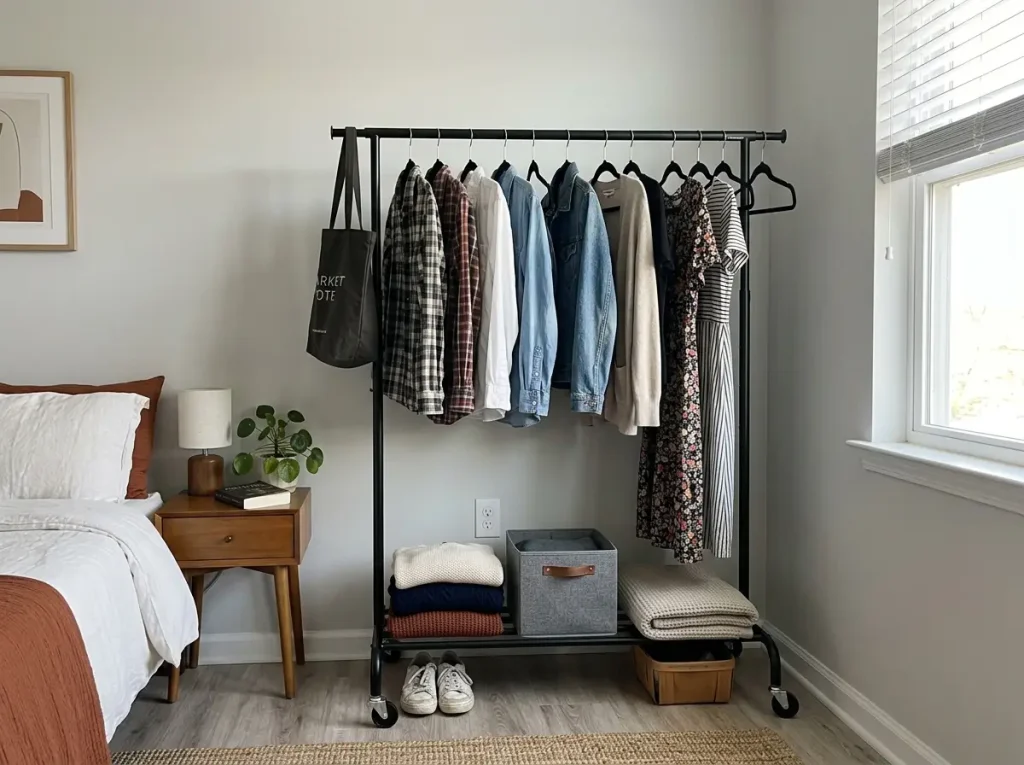
When there’s no closet, a freestanding garment rack (a freestanding clothes rack, in plain terms) becomes the closet, and it moves with you, which makes it the most renter-proof answer there is. The SONGMICS Rolling Garment Rack takes a genuinely heavy load (its rod is rated for a few hundred pounds) and rolls on locking wheels, so you can push a full wardrobe against the wall or out of the way. One honest limit: an open rack doesn’t hide anything the way a door does, so it rewards a smaller, tidier wardrobe and punishes an overflowing one. This is exactly where the floordrobe takes over if you skip the editing step, so the no-closet path leans hardest on the declutter you already did.
Maximize a Small or Rental Closet Without Drilling
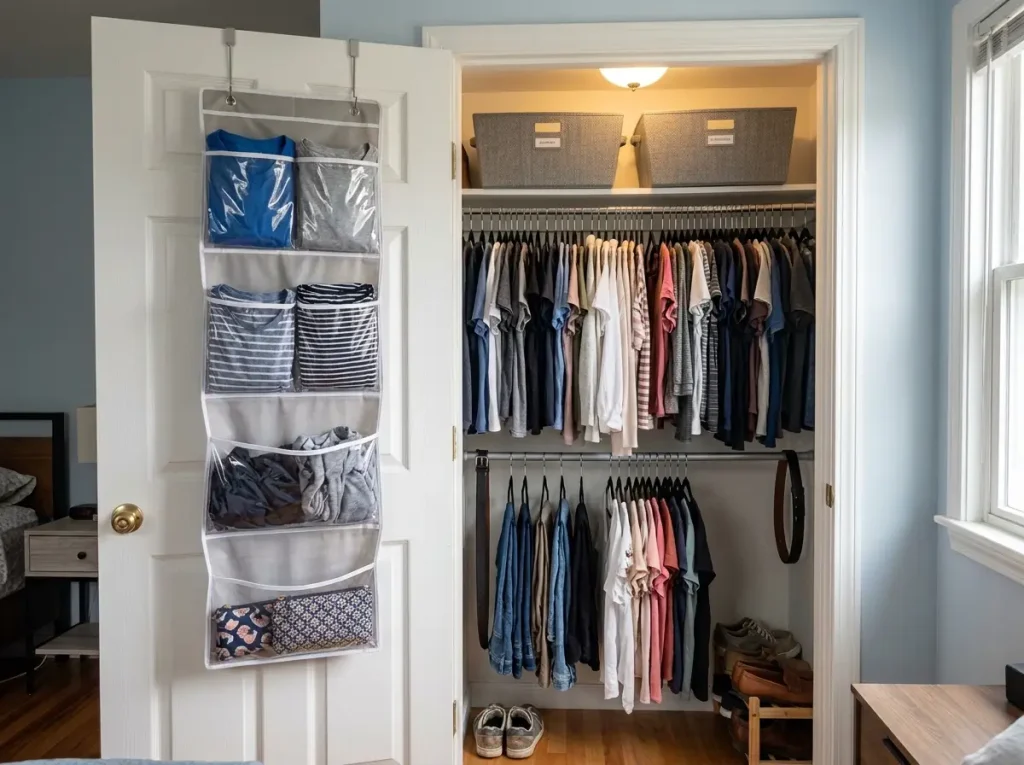
A rental reach-in wastes more than half its volume, and you can claim all of it back without a drill. Treat this as the main event, not a renter’s consolation prize. The whole no-drill toolkit of removable solutions, tension rods, over-door units, and Command hooks alongside other adhesive hooks, comes together here.
Go vertical with a second rod
That five feet of dead air under your shirts is vertical storage you already paid for. A no-drill rod doubler (also sold as a rod extender) hangs off the existing rod to double-hang it, splitting one closet rod into two tiers of roughly 40 inches each, and if your clothes skew short (shirts, folded pants, skirts), that nearly doubles your hanging capacity in the same footprint. It’s also the cheapest square footage you’ll ever add. For the full picture on why a reach-in wastes half its space, the geometry is worth understanding once so you stop fighting it.
Reclaim the dead space above the rod
The foot or so of height above the rod usually holds nothing but a single factory shelf. Add a hanging shelf organizer that drops down from the rod, or set a row of soft fabric bins or baskets, the kind of storage bins that nest on a slim second shelf, and that becomes your folded-knits or off-season zone. Keep the bins to about the same depth as the shelf, because the standard above-rod shelf is only about 12 inches deep and a deeper bin tips off the front.
Use the inside of the door
The back of the door is the most ignored surface in any closet. An over-the-door organizer turns it into shelves. The SimpleHouseware six-shelf over-the-door organizer adds six clear shelves for folded clothes and fits the standard 12-inch closet depth without a single screw. The catch is the door itself.
Knock on your closet door before you hang anything on it. A solid thud means a solid-core door that can take the weight. A hollow echo means a hollow-core door, and a screwed-in organizer will pull its mounts out and gouge the top edge within weeks. On a hollow door, hang the unit on the over-the-top hooks only and keep the load light.
The renter’s real free pass, though, is the humble tension rod. Home in Bold Tension Rod Shelving wedges in to add a whole second rail or a mini shelf with zero holes in the wall, and a basic spring tension rod does a lighter version of the same job for the cost of a coffee, the most budget-friendly upgrade in the room. It’s the highest fun-to-effort ratio in the closet.
Store Accessories, Shoes, and Off-Season Clothes
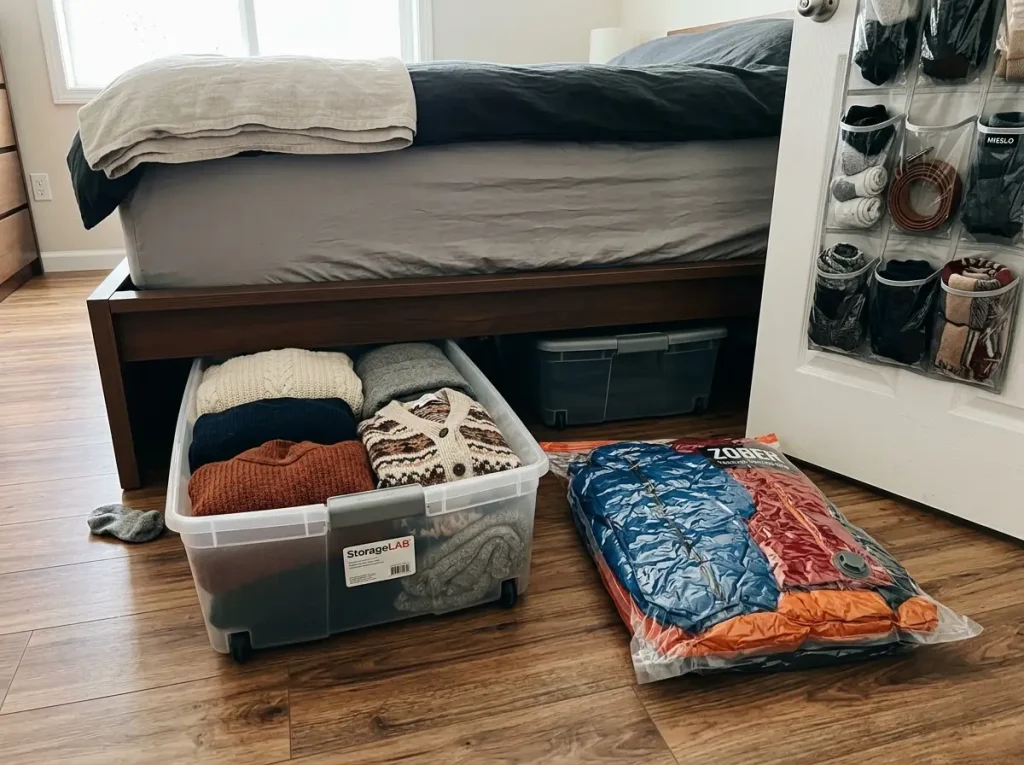
Most clothing advice stops at the rod and the drawer and abandons the belts, the boots, and the winter coats. Those three homeless categories are exactly where a closet re-clutters, so each one gets a real home.
Accessories (belts, scarves, socks, hats)
Small stuff disappears into drawers and then reappears as a tangle. The fix is to make it visible and vertical. A few adhesive hooks handle belts and bags for almost nothing, and for the rest, the MISSLO ten-tier over-the-door organizer was built for shoes, but in a clothing closet those wide pockets are ideal for rolled socks, coiled belts, scarves, ties, and hats, all visible behind the door and off your rod.
Shoes (the wardrobe’s other half)
Shoes share the closet floor and that dead space under your hanging clothes, so the simplest shoe storage keeps them off the floor on a low shoe rack or in an under-bed bin. They’re a big enough topic that they earn their own system, so rather than repeat it here, shoes get their own complete organizing guide.
Off-season clothes
Nothing wastes prime closet space like January coats sitting front and center in July. Rotate the off-season half out. ZOBER Vacuum Storage Bags, the compression bags that flatten a season of puffy synthetic jackets and cotton down to a fraction of their size, are a seasonal rotation staple and get recommended for absolutely everything. And they’re great, with one real exception: don’t long-term-compress wool or down, because crushing the loft for months flattens the fibers and they don’t fully bounce back.
For where the bags go, StorageLAB rolling under-bed containers turn the dead space under the bed into pull-out seasonal storage, and the low profile slides under most platform frames where a taller bin won’t fit. Setting up under-bed storage that actually stays organized is its own small skill, and it’s worth getting right, because there’s a specific failure mode where vacuum bags collapse under a low bed frame and undo the whole point. How to store sweaters, winter coats in a tight space, workout clothes, and the full seasonal swap each have their own quirks worth a deeper read when you get to them.
Keep It Organized After the “After” Photo
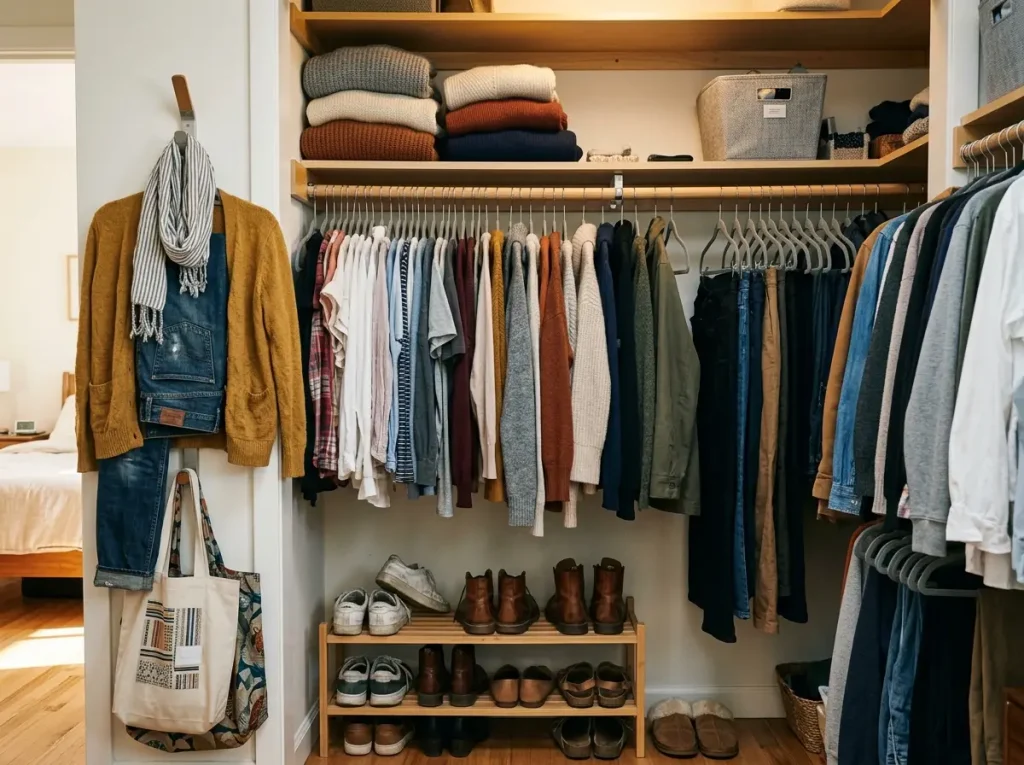
The after photo is not the finish line. Daily life is. This is the three-month test: every system above will drift without a little upkeep, and the honest version of maintenance is about designing for the person who won’t refold perfectly, not pretending that person is someone else.
Why clothing systems fall apart
The failures are predictable, and naming them is half the fix. Mismatched hangers slide and the rod goes ragged. The “miscellaneous” bin becomes a dumping ground and swallows everything without a home. File-folds collapse the moment a drawer creeps past 70% full. And color-coding dies on the first fast laundry reshelve.
None of these are willpower problems. They’re design problems, the same way budget closet makeovers so often revert when the pretty setup ignores how the space actually gets used.
The maintenance that actually holds
Build for a sloppy week, not a perfect one. Organize by category and frequency so a rushed reshelve still lands roughly right. Run a quiet one-in-one-out rule so volume can’t creep back past what your space holds. And trade the dreaded once-a-year overhaul for a ten-minute monthly reset: rehang the slipped pieces, empty the catch-all bin, thin whatever drawer stopped closing. Small and frequent beats huge and rare every time.
Design for the person who won’t refold perfectly
The chair from the opening isn’t a character flaw, it’s an unmet need. You have clothes that are worn-once and not dirty, and no system accounts for them, so they live on the chair. Give them a home on purpose.
Mount a single valet hook or a slim rod for the “worn once, not ready to wash” clothes. Designing a home for that pile is what finally kills the chair, because the clothes were never the problem, the missing landing spot was.
And if you share the closet, one more rule decides whether any of this survives: the system has to be obvious enough that someone who didn’t build it can follow it. A shared closet only holds when the categories are visible and simple, because a clever system nobody else understands is just your system, breaking quietly.
Conclusion
Three things carry the whole job. Subtract before you store, because you organize what you keep, not what you own. Let your space choose your method, since the reach-in, the dresser, and the no-closet room each get a different branch. And build for the imperfect user with category-and-frequency order, one-in-one-out, and a short monthly reset.
In three months, open the one drawer that flops and the one bin that’s overflowing. Those two spots tell you exactly where volume crept back in, so edit them, don’t run out and buy more storage.
Start with a single zone, the rod or one drawer. Get it right, live with it for a week, and let the rest of the wardrobe follow from there.
Frequently Asked Questions
01Should you hang or fold clothes?
Hang anything structured or wrinkle-prone: blouses, dresses, button-downs, and jackets. Fold knits and sweaters, because hanging stretches them, plus jeans, t-shirts, and activewear. The rule is about what keeps its shape on a rod versus what sags or creases.
02How do you organize clothes without a closet?
Use a freestanding garment rack as your closet, file-fold the rest into a dresser or cube unit, and add tension rods or hooks for overflow. A rolling rack moves with you, which makes it the most renter-friendly answer.
03Is it better to organize clothes by color or by type?
By type, then by how often you wear each piece. Color-coding looks great in photos but breaks the first time you reshelve laundry fast, since you put things back by open space, not by color. Category plus most-worn-forward survives daily use.
04How do you organize a small closet with too many clothes?
Declutter first, because you can only organize what you keep, then go vertical: a no-drill second rod, a hanging shelf for the dead space above the rod, and an over-door organizer for folded items. Anything that still doesn’t fit moves to under-bed or off-season storage.
05How full should clothes drawers be?
About 70% full. Past that, file-folded rows lean and collapse within a week, which is why neat folds never seem to last. If you can’t run a hand across the top of the drawer freely, it’s overstuffed, so thin it out or add dividers.